


Summary
- Amazon's "Shop Direct" and "Buy for Me" features list products from external websites, including Shopify stores, on Amazon without the merchant's direct consent.
- The "Buy for Me" feature uses an AI agent to purchase items from a merchant's site for an Amazon customer, resulting in merchants fulfilling orders they did not solicit from Amazon.
- Shopify merchants report issues with these features, including inaccurate listings, sales of out-of-stock items, and loss of brand control.
- Amazon provides an email address for merchants to opt out, but the practice of scraping data conflicts with Amazon's own policies against third-party scraping.
- Official, consent-based integration methods like Shopify's Marketplace Connect app and Amazon Pay give merchants control over their listings and fulfillment.
What to Know About Amazon Shop Direct and Shopify
Amazon Shop Direct Shopify has become a critical topic for e-commerce merchants. If you're looking to integrate your Shopify store with Amazon, here's what you need to know:
Quick Answer: Two Paths to Amazon Integration
Amazon's Experimental "Shop Direct" Method (Often Unwanted)
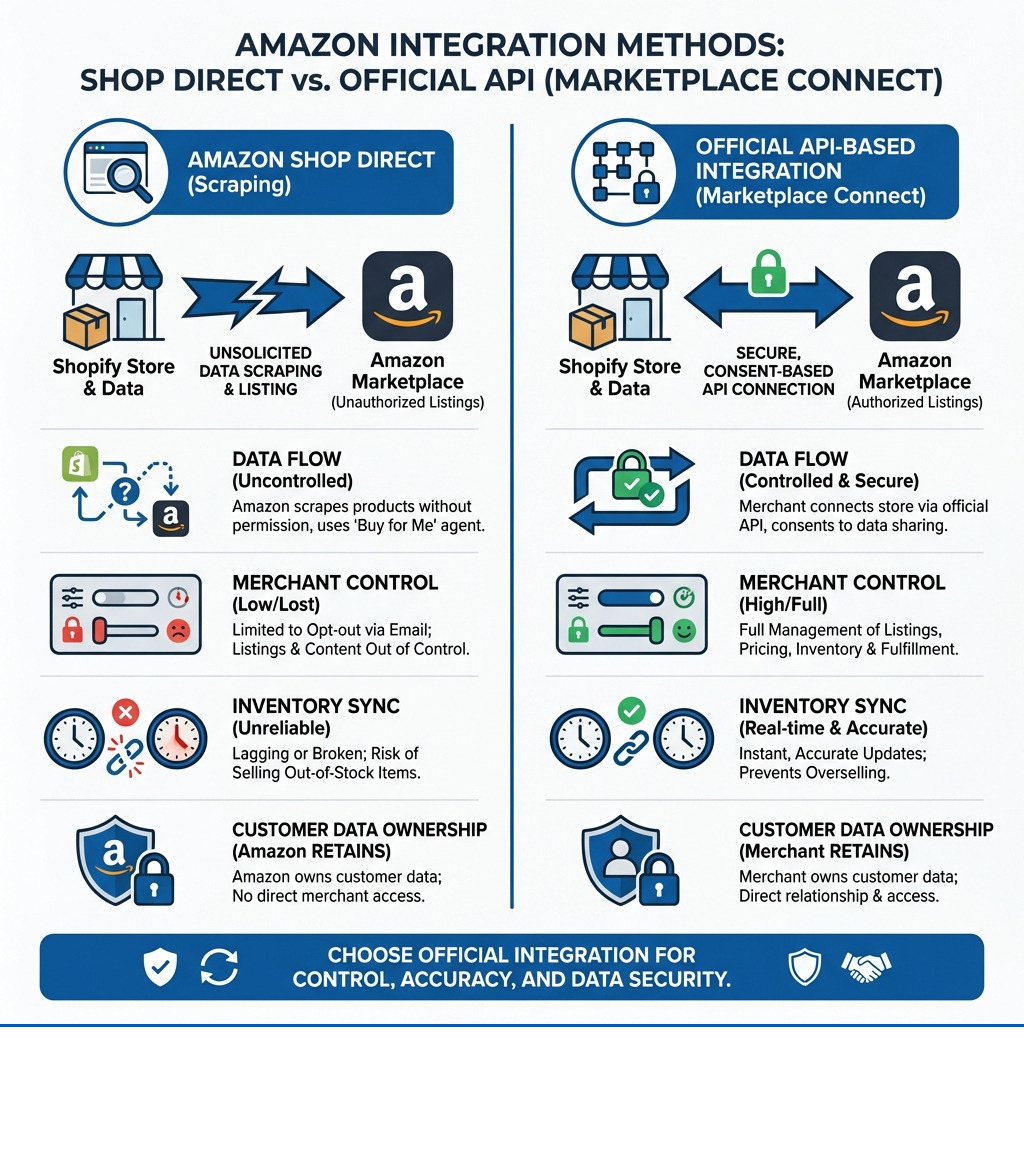
- Amazon scrapes your Shopify product data
- Lists appear on Amazon without your permission
- "Buy for Me" AI agent purchases from your site
- Opt-out required via email to branddirect@amazon.com
Official Integration Methods (Recommended)
- Shopify Marketplace Connect app
- Amazon Pay with Shopify Payments
- Amazon Multi-Channel Fulfillment (MCF)
- Full control over listings and inventory
The relationship between Shopify and Amazon has become more complex. Recently, Amazon introduced experimental features named "Shop Direct" and "Buy for Me," causing confusion and concern among independent merchants. These programs can pull product listings from Shopify stores onto Amazon without a formal agreement, creating operational problems for business owners.
More than 180 businesses using Shopify and other platforms have reported their products appearing on Amazon without permission. One merchant found they were selling a stress ball they didn't even stock when orders started arriving from a "buyforme.amazon" email address.
This guide explains what these features are, details the issues merchants are facing, and outlines the correct, official methods for integrating your Shopify store with Amazon to maintain control and grow your business.
Amazon Shop Direct Shopify terms to know:
Understanding Amazon's "Shop Direct" and "Buy for Me"
Amazon's "Shop Direct" and "Buy for Me" features represent a new frontier in online shopping, using artificial intelligence to expand Amazon's reach. Amazon describes "Shop Direct" as a feature that lets customers browse items from other brands' websites directly on Amazon. Some of these items then include a "Buy for Me" button. This button signifies an artificial intelligence agent that can purchase products from other websites on a shopper's behalf.
Amazon's stated purpose for these features is to simplify shopping for consumers and to help businesses reach new customers, driving incremental sales. The number of products accessible through "Buy for Me" has grown quickly, jumping from 65,000 at launch to more than 500,000. This rapid expansion highlights Amazon's push into agentic AI-powered commerce, a broader initiative that includes "Project Starfish." This project aims to make Amazon the "ultimate source of product information worldwide" by scraping brand websites and auto-rewriting content, with a projection to add $7.5 billion in Gross Merchandise Volume (GMV).
How the "Buy for Me" Agent Functions
The "Buy for Me" agent works by allowing customers to buy products from third-party websites without ever leaving the Amazon app or site. When a customer uses "Buy for Me," Amazon's AI agent steps in to complete the purchase on the merchant's actual website. This involves the AI using 'agentic AI capabilities' to pass the customer's encrypted payment and shipping information to the third-party site.
The transaction still occurs on the merchant's site, but it's initiated and managed by Amazon's AI. This means the customer experiences a single checkout process within Amazon, while the merchant receives an order from what often appears as a generic or proxy email address, like 'buyforme.amazon.com'. Amazon states that it does not currently collect a commission when customers use this feature.
Amazon's Stated Goal vs. Merchant Reality
Amazon promotes "Shop Direct" and "Buy for Me" as beneficial for both customers and businesses. For customers, it offers increased selection and convenience. For businesses, Amazon suggests it helps them reach new customers and generate incremental sales without paying a commission.
However, the reality for many merchants, especially those running Shopify stores, has been quite different. Many feel they are being "forced to be dropshippers" for Amazon, against their will. This involuntary participation leads to a significant loss of control over their sales process and customer experience. Angie Chua, CEO of Bobo Design Studio, shared her experience, stating she felt "exploited" after receiving "Buy for Me" orders despite never opting into the program. Similarly, Hitchcock Paper, a stationery shop in Virginia, expressed concern on Instagram, noting, "Sounds like a great program until the agentic AI starts selling customers things you don't have, all while your shop has no idea it's sending the wrong items to the customer." These experiences show a clear disconnect between Amazon's stated goals and the operational challenges faced by independent sellers.
The Merchant Backlash: Unauthorized Listings and Operational Headaches
The introduction of "Shop Direct" and "Buy for Me" has sparked a significant backlash from online retailers. Many Shopify merchants, along with those using platforms like Squarespace, WooCommerce, and Wix, have reported their products appearing on Amazon without their explicit consent. More than 180 businesses have contacted others, sharing similar experiences. This unauthorized listing raises serious concerns about brand control, customer experience, and operational integrity.
For a business that has built its brand and customer relationships, finding its products listed on Amazon without permission can be alarming. It can damage brand perception and create confusion for customers who are used to buying directly from the merchant's own site.

Specific Complaints from Business Owners
The complaints from business owners are varied and highlight the practical problems created by Amazon's AI-driven features. A major issue revolves around inventory management. Retailers have reported that Amazon's AI agents sometimes list products that are out of stock or, in some cases, items they have never sold at all. Hitchcock Paper, for example, received an order for a stress ball it did not offer, originating from a 'buyforme.amazon' email. This leads to customer disappointment and potential negative reviews for the unsuspecting merchant.
Pricing errors are another common concern. If Amazon's AI scrapes outdated or incorrect pricing information, merchants could be forced to fulfill orders at a loss or cancel them, further harming customer trust. The fulfillment process itself becomes confusing when orders arrive from anonymous proxy emails, making it difficult to track, manage, and provide personalized customer service. Angie Chua of Bobo Design Studio received such orders and found the experience disruptive to her business. Amanda Stewart, founder of Mochi Kids, found her entire catalog of 4,000 products listed on Amazon without her knowledge, a situation that many small businesses find deeply troubling.
The Impact on Brand Reputation and Autonomy
For independent sellers, these Amazon features represent a significant loss of autonomy and a potential dilution of their brand identity. Many businesses choose to sell exclusively on their own Shopify stores to control the customer journey, build direct relationships, and build their brand. When products appear on Amazon without consent, this control is compromised.
Merchants worry about the exposure of wholesale pricing or sensitive product details, which could disrupt their business models. They also lose the opportunity to collect customer data, which is crucial for retargeting and personalization. This forced participation can make them feel like unwilling dropshippers, rather than independent brand owners. As I often tell clients here at First Pier, a strong brand identity is a core business asset, and platforms that take away that control can be harmful. In fact, 80% of those using the Amazon marketplace also use other platforms like their own website to build their business and branding. This shows how important it is for sellers to maintain their own platforms for brand building, a task Amazon often makes difficult for its sellers. You can learn more about how we help businesses build and refine their brand identity by visiting our page on building refining brands.
Navigating the Amazon Shop Direct Shopify Controversy
The controversy surrounding Amazon Shop Direct Shopify features has forced Amazon to respond, albeit with an approach that many find unsatisfactory. Understanding Amazon's stance and the broader implications for AI in e-commerce is important for any merchant. For businesses looking to move their online presence, our team at First Pier also helps with platform migrations, to help with the transition while maintaining your digital assets.
Amazon's Official Response and How to Opt Out
Amazon has stated that its "Buy for Me" feature remains an "experiment" and has claimed to receive positive feedback from some businesses. They state that the feature uses publicly available data to help customers find products. Crucially, Amazon has provided an opt-out process for businesses that do not wish to participate. Merchants can request to have their products removed from the "Shop Direct" and "Buy for Me" programs by emailing branddirect@amazon.com. According to Amazon, these requests are processed promptly, with some retailers reporting removal within a few days. Amazon also clarifies that it does not collect a commission when customers use "Buy for Me" to make a purchase. You can find more details in Amazon's Merchant FAQs for the program and Customer FAQs for the program.
The AI Double Standard: Scraping vs. Being Scraped
One of the most striking aspects of this controversy is the perceived double standard in Amazon's approach to AI and data scraping. While Amazon uses AI agents to scrape external websites for its "Shop Direct" and "Buy for Me" features, it simultaneously takes a very hard line against other companies using AI to access and scrape its own marketplace. Recently, Amazon has taken multiple steps to prevent third-party crawlers from accessing its site, including legal actions such as a lawsuit against Perplexity AI.
This creates a puzzling inconsistency: Amazon uses publicly available data from other websites for its own commercial gain, but vigorously protects its own data from similar practices by others. Critics point out that this raises questions about fairness and competition in the digital marketplace. This dual approach has led to reputational risks for Amazon, contributing to the perception that it may be acting as a "bully" in the e-commerce space.
The Right Way: Official Shopify and Amazon Integration Methods
While the "Shop Direct" and "Buy for Me" features show a problematic side of Amazon's expansion, there are established, official, and merchant-controlled ways to integrate your Shopify store with Amazon. These methods respect merchant consent, provide control over listings and inventory, and help you reach Amazon's large audience on your own terms. This contrasts sharply with Amazon's experimental features, which often disregard merchant consent.
| Feature | Shop Direct / Buy for Me (Unofficial) | Shopify Marketplace Connect (Official) |
|---|---|---|
| Merchant Consent | Often none, opt-out required | Explicit, opt-in |
| Inventory Sync | Unreliable, prone to errors | Real-time, controlled by merchant |
| Brand Control | Minimal to none | Full control over listings and branding |
| Customer Data | None for merchant | Access to customer order data |
| Fulfillment | Merchant becomes dropshipper | Merchant manages or uses MCF |
| Pricing Control | Prone to errors, scraped | Full control |
Using Shopify Marketplace Connect for Controlled Selling
If you want to sell your products on Amazon while maintaining full control from your Shopify admin, the Shopify Marketplace Connect app is the way to go. This app provides a centralized dashboard to manage your presence across multiple marketplaces, including Amazon, Target Plus, Walmart, and eBay.
Here's how it helps:
- Sync Listings: You can create and manage your Amazon listings directly from your Shopify store.
- Sync Orders: Orders placed on Amazon appear in your Shopify admin, simplifying order processing.
- Sync Inventory: The app keeps your inventory levels synchronized across both platforms, helping to prevent overselling.
- Performance Metrics: You get a single view of your sales and performance across channels.
This official integration allows you to reach Amazon's large customer base—Amazon holds 40% of the e-commerce share in the USA and has over 213 million unique US visitors each month—without losing oversight. Here at First Pier, we help businesses manage their marketplace presence, and you can explore our services for marketplace feed management.
Integrating Amazon Pay and Buy with Prime
Beyond product listings, you can also integrate Amazon's payment solutions directly into your Shopify store, providing a trusted and familiar checkout experience for your customers. Amazon Pay with Shopify Payments lets customers use their Amazon account information for shipping and payment, which can significantly increase conversion rates. Studies show that Amazon Pay increases conversions by 35% compared to native checkout options.
Here are the benefits:
- Increased Conversion: Customers trust Amazon, making them more likely to complete a purchase.
- Customer Trust: Using a familiar payment method builds confidence.
- One-Click Activation: Integrating Amazon Pay into your Shopify store is a simple, one-click process within Shopify Payments.
- No Added Fees: There are no additional transaction fees for Amazon Pay when you use Shopify Payments.
- Centralized Management: All transactions, reporting, chargebacks, and refunds are handled directly within your Shopify admin.
Once Amazon Pay is activated, you can also enable Buy with Prime, offering Prime members fast, free shipping directly from your Shopify store. If you need help setting up your Shopify store for optimal performance and integrations like Amazon Pay, our team offers specialized Shopify setup services.
Fulfilling Orders with Amazon MCF
For Shopify merchants who want to use Amazon's large logistics network for all their orders, including those placed on their Shopify store, Amazon Multi-Channel Fulfillment (MCF) is an excellent option. Shopify Amazon integration helps you grow sales via multichannel selling while fulfilling orders through Amazon’s network.
With MCF, you send your inventory to Amazon's fulfillment centers, and Amazon handles the storage, picking, packing, and shipping for all your orders—whether they come from Amazon.com, your Shopify store, or another sales channel. This automates inventory tracking, order processing, and shipping, freeing up your time to focus on other aspects of your business. Apps like Amazon MCF: US Fulfillment connect your Shopify store to Amazon’s fulfillment centers.
Using MCF means you can meet consumer expectations for fast delivery, largely set by Amazon itself. Our team at First Pier understands the importance of efficient shipping, and we offer Shopify shipping optimization support to help businesses improve their logistics.
Strategic Considerations for Your Business
The situation with Amazon Shop Direct Shopify features and the broader role of AI in e-commerce requires careful planning. As an independent seller, you need to weigh the benefits and drawbacks of integrating with large platforms like Amazon while also preparing for the future of online shopping. Understanding your e-commerce data is also important for making informed decisions; our ecommerce analytics services can provide the insights you need.
Weighing the Pros and Cons of Amazon Integration
Integrating with Amazon offers advantages, primarily access to a large audience. Amazon has 9.5 million individual sellers and processes approximately $367 billion in the USA alone. This established trust and customer base can increase sales for your products. You can also use Amazon's large fulfillment network (MCF) for efficient shipping.
However, there are notable drawbacks. The Amazon marketplace is very competitive, making it challenging for your products to stand out. Referral fees, which can range from 6% to 45%, can eat into your margins. More importantly, selling on Amazon often means less control over your brand and direct customer relationships. Nine out of ten Amazon shoppers price check on the same website, often favoring the cheaper product, which can lead to price wars. This environment makes it hard to build the unique brand identity that is important for building a sustainable business. While Amazon can be a good starting point, many businesses find that their own Shopify store is essential for building brand loyalty and direct customer engagement.
The Future of AI in Commerce and What It Means for You
The rise of AI-powered shopping agents, like Amazon's "Buy for Me," is not an isolated incident. Companies like Perplexity AI, Microsoft, and OpenAI are all developing AI tools for conversational shopping and agentic commerce. OpenAI, for example, has even partnered with Shopify for its "Instant Checkout" feature, allowing customers to buy directly from Shopify stores within ChatGPT.
This trend means that your product data will become even more important. AI agents rely on structured data and schema markup to understand, recommend, and purchase products. To ensure your products are findable by these new AI search engines, you need to focus on what's called Answer Engine Optimization (AEO) or Generative Engine Optimization (GEO). This involves ensuring your Shopify store has clean, structured data, comprehensive product descriptions, and accurate schema markup (Product, Offer, Review, FAQPage). Our team at First Pier helps businesses improve their conversion rates and prepare for these future trends through our CRO services.
To Sum Up
The "Amazon Shop Direct Shopify" situation shows the growing pains of AI in e-commerce. While Amazon's unauthorized listing of products is a serious concern, it shouldn't deter you from a planned, controlled integration. By using official tools like Shopify's Marketplace Connect and Amazon Pay, you can access Amazon's large market without giving up control over your brand, inventory, and customer relationships. Here at First Pier, we help businesses navigate these issues to build a multi-channel plan. For help with setting up and managing your e-commerce presence, explore our services as an award-winning Shopify ecommerce agency.





.png)
.png)

