


Introduction
Summary
- A basic ecommerce website can cost as little as $29 per month with a do-it-yourself platform, or between $3,000 and $10,000+ for a professionally built template-based store.
- Main costs include the ecommerce platform subscription, domain name ($10–$30/year), web hosting (often included), SSL certificate ($0–$200/year), and payment processing fees (usually 1-3% per transaction).
- The total price depends on the development method (DIY or agency), design approach (template or custom), and the number of features or integrations needed.
- Ongoing expenses such as maintenance, marketing, app subscriptions, and transaction fees should be planned for each month.
The basic ecommerce website price is determined by the development approach and business needs. A do-it-yourself site on a platform like Shopify starts around $29 per month, while a professionally built store using a template typically costs between $3,000 and $10,000. A fully custom design can cost $10,000 to $50,000 or more.
There are two main ways to create an ecommerce website. You can use a website builder, which costs less but requires more of your time and technical work. Or you can hire a web development company to handle the design and setup, which costs more upfront but delivers a professional result faster. The final cost depends on the platform, the design (template vs. custom), the number of products, and the specific features required.
As Steve Pogson, founder of First Pier, I've helped dozens of businesses build their Shopify stores over the past two decades. I've seen that understanding the basic ecommerce website price from the start helps companies make better decisions about their investment. Knowing what to budget for—and why—creates a predictable budget and a smoother process for launching or upgrading an online store.
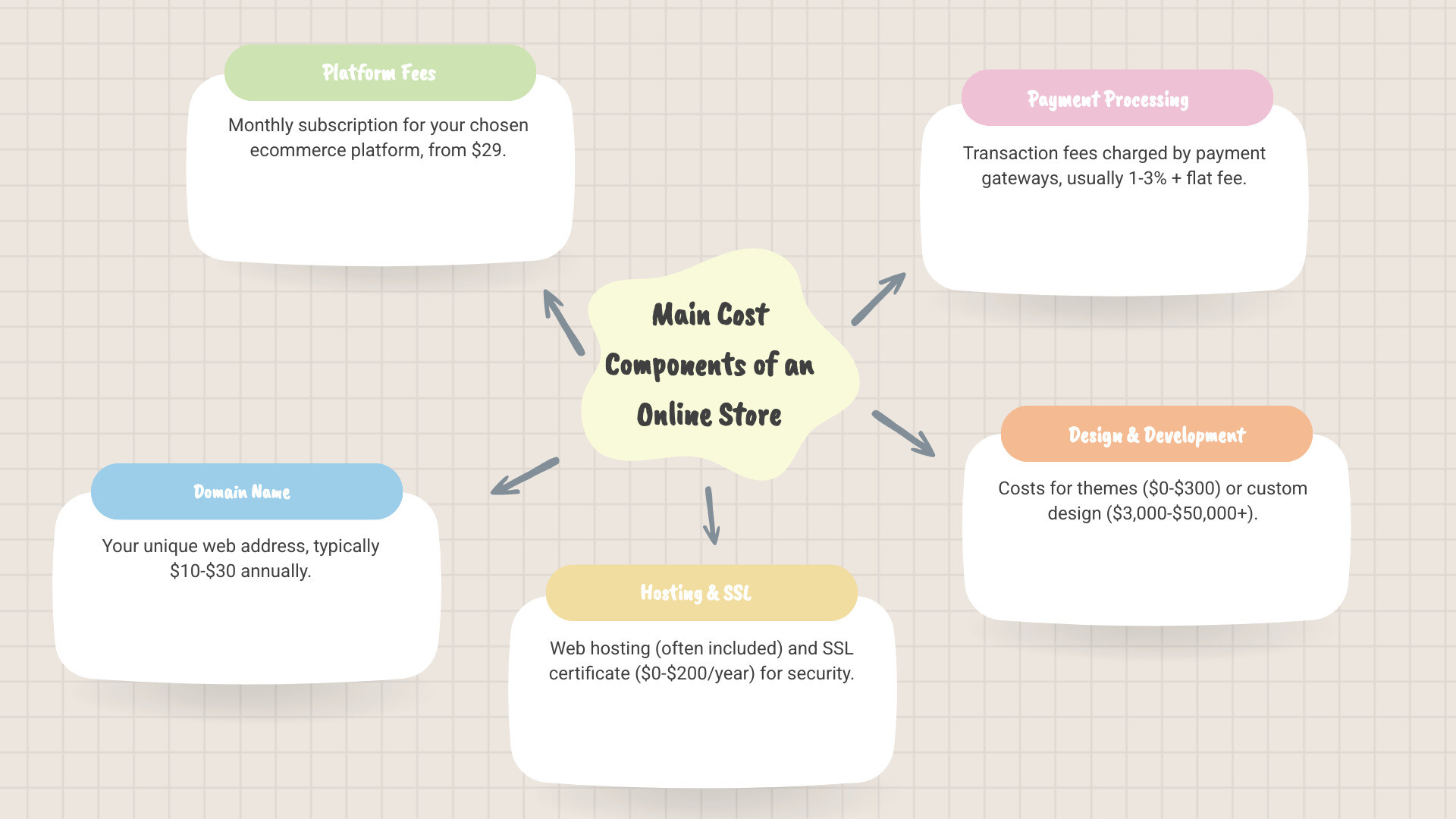
The Core Cost Components of an Online Store
Building an online store involves several fundamental expenses. Understanding them helps in accurately estimating your basic ecommerce website price.
First, you need a unique address on the web. That's your domain name. Domain registration typically costs between $10 and $30 annually. This is your brand's online address, so choosing a memorable and relevant name is an important first step.
Next is web hosting, which is where your website's files live on the internet. For ecommerce, reliable hosting is crucial for speed and uptime. Costs can range from $5 to $250 monthly, depending on the type of hosting and the traffic your site expects. Many hosted ecommerce platforms, however, bundle hosting into their monthly subscription fees, simplifying this cost.
Security is non-negotiable for an online store. An SSL certificate encrypts data between your customer's browser and your website, protecting sensitive information like credit card details. This builds trust and is often a ranking factor for search engines. SSL certificates can cost anywhere from $0 (often included with hosting or platforms) to $200 annually for more advanced options.
The core of your online store is the ecommerce platform itself. This is the software that allows you to list products, manage inventory, process orders, and manage customer accounts. Platform fees for hosted solutions typically range from $5 to $300 monthly, offering various features and support levels.
Finally, you'll have payment processing fees. When customers buy from you, a percentage of each transaction, plus a small flat fee, goes to the payment gateway. These fees are typically 1% to 3% plus $0.00 to $0.50 per transaction. For instance, Shopify Payments transaction fees range from 2.4% to 3.5%, depending on your plan and location. These are necessary for building customer trust and providing secure transactions. Almost 75% of the data breach cases investigated by Visa in early 2022 involved ecommerce companies, emphasizing the importance of robust security and data compliance like PCI-DSS standards.
Platform Choice: Hosted vs. Self-Hosted
One of the biggest decisions influencing your basic ecommerce website price is whether to choose a hosted (SaaS) platform or a self-hosted solution. Each approach has its own cost structure and technical demands.
Hosted platforms, often referred to as Software as a Service (SaaS), are all-in-one solutions where the provider manages the hosting, security, and software updates. Platforms like Shopify are prime examples. Their monthly subscriptions, which typically range from $29 to $300, bundle many essential services. This means you don't have to worry about separate hosting costs, SSL certificates, or maintaining servers. I find this approach ideal for many small to medium-sized businesses because it simplifies operations and reduces the need for in-house technical expertise. You pay a predictable monthly fee, and the platform handles the underlying infrastructure, including unlimited bandwidth and PCI compliance.
On the other hand, self-hosted platforms give you more control and flexibility. Open-source software like WooCommerce (which runs on WordPress) is free to download, but that "free" comes with additional responsibilities and costs. You'll need to arrange separate web hosting, which can range from $5 to $250 per month. You'll also need to purchase and manage your domain name and SSL certificates. For a self-hosted site, these could be around $7.99 per month for hosting, $15 per year for a domain, and $69 per year for an SSL certificate. Larger, high-volume self-hosted sites can see hosting costs climb upward of $1,000 per month.
My experience shows that self-hosted solutions also require ongoing technical maintenance, updates, and security patches, which can be time-consuming or require hiring a developer. Platforms like Magento, for example, offer extensive features but demand significant developer expertise and continuous technical oversight. For businesses in Portland, ME, without a dedicated IT team, the bundled simplicity of a hosted platform often presents a more straightforward and predictable cost model.
Security and Payment Processing
When I talk about the basic ecommerce website price, I always emphasize that security and payment processing are not optional; they are fundamental. Trust is essential for online shoppers, and a secure checkout experience is a core part of building that trust.
SSL certificates, as I mentioned, are vital for encrypting data. While many hosted platforms include a basic SSL certificate for free, you might consider a more advanced option if you need extended validation, which could cost up to $200 annually. The improved customer confidence can be worth the investment.
Payment processing fees are another required cost. These are the charges levied by payment gateways (like Stripe, PayPal, or Shopify Payments) for handling transactions. As I noted, these typically fall between 1% and 3% of the transaction value, plus a small fixed fee. For example, Shopify Payments, a popular choice for our clients, has transaction fees ranging from 2.4% to 3.5%, depending on your plan. If you choose a third-party gateway without using Shopify Payments, you might incur additional transaction fees from Shopify itself, usually 0.5% to 2% depending on your plan tier.
These fees are part of the cost of doing business online, but they also provide essential services: fraud detection, secure transaction handling, and compliance with industry standards like PCI-DSS. Building customer trust starts with a secure checkout. As one store owner I worked with said, "The ability to customize with Shopify really allows us to push it to the limit and create a custom checkout experience customers can trust and be confident in keeping their personal and payment information safe. It really makes customers feel like the site is going to take care of them."
How Website Complexity Influences the Basic Ecommerce Website Price
The more complex your vision for an online store, the higher your basic ecommerce website price will be. Complexity isn't just about how many extra features you have; it’s about the underlying structure, the number of products, the features you need, and the overall user experience.
The number of products you plan to sell is a major factor. A store with a handful of items requires less database management and design consideration than one with hundreds or thousands of products, each with multiple variants. Similarly, the desired features—anything from simple product pages to advanced filtering, personalized recommendations, or subscription models—add layers of development time and cost.
User experience (UX) is also a major factor. A well-designed UX ensures that customers can easily find what they’re looking for, navigate your site, and complete purchases without difficulty. Investing in professional UX design helps improve conversion rates and customer satisfaction. To learn more about how we approach this, you can check out our ecommerce UX design services.
Design: Template vs. Custom Build
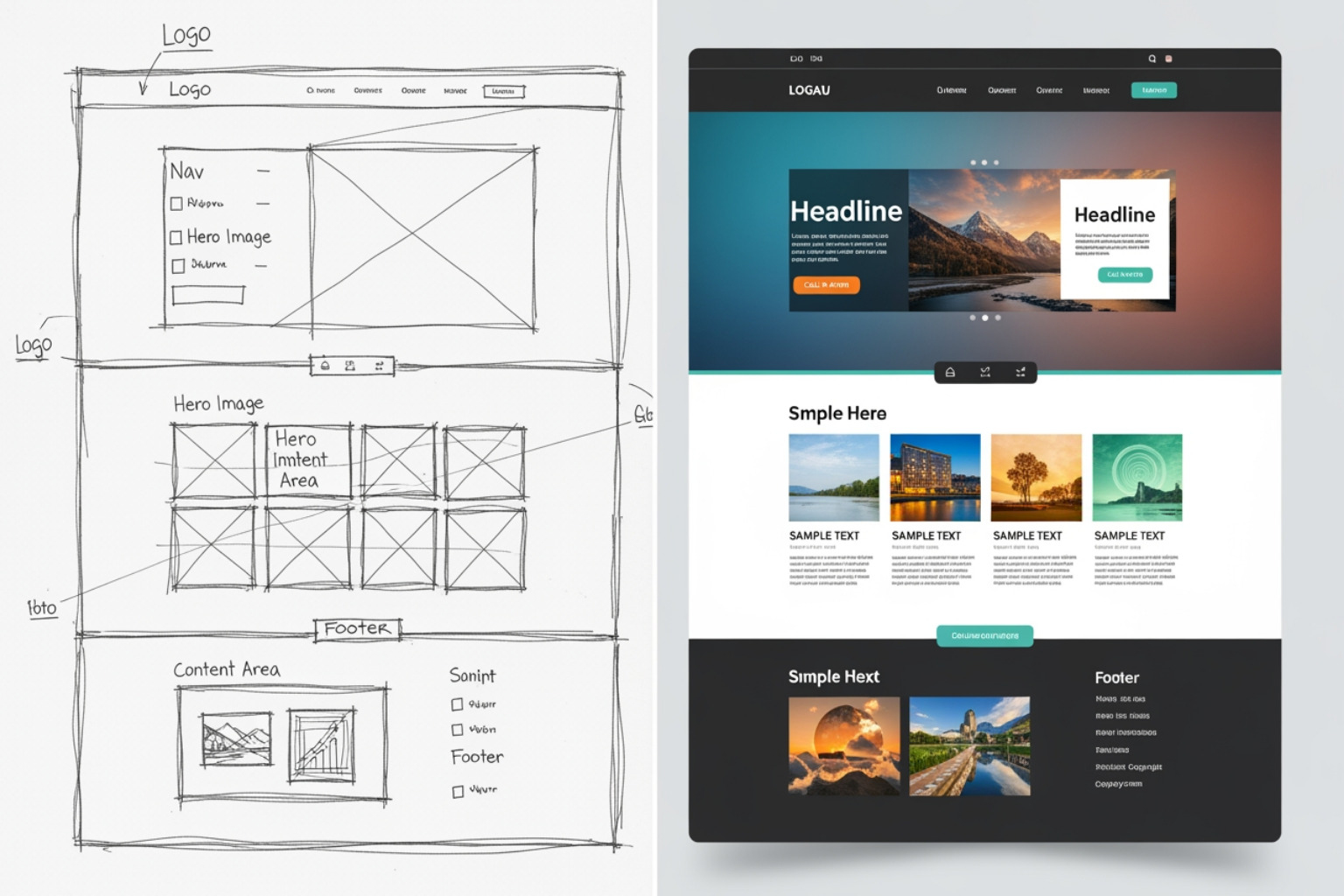
The visual design of your online store is critical. It shapes first impressions and builds trust. The choice between using a pre-made template or opting for a custom design is a major factor in your basic ecommerce website price.
Template-based design is the less expensive approach. Platforms like Shopify offer a wide array of pre-built themes, some free, others costing between $0 and $300. These themes provide a professional look and feel right out of the box, allowing for a faster launch time—often within 2 to 4 weeks. For many startups and small businesses, a well-chosen template with minimal customization is a smart way to get online quickly and affordably. I often recommend starting with a template to test a business idea before investing heavily in custom work.
However, templates come with limitations. If you need a unique brand identity or very specific functionalities that aren't supported by the template, you'll need custom design. Custom development gives you complete control over your store's appearance and functionality, ensuring it reflects your brand. This level of personalization, however, comes at a higher cost. Custom design work can add $2,000 to $10,000 to your project, while fully custom builds can range from $40,000 to $150,000 or more, taking 3 to 6 months to complete.
I always remind clients that first impressions happen fast. It takes about 50 milliseconds (0.05 seconds) for someone to form an opinion about your website. A unique, professional design communicates credibility and professionalism instantly. This is where investing in strong branding and identity can be a valuable investment. You can explore our expertise in branding and identity services to see how we help businesses in Portland, ME, make that first impression count.
Functionality: Add-ons and Custom Development
Beyond the core design, the specific features and integrations your store needs will also affect your basic ecommerce website price. Most platforms offer a foundational set of features, but specialized functionalities often require add-ons or custom development.
For platforms like Shopify, the Shopify App Store offers a large selection of applications that add new functions to your store. These apps can handle everything from email marketing and loyalty programs to advanced inventory management and shipping solutions. Many apps offer free plans, while others come with monthly subscription fees. It's easy to add up costs if you start installing too many paid apps without a clear plan. For example, advanced features like product filtering systems, AI-powered search, or loyalty programs can each add $500 to $5,000 in app or development costs.
Sometimes, a business has unique operational needs that off-the-shelf apps can't address. This is where custom development comes in. If you need specific API integrations to connect with existing business systems, or enterprise features like ERP (Enterprise Resource Planning) or CRM (Customer Relationship Management) connections, these projects can start at $10,000 in additional costs. Custom API integrations alone can add $500 to $5,000 each, depending on their complexity.
Here at First Pier, we specialize in Shopify development services, helping businesses in Portland, ME, build out custom features and integrations that fit their unique workflows and how customers use the site. We focus on building features that provide a clear business benefit.
Upfront Investment vs. Ongoing Expenses
When you're planning for your online store, it's easy to focus solely on the initial build cost. However, a significant part of the basic ecommerce website price comes from ongoing expenses. Think of it like buying a car: there's the purchase price, but then there's gas, insurance, and maintenance. Your online store is no different.
Initial setup costs include things like domain registration, theme purchase (if not free), and any upfront development fees if you hire an agency. These are generally one-time investments to get your store live.
But once your store is up and running, you'll have recurring monthly or annual fees. These include your platform subscription, any paid apps you use, and potentially separate hosting or security services if you're on a self-hosted platform. Planning for these ongoing expenses from the start is essential for accurate budgeting and your store's continued operation. I always advise my clients to account for these recurring costs to create a predictable budget.
What's the real basic ecommerce website price with ongoing costs?
Let's look at the elements that contribute to the ongoing basic ecommerce website price:
- Website Maintenance: Just like a physical store needs upkeep, your online store needs regular maintenance. This includes security patches, platform updates, and bug fixes to keep the site working correctly. For a professionally built site, budgeting 10% to 20% of your initial development cost annually for maintenance is a good rule of thumb. So, if your custom site cost $10,000 to build, expect to allocate $1,000 to $2,000 yearly for maintenance. Hosted platforms often include many of these updates in their subscription, but you'll still need to manage app updates and content.
- Marketing and Advertising: Building the store is the first step; you also need to attract customers. Marketing is an ongoing, essential expense. This includes:
- SEO (Search Engine Optimization): Ensuring your store ranks high in search results. SEO costs can range from $750 to $20,000 monthly, depending on the scope.
- Paid Search (SEM): Running ads on Google and other search engines. You can find more information about our paid search and SEM services.
- Social Media Marketing: Engaging with customers and running ads on platforms like Facebook, Instagram, and TikTok.
- Email Marketing: Building customer relationships and driving sales through targeted email campaigns.Basic marketing expenses for a small business might range from $500 to $5,000 per month, while larger operations could spend $10,000 to $50,000+ monthly.
- Branding: While initial branding is an upfront cost, maintaining brand consistency and updating your brand is an ongoing effort. Small to medium businesses typically spend between $4,500 and $15,000 per year on branding. This ensures your messaging, visuals, and overall presence remain cohesive and appealing.
These ongoing costs are necessary for operating and growing your online business. Skimping on them can lead to a stagnant store, regardless of its initial quality.
Average Cost Ranges and How to Manage Your Budget
To give you a clearer picture of the basic ecommerce website price, I've found it helpful to categorize stores by their size and complexity. This helps set realistic expectations for your investment.
| Store Size (by products) | Average Cost to Start (Initial Build) |
|---|---|
| Small (1-99 products) | $1,000 - $5,000 |
| Medium (100-499 products) | $5,000 - $10,000 |
| Large (500+ products) | $10,000 - $50,000+ |
These ranges reflect the initial investment for design, development, and basic setup. Ongoing costs like platform fees, maintenance, and marketing will be additional.
Estimating the basic ecommerce website price for a small store
For entrepreneurs and small businesses in Portland, ME, looking to launch without a large initial investment, estimating the basic ecommerce website price for a small store is often the starting point. This category typically involves 1-99 products and focuses on core selling functionality.
The most affordable options involve a DIY approach using hosted platforms. Shopify, for example, offers a Basic plan that can cost as little as $29 per month when billed annually. This plan includes essentials like hosting, an SSL certificate, and access to a variety of free pre-built themes. With a DIY approach, your upfront costs could be minimal—perhaps just the cost of a premium theme (up to $200) if you choose one, plus your domain name. Our Shopify setup services can help you get started efficiently, even with a basic setup.
The best way to control costs is to prioritize essential features. Focus on clear product pages, a functional shopping cart, and a secure checkout. You can always add more advanced features, apps, or custom integrations as your business grows and generates revenue.
Another way to keep initial costs low is by exploring business models like dropshipping. With dropshipping, you don't hold inventory, reducing upfront product investment. Many supplier apps integrate directly with ecommerce platforms, allowing you to test products and a business idea without significant financial risk.
How to Minimize Costs Effectively
Even with a comprehensive understanding of the basic ecommerce website price, everyone wants to be smart about their spending. Here are some ways I recommend to control costs effectively:
- Use Pre-Made Templates: This is often the biggest cost-saver. Instead of investing in a fully custom design, start with a high-quality, pre-made theme. Many free and paid options (up to $300) are available that are professional, mobile-responsive, and customizable enough to fit your brand. You can always upgrade to a custom design later as your business grows.
- Choose the Right Platform for Your Needs: For many, a hosted platform like Shopify is cost-effective because it bundles hosting, security, and many features into a single monthly fee. While open-source platforms like WooCommerce are "free" software, they require separate investments in hosting, SSL, and often more technical expertise, which can add up. Select a platform that aligns with your technical comfort level and budget.
- Start with Essential Features Only: Avoid the temptation to build a website with every possible feature from day one. Identify the absolute core features you need to sell your products, and launch with those. Advanced filtering, loyalty programs, or complex integrations can be added in phases as your business grows and you understand your customers' needs better.
- Handle Content Creation In-House: Professional product photography and copywriting can be expensive. If you have the skills or the time, consider creating your product descriptions and taking your own high-quality product photos. This can significantly reduce upfront content costs.
- Focus on One or Two Marketing Channels at First: Instead of trying to be everywhere, pick one or two marketing channels where your target audience is most active and focus your efforts and budget there. Once you see results, you can gradually expand.
Frequently Asked Questions about Ecommerce Website Pricing
What is the most affordable way to start an ecommerce website?
The lowest-cost option is using a DIY ecommerce platform with a basic plan, starting at about $29 per month. These plans usually include hosting, an SSL certificate, and access to free website themes, which keeps upfront costs low. You'll still need to budget for your domain name (around $10-$30 annually) and any transaction fees from payment processors.
What is the typical monthly cost for a basic ecommerce website?
A basic DIY ecommerce site can cost between $29 and $100 per month. This typically covers the platform subscription (like Shopify Basic) and perhaps a few essential paid apps. For a professionally managed site, where an agency handles ongoing maintenance, security, and support, monthly costs can range from a few hundred dollars to over a thousand, depending on the complexity and scope of services.
How much does a web development company charge for a basic site?
Hiring an agency to build a basic, template-based ecommerce website usually costs between $3,000 and $10,000. This often includes customizing a pre-existing theme, setting up your product catalog, and configuring basic functionalities. The price goes up with more extensive customization, a larger number of products to migrate or set up, or specific integrations beyond the standard offerings.
Partnering with an Agency for Predictable Results
To sum up, the basic ecommerce website price depends on your choices in platform, design, and features. While DIY options have a lower entry cost, they require a significant time investment and can become complex as your business grows. My experience has shown that working with a professional agency like here at First Pier brings specific expertise. We help businesses in Portland, ME, build a fast, scalable store from the start, helping them achieve predictable results from their investment.
Ready to get a clear understanding of your potential investment? Request a project estimate from First Pier.





.png)
.png)

