


Summary
- Shopify merchants can connect their stores to ChatGPT so customers can find and buy products directly in a chat.
- The connection uses the Agentic Commerce Protocol (ACP), which standardizes how AI tools exchange product and order data with merchants.
- Merchants pay a transaction fee to OpenAI on orders placed through ChatGPT, which has become more competitive since its launch, in addition to normal Shopify charges.
- Clean product data, conversational content, and accurate feeds are needed for products to appear correctly in ChatGPT responses.
- Direct chat-based sales can broaden reach but reduce early-stage access to customer data and add new competition for ranking inside AI tools.
ChatGPT for Shopify lets merchants sell products directly within the ChatGPT interface through a feature called Instant Checkout. Here's what you need to know:
- Direct Sales Channel: Products appear in ChatGPT when users ask shopping questions, with a "Buy" button allowing purchases without leaving the chat
- Powered by ACP: The integration uses the Agentic Commerce Protocol, an open standard co-developed by OpenAI and Stripe
- Competitive Transaction Fee: Merchants pay OpenAI a transaction fee on sales made through ChatGPT, on top of standard Shopify fees
- AI-Ready Product Data Required: Success requires structured product data, natural language descriptions, and schema markup
- Orders in Shopify Admin: All purchases process through your existing Shopify order system
Over 1.5 billion people use ChatGPT each week, with more than 100 million shopping queries hitting the platform daily. This integration has placed Shopify products in the middle of those conversations, creating a direct sales channel where buyers are asking for help choosing what to buy. This has solidified the shift from traditional keyword search to intent-led assistance, where the AI understands customer needs and suggests fitting products.
For merchants, this means products must be easy for AI to find and understand, not just for search engines. The technical requirements differ from standard SEO, and call for clean data structures, real-time inventory feeds, and content written for conversational questions rather than keyword lists. While the potential reach is significant, the integration also brings well-understood questions around customer data ownership, fee structures, and how products are ranked inside AI responses.
I'm Steve Pogson, founder of First Pier in Portland, ME, and I have spent nearly three decades helping e-commerce businesses build high-performance Shopify stores. As ChatGPT for Shopify has changed how customers find and buy products, here at First Pier we work with brands to optimize their stores for this established environment while keeping the direct customer relationships that support long-term growth.
Understanding the Shopify and ChatGPT Integration
The integration of Shopify and ChatGPT brings conversational commerce into a channel that many shoppers use regularly. It allows products from Shopify stores to be found and purchased directly within the ChatGPT interface. When a user asks ChatGPT for product recommendations, eligible Shopify products can appear with a "Buy" button, which turns that recommendation into a direct purchase. This feature, known as Instant Checkout, is built to shorten the path from intent to order. Here at First Pier, we see this as a strong option for our clients because it provides a sales channel where shopping intent is already clear.
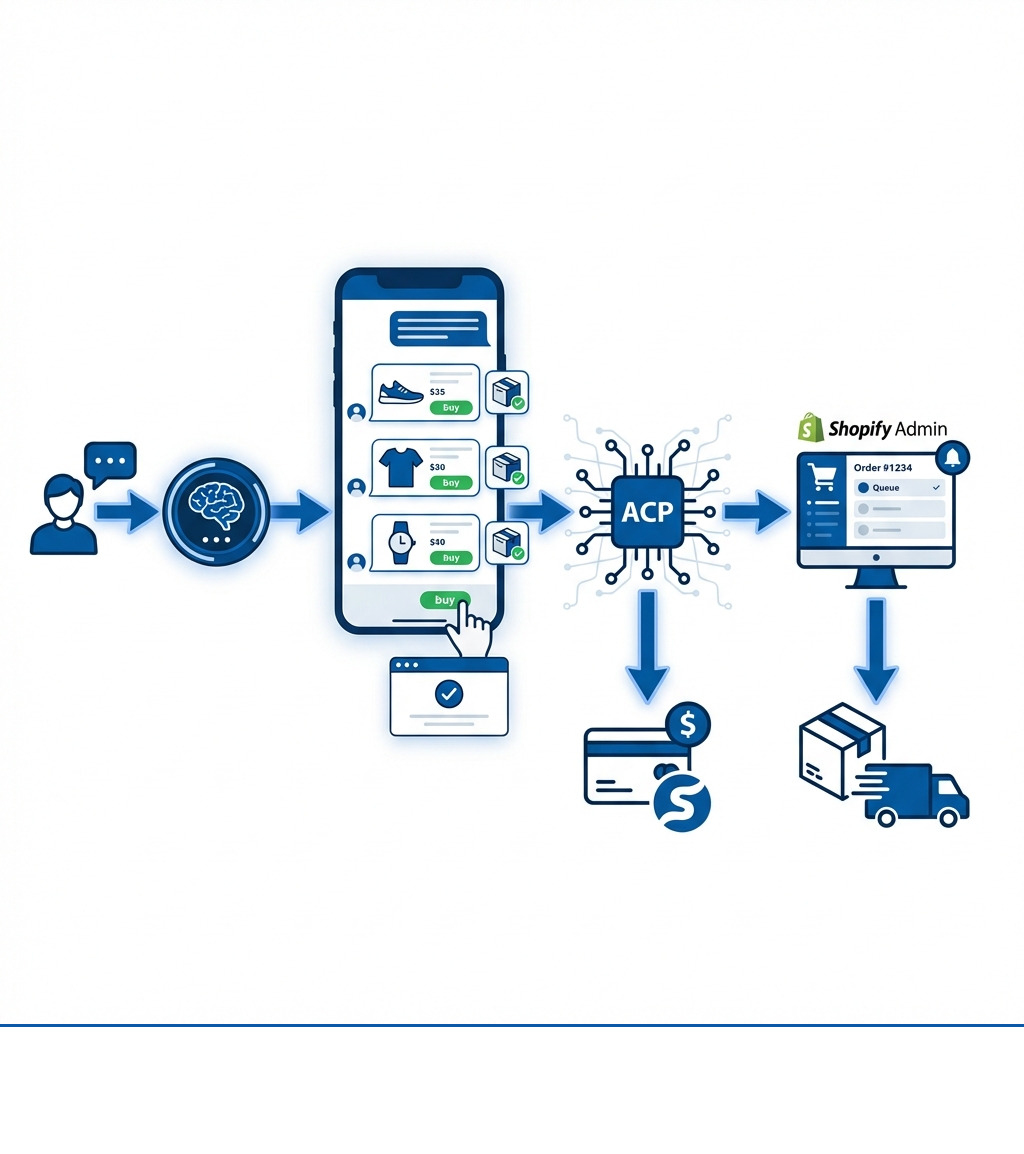
At its core, this integration is built on the Agentic Commerce Protocol (ACP), an open standard co-developed by OpenAI and Stripe. This protocol defines how AI agents like ChatGPT talk to merchant systems. When a purchase happens, payment processing is usually handled through Stripe, which handles the payments for this form of commerce. The order details are then sent directly to the merchant's existing Shopify order system, keeping the fulfillment process familiar. This direct sales channel simplifies the buying experience for customers and adds another way for merchants to reach them. For those not on Shopify, connecting to ChatGPT commerce still often requires custom development to align with the now widely-adopted ACP standards.
You can learn more about how AI is changing online retail on our AI in Shopify page.
How 'Instant Checkout' Works
With Instant Checkout, a user's shopping query can become a completed purchase directly within ChatGPT. Here is a simple breakdown of how it works:
When a user asks ChatGPT a shopping question, like "What are the best eco-friendly running shoes under $100?", ChatGPT processes the query. It then presents relevant product options from merchants who have opted into the integration. For these eligible products, a "Buy" button appears right within the chat.
The user can then tap this "Buy" button. They confirm their shipping and payment details directly inside the chat interface. The key point is that the user does not leave ChatGPT; there are no redirects to external websites. Once confirmed, the purchase is complete. ChatGPT then sends the order details to the merchant's Shopify store using the Agentic Commerce Protocol. The merchant processes the order as they would any other Shopify order, handling fulfillment and customer support.
For more details on the underlying mechanisms, you can explore More about the Agentic Commerce Protocol.
The Role of the Agentic Commerce Protocol (ACP)
The Agentic Commerce Protocol (ACP) is the foundation for this integration. It is an open standard for AI commerce, co-developed by OpenAI and Stripe. Its role is to standardize communication so AI agents, people, and businesses can work together to complete purchases.
ACP defines how AI systems like ChatGPT communicate with various merchant systems. This includes exchanging product feed information, handling checkout processes, and managing payment details. It helps make sure that when a user buys something in ChatGPT, the merchant's system receives all the information it needs to process the order correctly. This protocol allows for direct integration without forcing merchants to rebuild their existing backend systems. It is also designed to help keep merchant control over their operations, from payments to customer relationships.
Here at First Pier, our team specializing in More info about Shopify Development understands the importance of these foundational protocols. They are critical for building stable platforms with many features. Stripe plays a crucial part by providing the payment system that makes these agentic payments possible. You can learn more about Stripe's role in agentic commerce.
How to Prepare Your Shopify Store for ChatGPT Commerce
Getting your Shopify store ready for ChatGPT for Shopify commerce is not just about flipping a switch. It takes careful preparation of your product data and content. From our work with merchants, we know that a well-prepared store is the one that will see the most benefit from AI-driven channels like this. This preparation makes your products easier for AI to find and understand, which is different from how traditional search engines work. It also helps you meet any specific Shopify plan requirements. While broadly accessible, Shopify Plus merchants have access to more advanced configuration options and APIs for deeper customization.

You can find more information about how different AI Features can help your store.
Structure Product Data for AI
For your products to appear effectively in ChatGPT's responses, their data needs to be clean, structured, and complete. Think of it as making your product information easy for machines to read.
- Standardized Titles and Clear Descriptions: Product titles should be specific. Descriptions need to be written in natural language, avoiding jargon or excessive keyword stuffing, and should clearly state key details like size, color, material, and ideal uses.
- Rich Metadata: This includes all product attributes, variants, pricing, stock levels, and shipping details for every SKU.
- Schema Markup: Implementing comprehensive schema markup (like
Product,Offer,Review,FAQPage) is important. This helps AI understand the context and details of your products. - Accurate Product Feeds: Maintaining accurate and real-time product feeds is critical. This ensures that the information ChatGPT displays, such as price and availability, is always correct.
Here at First Pier, we put a lot of weight on data quality for all our clients. It is the base for any strong e-commerce plan, especially when you start to work with AI-driven platforms. For more on this, check out our insights on More info about Ecommerce Data Analytics.
Optimize Content and SEO for Conversational Search
Optimizing your content for conversational search, now standard practice known as Answer Engine Optimization (AEO) or Generative Engine Optimization (GEO), is essential for ChatGPT for Shopify. This goes beyond traditional SEO and focuses on how AI understands and responds to natural language queries.
- Buyer Intent Keywords: Instead of just targeting keywords, think about the questions customers might ask. Your content should naturally answer these questions.
- Conversational Language: Write product copy and descriptions in a conversational tone. This helps AI better match your products to user queries.
- Customer Reviews and Ratings: User-generated content (UGC), especially customer reviews, acts as a strong signal of product quality and relevance for AI. Encourage reviews and use review schema to make them easier to find.
- AI Crawler Accessibility: Ensure that AI crawlers, like
OAI-SearchBot, can easily access and index your product pages. This means your site structure should be clear and machine-readable.
By focusing on these areas, you help ChatGPT understand your products better, which can make your products appear more often in results. Our More info about SEO services can help you refine your plan for this new type of search.
How to Set Up the ChatGPT for Shopify Integration
Setting up the ChatGPT for Shopify integration is a straightforward process managed within your Shopify admin:
- Enable the ChatGPT Sales Channel: In your Shopify admin, navigate to the Sales Channels section and add the ChatGPT channel.
- Configure Product Syncing: Once the channel is added, you can configure which products are available to ChatGPT. You have control over your product catalog's visibility within AI channels.
- Review AI Channel Settings: Shopify provides merchants with control over where their products appear. You can manage your presence across different AI shopping features by toggling each platform on or off within your settings.
- Track Performance in Shopify Analytics: Performance data, including referrals and sales from ChatGPT, is integrated into your Shopify Analytics. Monitor this data to understand the channel's impact and ROI.
Merchants can manage these settings in their Shopify admin, and more information for new merchants is available through the Apply for Instant Checkout portal.
Using ChatGPT for Broader Shopify Store Operations
Beyond direct sales, ChatGPT can help Shopify merchants with a range of operational tasks. Many of our clients now rely on AI to help with marketing content, customer service, and basic website development. Used well, it can take pressure off your team so they can focus on work that needs human judgment.
For deeper insights into automating your store, explore our AI Automated Shopify Store resources.
Automating Marketing and Customer Communication
ChatGPT is a useful assistant for day-to-day marketing and customer communication tasks, helping merchants handle more of this work without adding headcount.
- Email Marketing Drafts: You can use ChatGPT to generate initial drafts for welcome emails, abandoned cart reminders, or promotional newsletters. These drafts still need human editing for brand voice and accuracy, but they give you a solid starting point.
- Google Ads Copy: ChatGPT can help write ad copy for Google Ads campaigns, which makes it faster to test different offers and angles.
- Social Media Posts: Generating content for platforms like Instagram, X, and Facebook becomes quicker with AI, which helps you keep a steady posting schedule.
- 24/7 AI Customer Care: AI chatbots, sometimes powered by models similar to ChatGPT, can act as 24/7 customer service specialists. They can answer common questions about products, store policies, shipping, and returns, which saves time and improves response times.
- Personalized Recommendations: AI can provide personalized product recommendations to customers, guiding them based on their questions or past interactions.
- Order Status Updates: Chatbots can quickly provide customers with updates on their order and shipment status, which reduces the load on your support team.
These uses help automate routine tasks, so your team can spend more time on complex customer issues and higher-impact marketing work. For help with your messaging plans, see our More info about Email & SMS Marketing page.
How to use chatgpt for shopify development and coding
While ChatGPT is primarily a language model, it can also help with certain parts of Shopify development and coding. In our work with merchants, we have seen it used in a few practical ways:
- Code Snippet Generation: ChatGPT can generate small code snippets for specific tasks, such as adding a button hover animation or modifying a section of your theme.
- Simple Theme Modifications: For basic changes to your Shopify theme, ChatGPT can provide instructions or code. For example, it might suggest how to adjust font sizes or colors.
- Debugging Assistance: If you run into a simple coding error, ChatGPT can sometimes help point to the issue or suggest potential fixes.
However, it is important to treat AI-generated code with care. While far more advanced, ChatGPT is still not a full replacement for a skilled developer. Its knowledge has a cutoff date, and it may not be aware of the very latest Shopify updates or nuanced coding best practices. Always test any AI-generated code on a duplicate theme or a staging environment before applying it to your live store. Without a full understanding of the code, you risk adding bugs or breaking existing features. Here at First Pier, we always recommend working with experienced developers for any significant changes to your store's code base. The Role of Artificial Intelligence in E-commerce is growing, but human expertise remains critical.
Navigating the Costs, Challenges, and Future of AI Commerce
The establishment of AI-driven commerce through ChatGPT for Shopify presents clear opportunities and well-understood tradeoffs. As an e-commerce agency in Portland, ME, we help our clients sort through these details and make practical decisions.
For a broader view of how AI can help your business, visit our AI Solutions for Ecommerce page.
Pricing Models and Associated Fees
The fee structure for AI commerce has matured. For sales made through the ChatGPT checkout, merchants pay a transaction fee to OpenAI, which started at 4% but has become more competitive. This is in addition to standard Shopify fees. Other major AI platforms, like Google's Gemini and Microsoft's Copilot, have also introduced their own transaction-based fee structures, creating a competitive landscape for AI sales channels.
Understanding these costs is necessary for calculating margins and deciding if this sales channel fits your targets.
Key Challenges: Data, Branding, and Security
While the integration offers new sales paths, it also brings challenges that merchants need to plan for:
- Loss of First-Party Customer Data: When a purchase happens directly within ChatGPT via Instant Checkout, the transaction occurs on OpenAI's platform. This means merchants do not directly collect first-party customer data during the initial interaction. This can affect retargeting and personalization. Merchants have adapted by focusing on collecting customer information post-purchase and leveraging the data available in their Shopify Admin to build long-term relationships.
- Attribution Gaps: Measuring the exact performance and attribution of sales driven by conversational AI can be difficult. It is hard to tell how much a conversation contributed to a sale if the final purchase happens outside your traditional analytics setup.
- Brand Voice Control: AI-generated responses may not always line up with your brand's voice and messaging. Merchants may have limited control over how products are presented or how queries are answered, which can affect brand consistency.
- Data Privacy Compliance: Connecting to AI platforms requires careful attention to data privacy. Merchants must make sure their operations comply with relevant regulations, especially when sharing product or customer data with third-party AI systems. The system uses encrypted payment tokens and limits data sharing to what is needed to complete an order, which helps with security.
- Secure Payment Tokens: The use of secure payment tokens, often provided by partners like Stripe, is important for protecting customer financial information during transactions within the chat.
Here at First Pier, we work closely with clients to address these concerns, focusing on ways to reduce data loss and keep compliance on track. Our More info about Shopify Accessibility & Data Compliance page offers relevant insights.
The Current State and Future Outlook for chatgpt for shopify
The ChatGPT for Shopify integration has solidified AI's role in commerce. What was once a future trend is now a core component of a modern e-commerce strategy. Several key developments have shaped the landscape:
- AI as a Core Sales Channel: AI platforms like ChatGPT are now established sales channels, moving from product discovery to direct, seamless purchasing. Merchants treat AI as a fundamental part of their sales mix.
- Advanced Personalization at Scale: AI's ability to interpret user intent has led to highly advanced, AI-powered personalization. This has become standard for matching customers with the right products.
- AEO is the New SEO: Competition for ranking within AI platforms is intense. Brands now dedicate significant resources to Answer Engine Optimization (AEO) to ensure their products are visible and favorably positioned in conversational results.
- Mature Features and Global Reach: Instant Checkout now fully supports multi-item cart purchases and is available to customers globally. These features, once in development, have dramatically expanded the scope and impact of AI-driven commerce.
This shift means merchants must stay adaptable, tuning their approach to data, content, and customer engagement to succeed as retail changes.
Frequently Asked Questions about ChatGPT for Shopify
What specific Shopify plans are required for the ChatGPT integration?
While the integration is available to most Shopify merchants, Shopify Plus plans offer access to more advanced features, such as custom checkout flows and deeper API integrations for enterprise systems that use ACP’s Delegated Payment Spec.
How does this integration impact customer data collection?
Purchases made via Instant Checkout in ChatGPT mean the merchant does not collect first-party customer data directly from the initial interaction, as the transaction occurs on OpenAI's platform. This can impact retargeting and personalization efforts. Successful merchants mitigate this by focusing on post-purchase communication and leveraging the order data that is routed into the Shopify Admin to build direct customer relationships.
How can my brand rank well in ChatGPT's product results?
Ranking depends on AI-readiness. Key factors include having clean, structured product data with comprehensive schema markup (Product, Offer, Review, FAQPage), accurate and real-time inventory feeds, competitive pricing, positive customer reviews, and product page content written in natural language that answers likely user questions. Ensuring AI crawlers can access your product pages is also important.
To Sum Up
The integration of ChatGPT with Shopify marked a real shift toward conversational commerce, establishing an essential channel for direct sales. For merchants, success depends on careful preparation of product data, a clear understanding of the new cost structures, and a strategy for managing the now-familiar challenges of data ownership and brand consistency. By adapting to this environment, businesses can meet customers where they now routinely make purchasing decisions.
Here at First Pier in Portland, ME, we help brands work through these technical changes and build high-performance online businesses on Shopify. If you need help preparing your store for the future of e-commerce, explore our award-winning Shopify services.





.png)
.png)

