


Why E-commerce PPC Management is Important for Online Growth
E-commerce PPC management is the process of planning, building, and improving pay-per-click advertising campaigns specifically for online stores. Here's what it involves:
- Campaign Setup: Creating targeted ad campaigns on platforms like Google Ads, Microsoft Advertising, and social media
- Keyword Strategy: Finding and bidding on high-intent search terms that bring in qualified traffic
- Budget Control: Managing daily and monthly ad spend to get the best return on investment
- Ongoing Improvement: Continuously testing and refining ads, bids, and targeting based on performance data
- Performance Tracking: Monitoring key numbers like ROAS, conversion rate, and cost per acquisition
If there's one truth about online retail, it's this: visibility drives sales. While building organic traffic takes time, PPC advertising puts your products in front of ready-to-buy shoppers right now. According to industry data, 65% of consumers click on PPC ads before making a purchase, and 85% of retail search clicks come from shopping ads.
PPC isn't just about spending money on ads. It's about smart investment. When managed correctly, it delivers measurable results, complete budget control, and the ability to scale quickly. You can target customers at the exact moment they're searching for products like yours, adjust campaigns in real-time based on performance, and gain useful information about what makes your customers buy.
The difference between profitable PPC campaigns and wasted ad spend comes down to smart setup and management. From selecting the right keywords and structuring campaigns effectively to improving product feeds and landing pages, every element matters. This guide walks you through the complete process for building and managing high-performing e-commerce PPC campaigns.
I'm Steve Pogson, founder of First Pier, a Shopify Expert Agency that has helped leading e-commerce brands scale through smart digital marketing. With over two decades of experience in e-commerce PPC management, I've seen how the right approach changes paid advertising from a cost center into a growth engine.
What is E-commerce PPC and Why Does It Matter?
At its core, e-commerce PPC is an online advertising strategy where online stores pay a fee each time one of their ads is clicked. Think of it as buying highly targeted traffic to your website. Instead of waiting for organic rankings, you're placing your products directly in front of people actively looking to buy what you offer. This is why PPC is a powerful way for online businesses to grow.
How does this magic happen? It all starts with an ad auction. When a user types a search query into a search engine like Google or browses a social media platform, an instant auction takes place. The ad network (Google, Microsoft Advertising, Facebook, etc.) reviews various factors, including your bid (how much you're willing to pay per click) and the quality and relevance of your ad and landing page. The ads that win the auction are then displayed to the user. You only pay when someone actually clicks on your ad, hence "pay-per-click."
For e-commerce, this model is incredibly valuable. It helps me target high-intent shoppers – people who are already in a buying mindset. This means a higher likelihood of conversion, which translates directly into sales for your online store. With so many other stores online, having a strong PPC strategy helps you stand out, gain immediate visibility, and compete effectively with larger players. It's a way to make sure your products are seen by the right people, at the right time, when they are most likely to make a purchase. If you're interested in learning more about how paid search can help your business, I encourage you to explore our paid search services.
The Key Benefits of PPC for Your Online Store
I often tell my clients that PPC isn't just an expense; it's an investment with great returns when managed correctly. Here's why I believe it's such a game-changer for online stores:
- Immediate Visibility: Unlike SEO, which can take months to show results, PPC offers instant exposure. Once your campaigns are live, your products can appear at the top of search results or on relevant websites and social media feeds right away.
- Precise Audience Targeting: Modern PPC platforms allow for very specific targeting. I can target potential customers based on their demographics, interests, search history, purchase intent, and even their physical location. For businesses in Portland, ME, this means I can make sure ads reach local customers or those interested in products relevant to our region.
- Complete Budget Control: You decide how much you want to spend. I can set daily, weekly, or monthly budgets and adjust them anytime. This flexibility helps manage costs and ensures you never overspend.
- Measurable ROI: Every click, impression, and conversion is tracked. This data allows me to see exactly how much revenue each campaign generates, making it easy to calculate your Return on Ad Spend (ROAS). PPC campaigns deliver 50% higher conversion rates compared to other traffic sources when managed well.
- Scalability: When a campaign performs well, I can easily increase the budget to reach more potential customers and drive more sales. This makes PPC a fantastic tool for growth.
- Data-Driven Insights: The wealth of data from PPC campaigns provides very useful information about customer behavior, popular products, and effective messaging. This information can then inform other marketing efforts and business decisions.
How PPC Works Specifically for E-commerce
PPC for e-commerce has its own set of rules and best practices. It's often focused on products, meaning the goal is to directly show your products to potential buyers.
A prime example of this is Google Shopping ads. These visual ads appear at the top of Google search results, displaying product images, prices, store names, and reviews. These are incredibly effective because they give shoppers key information upfront, leading to highly qualified clicks. In fact, 85% of retail search clicks come from shopping ads.
Another powerful tactic I use is dynamic remarketing. Imagine a customer browsing your site, looking at a specific pair of sneakers, but not buying them. With dynamic remarketing, I can show them ads for those exact sneakers as they browse other websites, gently reminding them and encouraging them to complete their purchase. This is a very effective way to recapture lost sales.
Social media platforms like Facebook and Instagram also play a huge role. Their great targeting options allow me to reach audiences based on their interests and behaviors, often leading to impulse buys or brand discovery.
The heart of all e-commerce PPC, especially for Google Shopping, is the Google Merchant Center (GMC). This is where you upload your product feed – a complete list of all your products with detailed attributes like price, image, description, and availability. The quality and accuracy of this product feed are very important, as it directly influences how your products appear in ads and how effective your campaigns will be. I always make sure my clients' GMC accounts are working at their best, as it's the engine driving their Shopping campaigns.
A Step-by-Step Guide to E-commerce PPC Management
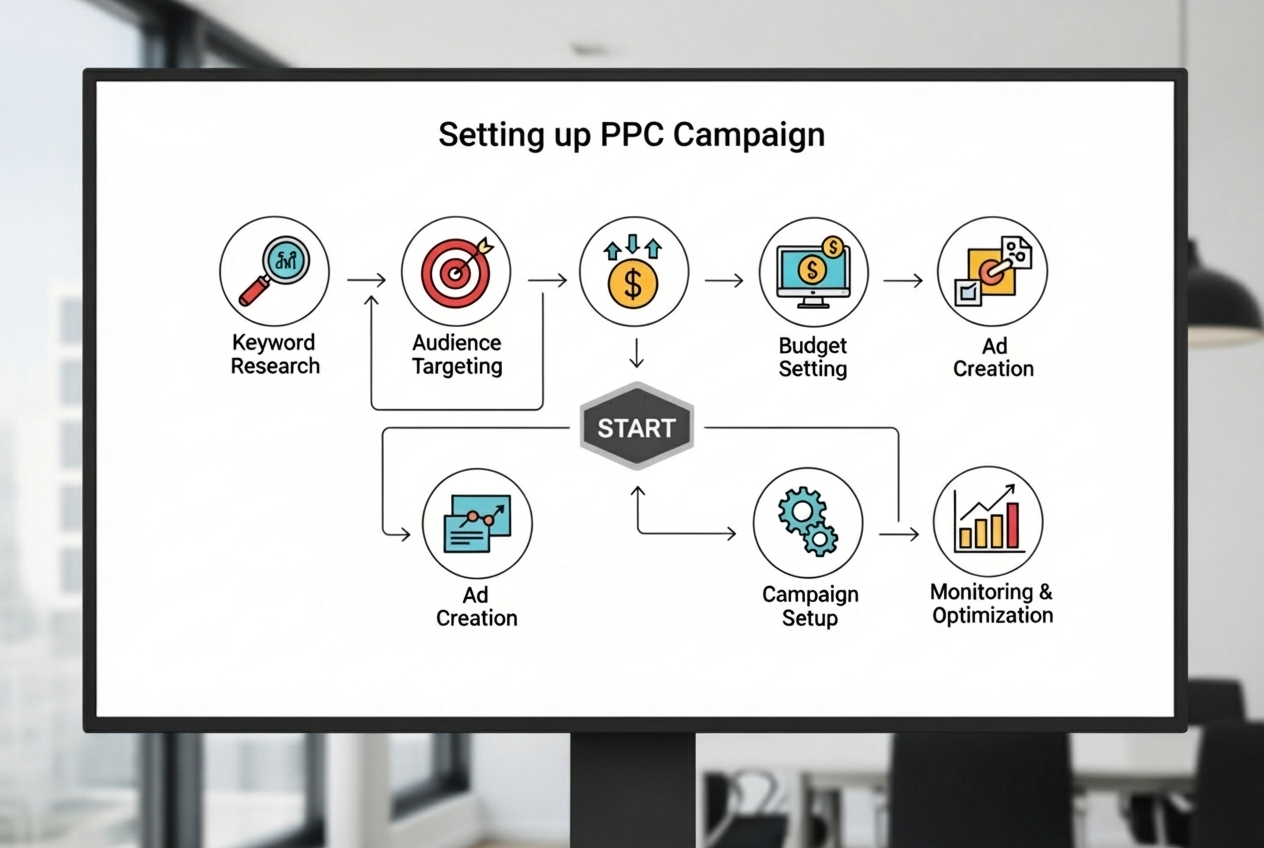
Setting up and managing an effective e-commerce PPC campaign might seem like a lot to handle at first, but I've broken it down into manageable steps. Think of it as following a recipe for success – each ingredient and step is key for the final delicious outcome.
Step 1: Starting with Keyword and Audience Research
This is where I put on my detective hat. Before spending a single dollar, I need to understand what your potential customers are searching for and who they are.
- Finding Customer Search Terms: I focus on three main types of keywords:
- Transactional keywords: These show high purchase intent (e.g., "buy running shoes online," "best coffee grinder for sale").
- Long-tail keywords: More specific phrases that often have lower search volume but higher conversion rates (e.g., "waterproof hiking boots for women Portland ME").
- Branded keywords: Terms that include your brand name or specific product names. These often have very high conversion rates.I use tools like Google’s Keyword Planner to find relevant keywords, look at their monthly search volume, how competitive they are, and estimated bid range. I also look at search terms reports to see what people are actually typing when they find your ads, which often reveals new keyword opportunities and helps me improve existing ones.
- Defining Target Audiences: Beyond keywords, I also define who I want to reach. This involves:
- Demographics: Age, gender, income, parental status.
- Interests: What else do they care about? What websites do they visit?
- Past purchase behavior: Have they bought similar products before? Are they loyal to certain brands?
- Geographic targeting: For my clients, I make sure we target users specifically in Portland, ME, or those showing interest in products relevant to the area.
Step 2: Structuring Your Campaigns and Ad Groups
A well-organized campaign structure is the backbone of successful PPC management. It gives me control, helps with assigning budgets, and makes improvements easier.
- Campaign Goals: First, I make the main goal for each campaign clear. Is it to drive sales, generate leads, or simply increase website traffic?
- Structuring by Product Category: For e-commerce, I typically structure campaigns around product categories (e.g., "Men's Apparel," "Home Decor," "Electronics"). This allows me to assign budgets and tailor ads more effectively.
- Brand vs. Non-Brand Campaigns: I often create separate campaigns for branded terms (e.g., "First Pier Shopify agency") and non-branded terms (e.g., "Shopify development services"). This gives me better control over bids and budgets for different types of search intent.
- Creating Logical Ad Groups: Within each campaign, I create ad groups. Each ad group should focus on a tight theme of keywords (ideally 10-15 keywords) and point to a single, highly relevant landing page. For example, a "Men's Running Shoes" campaign might have ad groups like "Nike Running Shoes," "Adidas Running Shoes," and "Trail Running Shoes." For Google Shopping, I divide products into product groups, allowing for fine-tuned control over bids for individual products or smaller groups.
Step 3: Creating Catchy Ads
Once I know who I'm targeting and what they're searching for, it's time to create ads that grab attention and encourage clicks.
- Writing Effective Ad Copy: Your ad copy is your sales pitch in a small space. I focus on:
- Showing Off Unique Selling Propositions (USPs): What makes your product or store special? Free shipping? Unique design? Local craftsmanship?
- Clear Call-to-Action (CTA): Tell people what to do next! "Shop Now," "Learn More," "Get Your Pair."
- Relevance: The ad copy should directly relate to the keywords used and the landing page content.
- Using High-Quality Images and Videos: For Shopping and display ads, visuals are everything. I make sure product images are high-resolution, clear, and appealing. For social media and video campaigns, catchy video content can make you stand out in a busy feed.
- Responsive Search Ads (RSAs): These allow me to provide multiple headlines and descriptions, and Google's AI mixes and matches them to find the best combinations. This means I'm constantly A/B testing different headlines and descriptions to see what connects best with your audience. If you need help with creative assets that truly shine, I can help you with collateral design.
Improving Your Campaigns for the Best ROI

Launching campaigns is just the beginning. The real magic of e-commerce PPC management happens with always improving them. I constantly review performance, look at data, and make smart changes to make sure every dollar spent is working as hard as possible for my clients.
Effective Budgeting and Bidding for E-commerce PPC Management
Budgeting and bidding are key for controlling costs and getting the best returns.
- Setting a Realistic Budget: While successful e-commerce businesses might invest between $9,000 to $10,000 monthly in PPC campaigns, initial budgets can start smaller. What matters most is smartly managing the budget, not just the total spend. I work with clients to figure out a daily or monthly spend that matches their business goals and expected ROI.
- Manual vs. Automated Bidding:
- Manual Bidding: This gives me complete control over individual keyword bids. It's great for new campaigns or when I want to be very precise, but it requires more hands-on management.
- Automated Bidding: Platforms like Google Ads offer Smart Bidding strategies that use machine learning to improve bids in real-time for specific goals. Strategies like Target ROAS (Return on Ad Spend) aim to achieve a specific return for every dollar spent, while Maximize Conversion Value focuses on getting the most value from your budget. I often use a blend of these strategies, starting with manual control and then moving to automated strategies once I have enough data.
- Adjusting Bids Based on Performance: I continuously review performance data. If a product or keyword is bringing in a high ROAS, I might increase its bid. On the other hand, if something is underperforming, I'll reduce its bid or pause it altogether. I also use bid adjustments for factors like device (mobile vs. desktop), time of day, or location to further improve targeting.
The Important Role of Landing Page Improvement
Even the most clever ad copy and precise targeting will fail if the landing page isn't up to par. Your landing page is where the conversion happens, so it needs to be smooth.
- Matching Ad Message to Landing Page: This is a must-do. If your ad promises "50% Off Blue Running Shoes," the landing page must immediately show blue running shoes with the discount clearly visible. Any mismatch will lead to bounces and wasted ad spend.
- Technical Performance: I make sure landing pages are:
- Fast: Page speed is very important. Slow pages frustrate users and hurt your Quality Score.
- Mobile-Friendly: A large part of e-commerce traffic comes from mobile devices, so the page must look and function perfectly on smartphones.
- Secure: An SSL certificate (HTTPS) is a must for trust and security.
- Clear Product Information and Easy Checkout: The page should clearly present product details, high-quality images, customer reviews, and an easy-to-see "Add to Cart" or "Buy Now" button. The checkout process needs to be easy to follow and have as few steps as possible.
- Tracking: I set up tracking codes, including an Urchin Tracking Module (UTM parameters), to track how visitors arrive and what actions they take on the page. To learn more about making your e-commerce site a conversion machine, check out our e-commerce UX design services.
How to Measure Success in E-commerce PPC Management
Measuring success isn't just about clicks; it's about conversions and profitability. I track a complete set of metrics to understand campaign performance:
- Return on Ad Spend (ROAS): This tells me how much revenue you make for every dollar spent on ads. It's often my North Star metric for e-commerce.
- Cost Per Acquisition (CPA): How much does it cost to get one customer or one sale? I aim to keep this below your profit margin per product.
- Conversion Rate (CVR): The percentage of clicks that result in a desired action (like a purchase). Average conversion rates for search ads are 2.81%.
- Click-Through Rate (CTR): The percentage of people who see your ad and click on it. A high CTR shows ad relevance.
- Average Order Value (AOV): The average amount customers spend per transaction. This helps me understand overall profitability.
- Lifetime Value (LTV): The total revenue a customer is expected to bring in over their relationship with your business. This is key for long-term strategy.
I use tools like Google Analytics and a solid conversion tracking setup to gather this data. I also pay close attention to attribution models, which help me understand which touchpoints contribute to a conversion. Data-Driven Attribution, which uses machine learning, is often the most accurate, but Position-Based and Time-Decay models also offer useful information. To make sure data is accurate and prevent loss, especially with changing privacy rules, I recommend setting up server-side tracking.
Common Mistakes and Future Trends
Even with the best intentions, it's easy to stumble in PPC. I've seen common mistakes that can quickly drain budgets. But I also keep a keen eye on new trends, as the future of e-commerce PPC management promises exciting changes.
9 Common PPC Mistakes to Avoid
- Vague Keyword Targeting: Using broad, generic keywords without a clear goal often leads to irrelevant clicks and wasted spend. Be precise!
- Neglecting Negative Keywords: Just as important as what you target is what you don't target. I use negative keywords to exclude irrelevant search terms (e.g., if you sell new shoes, add "used" as a negative keyword).
- Poor Product Feed Quality: For Shopping campaigns, a messy or incomplete product feed in Google Merchant Center can really hurt your visibility and performance. Garbage in, garbage out!
- Sending Traffic to the Homepage: Your homepage is rarely the best landing page for a specific ad. Direct users to the exact product or category page they're looking for.
- Ignoring Mobile Users: With most online shopping happening on phones, failing to improve ads and landing pages for mobile is a huge missed opportunity.
- Not A/B Testing: "Set it and forget it" is a recipe for average results. I constantly test different ad headlines, descriptions, images, and CTAs to find what performs best.
- Setting and Forgetting Campaigns: PPC is always changing. Campaigns need to be watched all the time and adjusted. I don't just launch and walk away; I'm always improving them.
- Mismanaging Budget: Dumping money into underperforming campaigns or failing to scale up successful ones is a waste. Smart budget planning is key.
- Poorly Performing Landing Pages: As I mentioned, a slow, confusing, or irrelevant landing page will kill your conversion rates, no matter how good your ad is.
The Future of E-commerce PPC
PPC marketing in 2025 is all about being unpredictable and changing fast. Staying ahead means adapting to new technologies and consumer behaviors. Here's what I'm seeing on the horizon:
- AI-Driven Campaigns: Artificial intelligence is already reshaping PPC. Automated bidding strategies are becoming more advanced, and AI data analytics can help find high-converting audiences and search terms more quickly, reducing time spent on manual keyword research.
- Performance Max: Google's Performance Max campaigns are an all-in-one campaign type that uses AI to improve performance across all of Google's channels (Search, Display, YouTube, Gmail, Find). They are powerful but require good data and clear goals to perform at their best.
- The Rise of Video and Social Commerce: As platforms like TikTok and Instagram add shopping features, video ads and social commerce will continue to grow in importance, offering new ways to reach customers.
- Augmented Reality (AR) in Ads: Imagine a customer "trying on" a pair of glasses or "placing" a piece of furniture in their living room directly from an ad. AR is beginning to improve PPC ad experiences, improving user interaction and conversion confidence.
- Increased Focus on Privacy and First-Party Data: With changing privacy regulations and the removal of third-party cookies, collecting and using your own first-party data (data directly from your customers) will become even more important for advanced targeting and personalization.
- Visual Search: As technology advances, searching with images will become more common. E-commerce PPC will need to adapt to work with these visual queries.
Frequently Asked Questions about E-commerce PPC
I often get asked these questions by clients looking to start or improve their PPC efforts. Let me share my thoughts.
How much should an e-commerce store spend on PPC?
This is a common question without a one-size-fits-all answer, as it depends heavily on your industry, profit margins, competition, and growth goals. While successful e-commerce businesses typically invest between $9,000 to $10,000 monthly in PPC campaigns, initial budgets can certainly start smaller. What's most important is smart budget management. I always recommend starting with a budget that allows for good testing and data collection, focusing on your highest-performing products or categories. As campaigns prove their profitability, you can slowly increase your budget.
How long does it take to see results from PPC?
One of the great advantages of PPC is its speed. You can see early signs of performance within the first two weeks of launching campaigns. This includes impressions, clicks, and initial conversions. However, to get enough data to see patterns that allow for smart decisions about improvements, I usually look at a 30-60 day window. For a campaign to be fully working, including the best performance of automated bidding strategies, it typically requires 90 days of consistent data. Patience during the initial "learning phase" is key, as the algorithms need time to gather data and improve.
What is a good ROAS for e-commerce?
A "good" ROAS (Return on Ad Spend) depends on the business and changes a lot by industry, product type, average order value, and your profit margins. For instance, a business selling high-margin luxury goods might aim for a lower ROAS than a business selling low-margin everyday items. Generally, a ROAS of 2:1 (meaning you get $2 back for every $1 spent) is considered a break-even point for many businesses, but you ideally want something higher for profitability. I work with my clients to figure out their specific target ROAS based on their own finances. The goal is always to achieve a ROAS that makes your PPC campaigns affordable in the long run and helps your bottom line after accounting for all costs.
To Sum Up: Partnering for Long-Term Growth
I hope this guide has clarified the power and potential of e-commerce PPC management. It’s an always-changing and effective way to drive targeted traffic, increase sales, and grow your online business. Smart management is key: from careful keyword research and thoughtful campaign structuring to catchy ad creative and always making improvements, every detail helps you succeed.
The online world is constantly changing, with new technologies and privacy considerations influencing how we advertise. Staying alert and adapting to these changes is not just an option but a must. That's why always making improvements and using a data-driven approach are so important.
At First Pier, I believe in helping brands and boutiques build high-performance online businesses. My team and I specialize in Shopify development and improvement, making sure our clients have a stable platform that has lots of features. We combine this platform expertise with smart digital marketing, including e-commerce PPC management, to create a complete plan for growth. We're here to guide you through the tricky parts of online advertising, making sure your campaigns are not just running, but truly thriving.
To get started with a winning strategy for your store, explore our award-winning Shopify e-commerce agency services. Let's work together to help your e-commerce business grow.





.png)
.png)

