


Why E-commerce PPC Management Matters for Your Business
Summary
- E-commerce PPC management is the process of planning, executing, and optimizing paid ad campaigns to drive sales and revenue for online stores.
- An effective PPC strategy includes clear goal setting, thorough keyword and audience research, compelling ad creation, and continuous data-driven optimization.
- Pay-per-click advertising offers significant advantages for e-commerce, including immediate traffic, precise targeting of high-intent shoppers, and measurable results.
- Key metrics for success include Return on Ad Spend (ROAS), Conversion Rate, and Cost Per Acquisition (CPA), which are improved through strategic bid management, negative keywords, and landing page optimization.
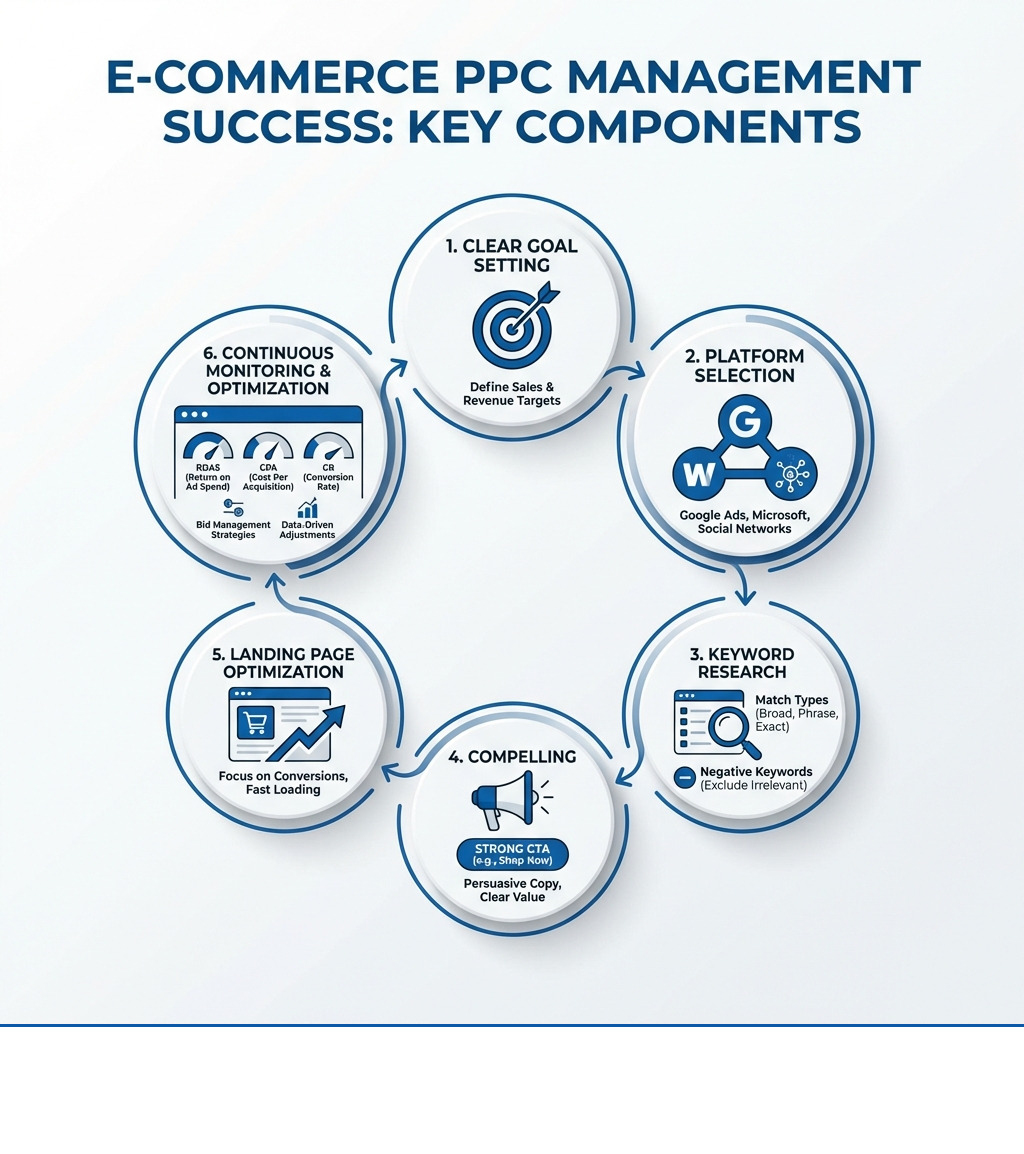
E-commerce PPC management is the work of turning paid ad clicks into profitable sales for an online store. The difference between a successful campaign and wasted budget comes down to execution. This requires understanding auction dynamics, managing bids, and continuously testing based on performance data. Effective management involves:
- Strategic Planning: Setting clear campaign goals, selecting the right platforms (Google Ads, Microsoft Advertising, social media), and allocating budgets based on performance targets.
- Audience & Keyword Targeting: Researching high-intent keywords, building customer segments, and using negative keywords to eliminate wasted spend.
- Campaign Execution: Creating compelling ad copy, building optimized landing pages, and setting up conversion tracking.
- Continuous Optimization: Monitoring key metrics like ROAS, CTR, and CPA, then adjusting bids, testing ads, and refining targeting based on data.
With 65% of clicks on commercial search terms going to sponsored links, paid advertising is a primary source of revenue for online stores. But with an average cost per click of $2.59 and businesses often investing $9,000 to $10,000 per month, there is no room for error. Effective E-commerce PPC management builds a data-driven system that targets the right shoppers and turns ad spend into profitable revenue.
Unlike organic strategies that take months to build momentum, PPC delivers immediate visibility. You can reach customers actively searching for your products right now. When managed well, PPC campaigns can achieve a 400% ROAS (4:1 return) or better, making them one of the most accountable and measurable marketing channels available.
I'm Steve Pogson, and over the past two decades I've helped e-commerce brands grow their revenue through strategic E-commerce PPC management and conversion optimization. Here at First Pier, we've managed campaigns for leading brands, turning ad spend into sustainable growth by combining platform expertise with deep e-commerce knowledge.
Must-know E-commerce PPC management terms:
Building Your E-commerce PPC Foundation
Before I dive into the granular details of managing paid campaigns, it is important to lay a solid groundwork. This involves setting clear goals, picking the right platforms, and defining your budget. These initial steps are the backbone of any successful E-commerce PPC management strategy. For more in-depth information about paid search services, you can check out more info about paid search services.
Defining Clear Campaign Goals
Every effective E-commerce PPC management strategy begins with clear, measurable goals. Without them, you are simply spending money without a target. I always advise setting SMART goals: Specific, Measurable, Achievable, Relevant, and Time-bound.
For e-commerce, common goals include:
- Increase sales: This is often the ultimate goal. For example, "Increase monthly online sales by 20% within the next quarter."
- Generate leads: If your business model involves capturing leads before a sale (e.g., for high-value items or custom orders), a goal might be "Generate 50 qualified leads per month through PPC."
- Drive website traffic: While traffic alone isn't enough, it is a necessary precursor to sales. A goal could be "Increase targeted website traffic by 30% in 90 days."
- Brand awareness: For new products or brands, increasing visibility can be a primary objective.
Clearly defined goals allow me to measure success accurately and make informed decisions about campaign adjustments.
Choosing the Right PPC Platforms
The choice of platform significantly impacts your E-commerce PPC management strategy. Each platform has unique strengths.
- Google Ads: For most e-commerce businesses, Google Ads is foundational. It provides the broadest reach, with ads appearing on Google Search, Google Shopping, YouTube, and its Display Network. Google Shopping, in particular, delivers strong performance for visual product promotion, displaying product images, prices, and store names directly in search results. With 65% of clicks on commercial terms going to sponsored links, Google Search is where high-intent buyers look.
- Microsoft Advertising (Bing Ads): This platform can be a profitable secondary channel. Microsoft Advertising gives access to 724 million unique searchers per month, and depending on your product, you might find less competition and a cheaper cost per click than on Google.
- Social Media Ads: Platforms like Facebook, Instagram, and TikTok are excellent for building brand awareness, nurturing leads, and remarketing. Unlike search ads that target active queries, social media PPC focuses on targeting people based on demographics, interests, and behaviors. For more details on the differences, you can read more info about paid social services.
| Feature | Google Ads | Social Media PPC |
|---|---|---|
| User Intent | High (active search for products/solutions) | Lower (findy, interest-based browsing) |
| Ad Formats | Text, Shopping (product images/prices), Display, Video | Image, Video, Carousel, Collection, Stories |
| Targeting | Keywords, location, demographics, audience lists | Demographics, interests, behaviors, custom audiences, lookalikes |
| Primary Goal | Direct conversions, sales, leads | Brand awareness, engagement, lead generation, remarketing |
| Reach | Broadest for search queries | Extensive for demographic & interest-based audiences |
| Typical CPC | Generally higher for high-intent keywords | Often lower, but conversion rates can vary |
| Visuals | Critical for Shopping Ads, optional for Search | Central to ad effectiveness |
| Customer Journey | Bottom-of-funnel (ready to buy) | Top to mid-funnel (findy, consideration) |
Setting and Managing Your PPC Budget
Effective E-commerce PPC management is deeply tied to how you set and manage your budget. Businesses typically invest between $9,000 to $10,000 per month in PPC advertising, but initial budgets can start smaller, scaling up based on results.
I always recommend starting with a clear understanding of your overall marketing budget. You can then calculate a daily budget by dividing your monthly spend goal by 30.4 days. This approach allows for flexibility, but with an average cost per click of $2.59, there is little room for error.
Budget allocation strategies typically involve:
- Primary allocation (70-80%): For high-performing categories, proven search ads, and top-converting ad formats.
- Secondary allocation (15-20%): For testing new opportunities, seasonal promotions, social media ads, and awareness campaigns.
- Reserve allocation (5-10%): For competitive responses, market testing, or unexpected pivots.
The key is to remain flexible and adjust your budget based on real-time performance.
Audience and Keyword Targeting Strategy
Once your foundation is set, the next step in E-commerce PPC management is to pinpoint who you want to reach and what words they use to find you. This involves meticulous audience and keyword research.

Researching and Targeting Your Ideal Audience
Gone are the days of guessing who your customers are. Modern PPC allows for precise targeting.
- Customer data analysis: By reviewing your existing customer data, you can build detailed buyer personas. What are their demographics, interests, and purchasing behaviors?
- Competitor research: Examine what your competitors are doing. What audiences are they targeting? This can reveal gaps or opportunities.
- Custom intent audiences: On platforms like Google, you can target users who have actively searched for specific products or services, or who have recently visited competitor websites. This allows me to reach people with strong commercial intent.
- Geographic targeting: For businesses with physical locations in Portland, ME, or those serving specific regions, local targeting is crucial. You can target users within a specific radius, or those in relevant "feeder markets" that often travel to your area.
- Demographic targeting: This includes age, gender, household income, and parental status.
Targeting capabilities differ between search and social platforms. Paid search ads target people based on the keywords they search for, while social media PPC focuses on demographic features and interests.
Mastering E-commerce Keyword Research
Keyword research is the bedrock of any successful E-commerce PPC management campaign. It is about finding the specific words and phrases your potential customers use when looking for your products.
- Commercial intent keywords: These are phrases that show a strong intention to buy, such as "buy [product name] online," "[product category] for sale," or "best [product] deals."
- Long-tail keywords: These are longer, more specific phrases (e.g., "women’s waterproof trail running shoes wide fit"). While they have lower search volume, they often have higher conversion rates because they indicate very specific buying intent.
- Branded vs. non-branded terms: Bidding on your own brand name can be important for protecting your brand and capturing high-intent searches. However, the real growth usually comes from non-branded, generic keywords.
- Using tools: Tools like Google’s Keyword Planner help by showing a keyword’s monthly search volume, competitiveness, and bid range.
- Keyword match types: Understanding these is crucial:
- Exact Match: Shows your ad only for searches that are an exact match to your keyword (with some close variants).
- Phrase Match: Shows your ad for searches that include your keyword phrase in the correct order, with additional words before or after.
- Broad Match: Shows your ad for searches related to your keyword. I generally advise caution with broad match, as it can lead to irrelevant clicks if not carefully managed with negative keywords.
How to Use Negative Keywords in E-commerce PPC Management
Negative keywords are words or phrases you add to your campaign to prevent your ads from being triggered by irrelevant searches. This is a vital part of E-commerce PPC management because it stops wasted ad spend and improves ad relevance. For example, if you sell high-end silver jewelry, adding "cheap," "costume," or "gold" as negative keywords ensures your ads don't appear for those less relevant searches.
- Reducing wasted ad spend: By excluding irrelevant searches, you only pay for clicks from users genuinely interested in what you offer.
- Improving relevance: This helps improve your ad's Quality Score, which can lead to lower costs and better ad positions.
- Finding negative keywords: I regularly review the Search Terms Report in Google Ads. This report shows the actual queries people typed before seeing your ad. It is a goldmine for identifying irrelevant terms to add as negatives.
- Building shared lists: Create shared negative keyword lists that can be applied across multiple campaigns, streamlining management.
You can learn more about negative keywords directly from Google's support.
Creating High-Converting Ads and Landing Pages
Once you know who you are targeting and with what keywords, the next step in E-commerce PPC management is to craft the message and the destination. Your ads need to be compelling, and your landing pages need to be persuasive.

Writing Compelling E-commerce Ad Copy
Your ad copy is often the first impression a potential customer has of your brand. It needs to stand out.
- Benefit-focused headlines: Highlight what makes your product great for the customer. Instead of "Running Shoes," try "Boost Your Pace with Lightweight Running Shoes."
- Clear Calls-to-Action (CTAs): Tell people exactly what to do. Use action phrases like "Shop Now," "Buy Online," "Get Your Pair," or "Find Deals."
- Keyword inclusion: Naturally weave your target keywords into your ad copy. This improves relevance and Quality Score.
- Unique Selling Propositions (USPs): What makes you different? Free shipping, unique designs, local craftsmanship (here in Portland, ME), or a special guarantee?
- Adhering to character limits: Platforms have strict limits. Be concise and impactful. Google Ads, for example, allows up to 90 characters for each description line. You can find guidelines on character limits.
- Using ad extensions: These expand your ad's real estate and provide additional information, like sitelinks to specific product categories, structured snippets for product features, or price extensions.
For social media or display ads, visuals are key, so select enticing imagery.
Optimizing Landing Pages for Conversions
Even the best ad copy will fail if it leads to a poor landing page. The landing page is the final step before conversion, and its optimization is a critical part of E-commerce PPC management.
- Ad-to-page message match: The content of your landing page must directly align with the ad that brought the user there. If your ad promises "20% off Summer Dresses," the landing page should immediately showcase summer dresses with the discount applied.
- High-quality product images: Clear, high-resolution images that showcase your products from multiple angles are essential.
- Trust signals: Include customer reviews, testimonials, security badges, and clear return policies to build confidence.
- Customer reviews: Social proof is incredibly powerful. Highlight positive customer feedback prominently.
- Fast page speed: Slow loading pages kill conversions. Aim for a fast loading time across all devices.
- Mobile-first design: Most online shopping happens on mobile. Your landing pages must be responsive and optimized for mobile users.
- Clear Call-to-Action (CTA): Make the "Add to Cart" or "Buy Now" button prominent and easy to find.
An attractive, conversion-optimized landing page makes it easy for customers to purchase your goods or services. You can also set up the URL to have an Urchin Tracking Module to track how visitors interact with your page. For assistance with creating user-friendly e-commerce experiences, consider our more info about ecommerce UX design services.
Using Remarketing to Re-engage Shoppers
Not every visitor will convert on their first visit. Remarketing is a powerful E-commerce PPC management strategy to bring back interested shoppers. It allows you to show ads to people who have previously visited your website or interacted with your brand.
- What is remarketing: It involves serving targeted ads to users who have previously shown interest in your products but did not complete a purchase. This keeps your brand top-of-mind.
- Audience segmentation: I segment audiences for remarketing to make campaigns more relevant:
- Cart abandoners: These are high-intent users who added items to their cart but did not check out. Offer them a small discount or free shipping to complete the purchase.
- Product viewers: Target users who viewed specific products. Show them ads for those exact products or related items.
- Category browsers: Target users who browsed a specific product category.
- Dynamic remarketing ads: These ads automatically show users the exact products they viewed on your site. This personalization significantly increases their effectiveness.
Remarketing campaigns are a great way to improve the ROI of your e-commerce PPC campaigns. Google Ads allows you to target people who visited your site or browsed a specific product or service. You can learn more about setting up remarketing campaigns to re-engage past visitors. For further engagement strategies, explore our more info about email & SMS marketing services.
The Core of E-commerce PPC Management: Analysis and Optimization
Effective E-commerce PPC management is not a "set it and forget it" activity. It demands continuous monitoring, data analysis, and optimization. This is where the real wins happen.
Key Performance Indicators (KPIs) to Track
To truly understand how your PPC campaigns are performing, I focus on several key metrics:
- Clicks: The number of times your ad was clicked.
- Click-Through Rate (CTR): The percentage of impressions that resulted in a click. A high CTR indicates your ad is relevant and compelling.
- Cost Per Click (CPC): The average cost you pay for each click on your ad.
- Conversion Rate: The percentage of clicks that result in a desired action, such as a purchase. For search ads, the average conversion rate is 2.81%, but this varies by industry. Understanding what a good conversion rate is for your market is key to setting realistic expectations.
- Cost Per Acquisition (CPA): The total cost to acquire one customer or achieve one conversion.
These KPIs provide a snapshot of campaign health. For a deeper dive into your e-commerce data, consider our more info about ecommerce analytics services.
Improving Return on Ad Spend (ROAS)
ROAS is arguably the most critical metric for e-commerce PPC. It directly measures the revenue generated for every dollar spent on advertising.
- What is ROAS: Return on Ad Spend (ROAS) tells you how much revenue your PPC ad campaigns generate for every advertising dollar spent. Improving ROAS requires tying every campaign back to real business outcomes.
- ROAS calculation: It is calculated as (Revenue from Ad Campaign ÷ Cost of Ad Campaign) x 100. For instance, if you spend $1,000 and generate $4,000 in revenue, your ROAS is 400%. Most successful e-commerce sites target at least a 400% ROAS (4:1 return).
- ROAS vs. Return on Investment (ROI): While related, ROAS focuses purely on ad revenue relative to ad spend, while ROI considers all costs (product, operations, ad spend) relative to profit. A high ROAS is great, but a campaign with 600% ROAS could still lose money if product margins are too thin.
- Strategies to improve ROAS:
- Bid management: Use smart bidding strategies like Target ROAS or Maximize Conversion Value. These strategies automatically adjust bids to help you get the most conversion value for your budget.
- Quality Score improvement: A higher Quality Score (driven by ad relevance, expected CTR, and landing page experience) often leads to lower CPCs and better ad positions.
The Role of Continuous Optimization
The e-commerce landscape is dynamic, and your PPC campaigns need to adapt. Continuous optimization is non-negotiable for long-term success.
- A/B testing ads: Regularly test different headlines, descriptions, and calls-to-action to see what resonates best with your audience. Even small changes can lead to significant improvements in CTR and conversion rates.
- A/B testing landing pages: Experiment with different layouts, images, trust signals, and CTA placements on your landing pages. Personalized landing pages can make PPC advertising up to 5% more effective.
- Bid adjustments: Adjust bids based on performance data for devices, locations, time of day, and audience segments. If mobile users convert better, I will increase bids for mobile.
- Search Term Report analysis: I routinely review this report to find new negative keywords to add and new high-performing keywords to target.
- Google's "learning phase": After making significant changes, Google Ads campaigns go through a "learning phase" where the algorithm gathers data. I always allow 2-4 weeks for the system to adjust before making further major changes.
Frequently Asked Questions about E-commerce PPC
I often get asked specific questions about E-commerce PPC management. Here are some of the most common ones.
How much should an e-commerce store spend on PPC?
The amount an e-commerce store should spend on PPC varies widely, but successful e-commerce businesses typically invest between $9,000 to $10,000 monthly in PPC campaigns. However, initial budgets can start smaller, focusing on high-performing products and scaling based on results.
- Budget dependency on goals: Your specific goals heavily influence spending. If you aim for rapid growth, a larger budget might be necessary. If the goal is consistent, steady sales, a more modest budget can work.
- Industry competition: Highly competitive industries or keywords will naturally require higher bids and thus more budget.
- Scaling based on performance: I recommend starting with a manageable budget, watching performance, and then gradually increasing spend on campaigns that demonstrate a positive ROAS.
You need enough budget to generate at least 100 conversions per month for statistically valid optimization. This often means $3,000–$10,000/month in ad spend for small to mid-size stores, and $10,000+/month for large-catalog brands.
How long does it take to see results from PPC?
One of the advantages of PPC over other marketing channels is its speed.
- Initial data within weeks: You can expect to see initial performance indicators emerge within the first two weeks of launching campaigns. This includes clicks, impressions, and early conversion data.
- Meaningful patterns in 30-60 days: Within one to two months, enough data usually accumulates to identify meaningful performance patterns. This allows for initial strategic optimization decisions.
- Full optimization after 90 days: For automated bidding strategies to fully mature and for comprehensive optimization to take effect, consistent data over about 90 days is typically needed. Patience is key, as the algorithm needs time to learn.
Should I manage PPC in-house or hire an agency?
This is a common dilemma for e-commerce businesses.
- In-house control vs. agency expertise: Managing PPC in-house gives you direct control and builds internal knowledge. However, it requires significant time and specialized skills. An agency, like First Pier, brings dedicated expertise, experience across many clients, and access to advanced tools and strategies.
- Time commitment: Effective E-commerce PPC management is a full-time job. It requires daily monitoring, weekly analysis, and monthly strategic reviews. If your team lacks the bandwidth, performance will suffer.
- Cost analysis: While an agency has fees, these are often offset by improved ROAS and efficiency that an inexperienced in-house team might not achieve. Many digital marketing agencies offer e-commerce PPC management services.
- Technical skills required: PPC demands skills in data analysis, copywriting, strategic thinking, and platform navigation. If you are new to PPC or have limited resources, hiring an agency can be a more efficient path to growth. When choosing an agency, look for one specializing in e-commerce PPC management, with proven success and transparent reporting.
Driving Growth with Expert PPC Management
Successful E-commerce PPC management is a powerful growth lever. It is not just about running ads; it is about building a system that consistently drives profitable sales for your online business.
Key takeaways:
- Strategic foundation: Start with clear goals, the right platforms, and a well-managed budget.
- Continuous optimization: The e-commerce landscape changes quickly. Regular analysis, testing, and adjustments are essential.
- Focus on ROAS: Keep an eye on your Return on Ad Spend to ensure every dollar you spend contributes to your bottom line.
Here at First Pier, we understand the nuances of e-commerce and the specific demands of running profitable PPC campaigns. My team and I are dedicated to helping brands like yours succeed by crafting data-driven strategies that convert clicks into customers. We combine our platform expertise with deep e-commerce knowledge to build and refine campaigns that deliver measurable, sustainable growth.
If you are ready to take your e-commerce business to the next level with expert PPC management, I invite you to learn more about our services. You can find more info about our award-winning Shopify ecommerce agency. Let us help you build a PPC strategy that drives the growth you are looking for.





.png)
.png)

