


Why an Ecommerce Ads Strategy is Critical for Growth in 2026
Summary
- An effective ecommerce ads strategy integrates paid channels with organic efforts like SEO and CRO for long-term growth.
- Core advertising platforms like Google Ads and social media (Instagram, TikTok) require platform-specific creative and targeting to reach high-intent shoppers and engaged audiences.
- Advanced tactics such as retargeting, user-generated content (UGC), and influencer marketing are essential for recovering sales, building social proof, and increasing return on ad spend (ROAS).
- Measuring key metrics like ROAS, cost per acquisition (CPA), and customer lifetime value (CLV) is critical for data-driven decision-making and campaign iteration.
- For 2026, strategies that build community and brand loyalty through cause-driven marketing and product customization will differentiate successful ecommerce businesses.
An ecommerce ads strategy is your roadmap for investing in paid advertising across platforms like Google, Instagram, and TikTok to drive traffic, conversions, and long-term customer value. Here's what a winning strategy includes:
- Platform Selection: Choose channels where your target audience actively shops (Google for high-intent searches, Instagram/TikTok for findy).
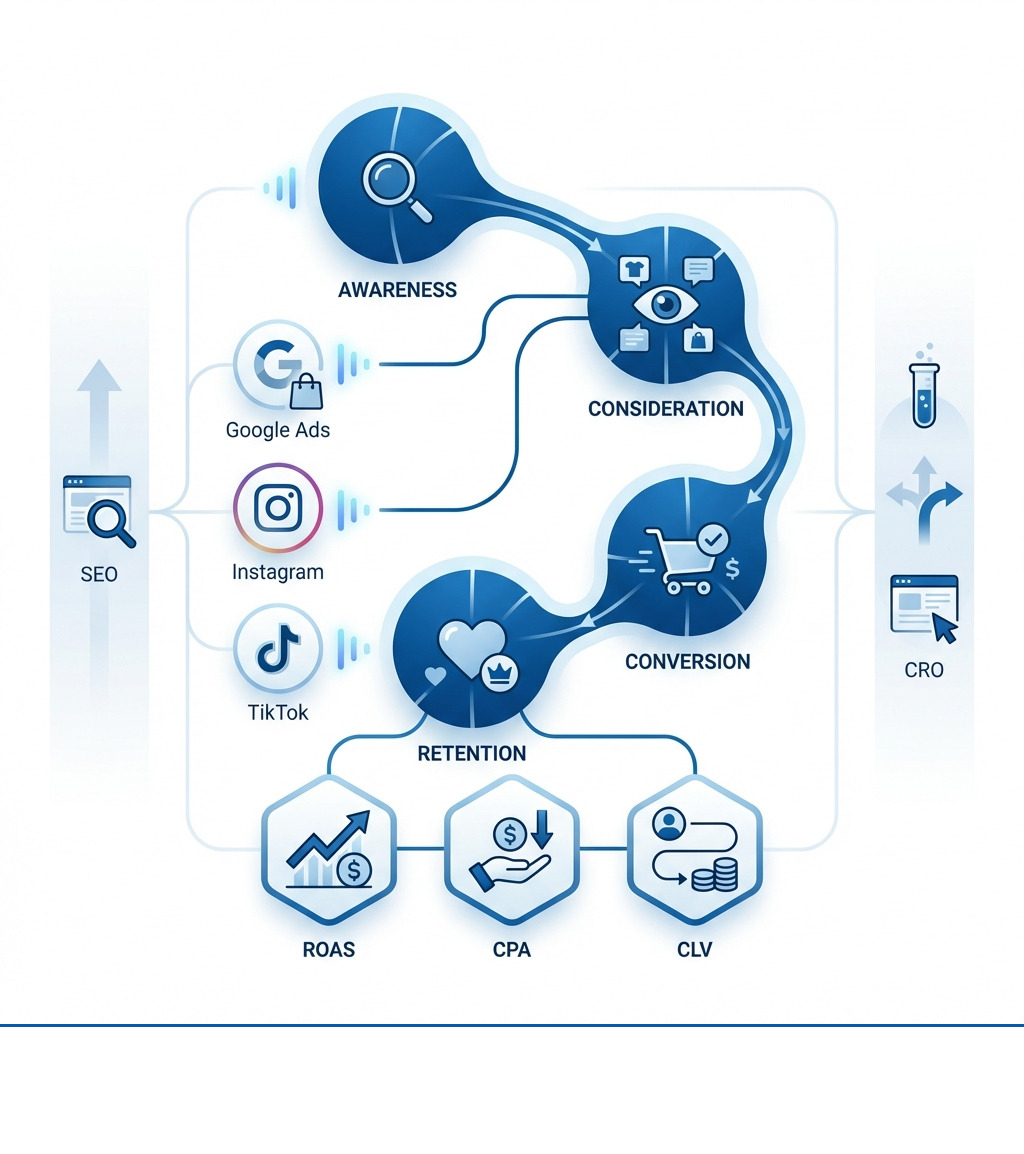
- Full-Funnel Approach: Use awareness ads to build reach, retargeting to recover abandoned carts, and post-purchase campaigns to drive repeat sales.
- Key Metrics: Track ROAS (Return on Ad Spend), CPA (Cost Per Acquisition), and CLV (Customer Lifetime Value) to measure profitability.
- Integration with Organic Efforts: Combine paid ads with SEO and CRO to multiply results and reduce long-term ad dependency.
- Creative and Targeting: Tailor ad copy, visuals, and audience segments to each platform and funnel stage.
The competitive reality of ecommerce in 2026 is stark. Global online retail sales hit $5.8 trillion in 2024, yet with over 4.5 million Shopify stores globally and giants like Amazon commanding 40% of U.S. transactions, simply having an online store is no longer enough. A search for "buy washing detergent online" reveals a battlefield where ads appear above organic results, and platforms like Google and Meta have become pay-to-play ecosystems. Organic traffic and good rankings alone won't cut it--you need a strategic, data-driven approach to paid advertising that works in concert with your broader marketing efforts.
The market is changing quickly. Third-party cookies are obsolete, iOS14 changes have disrupted tracking, and consumers now expect authentic, creator-led content across multiple touchpoints. Social media usage patterns have shifted dramatically: U.S. adults now spend just 33 minutes daily on Facebook (down 20% since 2017), while TikTok commands 34 hours per month and YouTube captures 28 hours. This means your 2026 strategy must be adaptable, platform-specific, and rooted in first-party data.
Here at First Pier, we've built and grown advertising campaigns for leading ecommerce brands by integrating paid channels with organic growth methods like SEO and conversion rate optimization. A winning ecommerce ads strategy isn't just about buying clicks--it's about building an effective system that turns traffic into loyal customers and sustainable revenue. As Steve Pogson, founder of First Pier, I've spent over two decades refining ecommerce ads strategy frameworks that balance immediate ROAS with long-term brand building, working with brands like Wyman's Blueberries and Hyperlite Mountain Gear to create advertising systems that support growth. This guide will walk you through the foundational elements, core channels, advanced tactics, and measurement frameworks you need for 2026.
Laying the Groundwork: Audience, Website, and Budgeting
Before I even think about launching ads, I ensure the groundwork is solid. This means I have a deep understanding of the customer, a high-performing website, and a clear financial plan. Without these, even the best ad campaigns can fall flat.
Defining Your Target Audience
I've learned that you can't effectively speak to everyone, and trying to usually means you speak to no one. My first step is always to define the target audience. This involves more than just demographics; I build detailed buyer personas that capture psychographics, online behavior, pain points, and aspirations.
For example, if you're selling handmade art items, your target audience isn't just "art lovers." It might be "young professionals seeking unique home decor" or "collectors interested in emerging artists." This precision allows me to tailor messaging and select the right platforms. Research shows that companies with fully developed buyer personas can see twice the conversion rates. I also research where my target audience spends time online--whether it's on specific social media platforms, niche blogs, video channels, or podcasts. This helps me prioritize where to allocate ad spend.
Optimizing Your Website for Advertising Success
Even the most compelling ad creative is wasted if it leads to a clunky website. The website is the destination for your ad traffic, so it must be ready to convert. I prioritize a mobile-first design because more than half of all online traffic occurs on mobile devices. Fast loading times are non-negotiable; users will abandon slow sites. Clear navigation, compelling product pages, and a streamlined checkout process are all critical.
My team and I work closely with brands to ensure their Shopify stores are optimized. For instance, offering multiple payment options is crucial, as more than half of buyers will abandon a purchase if their preferred option is not available. I also emphasize designing robust landing pages that align perfectly with ad messaging, featuring clear headlines, engaging copy, high-quality visuals, and strong calls to action. A well-optimized website is fundamental to any successful ecommerce ads strategy. If you're curious about how we approach this, you can learn more about our ecommerce UX design services.

Aligning Ad Spend with Business Goals
Budgeting isn't just about how much to spend, but how to spend it wisely to achieve business goals. For small businesses, I often suggest starting with an advertising budget of 5% or 10% of sales. For Google Ads specifically, I advise a bare minimum of $10/day for a month, with an ideal minimum of $1,000/month to allow for meaningful testing.
The key is to align ad spend with your testing frequency and strategy. For lower budgets (under $1,000/month), I recommend testing distinctly different creative approaches--like video versus static images--to identify what resonates best. For higher budgets ($5,000+/month), you can refine high-performing formats by testing granular changes, such as CTA placement or simplifying product showcases. I always define clear Key Performance Indicators (KPIs) like Return on Ad Spend (ROAS), Cost Per Acquisition (CPA), and Customer Lifetime Value (CLV). This data-driven approach ensures every dollar contributes to growth.
Dominating Core Channels: Google and Social Media
Once the foundation is set, I focus on the core channels that drive the most effective traffic for ecommerce businesses: Google and social media. Each plays a distinct role in a comprehensive ecommerce ads strategy.
Using Google Ads for High-Intent Shoppers
Google remains the world's leading search engine, with over 132 billion visits per month and approximately 90% of global market share. This makes Google Ads a non-negotiable part of any ecommerce ads strategy, particularly for capturing high-intent shoppers. As much as 18% of all ecommerce revenue is a direct result of Google Ads.
My focus often starts with Google Shopping Ads. These highly visual ads appear directly in search results, showcasing product images, prices, and store information. They're incredibly effective because they target users with immediate purchase intent. While Google Shopping's average CTR is 0.86%, it accounts for 76% of search ad spend in the eCommerce sector due to its direct conversion power. I ensure product feeds are carefully optimized in Google Merchant Center, with accurate titles (including keywords at the start), descriptions, and high-quality images.
I also use Search Ads for specific keywords and Performance Max campaigns for a broader, automated approach across Google's network. For Performance Max, I recommend starting with Standard Shopping campaigns first, as they offer more control over bids and targeting. We offer specialized paid search services to help brands steer these complexities.
Engaging Audiences with Social Media Advertising
Social media advertising is vital for building brand awareness, driving findy, and connecting with audiences where they spend a significant amount of their time. The average internet user spends more than two hours a day on social media, but where they spend that time is shifting.
Instagram is still a powerhouse, boasting over 1.1 billion monthly users and 200 million visiting business profiles daily. A phenomenal 72% of Instagram users say they have purchased through the social platform. For Instagram, I tailor content to its various ad formats:
- Stories Ads: Use vertical video with quick cuts and clear CTAs in the first 3 seconds.
- Reels Ads: Focus on product demonstrations under 15 seconds, using current trends.
- Feed Ads: Need scroll-stopping visuals with product benefits highlighted immediately.
- Shop Ads: Prioritize clean product shots from multiple angles, as seen on Williams Sonoma's Instagram.
TikTok has also exploded, with users spending nearly 34 hours per month on the platform. Its diverse user base (over 60% of US users are above 20) and unique formats make it essential. I advise creating shorter, engaging video ads that use TikTok’s trends, and using branded effects and hashtag challenges to build awareness.
Across all social channels, I strongly advocate for user-generated content (UGC). User-generated ads deliver 3x higher click-through rates (CTR) than standard ads. They feel authentic and blend seamlessly with organic content. My team at First Pier also offers paid social services to help brands create and run effective social media advertising strategies.
A Full-Funnel Ecommerce Ads Strategy: From Acquisition to Retention
A truly effective ecommerce ads strategy isn't just about acquiring new customers; it's about building a relationship that spans the entire customer journey, from initial awareness to long-term loyalty.
Implementing a Powerful Ecommerce Ads Strategy with Retargeting
One of the most effective strategies I use is retargeting. Why? Because 97% of people who visit a site for the first time leave without buying anything. That's a huge pool of interested but undecided potential customers. Retargeting allows us to recover lost sales and significantly increase Return on Ad Spend (ROAS).
I implement retargeting campaigns by installing platform-specific pixels (like the Meta Pixel or Google Ads tracking code) on the website. This allows me to create audience segments of users who visited specific product pages, added items to their cart, or even just browsed the site. Dynamic remarketing is particularly powerful, as it shows users ads for the exact products they viewed. This acts as a convenient reminder and a nudge towards conversion. It's no wonder that 20% of marketers allocate dedicated budget to retargeting campaigns, and 50% plan to increase their investment.
Integrating CRO to Turn Clicks into Customers
Sending traffic to your site is only half the battle; the other half is converting that traffic into sales. This is where conversion rate optimization (CRO) becomes an integral part of the ecommerce ads strategy. CRO is about continuously refining and testing your website to improve results from existing traffic.
I integrate CRO by constantly A/B testing elements like ad copy, landing page layouts, product descriptions, and calls to action. This helps me understand what resonates most with your audience. For example, ensuring product pages tell a compelling story, feature strong visuals, and address customer questions upfront can significantly improve conversion rates. My team specializes in Shopify CRO services to help brands identify and fix friction points in the customer journey, turning more clicks into customers.
Combining SEO and Paid Ads for a Multiplier Effect
While advertising focuses on paid traffic, I never forget the power of organic search. The relationship between SEO and ecommerce ads strategy is symbiotic. They don't compete; they complement each other.
I use keyword data from SEO research to inform my paid search campaigns, ensuring I'm bidding on terms that have proven intent. Conversely, PPC data can reveal high-converting keywords that we can then target with SEO efforts. By having both paid ads and organic listings appear for key search terms, we achieve greater SERP (Search Engine Results Page) presence and brand visibility.
Building backlinks is a major Google ranking factor for SEO, yet 94% of online content receives no external links. I focus on creating valuable, long-form content (over 3,000 words attracts 77.2% more links) that naturally earns backlinks. User-generated content also helps here, as it adds fresh content to your site, signaling activity to search engines. For a deeper dive into how we approach organic growth, explore our SEO services.
Innovative Tactics for 2026: UGC, Influencers, and Cause Marketing
To stand out in 2026, an ecommerce ads strategy needs to move beyond traditional ad formats and focus on authenticity, community, and purpose.
Turning Customers into Creators with UGC and Influencer Marketing
In a market saturated with polished brand messaging, authenticity wins. This is where User-Generated Content (UGC) and influencer marketing are most effective. Instead of just pushing your message, you let your customers and trusted voices tell your story.
I've seen how powerful this can be. 80%+ of marketers say influencer campaigns drive results. The key is often micro-influencers--individuals with smaller, highly engaged, and niche audiences. They're often more cost-effective and authentic. Daniel Wellington, for example, didn't buy billboards; they mailed watches to small Instagram creators, resulting in over 1 million watches sold and $200M+ in revenue.
UGC is also incredibly persuasive because it's real. I encourage brands to prompt buyers to post content with their products through simple tactics like hashtags, referral rewards, or social challenges. This not only provides authentic ad content (which, as mentioned, has higher CTRs) but also fosters a sense of community. This is why we prioritize e-commerce community & loyalty services for our clients.
Building Brand Loyalty Through Cause-Driven Marketing
Consumers today, especially in the US and Europe, want to know that the brands they buy from stand for something. Integrating cause-driven marketing into your ecommerce ads strategy isn't just about doing good; it's smart business.
I advise brands to align with a cause that genuinely makes sense for their product, values, and customers. This commitment should be real, measurable, and visible. Canadian apparel brand Tentree is a prime example: they plant ten trees for every item purchased, aiming for a billion trees by 2030. This isn't just a side campaign; it's central to their identity, resonating deeply with eco-conscious consumers. Campaigns tied to purpose consistently outperform generic brand promotions. By clearly communicating your brand's social impact, you build trust and emotional connection that fosters deep loyalty.
Creating Memorable Experiences with Customization and 'Surprise & Delight'
In a competitive market, memorable experiences differentiate brands. Two tactics I recommend are product customization and 'surprise & delight.'
Product customization allows customers to become co-creators, tailoring items to their specific needs or style. This increases their investment and perceived value in the product. For instance, UNDONE Watches lets shoppers personalize nearly every aspect of their timepiece, from the case to the dial. This turns every product into a story, creating an emotional connection that is highly marketable. Customized products enjoy higher conversion rates, lower return rates, and stronger word-of-mouth.
'Surprise & delight' tactics are about exceeding customer expectations with thoughtful, unexpected gestures. It's not just a feel-good tactic; it's a growth lever. A small, economical gift, like a sample of shoe cream with leather boots from Viberg Boot, not only helps customers care for their purchase but also introduces them to another product. A handwritten note, a small bonus item, or an exclusive early access offer can turn a transaction into a lasting relationship, significantly increasing customer satisfaction and loyalty.
Frequently Asked Questions about Ecommerce Ad Strategy
What is the difference between ecommerce advertising and ecommerce marketing?
This is a common question, and it's important to be clear. I explain it this way: Marketing is the umbrella term for all activities a business does to promote and sell products or services, including market research, product development, pricing, distribution, and promotion. Advertising is a subset of marketing, specifically referring to paid promotional efforts.
So, while marketing encompasses both organic tactics (like SEO, content marketing, email marketing) and paid ones, advertising focuses solely on the paid channels. An effective ecommerce ads strategy is a crucial component of a broader ecommerce marketing plan, but it's not the entire plan itself. Advertising often focuses on immediate visibility and driving traffic, while marketing aims for long-term brand building and customer relationships.
What key metrics should I track for my ad campaigns?
To truly understand if your ecommerce ads strategy is working, you need to track the right metrics. I focus on these core KPIs:
- Return on Ad Spend (ROAS): This is the ultimate measure of advertising success, showing how much revenue you generate for every dollar spent on ads.
- Cost Per Acquisition (CPA): How much it costs to acquire a new customer through your ads. I compare this to Customer Lifetime Value (CLV) to ensure profitability.
- Customer Lifetime Value (CLV): The predicted net profit attributed to the entire future relationship with a customer. This helps me understand the long-term value of an acquired customer.
- Click-Through Rate (CTR): The percentage of people who see your ad and click on it. A higher CTR often indicates ad relevance.
- Conversion Rate: The percentage of clicks that result in a desired action, like a purchase.
- Cost Per Click (CPC): The average cost for each click on your ad.
Regularly monitoring these metrics allows me to make data-driven decisions, iterate on campaigns, and ensure we're getting the best possible results.
How much should a small business spend on ecommerce ads?
There's no one-size-fits-all answer here, but I can give you a framework. As I mentioned earlier, a common rule of thumb for marketing budgets, including ads, is 5% or 10% of sales. However, this can vary significantly based on several factors:
- Industry Competition: Highly competitive niches will require a larger budget to stand out.
- Profit Margins: If your product has high margins, you have more room to spend on customer acquisition.
- Sales Cycle Length: Products with longer sales cycles (e.g., high-ticket items) may require more ad spend over time to nurture leads.
- Business Goals: Are you aiming for rapid growth, or sustainable, steady expansion?
- Testing and Iteration: I always advise allocating enough budget for testing. For Google Ads, a bare minimum of $10/day for a month is needed, but an ideal minimum of $1,000/month provides more meaningful data.
The most important thing is to start with a budget you're comfortable with, track your performance carefully, and increase your spend as you see positive ROAS. It's an iterative process.
Conclusion: Building a Resilient Advertising Plan
The world of ecommerce is always changing, but one constant remains: a well-executed ecommerce ads strategy is indispensable for growth. As Steve Pogson, I've seen brands thrive by adopting a holistic, data-driven approach that integrates paid advertising with strong website foundations, CRO, and SEO. The future of ecommerce advertising in 2026 demands adaptability, platform-specific creativity, and a genuine connection with customers through tactics like UGC, influencer marketing, cause-driven initiatives, and personalized experiences.
Here at First Pier, my team and I are dedicated to helping brands build resilient advertising plans that not only drive immediate sales but also foster long-term customer loyalty and sustainable growth. We believe in building for conversation, not just conversion.
To explore how we can help you refine your ecommerce ads strategy and achieve your business goals, learn more about our digital marketing services.





.png)
.png)

