


Why Your Ecommerce Brand Needs More Than Just a Logo

Summary
- An ecommerce branding checklist is a step-by-step list that helps online stores define, document, and apply their brand across all channels.
- A checklist keeps brand decisions tied to clear goals, so visual design, messaging, and customer experience stay consistent.
- Research shows that consistent brand presentation can increase revenue by up to 23%, and customers who feel connected to a brand are 52% more valuable.
- Applying the checklist across website design, customer communications, and legal pages helps reduce confusion, build trust, and support long-term growth.
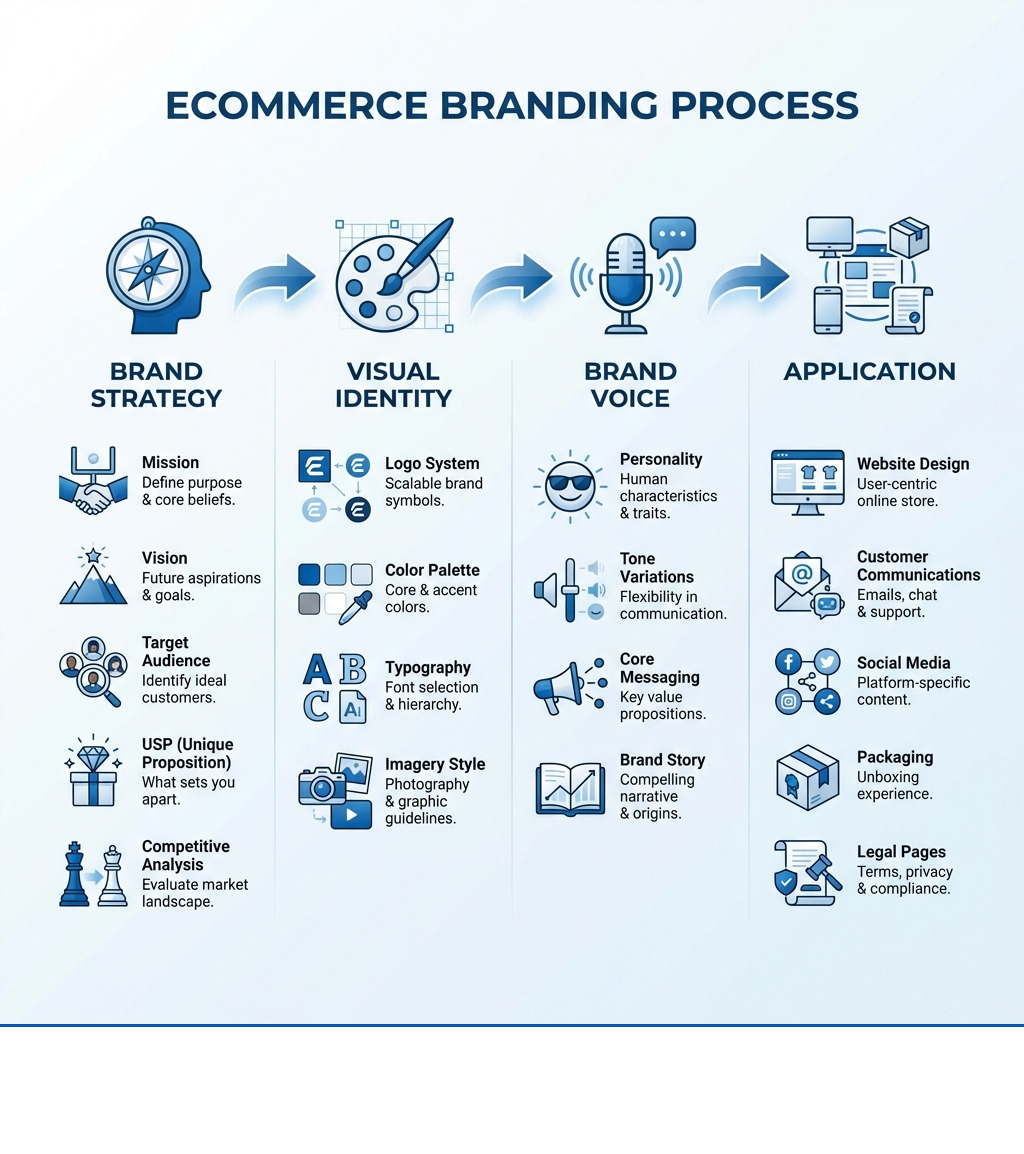
An ecommerce branding checklist is a structured framework for building and maintaining a cohesive brand identity across every customer touchpoint. A complete checklist moves from high-level strategy like your mission, vision, and target audience to the specifics of your visual identity and brand voice. It then guides you in applying that identity to your website, customer communications, and even legal pages, before finally helping you measure performance.
Without a systematic approach, your brand becomes inconsistent. One page on your site might feel professional while another feels casual. Your Instagram voice might be playful, but your customer service emails sound robotic. These disconnects confuse customers and weaken trust.
Every year, businesses lose millions because their branding feels scattered or forgettable. Customers check their phones 96 times per day and are exposed to thousands of brand messages. If your brand does not consistently communicate who you are and why you matter, you disappear into the noise.
A strong brand does more than look good. It builds recognition, creates emotional connections, and turns first-time buyers into loyal customers. Research shows that companies with consistent brand presentation across all platforms increase revenue by up to 23%. Customers who feel connected to a brand are 52% more valuable to a business than those who do not.
But creating that consistency is hard work. You are juggling product pages, email campaigns, social media posts, customer service scripts, and packaging design. Each needs to feel like it comes from the same company, with the same values and personality. That is where a checklist becomes essential. It keeps you on track when opinions pile up and decisions get overwhelming.
I am Steve Pogson, founder of First Pier, and over the past two decades here at First Pier I have helped growing Shopify stores build and refine their brand identities using a proven ecommerce branding checklist. This systematic approach helps make sure nothing is missed as your business grows.
What is Ecommerce Branding and Why Does it Matter?
Ecommerce branding is the process of creating a unique identity for your online business that sets it apart from others. It goes beyond just a logo; it includes your mission, vision, values, and personality, and it shapes everything from your website copy to social media content and support emails. For me, a brand is the feeling people have about your store when you are not there to explain it. It is what shoppers remember, trust, and recommend. A generic brand is easily forgotten.
A thorough ecommerce branding checklist is essential for online success because it provides a roadmap. It helps you make purposeful decisions, so every element of your brand works together to create a coherent experience for your customers. This systematic approach helps your brand build recognition, trust, and loyalty, which are crucial for driving sales and long-term business growth.
Without a checklist, it is easy to get lost in opinions and external influences. This tool helps you focus on your core brand elements, so you can grow your business while maintaining consistency and recognizability. As the research shows, companies with consistent brand presentation increase revenue by up to 23%, and customers who feel connected to a brand are 52% more valuable. These numbers show why building a strong brand is not a luxury but a requirement for any ecommerce store that wants to grow over time.
Phase 1: Brand Strategy & Foundation
The first phase of any effective ecommerce branding checklist involves laying the strategic groundwork. This is about defining the "why" and "who" before moving to the "what" and "how." It sets the direction for all future branding efforts. As a guiding principle, I often look to the insights from the Research on web credibility, which emphasizes how trust is built online.

Define Your Brand's Core Purpose
Your brand's core purpose forms its backbone. This step makes sure you understand what your business stands for.
- Mission statement: This explains why your business exists. It is not just about what you sell, but the problem you solve or the change you want to create. For example, a mission might be "to offer a safe and affordable solution to underarm sweat and keep people’s confidence intact," as one brand states.
- Vision statement: This describes where your company is going. It is your long-term aspiration, a picture of the future you want to help create.
- Core values: These are the guiding principles that shape how your brand operates and relates to its community. They should be non-negotiable and actionable.
- Brand promise: This is what customers can expect from your brand, consistently. It is the assurance of quality, service, or experience you offer.
These elements are more than just words; they are the foundation of your brand. They help make sure that every decision aligns with your brand's true intent.
Identify Your Target Audience and Niche
Knowing your audience intimately is essential for effective branding. If you try to target everyone, you will reach no one. This step helps you tailor your message and offerings.
- Demographics: Basic information like age, location, income, and gender.
- Psychographics: Deeper insights into your customers' values, interests, lifestyles, and pain points. What motivates them? What are their aspirations?
- Customer personas: Create 2-3 detailed customer personas. These go beyond demographics to build a clear picture of your ideal customer, including their online behavior and shopping habits.
- Market research: Understand what needs your target audience has that are not being met by current solutions.
Consider the generational shifts: Millennials and Gen Z together make up 42.3% of the U.S. population. These generations grew up with texting and expect fast, natural communication. Understanding these preferences is vital for how you interact with them. You can learn more about these trends in A study on generational population share.
Solidify Your Unique Selling Proposition (USP)
Your USP is what makes your brand stand out. It is the clear reason why customers should choose you over others.
- What you do better: Identify your strengths and areas where you excel.
- How you do it differently: Explain your unique approach or method.
- Positioning statement: I suggest crafting a statement like: "For [Target Audience], [Brand] is the only [Category] that delivers [Unique Value Proposition] because [Proof]." This helps clarify your place in the market.
- Value proposition: Clearly state the benefits your products or services offer. This is what you deliver that others do not.
This involves looking at your competitors to find market gaps, but not copying them. Your goal is to find your distinct position.
Phase 2: Crafting Your Brand's Look and Voice
Once your strategic foundation is solid, the next step in your ecommerce branding checklist is to bring that strategy to life through visual identity and brand voice. This is where your brand becomes recognizable and relatable.
Develop a Cohesive Visual Identity
Your visual identity is the face of your brand. It must be consistent across all platforms to build instant recognition.
- Logo system: This includes your primary logo, secondary variations, a logomark (icon-only), and a wordmark (text-only). A comprehensive system makes sure your logo works well in different contexts, from a large banner to a small app icon.
- Color psychology: Choose a color palette that creates the right emotions. For example, blue often conveys trust, while red can signal passion or urgency. Your palette should include primary, secondary, and accent colors.
- Typography: Select fonts that reflect your brand's personality. A heavy slab-serif font feels strong, while a light script font conveys elegance. Establish a clear font hierarchy (for example, one font for headlines, another for body text) to guide readability. You can learn more about The personality of typography.
- Imagery style: Define the type of images you use, including photography guidelines, graphic elements, and iconography. Are your images bright and airy, or dark and moody? Do they feature real people or abstract concepts?
- Consistency: Every visual element, from product photos to social media graphics, must follow these guidelines.
Establish a Consistent Brand Voice and Messaging
Your brand voice is the personality behind your words. It builds trust and makes your brand relatable.
- Brand personality: Assign your brand an archetype (for example, The Hero, The Jester, The Sage). This helps make your brand feel more human and consistent.
- Brand voice: This is your brand's consistent personality (for example, confident, witty, direct).
- Tone variations: While your voice is constant, your tone can adapt to context. For instance, your social media tone might be more casual than your customer service emails.
- Core messaging pillars: Define 3–5 key talking points that you want your audience to remember about your brand.
- Brand story: Craft a narrative that includes a problem, an "aha" moment, your solution, and your vision for the future. This creates an emotional connection.
- Tagline: A concise phrase that captures your brand's essence and unique benefits.
The goal is to avoid "tone whiplash," where your brand's communication style shifts unexpectedly. Consistency in voice and messaging is crucial for building a strong and recognizable brand.
Phase 3: Applying Your Brand Across All Touchpoints
A strong brand is only effective if it is consistently applied everywhere your customer interacts with your business. This part of the ecommerce branding checklist focuses on making sure every touchpoint reflects your core brand identity.
Align Your Website Design and User Experience (UX)
Your website is often the first and most important interaction customers have with your brand. It needs to reflect your brand identity while also providing a smooth and easy experience.
- Homepage design: Your homepage must clearly communicate your value proposition and any guarantees. It should immediately show your brand's aesthetic.
- Product pages: These need rich, engaging content, high-quality images and videos, customer reviews, and user-generated content (UGC).
- Checkout process: A streamlined, easy, and secure checkout flow is essential. Unexpected costs are a major conversion rate killer.
- Mobile responsiveness: More than half of ecommerce traffic comes from phones. My advice is to design for mobile first. For example, 50% of emails are opened on mobile devices.
- Site speed: Aim for mobile load times under three seconds. Slow sites frustrate customers and hurt conversions.
- User experience: Integrate your brand into every aspect of the user experience, from color schemes and typography to the style of images and microcopy. A design system helps make sure styles are applied consistently across your site.
- Examples: Warby Parker shows top results in the search bar as you type, helping customers find products faster. Zara's search field autocompletes with filtering options. For email sign-ups, Allbirds includes a sentence about what type of emails you can expect, and Buffy offers an incentive like $10 off your first purchase.
- Expert help: If you need guidance, here at First Pier, we offer specialized More info about ecommerce UX design services to help you create a website that clearly represents your brand and converts visitors into loyal customers.
Weave Your Brand into Customer Communications
Every communication with your customers is an opportunity to reinforce your brand.
- Customer service tone: Make sure your customer service team communicates with a tone consistent with your brand personality. Fast replies and easy returns are brand differentiators.
- Live chat: This is a preferred communication method for 42% of customers, especially Millennials. They value real-time responses.
- Email marketing: Use branded templates for all emails, including welcome sequences, promotional offers, abandoned cart reminders, and newsletters. Your tone should be consistent, and personalization can make a big difference. For more insights on this, you can explore our More info about email & SMS marketing services.
- SMS marketing: Text messages have a 98% open rate, and 97% are read within 15 minutes. This makes SMS a very effective channel for direct communication, especially with Millennials and Gen Z, who together make up 42.3% of the U.S. population. You can see how impactful this channel is with the statistic that Text messages have a 98% open rate.
- Transactional emails: Even order confirmations and shipping updates should be branded and professional.
- Email branding tools: Consider using platforms like Klaviyo, Canva, Brevo, Moosend, Stripo, or MailerLite to help maintain brand consistency in your email designs.
Ensure Legal and SEO Foundations are Branded
Legal compliance and search engine optimization (SEO) are not just technical requirements; they are also a key part of your brand's trustworthiness and visibility.
- Privacy Policy & Terms & Conditions: These essential legal pages must be clear, easy to understand, and readily accessible. They are part of showing your customers they can trust you.
- About Us page: This is a key page to bring your brand to life. Tell your brand story, share your values, and introduce your team of experts. This humanizes your brand and builds credibility.
- E-E-A-T (Experience, Expertise, Authoritativeness, Trustworthiness): This concept, outlined in Google Search Quality Rater Guidelines, is crucial for how Google assesses your website's quality. For ecommerce, which often deals with financial transactions, E-E-A-T is especially important.
- How to apply E-E-A-T:
- Content: Create high-quality content written by subject experts. Provide rich product information and aftercare guides.
- Technical: Secure your website with HTTPS. Fix broken links. Design a professional, mobile-friendly user experience. Control which URLs get indexed to avoid low-quality pages diluting your site's overall quality.
- Reputation: Display positive testimonials. Monitor your brand's reputation online and respond to reviews.
- How to apply E-E-A-T:
- Compliance: For detailed guidance on legal and accessibility requirements for your Shopify store, you can find more information on our More info about Shopify accessibility & compliance page.
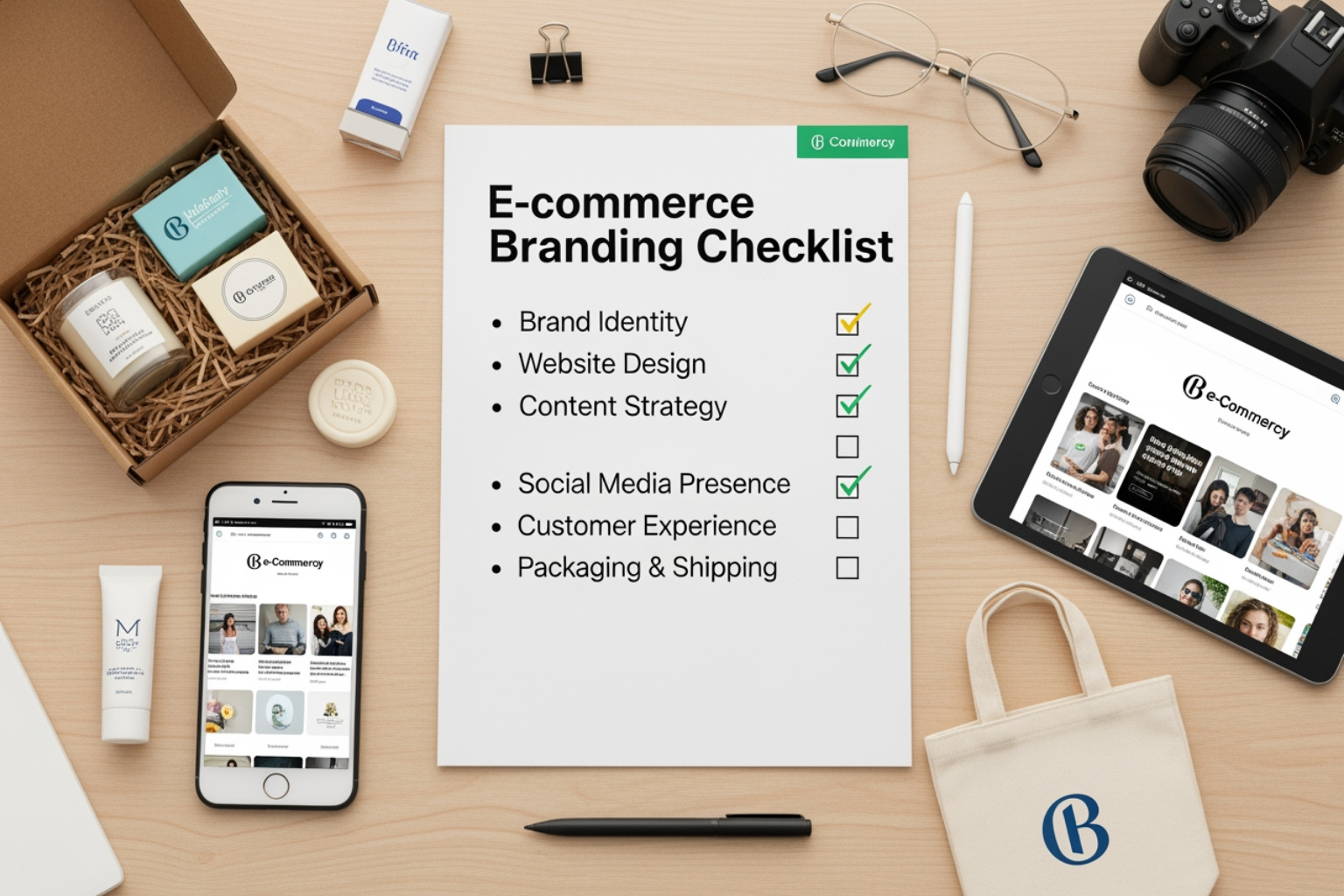
Your Complete Ecommerce Branding Checklist
This section summarizes the key actionable steps across all phases. It serves as a practical tool for consistent brand application.
The Foundation & Strategy Ecommerce Branding Checklist
- Mission defined
- Vision defined
- Target audience personas created
- USP statement crafted
- Competitor analysis complete
The Visual & Voice Ecommerce Branding Checklist
- Logo system created (primary, secondary, wordmark, logomark)
- Color palette selected (primary, secondary, accent)
- Typography chosen (headlines, body text)
- Brand voice guide written (personality, tone variations)
- Core messaging pillars defined
- Brand story crafted
- Tagline developed
The Application & Experience Checklist
- Website design reflects brand identity and provides user-friendly experience
- Customer service scripts and interactions are on-brand
- Email templates are fully branded and consistent
- Social media profiles and content are consistent with brand guidelines
- Packaging experience designed to extend brand identity
- Legal pages (Privacy Policy, Terms & Conditions) are branded and clear
- E-E-A-T factors are addressed across content, technical, and reputation aspects
Measuring Brand Effectiveness and Knowing When to Evolve
Branding is not a one-time task; it is an ongoing process. Once you have implemented your ecommerce branding checklist, you need to measure its effectiveness and know when to adapt.
Key Metrics for Tracking Brand Performance
To understand if your branding efforts are working, I look at several key performance indicators (KPIs):
- Brand awareness: Track direct traffic to your site, branded search volume (how many people search for your brand name), and social media mentions.
- Customer loyalty: Monitor repeat purchase rates and customer lifetime value (LTV). Customers who feel connected to a brand are 52% more valuable.
- Customer sentiment: Use tools like Net Promoter Score (NPS) surveys and analyze customer reviews (both positive and negative).
- Revenue: As noted earlier, consistent brand presentation can increase revenue by up to 23%.
- Analytics: For more detailed performance analysis, I recommend using our More info about ecommerce analytics services.
How Often to Review Your Branding
Your brand is a living document; it needs to evolve.
- Annual brand audit: I suggest conducting a thorough brand audit once a year. This helps you assess what is working, what is not, and where adjustments are needed.
- When to refresh: Minor visual updates or refreshes typically happen every 5-7 years. This might involve small tweaks to your logo, an updated color palette, or new imagery styles to keep your brand modern.
- When to rebrand: A full rebrand, which involves a complete change in strategy, should only occur if your business model, target audience, or market positioning fundamentally changes. It is a significant undertaking.
Frequently Asked Questions about Ecommerce Branding
What are the most common ecommerce branding mistakes?
I see several common mistakes:
- Inconsistent visuals: Using random colors or fonts that do not align with your brand. This makes your brand look unprofessional and confusing.
- Mismatched brand voice: "Tone whiplash" occurs when your brand's voice changes significantly across different communications, eroding trust.
- Neglecting mobile experience: With so many customers shopping on phones, a slow or poorly designed mobile site is a silent revenue leak.
- Ignoring customer feedback: Not listening to or acting on customer input can damage your brand's reputation.
- Copying others: Trying to imitate competitors instead of finding your unique position. A generic brand is easily forgotten.
- Failing to deliver on your brand promise: If you promise "all-natural" products but use harsh chemicals, you break trust.
How much does professional ecommerce branding cost?
The cost of professional ecommerce branding varies widely depending on the scope. A simple logo design might be relatively inexpensive, especially from online contest sites, but these often yield generic or ineffective results. For a comprehensive brand identity project that includes strategy, voice, visuals, and brand guidelines from a professional agency like here at First Pier, the investment typically ranges from $5,000 to $20,000+. We provide specific quotes for branding projects based on your unique needs.
What's more important: a great product or great branding?
Both are important and work together. A great product solves a genuine need. However, great branding is what helps that product stand out from competitors. It creates trust, builds emotional connections, and fosters loyalty, which can even support higher pricing. As the saying goes, a great logo with a terrible voice is like a person in a nice suit with nothing to say. A great voice with a terrible logo is a brilliant person in a clown costume. You need both for long-term success.
Build a Brand That Lasts
A strong brand is one of your most valuable assets in the online world. It helps you connect with customers, build trust, and drive sustainable growth. Using a structured ecommerce branding checklist provides a clear, practical approach to building a memorable and trustworthy online store.
Here at First Pier, we help businesses turn their vision into a clear brand experience. We specialize in Shopify development and optimization, making sure your brand is not only well-defined but also perfectly executed across your entire online presence.
If you are ready to refine your brand or start building a new one with a proven framework, I encourage you to explore our approach. You can learn more about Learn more about our approach to building and refining brands.





.png)
.png)

