




Why Understanding Ecommerce Website Cost & Pricing Matters

Summary
- Ecommerce website costs range from under $10,000 for basic builds to more than $100,000 for complex custom stores.
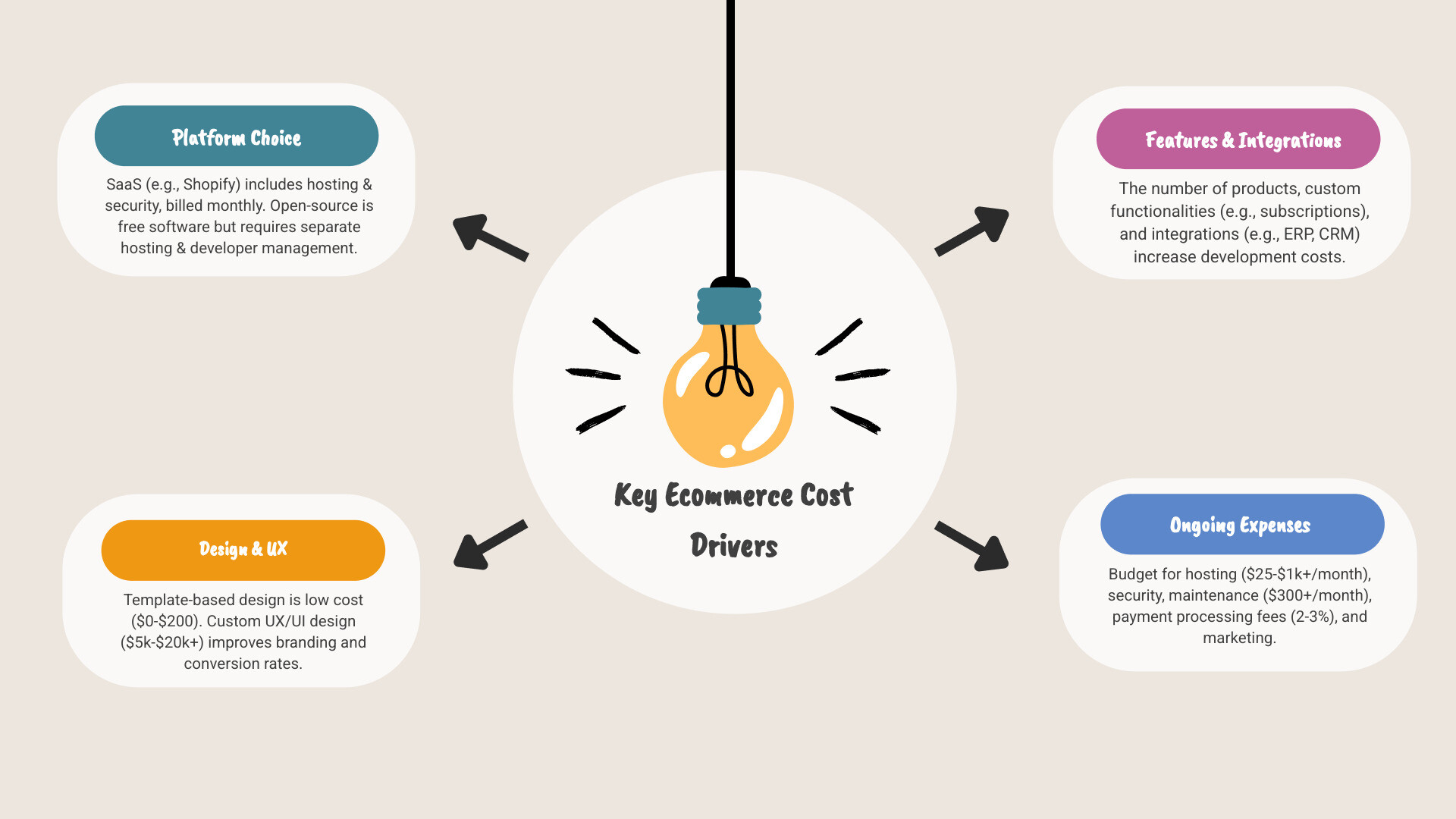
- Main cost drivers include platform choice, design approach, feature set, catalog size, and required integrations.
- Ongoing annual costs for hosting, maintenance, security, and marketing commonly run from $800 to more than $10,000.
- Payment processing, third-party apps, and marketing often account for a large share of long-term spend.
- A phased build can manage initial investment by launching with core features and adding more over time.
Ecommerce Website Cost & Pricing varies widely based on your business needs, platform choice, and required features. Here is the core context you need before you start:
Quick Cost Overview:
- DIY/SaaS Platforms: $29–$300/month plus $200–$500 annually in fees
- Small Store (under 100 products): $5,000–$15,000 initial build
- Medium Store (100–1,000 products): $15,000–$45,000 initial build
- Large Store (1,000+ products): $45,000–$100,000+ initial build
- Ongoing Annual Costs: $800–$10,000+ for hosting, maintenance, security, and marketing
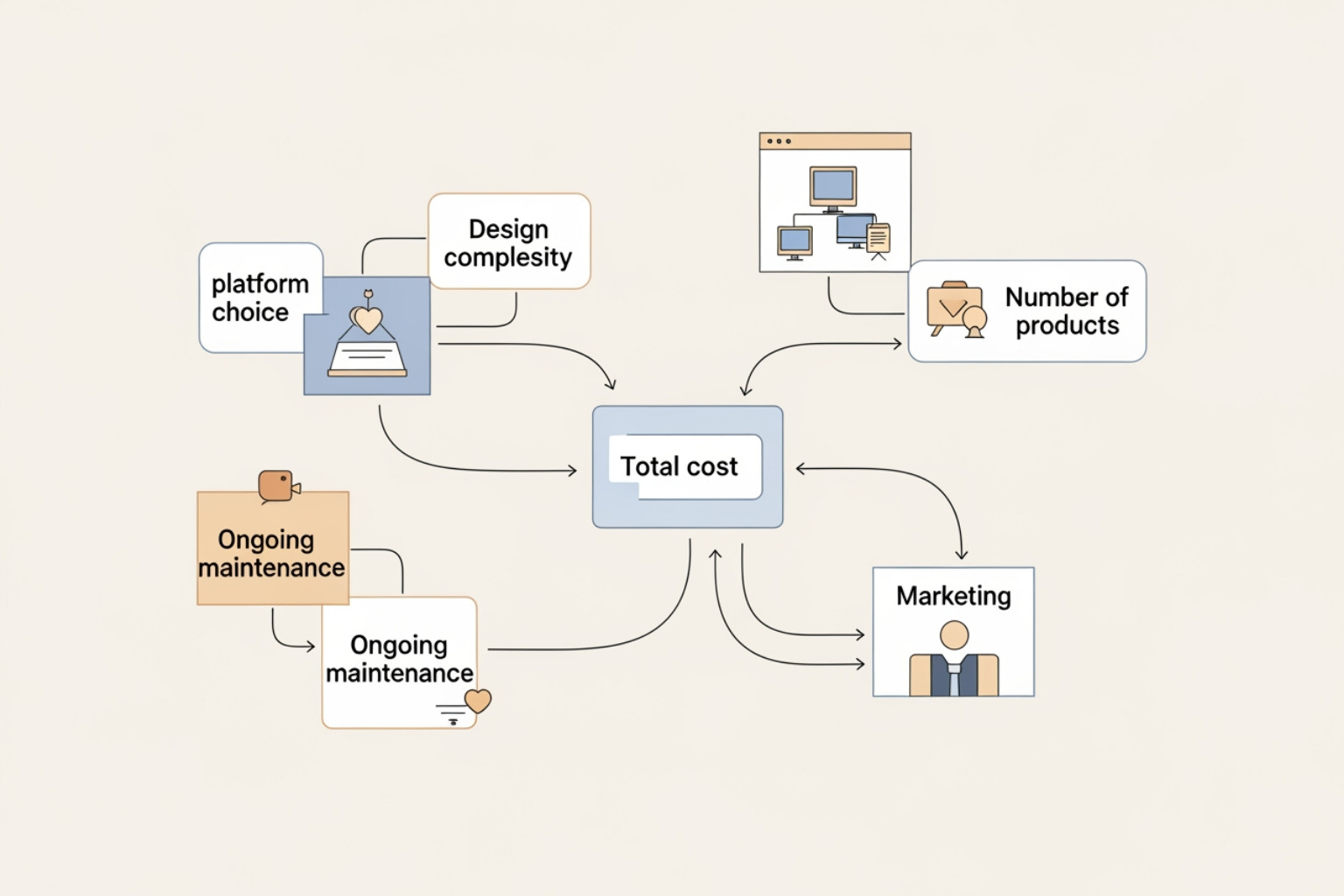
Key Cost Drivers:
- Platform selection (hosted vs. self-hosted)
- Design complexity (template vs. custom)
- Number of products and variations
- Custom features and integrations
- Ongoing maintenance and marketing
If you are planning to launch or grow your online store, knowing what drives costs lets you make clear decisions instead of guesses. Global ecommerce sales reached over $5.7 trillion in 2023 and are expected to exceed $8 trillion by 2027. That growth means more opportunity, but it also increases expectations for site performance, reliability, and user experience.
The reality is that ecommerce projects do not have a fixed price tag. A basic store on Shopify can launch for a few thousand dollars, while a complex custom build with advanced integrations can exceed $100,000. The difference comes down to what your business actually needs to operate and grow, not a generic feature checklist.
Many business owners underestimate ongoing costs. Beyond the initial build, you will pay for hosting, security, payment processing fees, maintenance, and marketing. These recurring expenses add up, but they are what keep your store secure, fast, and visible to customers.
I am Steve Pogson, and I have spent over two decades helping businesses plan and control Ecommerce Website Cost & Pricing so it lines up with real revenue targets. Here at First Pier, we work with brands like Wyman's Blueberries and Hyperlite Mountain Gear to build Shopify stores that carry the load of their day‑to‑day sales and operations.
The Range of Ecommerce Website Costs
Ecommerce is a large global market, with sales exceeding $5.7 trillion in 2023 according to Statista. The cost to enter this market varies widely. Projects can range from a simple DIY site for under $10,000 to a complex custom build for over $100,000. Understanding the different tiers is the first step in planning your project.
Building an online store has different investment levels. Think of it like buying a car: you can get a reliable, entry-level model, a mid-range sedan with some extra features, or a luxury custom build. Your Ecommerce Website Cost & Pricing will reflect the level of sophistication and functionality you choose.
DIY Website Builders: These are the most accessible entry points, typically costing $29–$300 per month. Platforms like Shopify offer user-friendly interfaces, pre-built themes, and basic features that allow startups to get online quickly. These SaaS (Software-as-a-Service) platforms bundle hosting and security, making them a straightforward option for those with limited technical skills or budget. While the monthly fee might seem low, you should also account for potential annual fees for certain features or apps, which can run $200–$500.
Agency-Assisted Template Builds: For businesses looking for a more professional site without the full custom price tag, an agency-assisted template build is a great middle ground. This typically costs $5,000–$20,000. Here, my team or another agency helps you select a suitable template, customize it to fit your brand, and configure core integrations. This approach balances cost-effectiveness with professional design and setup, making it good for growing businesses that need a reliable and professional site.
Fully Custom Development: When your business has unique needs, specific workflows, or a distinct brand vision that off-the-shelf solutions can't meet, fully custom development is the necessary approach. This tier starts at $20,000 and can go over $100,000. This involves creating a unique design and user experience from scratch, building advanced functionality, and implementing complex integrations. Here at First Pier, we specialize in this kind of Shopify development, building scalable sites suited for established brands that need specific features to compete. This level of investment ensures your website is custom precisely to your business processes and customer journey.
Key Factors That Determine Ecommerce Website Cost & Pricing
The final price is based on the time, resources, and expertise needed to meet your business goals. Several main components have the biggest impact on the overall investment.
Ecommerce Platform Choice
The platform you choose affects both upfront and long-term costs. It's the foundation of your online store, and making the right choice influences everything from ease of use to scalability and overall Ecommerce Website Cost & Pricing.
Hosted Platforms (SaaS): These platforms, such as Shopify, involve a monthly subscription, typically ranging from $29–$2,000+ per month. The big advantage here is that hosting, security, and managed updates are all included. This means less technical overhead for you, allowing you to focus on your business. For instance, the Shopify Basic plan starts around $29 per month. These platforms are generally easy to set up and manage, especially with expert help for Shopify setup. While they offer extensive app stores for added functionality, deep code-level customization can be limited.
Open-Source Platforms: Solutions like WooCommerce (for WordPress) offer more flexibility and ownership of your site's code. The software itself is often free, but you'll need to pay for separate hosting, which can cost $25–$250+ per month, or even more for high-traffic sites (SaaS platform hosting can range from $80–$730 per month). You'll also be responsible for security, maintenance, and updates, often requiring a developer. This approach offers greater customization potential but comes with higher technical management responsibilities. If you're considering moving from another platform, our team can help with platform migrations to ensure a smooth transition.
Design and User Experience (UX)
With 94% of first impressions relating to your site’s design, visual appeal and usability are important investments. A template is a cost-effective start, but a custom design creates a unique brand experience that builds trust and helps conversions. Did you know it takes about 50 milliseconds (0.05 seconds) for someone to form an opinion about your website? That's why design isn't just about looking pretty; it's about building trust and guiding customers.
Template-Based Design: This is the most budget-friendly option, with themes often costing $0–$200 (one-time purchase). You can implement these quickly, but customization options are limited to what the template allows. While many templates are well-designed, they might not perfectly match your brand identity or provide the exact user path you want.
Custom UX/UI Design: This is where you invest in a unique online storefront. Costs typically range from $5,000–$20,000+, depending on complexity. A custom design is built specifically for your brand and target audience, focusing on a customer path designed to increase conversions. This includes detailed wireframes, mockups, and user testing to ensure an intuitive and enjoyable shopping experience. At First Pier, our ecommerce UX design services focus on creating clear interfaces that guide your customers from browsing to checkout.
Essential Design Elements: Regardless of whether you choose a template or custom design, some elements are non-negotiable.
- Responsive design for mobile: With roughly half of all internet traffic coming from mobile devices, your site must look and function flawlessly on phones, tablets, and desktops. This is no longer an optional feature; it's a necessity.
- Professional product photography: High-quality images are crucial for showing your products and building customer confidence. Poor photography can deter sales faster than almost anything else.
- Consistent branding: Your logo, color palette, and overall visual identity should be cohesive across your site and all marketing materials. Branding is a crucial investment, with small to medium businesses typically spending between $4,500 and $15,000 per year on it. Our team can help with collateral design to ensure your brand is presented consistently.
Website Complexity and Features
The more your website needs to do, the more it will cost. Think of it this way: a simple brochure site is a bicycle, while a complex online marketplace is a sophisticated spacecraft. The number of products is a starting point, but custom features are what drive development hours and increase the price.
Product Catalog Size: The sheer volume of your products impacts Ecommerce Website Cost & Pricing.
- Number of products: More products mean more data entry, more pages, and potentially more robust hosting.
- Product variations (size, color, material): Each variation adds complexity to product listings and inventory management.
- Data import and management: Migrating a large product catalog from an old system or spreadsheet requires time and effort. For context, a small store (1-99 products) might cost $1,000–$5,000 to start, while a large store (500+ products) could be $10,000–$50,000+.
Custom Functionality: This is where your unique business needs translate into specific development tasks. Examples include:
- Product configurators: Allowing customers to build their own products (e.g., custom shoes, personalized jewelry).
- Subscription models: Setting up recurring billing for products or services, which we can help with through our subscription strategy services.
- Wholesale portals: Creating a separate, password-protected section for B2B customers with special pricing, an area where we have deep expertise in wholesale strategy.
- Loyalty programs: Implementing points systems, rewards, or tiered membership.A lean build might take 120–240 hours, but a feature-rich, customized build can easily exceed 600 hours, pushing costs up significantly.
Integrations: Connecting your site to other business systems is important for efficiency but adds complexity and cost. Each integration requires development time and expertise.
- Payment Gateways: To accept online payments, you'll need integrations with services like Stripe (typically 2.9% + $0.30 per transaction), PayPal (3.49% + fixed fee), or Shopify Payments (2.4%–3.5%). These fees are ongoing and scale with your sales.
- Shipping & Fulfillment: Integrating with carriers (UPS, FedEx, USPS) or multi-carrier software automates shipping calculations and label printing. Our team offers specialized Shopify shipping optimization and support to make this process more efficient.
- ERP & CRM Systems: Connecting your ecommerce site to existing Enterprise Resource Planning (ERP) or Customer Relationship Management (CRM) systems (like through our Shopify ERP services) is crucial for managing inventory, orders, and customer data centrally. This often involves complex API integrations.
- Marketing Automation: Tools like Klaviyo integrate with your store to automate email and SMS campaigns. Our Klaviyo template design ensures your automated messages are on-brand and effective.
- Plugins and apps can range from free to $40–$500 on average. Some, like a QuickBooks Connector, might have subscription fees of $30–$200 a month. These add-ons can quickly increase your monthly outgoings.
Ongoing Ecommerce Operating Costs
The launch of your site is not the final step. A successful online store requires ongoing investment in maintenance, security, and marketing to function correctly and grow. These recurring costs are a key part of your overall ecommerce budget.
Hosting, Security, and Maintenance
These are the basic costs of keeping your store online, secure, and running smoothly. SaaS platforms include some of these, but all sites need regular attention.
Domain Name: Your website's address. This is a recurring annual cost, typically $10–$20 per year. It's a small fee but essential for your online identity.
Hosting: This is where your website "lives" on the internet. With SaaS platforms like Shopify, hosting is included in your monthly subscription. For self-hosted solutions, costs can range from $25–$1,000+ per month, depending on your traffic volume and the resources your site needs. High-traffic sites require more robust hosting.
SSL Certificate: This encrypts data between your customer's browser and your website, crucial for security and trust. Many hosting providers and SaaS platforms now include an SSL certificate for free. If not, they typically cost $20–$70 per year.
Security & Maintenance: This is not optional. Data breaches affected nearly 75% of ecommerce companies in a 2022 Visa study. Regular security checks, software updates, and backups are vital to protect your business and customer data. Maintenance costs can be a monthly retainer (e.g., $300+) with an agency, or included in your platform fees. Annual maintenance can range from $1,800 to $12,000+ for a professionally built site. Data backups are also essential; costs often depend on the size of your site files.
Payment Processing and Transaction Fees
Each sale includes a fee paid to the payment processor. These fees are usually around 2.9% + $0.30 per transaction but vary by provider and plan. These fees are a direct cost of doing business online and scale directly with your sales volume.
- Shopify Payments: Transaction fees range from 2.4%–3.5% depending on the payment method and your plan tier.
- Stripe: Standard fees are 2.9% + $0.30 per transaction.
- PayPal: Fees are typically 3.49% + a fixed fee based on transaction location.
Marketing and Growth
Your website needs traffic to generate sales. A dedicated marketing budget is needed for customer acquisition and retention. Building a well-designed website is one part of the process; attracting customers is the other.
- Search Engine Optimization (SEO): This is about making your website visible in search engine results. SEO services can cost $750–$5,000+ per month, depending on the competitiveness of your industry and your goals. Our SEO services focus on driving organic traffic to your store.
- Paid Advertising (PPC & Social): These are immediate ways to get traffic. Paid search (PPC) campaigns can range from $500–$50,000+ per month, depending on scale, while paid social campaigns might start at $500 per month. Here at First Pier, we offer expertise in both paid search (SEM) and paid social strategies.
- Email & SMS Marketing: Building direct relationships with your customers through email and SMS campaigns is highly effective for retention and repeat purchases. This involves platform costs and ongoing content creation. Our email & SMS marketing services help you connect with your audience effectively.
- Content Creation: This includes writing product descriptions, blog posts, and marketing copy. Freelance copywriters might charge $50–$150/hour or $500–$3,000+ per project.
- Branding: Beyond the initial design, ongoing branding efforts to maintain a consistent message and identity can cost small to medium businesses between $4,500 and $15,000 per year.
How to Plan Your Ecommerce Project
With a clear understanding of the cost factors, you can make decisions that fit your budget and business goals, whether you are starting small or building a large storefront.
Understanding Ecommerce Website Cost & Pricing
To get an accurate estimate, you need to define your project's scope. A small store with under 100 products built on a template will have a very different price than a large, custom site with thousands of products and complex integrations. It's about setting realistic expectations for what you'll get for your investment.
- Small Store (under 100 products): For businesses with a limited product catalog and simpler needs, initial costs typically fall in the $5,000–$15,000 range. This often involves a template-based design with basic integrations.
- Medium Store (100–1,000 products): As your product count grows, so does the complexity. Expect to invest $15,000–$45,000. This tier often includes more customized design elements, advanced search and filtering, and more complex integrations.
- Large Store (1,000+ products): For extensive catalogs and unique customer experiences, the investment can be $45,000–$100,000+. These projects frequently involve custom development, complex integrations with ERP/CRM systems, and a highly custom user experience.
Choosing Your Development Partner
The team you hire will affect the quality and final price of your website. This is a critical decision, as the right partner can save you time, money, and headaches in the long run.
- Freelancers: These individuals typically charge $50–$150 per hour. They can be a cost-effective option for specific tasks or smaller projects, but you'll need to manage the project yourself and coordinate different specialists (designer, developer, copywriter).
- Agencies: Agencies, like First Pier here in Portland, ME, generally charge $100–$250+ per hour for their services. While the hourly rate is higher, you get a comprehensive team (designers, developers, project managers, strategists) who handle everything from initial concept to launch and ongoing support. This integrated approach often leads to higher quality work, better project management, and long-term guidance for your online business.
A Practical Approach for a Limited Budget
You do not need every feature on day one. A phased approach lets you get to market quickly and invest in new features as your business grows. This Minimum Viable Product (MVP) mindset helps you save money and prove your concept before making larger investments.
- Start with a reliable SaaS platform like Shopify. Its integrated features and app ecosystem make it easy to add functionality as you scale.
- Use a professionally designed, pre-built theme. Many platforms offer free or affordable premium themes that provide a great starting point without the cost of a custom design.
- Focus on essential features first: high-quality product pages, a secure and smooth checkout process, and mobile responsiveness. These are the core elements that drive sales.
- Reinvest profits into custom features and marketing over time. Once your store is generating revenue, you can strategically add more complex functionality or expand your marketing efforts.
Frequently Asked Questions about Ecommerce Website Cost & Pricing
How much does a basic ecommerce website cost?
A basic ecommerce website, particularly one using a SaaS platform like Shopify and a pre-built theme, can be launched for an initial cost of $5,000 to $20,000 when you work with an agency for setup and customization. This range typically covers professional theme customization, initial product setup, and core integrations. If you opt for a purely DIY approach, costs can be lower, but be prepared to invest significant time to learn the platform and its best practices.
What are the main hidden costs of an ecommerce website?
The most common hidden costs are often the recurring expenses that aren't part of the initial build. These include ongoing maintenance and security updates, which are essential to protect your site and customers. You also have transaction fees from payment processors, which can add up quickly as sales grow. Subscriptions for essential apps or plugins to add functionality are another common hidden cost, as are the ongoing investments needed for digital marketing to attract customers. Don't forget data backups; their cost often depends on the size of your site files.
How does the number of products affect the website cost?
The number of products significantly affects your Ecommerce Website Cost & Pricing. A higher product count increases costs in several ways:
- Data entry and migration: More products mean more time spent inputting details, descriptions, and images, or migrating existing data.
- Platform and hosting: A larger catalog often requires a more robust hosting plan or a higher-tier platform subscription to handle the data and traffic efficiently.
- Complexity of features: With more products, you'll likely need more complex navigation, filtering, and search features to help customers find what they're looking for. These advanced functionalities add to design and development time, increasing the overall cost.
Let's Build Your Online Store
The cost of an ecommerce website is an investment in your business's future. The right platform, design, and features will support future growth. The key is to match your budget to clear business objectives and choose a partner who can help you reach them. Here at First Pier, we specialize in building Shopify stores that are fast, reliable, and effective at generating sales. We're here in Portland, ME, ready to help your brand build an effective online store.





.png)
.png)

