


Why Your Ecommerce Website Marketing Strategy Needs to Drive Real ROI

Summary
- An ecommerce website marketing strategy is a coordinated plan to attract, convert, and retain customers profitably through channels like SEO, social media, email, and paid advertising.
- Successful strategies require understanding your target audience, analyzing competitors, setting clear business goals using the SMART framework, and tracking key metrics like conversion rate, customer acquisition cost, and customer lifetime value.
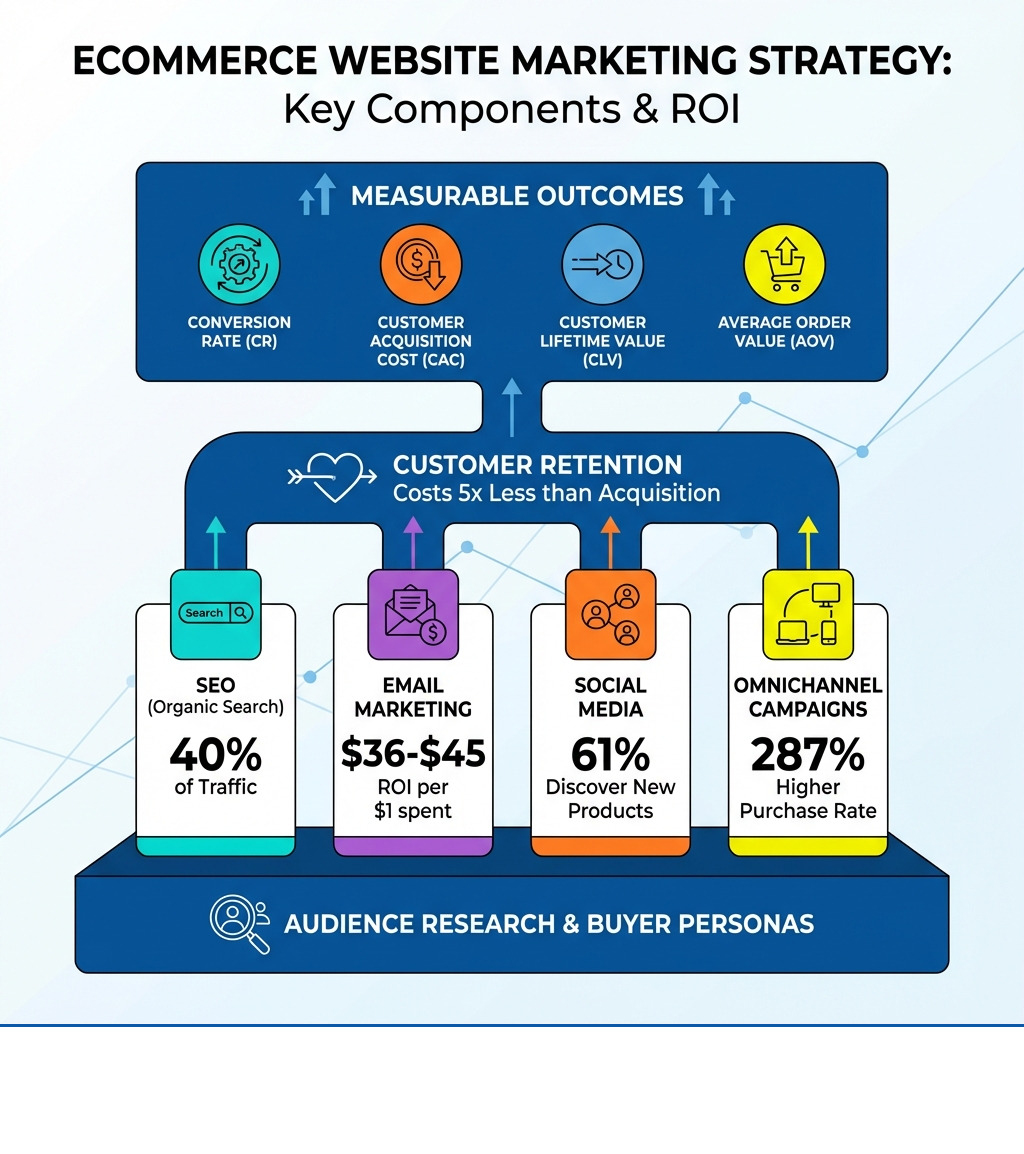
- Organic search drives approximately 40% of ecommerce traffic, while email marketing returns $36-$45 for every dollar spent in the retail sector.
- Omnichannel campaigns using three or more channels generate a 287% higher purchase rate than single-channel approaches.
- The most cost-effective strategy is creating a remarkable product experience that generates word-of-mouth marketing and customer advocacy.
An ecommerce website marketing strategy coordinates activities to sell products online. By 2026, nearly a quarter of all purchases are expected to happen online, with over 2 billion digital shoppers worldwide. With over 1.2 billion websites competing for attention and global marketing spend projected to reach $1.87 trillion in 2025, a disconnected set of tactics leads to wasted ad spend. A successful plan requires integrating channels into a cohesive system focused on measurable returns, from attracting traffic to building customer loyalty. The difference between profitable growth and failure comes down to preparation, execution, and continuous refinement based on real data.
I'm Steve Pogson, and over the past two decades I've built and refined ecommerce website marketing strategies for leading brands like Wyman's Blueberries, Hyperlite Mountain Gear, and Tandem Coffee Roasters. Here at First Pier, we've learned that the most effective strategies combine technical excellence with a deep understanding of customer behavior—and that's exactly what this guide will help you build.
The Core Components of a High-ROI Ecommerce Website Marketing Strategy
Building an effective ecommerce website marketing strategy starts with a clear foundation. I approach this by thinking about an omnichannel strategy, defining precise business goals, understanding the target audience intimately, and analyzing the competitive landscape. These elements, when combined with cost-effective tactics and a focus on word-of-mouth, create a robust plan for growth.
An omnichannel approach is crucial. It means providing a consistent and unified customer experience across all touchpoints, whether online, on social media, or through email. Marketers using three or more channels in a campaign see a 90% higher customer retention rate than those using a single channel. This integration helps customers feel recognized and valued, no matter how they interact with your brand.
Defining clear business goals is the next step. I use the SMART framework to ensure goals are Specific, Measurable, Achievable, Relevant, and Time-bound. For example, instead of "increase sales," a SMART goal might be "increase organic website traffic by 25% in the next 6 months to improve conversion rates." These goals should align with your overall business objectives, whether that's boosting revenue, expanding into new markets, or improving customer loyalty.
Understanding your target audience is essential. You need to know who your customers are, what they want, and how they behave online. This insight helps you create detailed buyer personas, which are semi-fictional representations of your ideal customers. These personas guide all your marketing efforts, ensuring your messaging resonates.
Finally, competitive analysis helps you understand the market. By examining what your competitors do well and where they fall short, you can identify market gaps and refine your unique value proposition. This analysis isn't about copying; it's about finding opportunities to stand out. When you combine these insights, you can craft strategies that generate buzz, like word-of-mouth marketing, which is earned by creating a product and experience so remarkable that people talk about it.
Know Your Audience and Competition
To connect with your customers, you need to understand them beyond basic demographics. I gather customer data from various sources, starting with tools like Google Analytics to track website behavior. Social media insights show me where customers spend their time and what content they engage with. Surveys are another valuable tool, offering direct feedback on their needs, preferences, and pain points. For instance, you might find one key persona is a 28-year-old urban professional who primarily shops via mobile and cares about eco-friendly products, while another is a budget-conscious parent who values durability and ease of use. This data allows for personalized messaging that hits home.
Competitive analysis involves identifying who your main online competitors are and dissecting their online presence. I look at their social media strategies, product pages, content marketing, and email campaigns. This helps me identify their strengths (e.g., a strong influencer network) and weaknesses (e.g., poor site speed). For example, if I notice competitors focus heavily on low prices, I might advise a client to differentiate by emphasizing product quality, craftsmanship, or exceptional customer service. This process helps us define a unique value proposition that clearly sets your brand apart. Consider a brand that creates bras specifically for small-chested women, addressing a common struggle to find flattering and comfortable options. Or a brand that positions itself as a minimalist, RFID-blocking wallet with a lifetime guarantee, standing out from standard wallet brands. These examples show how a focused approach to a specific niche can build a strong brand identity.
Focus on Cost-Effective Growth
In my experience, the most durable ecommerce website marketing strategy is rooted in a strong product and an exceptional customer experience. This fuels genuine word-of-mouth marketing, which compounds over time without requiring continuous ad spend. As I mentioned, when your product and experience are remarkable, people naturally become advocates.
User-generated content (UGC) is another effective, low-cost tactic. It's authentic, often free, and persuasive. Customers sharing photos and videos of themselves using your products acts as social proof, building trust with potential buyers.
SEO (Search Engine Optimization) and email marketing are also pillars of cost-effective growth. SEO is a long-term investment that brings qualified organic traffic, while email marketing consistently delivers one of the highest returns on investment. For more details on building a marketing plan that incorporates these elements, I recommend exploring our insights on creating a scalable marketing strategy.
Attracting Your Ideal Customer: SEO, Content, and Paid Ads
Attracting the right customers to your online store requires a multi-faceted approach. I combine Search Engine Optimization (SEO), Pay-Per-Click (PPC) advertising, and content marketing to create a comprehensive strategy that captures attention at various stages of the customer journey.

Integrating SEO and PPC for Maximum Visibility
SEO ensures your site gets found when shoppers search for your products. Pages that rank at the top of Google get 10 times more clicks than those on the bottom. My SEO approach involves thorough keyword research to identify what potential customers are searching for. Then, I focus on on-page SEO (optimizing product pages, meta descriptions, and headers) and technical SEO (ensuring fast load times, mobile responsiveness, and a secure HTTPS connection). A skincare brand, for instance, might optimize its product page to rank for "vitamin c rose oil," a term searched hundreds of times each month, leading to significant organic traffic. For specialized help with improving your visibility in search engines, you can learn more about our SEO services.
PPC advertising, on the other hand, provides immediate visibility. It's especially useful for new product launches or for quickly capturing high-intent traffic. Google Shopping Ads, for example, display your products with images and prices directly in search results, reaching customers who are ready to buy. Retargeting campaigns are also highly effective, as they target users who have already visited your site but didn't convert. These ads can convert up to three times better than cold prospecting ads because the audience already recognizes your brand. Integrating SEO and PPC means you cover both long-term organic growth and short-term, targeted campaigns. For more information on paid advertising strategies, I recommend our paid search services.
Developing a Content Plan for Your Ecommerce Website Marketing Strategy
Content marketing plays a crucial role in attracting and retaining ecommerce customers by providing value beyond just product listings. My content plans often include a mix of blog posts, how-to guides, videos, and customer reviews. The goal is to answer customer questions, build trust, and position your brand as an authority.
For example, an online store selling outdoor gear might maintain a blog with articles on hiking tips, gear guides, and adventure stories. This content attracts readers who are interested in the lifestyle associated with the products, even if they aren't ready to purchase immediately. It also helps capture informational search queries, bringing potential customers into your funnel. High-quality content reduces friction in the customer journey; shoppers who find answers to their questions are more likely to stay on your site and convert. We also see the power of visual content. A flower delivery brand, for instance, might optimize its product pages with detailed descriptions, size guides, options to add related items, and a long list of reviews that visitors can filter based on rating and use case. These details help customers make informed decisions. If you need assistance with creating compelling marketing materials, explore our collateral design options.
Building Community and Trust: Social Media, Influencers, and UGC
Social media platforms are modern-day marketplaces where billions of potential customers spend their daily time browsing, finding, and shopping. Using these platforms effectively is a key part of any ecommerce website marketing strategy. I use social media not just for advertising, but to build community, foster trust, and gather valuable user-generated content.
Using Social Proof with UGC and Influencers
User-Generated Content (UGC) is one of the most authentic and persuasive marketing tactics available. It's cheap (often free) and deeply authentic because it comes from real customers. I encourage brands to run hashtag campaigns or contests that prompt customers to share photos and videos using their products. For example, an outdoor food brand launched a simple UGC campaign where customers shared photos of themselves enjoying meals during hikes and camping trips. This showcased real people using their product and led to a boost in conversion rates.
Influencer marketing is another effective way to build social proof. Over 80% of marketers report that influencer campaigns drive results. I often advise clients to work with micro-influencers, who might have smaller but highly engaged and loyal niche followings. These creators often feel more authentic and relatable to their audience. For instance, a fitness apparel brand might partner with fitness creators who organically mention the brand as part of their workout routines. These partnerships bring your products to audiences who already trust the influencer. For more strategic guidance on reaching your audience through social channels, consider our paid social services.
Creating a Brand That Stands for Something
Consumers today want to know that the brands they buy from stand for something. Cause-driven marketing and brand partnerships can build deep emotional connections and trust. For example, an apparel brand has embedded environmental stewardship into its core business model, planting ten trees for every item purchased and aiming for one billion trees by 2030. This commitment isn't just a side campaign; it's central to their identity and resonates with eco-conscious consumers.
Brand partnerships are another way to expand reach and build credibility. When a customer sees their favorite brand collaborating with another business, it transfers credibility. Think of a boot company partnering with a leather care product brand. Recognizing the complementary nature of their offerings, they engage in mutual promotion, tapping into each other's customer bases.
Pop-up shops and experiential retail can also improve an ecommerce brand's presence. These temporary, physical spaces create urgency and excitement, prompting people to visit, buy, and share their experiences. They offer a 3D brand storytelling opportunity that can amplify your online presence. To learn more about fostering deep connections with your customer base, explore our building ecommerce community & loyalty offerings.
Converting Visitors and Fostering Loyalty
Getting visitors to your site is only half the battle; converting them into paying customers and then into loyal, repeat buyers is where profitability truly lies for any ecommerce website marketing strategy. I focus heavily on Conversion Rate Optimization (CRO), ensuring an efficient website user experience (UX), and using automation and personalization to build lasting relationships.
Optimizing Your Website for Conversions
An efficient website is critical for conversions. I prioritize fast load times, mobile responsiveness (since mobile traffic represents the majority of global web traffic and around 51% of all shoppers purchase items using their smartphones), and high-quality product images. Clear calls-to-action (CTAs) and a streamlined checkout process are also essential. Every additional second of load time between 0 and 5 seconds drops conversion rates by an average of 4.4%.
A/B testing is my go-to for continuous improvement. We test everything from button colors to product description layouts to see what resonates most with users. Custom checkout features can significantly reduce friction and improve satisfaction. For example, an eyewear brand created a customized checkout process where, as customers added products to their cart, a sidebar popped up with product details, a subtotal, and additional recommended items. This boosted sales and customer lifetime value. Product customization also increases engagement; a hockey equipment retailer, for instance, offers a stick customization experience that lets athletes choose their curve, flex, grip, and shaft, updating it all in real time. This builds loyalty by giving customers control over their gear. To refine your site's performance, consider our ecommerce UX design services.
Using Email Automation in Your Ecommerce Website Marketing Strategy
Email marketing remains one of the highest ROI drivers for ecommerce. I use email automation to keep the conversation going with customers at key points in their journey.
Automated flows include welcome series for new subscribers, abandoned cart reminders, and post-purchase follow-ups. Abandoned cart emails are particularly effective, as nearly 69% of online shopping carts are abandoned. These emails can remind customers of what they left behind, sometimes with a small incentive like a discount code. For example, a brand making comfortable watch bands uses a bold, personal abandoned cart email that rewards the customer for taking action. Segmentation and personalization are crucial here, ensuring messages are relevant to the recipient. We also send personalized post-purchase emails based on past purchases or browsing history, perhaps recommending complementary products or reminding customers to reorder. For expert help with your email campaigns, check out our email & sms marketing services.
Building Loyalty and Encouraging Repeat Purchases
Acquiring a new customer can cost five times more than retaining an existing one, and loyal customers spend 67% more than new ones. Therefore, building loyalty and encouraging repeat purchases is a cornerstone of a profitable ecommerce website marketing strategy.
I implement loyalty programs that reward customers with points for purchases, redeemable for discounts or exclusive products. For example, a curly hair care company sends simple, value-driven emails to customers about their loyalty points balance, showing them they have a tangible reward waiting. Referral programs also incentivize existing customers to bring in new ones. Subscription models are effective for predictable revenue and increased customer lifetime value, especially for replenishable products. A direct-to-consumer brand, for instance, offers both one-time purchase and subscription options, with a discount for recurring deliveries. Finally, "surprise and delight" tactics, like including a small, economical gift (e.g., a sample of shoe cream with leather boots) can exceed expectations and create memorable moments that foster advocacy. If you're looking to build a robust subscription model for your business, our subscription strategy execution team can assist.
Measuring Success and Turning Feedback into Strength
No ecommerce website marketing strategy is complete without robust measurement and a process for turning feedback into actionable improvements. I constantly track key metrics and view customer criticism not as a setback, but as an opportunity to build trust and strengthen the brand.
Tracking Key Metrics for Your Strategy
To understand what is working and what is not, I focus on key performance indicators (KPIs) that give a clear picture of profitability and growth. I pull data from across the ecosystem—your ecommerce platform, website analytics (like Google Analytics), your CRM, and email or ad tools—to get a full, multi-channel attribution picture. This comprehensive view helps me make data-driven decisions and allocate resources effectively. For detailed analysis and insights into your ecommerce performance, our ecommerce analytics & analysis expertise can help you make sense of your data.
Turning Customer Criticism into a Brand Strength
Customer criticism, while sometimes uncomfortable, can be a valuable tool. When you acknowledge criticism openly and reframe it, you earn trust. I've seen brands use radical transparency to their advantage. For instance, one brand, when facing legal threats or product delays, pulled back the curtain, documented the challenges, and talked about them publicly. This wasn't damage control; it was marketing fueled by honesty, making the brand human and relatable.
Similarly, sharing negative reviews, especially those that highlight a brand's unique stance, can differentiate you. If a sustainable fashion brand shares criticism like "Too political," it doubles down on their mission and rallies their community, attracting customers who align with their values. This approach builds trust and earns customer respect by showing authenticity and a willingness to stand by your principles.
To Sum Up
A strong ecommerce website marketing strategy is an integrated system, not a list of separate tactics. It starts with a clear understanding of your audience, is carried out across channels like SEO, social media, and email, and is improved through data analysis. By focusing on brand strength, customer experience, and loyalty, you can build a business that grows over time. Here at First Pier, we help brands build these systems. If you want a strategy that delivers measurable ROI, our team can help.





.png)
.png)

