




Why Your E-commerce Data Is Working Against You
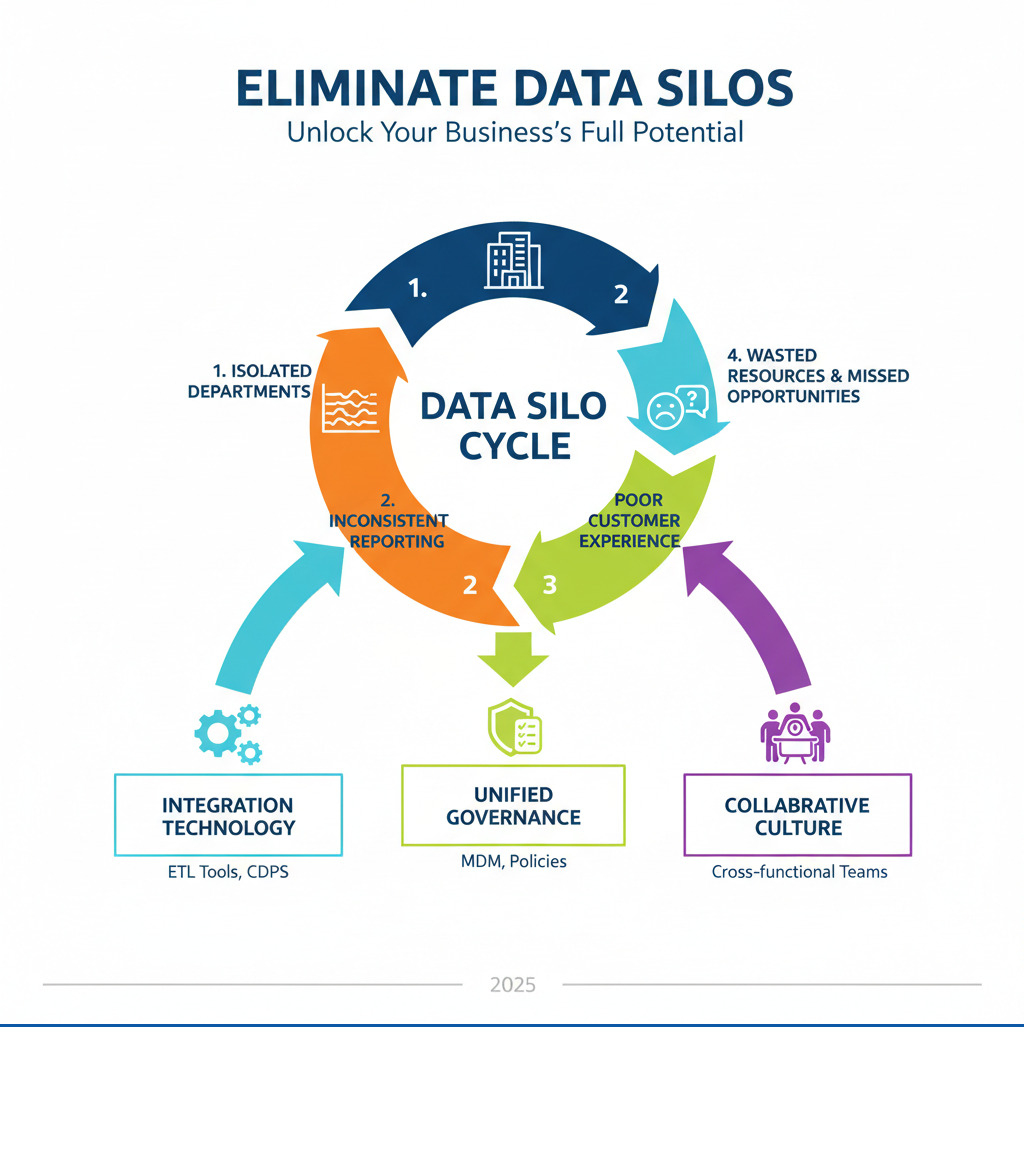
Eliminate data silos to open up your business's full potential. Data silos are isolated pockets of information trapped in different systems that don't communicate. Here's how to break them down:
Quick Action Steps:
- Find where silos exist - Look for inconsistent reports or teams asking, "Where can I find this data?"
- Build a data-sharing culture - Get leadership buy-in and create cross-functional teams with shared goals.
- Use connection technology - Connect systems with ETL tools, centralized storage, and Customer Data Platforms.
- Set up data governance - Establish clear policies and a single source of truth with Master Data Management.
Imagine your marketing team runs a campaign using data from your email platform, while your service team sees different information from your Shopify store. When a customer calls about a promotion, your support rep is clueless. This disconnect frustrates customers and costs you sales.
Bad data from siloed systems costs companies an average of $12.9 million per year. For e-commerce, this means missed personalization opportunities and slower decisions. Customers feel like you don't know them, even when 81% of brands think they have a deep understanding.
Data silos appear as businesses grow. Departments buy their own tools, and old systems don't talk to new ones. Soon, your sales, inventory, and customer service data all live in separate places.
I'm Steve Pogson. With two decades in e-commerce, I've seen how eliminating data silos turns struggling stores into data-driven powerhouses. At First Pier, we help leaders unify their data to make smarter decisions and grow faster.
This guide shows you how to find, break down, and prevent data silos for a complete view of your customers and operations.
What Are Data Silos and Why Do They Happen?
Think of a farm where each grain is in its own silo. To get a total count of your harvest, you'd have to walk from silo to silo, adding it all up manually. Trying to create a special grain blend would be a logistical nightmare.

This is what happens with data silos in your e-commerce business. A data silo is information accessible to one team but locked away from everyone else. Your marketing team has email data, sales has purchase history, and customer service has support tickets—but none of these systems talk to each other.
Silos don't happen on purpose. They grow naturally as your business evolves, like weeds in a garden you're too busy to tend.
The Common Causes of Data Isolation
Organizational structure is often the main cause. As companies grow, they form distinct departments like marketing, sales, and operations. Each department gets its own goals, budget, and tools. Before long, you have a patchwork of systems that don't communicate.
A silo mentality also contributes, where teams hoard data instead of sharing it. This can stem from internal competition or a protective instinct, turning information into a guarded resource instead of a shared asset.
Technology gaps and incompatible software make the problem worse. As your business grows, you add new platforms. However, just because two programs are "business solutions" doesn't mean they can talk to each other. Legacy systems—older platforms you've used for years—are especially difficult because they were built before modern system connections became standard.
Decentralized IT, where departments choose their own tech, adds to the chaos. It offers flexibility but means no one is looking at the big picture to ensure everything connects properly.
Rapid business growth and mergers and acquisitions can speed up silo formation. When you're growing fast or bringing in another company, your focus is on keeping operations running. Connecting data systems gets pushed to "later." You inherit their systems, add them to your existing ones, and the data becomes even more scattered.
Sometimes, restrictive data access and poor communication turn necessary security into accidental barriers. You need to protect sensitive customer information, but when access isn't managed thoughtfully, those protective walls become isolation chambers.
The result is a fragmented data ecosystem where valuable insights are locked away. Your teams can't get a complete picture of what's happening, which is the real cost of not being able to eliminate data silos.
The Hidden Costs: How Data Silos Hurt Your E-commerce Business
Data silos might seem like a small hassle, but they create hidden costs for your business. I've seen e-commerce companies struggle with these issues for years, and the damage goes beyond the balance sheet.

Think about your customer service team. A customer calls about a promotion. Your support rep opens their system, but the marketing data is somewhere else. The purchase history? A third system. The rep is now juggling screens, putting the customer on hold, and everyone gets frustrated.
Reduced productivity is the most immediate cost. Teams spend hours hunting for information or manually copying data between systems. This is time they could be using to help customers or grow the business.
When your leaders don't have the full picture, they're making decisions in the dark. Your marketing director might see strong email engagement while the sales team sees conversion rates drop. Poor decision-making happens when these insights live in separate worlds. You might pursue the wrong strategy simply because no one can see how the pieces fit together.
According to research from Gartner, bad data quality costs organizations an average of $12.9 million each year. When information is scattered, maintaining accuracy is nearly impossible. Reports contradict each other, and eventually, no one trusts the data.
Wasted resources also pile up. You're paying for duplicate data storage across multiple systems. Your IT team maintains separate platforms, and your staff manually syncs data that should be automatic.
But the biggest hit for e-commerce is an inconsistent customer experience. Customers expect you to know them. When a support agent can't see a customer's previous calls, that customer feels ignored. When marketing sends a promotion for an item they just returned, it feels tone-deaf. These experiences erode trust.
You're also missing sales opportunities. Without a complete view of customer behavior, you can't spot patterns for cross-selling. Understanding Customer Behavior Insights requires connecting data from across your business, which silos make impossible.
This directly impacts your ability to improve Customer Value Optimization. You can't increase lifetime value if you don't know the full customer journey. Eliminating data silos isn't just an IT project—it's about protecting your bottom line and serving your customers better.
Your Blueprint to Eliminate Data Silos
Breaking down data silos requires a plan that addresses four key areas: change management, technology, governance, and culture. Think of it as renovating a house—you need a plan, the right tools, and agreement from everyone living there. Here’s how to do it.
Step 1: Find Where Your Data is Hiding
You can't fix what you can't see. The first step to eliminate data silos is to figure out where your data is trapped.
Start by looking for the signs. Do marketing and finance report different sales numbers for the same period? Do teams track different KPIs for the same goal? If employees are constantly downloading spreadsheets or manually copying data, you have silos. Listen for phrases like, "I don't know where to find that data."
To get a complete picture, conduct a data audit. Map out every place data lives in your business—your Shopify store, CRM, email platform, and other systems. Then, talk to your teams. Ask them what data they collect, what they wish they had access to, and what challenges they face. These conversations often show silos you didn't know existed.
Step 2: Build a Culture of Collaboration
Technology alone won't fix silos if your teams don't want to share data. Breaking down silos requires changing how people think about information.
This starts at the top. Leadership buy-in is essential. When executives actively use data and discuss challenges and wins, it sets the tone for the whole company.
Get everyone focused on shared business goals that are more important than departmental wins. When sales, marketing, and service teams see how their data contributes to the bigger picture, they are more willing to share.
Create cross-functional teams with people from different departments. When a marketing analyst, service rep, and product manager work together, they see how connected their data is. This breaks down walls naturally.
Encourage regular meetings where teams share insights. Establish a data governance committee with representatives from across the organization to set rules for how data is managed and shared.
Finally, invest in data literacy training. When employees understand basic data concepts, they become better at working together. For e-commerce teams, this might include training on Data Management in Shopify.
Step 3: Use Technology to Eliminate Data Silos
Once you have a collaborative culture, technology is your most powerful tool for connecting everything.
Tools for connecting data are your first line of defense. They work by extracting data from various sources, changing it into a consistent format, and loading it into a central location. This process is called Extract, Transform, Load (ETL). The goal is to make data accessible across systems.
Next, you need centralized data storage. Data lakes can store large amounts of raw data, while cloud data warehouses are great for running queries and reports quickly. Many e-commerce businesses use cloud data warehouses to analyze sales and customer behavior.
Cloud services like AWS offer scalable solutions that grow with your business, providing tools for data connection, processing, and analysis.
For e-commerce, a Customer Data Platform (CDP) is often the key. A CDP combines customer data from every touchpoint—website, email, CRM, purchases, support tickets—into a single, complete profile for each customer. This unified view allows marketing to personalize campaigns, support to see a customer's full history, and your product team to understand the entire customer experience.
Step 4: Ensure Data Quality with Master Data Management (MDM)
You've connected your systems and centralized your data. Now, you must ensure that data is accurate and consistent. This is where Master Data Management (MDM) comes in.
MDM creates a "single source of truth" for your key business data, like customers and products. It's the main record that all other systems refer to.
For example, a customer might exist in three different systems with slightly different information. MDM identifies these duplicates, combines them, and creates one master profile. This is especially important when working with First-Party Data Shopify to avoid inconsistencies.
MDM also enforces data consistency by setting standards for how information is formatted. When everyone agrees on definitions, your reports become reliable.
Most importantly, MDM maintains data accuracy over time by cleaning data, removing duplicates, and confirming information. It's an ongoing process that keeps your data ecosystem healthy and prevents silos from returning.
The Future is Connected: Advanced Ways to Bust Silos
The world of data management is always changing, and forward-thinking e-commerce businesses are exploring next-generation approaches to stay ahead. If you've handled the basics of eliminating data silos, these new technologies can help you build an even smarter data ecosystem.
Data fabric architecture is like a smart layer that connects your data sources where they are, rather than forcing you to move everything. It uses AI to automate connection tasks, manage data quality, and help you find what you need. For businesses dealing with Big Data, this approach provides access to information without complex manual work.
Data mesh principles change how your organization thinks about data ownership. Instead of a central IT team controlling everything, each department manages its own data but is responsible for making it clean and accessible to others. This distributed ownership prevents new silos because sharing becomes part of each team's job.
AI and machine learning are changing how businesses handle data. These technologies can automatically map data fields between systems, saving hours of manual work. They are also great at spotting problems like duplicate records or unusual patterns. When you apply Data Mining techniques, AI can build predictive models to help you anticipate customer needs and find new sales opportunities.
These advanced approaches don't just fix today's problems—they help you build a data infrastructure that adapts as your business grows. They turn data management from a struggle into a strategic advantage.
The Payoff: Benefits of a Silo-Free Business
Eliminating data silos is about more than fixing a technical problem—it's about opening up your e-commerce business to new opportunities. When data flows freely, the change affects every part of your operations.
First, you'll make better decisions. With a unified and accessible view of your business, you get accurate, real-time information you can trust. No more conflicting reports or waiting for IT to pull data. You can spot a trend and react immediately.
A unified view also improves operational efficiency and saves money. Your teams stop wasting time hunting for information or fixing contradictory data. They can focus on work that moves the business forward. The savings can be significant—Covanta, for example, cut maintenance costs by 10% per year by breaking down its data barriers.
For e-commerce, the biggest win is a true 360-degree view of your customers. When you combine data from your Shopify store, email campaigns, and service interactions, you see the complete customer picture. This is key for personalization. You can send marketing messages that connect because you know their history. This helps with Customer Value Optimization and leads to higher conversion rates and more repeat purchases.
Your business also becomes more agile. Need to test a new marketing strategy? You can quickly pull the data you need to review it. When you can easily combine your Shopify Data with other information, you spot trends your competitors miss.
Finally, your teams will work together better and trust each other more. When everyone uses the same reliable data, the finger-pointing stops. This shared understanding breaks down walls between departments and gets everyone pulling in the same direction.
The payoff from eliminating data silos grows over time. Better Ecommerce Data Analytics leads to smarter decisions and better results, creating a positive cycle that helps your business thrive.
Frequently Asked Questions about Eliminating Data Silos
What's the first step to eliminate data silos?
The first step is identification—you can't fix what you can't find. Before you buy any technology, you need to know where your data silos are and how they affect your business.
Start by auditing your current data sources. Take inventory of every system and tool where your business stores information. Then, talk to your teams. Your marketing, customer service, and finance departments know where they hit walls when trying to access data.
Map out where information lives, who has access, and where the bottlenecks are. This initial detective work is crucial for understanding the problem and building a plan to fix it.
Can data silos ever be a good thing?
Rarely. Intentional silos can be useful for security and compliance. For example, sensitive customer information like credit card details or data subject to GDPR might need to be intentionally isolated to meet legal requirements and prevent unauthorized access.
However, for the vast majority of your operational data, silos create far more problems than they solve. The data that drives your daily business decisions—for marketing, inventory, and customer understanding—should flow freely. For an e-commerce business, the benefits of connected data almost always outweigh the downsides of keeping information locked away.
How does breaking down data silos help with e-commerce analytics?
It transforms your e-commerce analytics from separate snapshots into a complete movie of your business. When you break down silos, you combine data from sales, marketing, customer service, and every other touchpoint. This provides true Ecommerce Data Analytics that shows the full customer experience.
For example, instead of just knowing a customer made a purchase, you can see they came from a Facebook ad, abandoned their cart, received an email, and then returned to buy. This complete view helps you understand which marketing channels work, measure the true ROI of your campaigns, and find personalization opportunities you'd otherwise miss.
Without connected data, your analytics will always be incomplete, like trying to solve a puzzle with half the pieces missing. Unified data is essential for making the smart, profitable decisions that drive real growth.
Finally, Achieve a Unified View of Your Business
Breaking down data silos is a big project, but it's one of the best investments you can make in your e-commerce business. We've covered how silos form, the costs they create, and the practical steps you can take to fix them.
The solution requires a mix of culture, process, and technology. You need teams that want to share information, clear rules for data management, and the right tools to connect your systems.
It all comes down to getting a single, unified view of your customers and business. When you can see the complete picture—from a customer's first website visit to their repeat purchase—that's when the magic happens.
This isn't just about making reports easier to read. It's about building a foundation that lets you grow, create new things, and truly understand your customers. When you eliminate data silos, you're giving your business the ability to make smarter decisions, move faster, and create experiences that keep customers coming back.
At First Pier, here in Portland, Maine, we've helped many e-commerce businesses untangle their data. We know the frustration of disconnected systems and the relief that comes when everything clicks into place. Breaking down silos is an ongoing process, but the payoff is worth the effort.
If you're ready to stop fighting with your data and start using it to grow, we're here to help. For expert guidance on turning your disconnected data into actionable insights, explore our ecommerce data analysis services. Let's build something great together.





.png)
.png)

