



Summary
- Google Display Ads show visual ads across the Google Display Network to increase brand visibility and familiarity.
- Brand-focused Display campaigns use audience and placement targeting with CPM-based bidding to pay for impressions rather than clicks.
- Key performance indicators for these campaigns are impressions, reach, frequency, and view-through conversions.
- Display campaigns work best when combined with channels like search, social, and YouTube as part of a full-funnel plan.
Why Google Display Ads Are Essential for Building Brand Awareness
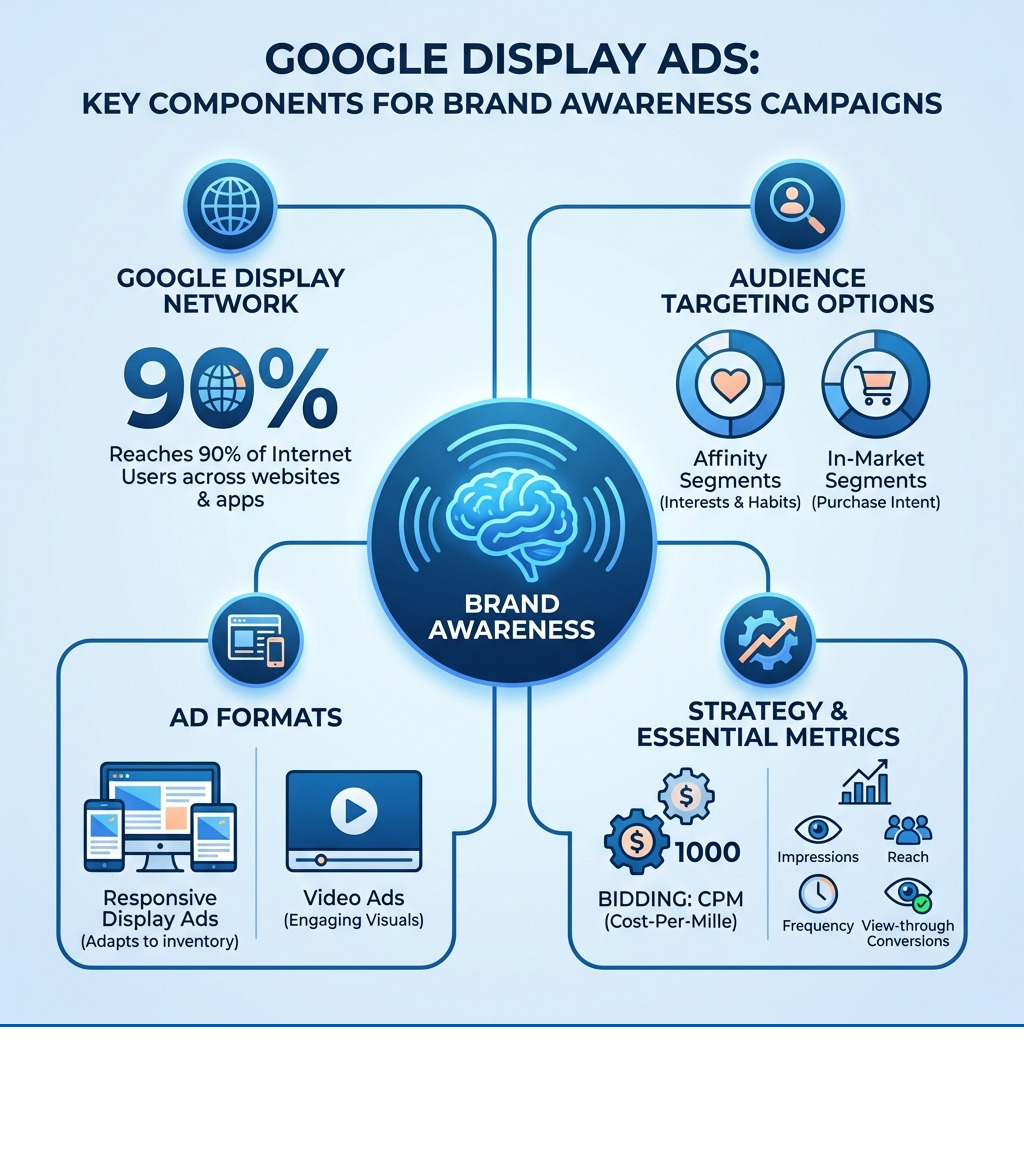
A google display ads brand awareness campaign is a specific tool for increasing your brand's visibility and familiarity. It works by showing visual advertisements across a large collection of websites, apps, and videos. This network is called the Google Display Network (GDN), and according to Google, it reaches over 90% of internet users worldwide. The core purpose is to build recognition and positive feelings about your brand, not to drive immediate sales.
Here is a breakdown of how these campaigns function and how we use them here at First Pier for ecommerce brands on Shopify:
Primary Goal: Building Recognition, Not Immediate Sales. The main objective is to make your brand a familiar name to your target audience. Unlike campaigns focused on direct response (like a "Buy Now" button), brand awareness is about creating familiarity with your brand. When a potential customer eventually needs a product you sell, your brand is already one they know and trust. This is a long-term play that builds the foundation for future sales and improves the results of search and email over time.
How It Works: Placing Visuals in Your Audience's Path. Your ads, which can be images, animations, or videos, appear on sites within the GDN while people are doing other things online. They might be reading a news article, browsing a favorite blog, watching a YouTube video, or checking their Gmail. The ads are placed contextually, meaning they can appear on sites related to your industry, or they can be shown to specific people based on their interests and online behavior. For ecommerce, this can mean showing a lifestyle image of your product on outdoor blogs, recipe sites, or fashion publications that match your customer profile.
Key Targeting: Reaching the Right People. The strength of the GDN lies in its targeting options. You are not just broadcasting your ad to everyone. You can select specific audience segments, such as people with certain demographics, interests (Affinity Audiences), or those actively researching products like yours (In-Market Audiences). You can also choose specific websites or YouTube channels where you want your ads to appear (Placement Targeting). For Shopify merchants we often combine:
- broad interest-based audiences for reach,
- remarketing lists built from site visitors and email lists,
- and hand-picked placements that match your niche.
This mix keeps your message in front of people who are most likely to become customers, without wasting budget.
Bidding Strategy: Paying for Eyeballs with CPM. For brand awareness, the most common bidding strategy is CPM (Cost-Per-Mille), which means you pay for every thousand times your ad is shown (impressions). This lines up with the goal of getting your brand seen by as many relevant people as possible. You are paying for visibility, not for clicks, because the immediate goal is not to get someone to your website, but to make them aware that your brand exists. For some campaigns we also use viewable CPM (vCPM), which focuses on impressions that actually appear on screen.
Core Metrics: Measuring Visibility. Because the goal is awareness, the key performance indicators (KPIs) are different from sales-focused campaigns. We track metrics like impressions (how many times the ad was shown), reach (how many unique people saw the ad), and frequency (the average number of times each person saw the ad). We also look at view-through conversions, which track when a user sees your ad, does not click, but later converts on your site. This measures the ad's influence on their decision. For ecommerce clients we often compare these numbers against branded search volume and direct traffic to see how awareness flows into other channels.
Recommended Formats: Telling a Visual Story. The most effective display ads are visually engaging. Responsive Display Ads are a flexible format where you provide assets like images, headlines, and logos, and Google automatically assembles them into ads that fit different ad spaces. Rich media and video ads are also useful for telling a more complete brand story and creating an emotional connection. Merchants with a strong library of product photography and lifestyle content usually see better performance, because the ads look more like the content their customers already enjoy.
Display advertising works at the top of the marketing funnel by creating demand. It introduces your brand to people who are not actively looking for your products yet. This is the opposite of search advertising, which captures existing demand from people already typing in search queries. By building familiarity through repeated exposure on relevant sites, you ensure that when someone does start searching, your brand is already in their consideration set.
I am Steve Pogson, and for over 20 years, I have worked with brands like Wyman's Blueberries and Hyperlite Mountain Gear to plan and run google display ads brand awareness campaigns that create lasting recognition. Here at First Pier, we use our ecommerce experience to design display campaigns that put your brand in front of the right audiences to support long-term growth.
Display vs. Search Ads for Brand Awareness
When I create a digital advertising plan for a client, I always start by clarifying the roles of Google Display Ads and Google Search Ads. They are both critical parts of a complete marketing plan, but they serve very different functions. Confusing them can lead to wasted budget and missed opportunities.
Google Search Ads are about capturing demand. When someone types a query like "waterproof hiking boots for women" into Google, they have a clear and immediate need. They are actively looking for a solution. My job with search ads is to place my client's product directly in their path on the search results page. The ad addresses an existing intent. It is the digital equivalent of having a store right where customers are asking for directions to what you sell.
Google Display Ads, on the other hand, are about creating demand. These ads appear across the Google Display Network, a large collection of websites, apps, and Google properties like YouTube and Gmail. Here, users are not actively searching for your product. They are engaged in other activities: reading an article about a national park, watching a gear review video, or checking their email. My display ads appear alongside this content, introducing the brand in a less direct way. We use images and short videos to create a connection with the brand and generate interest.
For ecommerce brands on Shopify, we often use Search and Display together:
- use Search to show high-intent shoppers the exact product pages or collections that match their query,
- use Display to stay visible while people browse elsewhere, compare options, and move between devices,
- and then use remarketing on Display to keep your brand present for people who visited but did not buy.
The core difference is user intent. With search, the intent is high and clear. With display, the user's intent to purchase is often low or non-existent. My goal is to generate awareness and future interest. This difference shapes the plan for bidding, ad creative, and measuring success. For search, we often use a Cost-Per-Click (CPC) model because we want to pay when someone with high intent takes the action of clicking through to the site. For display brand awareness, we typically use a Cost-Per-Thousand Impressions (CPM) model because the primary goal is broad visibility, not immediate clicks.
Here is a direct comparison of the two platforms for brand-building purposes:
| Attribute | Google Display Ads (for Brand Awareness) | Google Search Ads |
|---|---|---|
| Goal | Create demand, build brand recognition | Capture existing demand, drive conversions |
| Targeting | Audiences (demographics, interests), placements, topics | Keywords, user search queries |
| Ad Format | Visual (images, videos, responsive ads) | Text-based |
| Cost Model | CPM (Cost-Per-Thousand Impressions) | CPC (Cost-Per-Click) |
| Key Metrics | Impressions, reach, frequency, view-through conversions | Clicks, click-through rate (CTR), conversion rate |
When we build a full plan here at First Pier, Display and Search sit next to email, organic search, and paid social. Display introduces the brand, Search connects with buyers when they are ready to purchase, and your Shopify store is responsible for turning that attention into revenue.





.png)
.png)

