




Why Conversion Rate Optimization on Shopify Matters for Your Bottom Line
Summary
- Conversion rate optimization (CRO) on Shopify means increasing the percentage of store visitors who complete a desired action, such as making a purchase.
- The average Shopify store conversion rate is between 1.4% and 1.8%; rates above 3.2% are considered strong.
- Key CRO focus areas include product pages, navigation, mobile experience, site speed, and checkout.
- Effective CRO uses data analysis, user feedback, and A/B testing to guide improvements.
- Shopify’s built-in analytics and apps for reviews, pop-ups, and cart recovery support CRO efforts.
Conversion rate optimization shopify refers to the process of increasing the percentage of your store visitors who complete a desired action—most often, making a purchase. Instead of spending more money to drive additional traffic to your site, CRO helps you earn more from the visitors you already have.
Key Facts About Shopify CRO:
- What it is: The practice of improving your store to turn more visitors into paying customers
- Average rate: Most Shopify stores convert between 1.4% and 1.8% of visitors
- Strong performance: Conversion rates above 3.2% place you in the top 20% of stores
- How to calculate: Total orders divided by total sessions, multiplied by 100
- Where to focus: Product pages, checkout flow, site speed, mobile experience, and navigation
Most store owners focus on driving more traffic through ads or SEO. But if your site converts at 1.5% and your competitor's converts at 3%, they will make twice as many sales from the same number of visitors. That gap compounds quickly. Research shows that more than two-thirds of shoppers abandon their carts before checkout, and as many as 85% of mobile shoppers leave without buying. These are not just statistics—they represent real revenue left on the table.
The good news is that CRO is not guesswork. Using Shopify Analytics, heatmaps, session recordings, and customer feedback, you can see exactly where visitors get stuck or leave. Then you can test changes to those areas and measure the impact. A clear product photo, a faster checkout, or a better product description can each move the needle. When you stack these improvements over time, the results add up.
I'm Steve Pogson, and I've spent over two decades helping ecommerce businesses grow through conversion rate optimization shopify strategies. At First Pier, we work with brands like Wyman's Blueberries and Hyperlite Mountain Gear to analyze their data, identify friction points, and implement changes that increase sales without increasing ad spend.
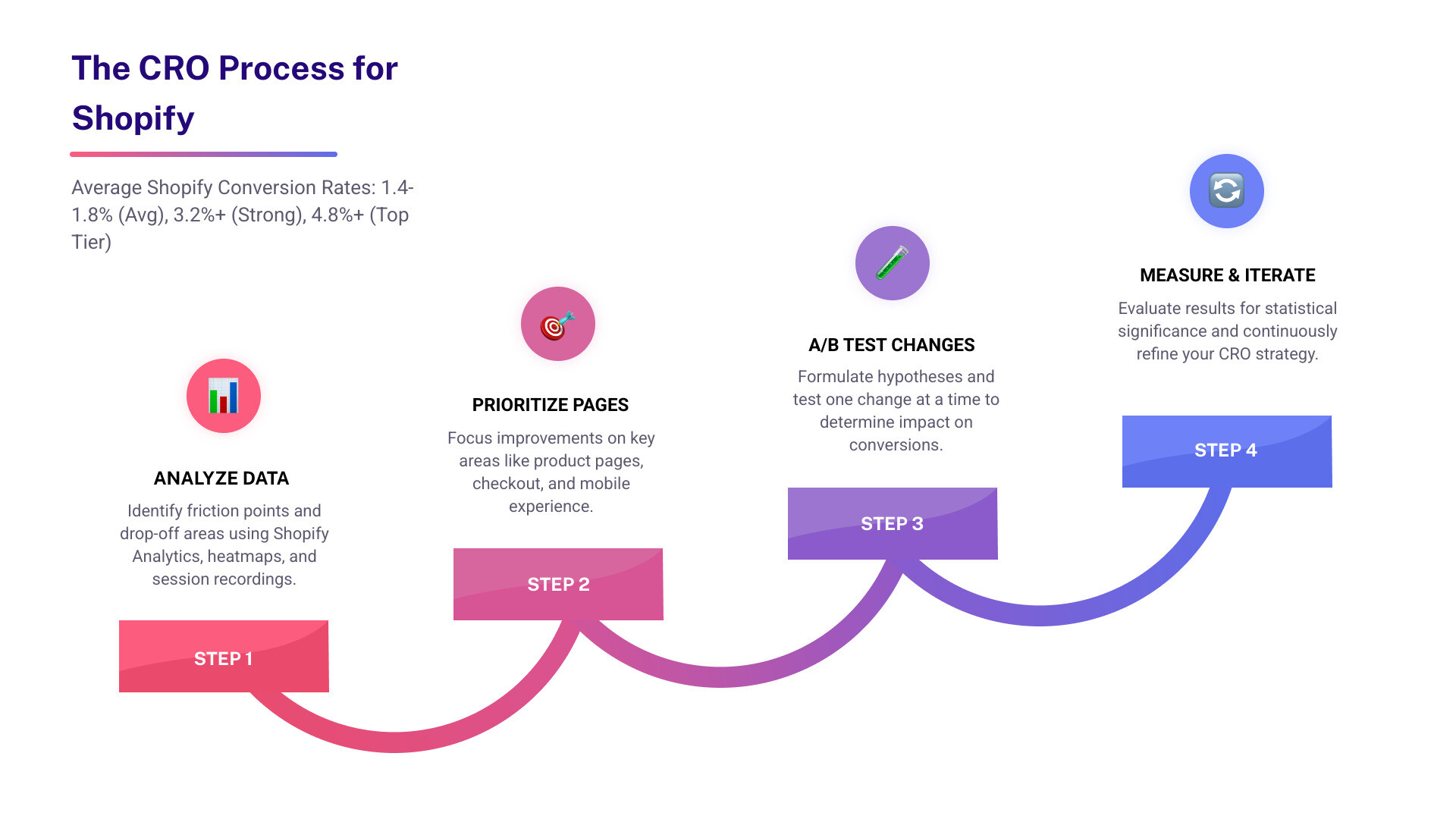
Conversion rate optimization shopify definitions:
Understanding Conversion Rate Optimization (CRO) for Shopify
Conversion rate optimization (CRO) is a methodical approach to increasing the percentage of website visitors who complete a desired action. For Shopify stores, this primary action is usually a purchase, but it can also include other valuable steps like signing up for a newsletter, adding an item to a cart, or creating an account. The real magic of CRO is that it helps you get more value from your existing website traffic. Instead of constantly chasing new customers, you are making your existing visitors more likely to buy. This directly impacts your store's profitability by boosting revenue without needing to spend more on advertising or marketing to bring in new eyes.
To calculate your store's conversion rate, the formula is straightforward: divide your total number of conversions (e.g., completed purchases) by the total number of visitors (or sessions) to your store, then multiply by 100 to get a percentage. For example, if you had 50 sales from 1,000 visitors last month, your sales conversion rate would be 5%.
Shopify's analytics dashboard is your go-to place for this data. It shows you key metrics and trends, helping you track how well your store is converting. Beyond the main purchase, I also pay close attention to microconversions. These are smaller actions that indicate a user is moving closer to a purchase. Examples include adding a product to the cart, signing up for your email list, or creating an account. Tracking these helps me understand friction points even before the final checkout.

What is a Good Conversion Rate?
When we talk about conversion rate optimization shopify, one of the first questions I often hear is, "What's a good conversion rate?" Based on industry data, most Shopify stores convert between 1.4% and 1.8%. This is a general average, and it is important to remember that rates vary widely based on several factors.
A strong conversion rate for a Shopify store is generally considered to be anything above 3.2%. If your store hits this mark, you are in the top tier of ecommerce converters. For truly top-performing stores, conversion rates can climb to 4.8% or higher, placing them among the top 10% of online retailers.
However, these numbers are just benchmarks. Your specific conversion rate can be affected by many things:
- Product Price: Higher-priced items often have lower conversion rates because they require more consideration.
- Industry: Different niches have different buying behaviors. For instance, a store selling everyday essentials might see higher rates than one selling luxury goods.
- Traffic Source: Visitors from organic search or direct traffic often convert higher than those from social media ads, as their intent is typically stronger.
- Product Type: Unique or bespoke items might have different conversion patterns than common, mass-market products.
It is helpful to look at other metrics too, like average add-to-cart rates, to understand your funnel. You can find data on average add-to-cart rates to see how you stack up. The most important thing is not just to hit an arbitrary number, but to consistently improve your own store's performance over time.
A Data-Driven Framework for Conversion Rate Optimization on Shopify
My approach to conversion rate optimization shopify is always data-driven. This means we do not guess; we investigate, test, and learn. I have found that a structured framework helps keep efforts focused and effective.
Step 1: Use Data and Analytics to Find Friction
The first step in any CRO initiative is to understand what is happening on your site and why. This is where data and analytics become your best friends. I start by conducting a thorough user experience (UX) review, looking at the entire customer journey from landing on the site to completing a purchase.
Shopify Analytics provides a wealth of information. I often dive into:
- Behavior reports: These show what people do on your site, which pages they visit, and their paths.
- Live view reports: These provide real-time activity, which can be fascinating to watch.
- Marketing reports: These help understand what drives traffic and conversions.
- Customer reports: These offer insights into your customer base for segmented campaigns.
- ShopifyQL: For more advanced analytical queries on store data.
- Web pixels: These help manage tracking pixels from third-party analytics tools to observe behavior more closely.
Beyond Shopify's built-in tools, I use specialized platforms to gather more detailed insights:
- Heatmaps and Scroll Maps: Tools like Hotjar, Lucky Orange, and Crazy Egg visually show where users click, move their mouse, and how far down a page they scroll. This helps identify areas of interest or where content might be missed.
- Session Recordings: These let you watch anonymous recordings of actual user sessions. It is like looking over a customer's shoulder, showing exactly where they struggle or hesitate.
- Customer Feedback Surveys and Post-Purchase Surveys: Directly asking customers about their experience can show pain points that data alone might not. These can be on-site pop-ups or sent via email after a purchase.
- User Testing: For a more hands-on approach, I sometimes contract users to walk through a site and verbalize their thoughts. This often finds usability issues or questions that were not obvious.
By combining all this data, I can identify specific drop-off points in the conversion funnel. For example, if I see a high bounce rate on a particular product page, or a lot of users leaving during the payment step of checkout, I know exactly where to focus my efforts.
If you are looking for help understanding your site's data and improving user experience, here at First Pier, we offer ecommerce UX design services and ecommerce analytics analysis services.
Step 2: Make High-Impact Changes on Key Pages
Once I know where the friction points are, the next step is to make targeted changes. I prioritize areas that have the biggest potential impact on conversion rate optimization shopify, typically focusing on the pages customers interact with most during their buying journey.
- Homepage Clarity: Your homepage is often the first impression. It needs to clearly communicate your value proposition and guide visitors to relevant products or categories. A clear hero image and simple navigation are key.
- Product Page Improvements: This is where buying decisions are often made. I focus on:
- High-Quality Product Photos: Customers cannot touch your products online, so visuals are crucial. Use multiple angles, high resolution, zoom options, and even 360-degree views or 3D models. A product with five reviews is 270% more likely to be purchased than one with no reviews, and good photos support reviews.
- Video Demonstrations: Product videos can help visitors imagine owning the product, especially for complex items, by showing them in use.
- Clear, Direct Product Descriptions: These should be persuasive, detailed yet easy to skim, and highlight both features and benefits. Use bullet points and images within descriptions to break up text. Avoid jargon and address potential customer questions. According to Baymard's research, 10% of ecommerce sites have insufficient product descriptions.
- Transparent Pricing: Be upfront about costs, including shipping. More than 60% of shoppers will not consider buying from a retailer that does not offer free shipping.
- Call-to-Action (CTA) Buttons: These are your guides. They need strong contrast against the page background so they stand out, and clear, action-oriented text like "Add to Cart" or "Shop Now." Their placement matters too—often above the fold on homepages or prominently next to product details.
- Site Navigation: An intuitive navigation menu is crucial. Improving site navigation can increase conversion rates by 18.5%. Use clear categories, mega menus for larger inventories, and filtering options to help users find what they need quickly.
- Search Bar Functionality: Shoppers do not want to search for hours; 69% go straight to the search bar. A smart search bar with predictive results, auto-suggestions, and even image-based search helps customers find products faster. Apps like Searchanise, Findify, and Algolia can add this functionality. Fitness brand Alo uses a smart search bar to suggest categories and products as users type, which also helps with upselling and cross-selling.
Implementing these changes often involves working with your Shopify theme or custom development. Here at First Pier, we provide Shopify development services to help stores build out these improvements.
Step 3: A/B Test and Refine Your Shopify CRO Approach
Making changes without testing is just guessing. That is why A/B testing is a core part of my conversion rate optimization shopify strategy. A/B testing means comparing two versions of a webpage element (A and B) to see which one performs better.
My process for A/B testing involves:
- Creating a Hypothesis: Before I change anything, I form a clear hypothesis. For example, "Changing the 'Add to Cart' button color from green to orange will increase clicks by 10% because orange stands out more on our product page."
- Control vs. Variant: Version A is your control (the original). Version B is the variant with the single change you are testing.
- Testing One Change at a Time: It is critical to test only one element per experiment (e.g., button color, headline, image). If you change multiple things, you will not know which change caused the difference in results.
- Statistical Significance: I need enough traffic and enough time to ensure the results are statistically significant. This means the observed difference is likely real and not due to random chance. Ending tests too soon is a common mistake.
- A/B Testing Tools: Platforms like Optimizely and VWO make it easy to set up and run these tests without deep technical knowledge. They can also provide heatmaps and on-site surveys.
- Interpreting Results: Once a test concludes, I analyze the data. If the variant performs better with statistical significance, we implement the change permanently. If not, we learn from it and form a new hypothesis.
- Iterative Process: CRO is not a one-time fix. It is a continuous, iterative process of research, hypothesis, testing, and learning. Even small improvements, when stacked, can lead to significant gains over time.
For instance, one A/B test on a shopping cart for a grooming brand found that a variant with extra iconography and trust-building information improved conversions by 18% above the baseline. This shows the power of careful testing.
Essential Tactics and Tools for Shopify CRO
Beyond the framework, there are specific tactics and tools that consistently move the needle for conversion rate optimization shopify.
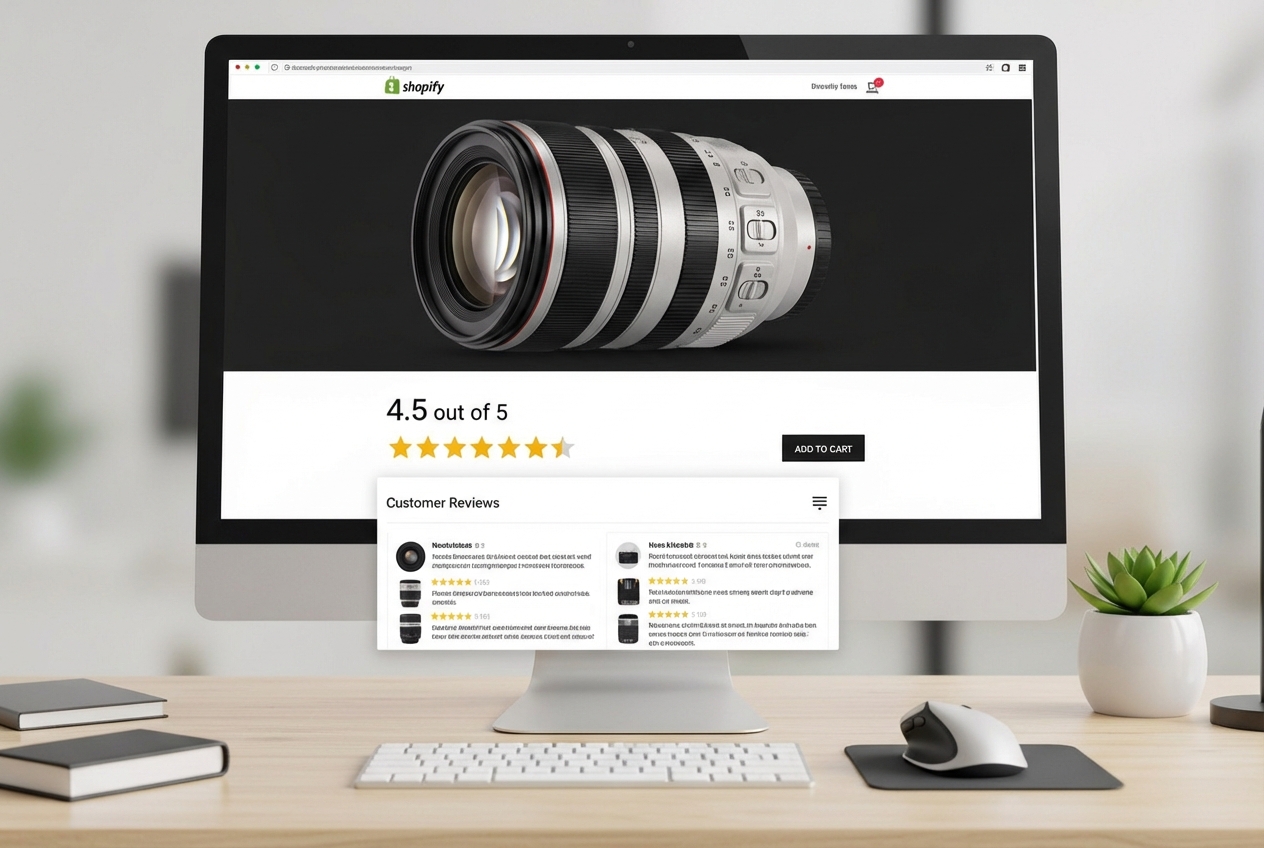
Recommended Shopify Apps and Tools for CRO
The Shopify app ecosystem is robust, offering tools for nearly every aspect of the customer journey. Here are some categories and examples I find essential for CRO:
- Pop-up & Email Capture: Pop-ups, when well-designed and timed, can have an average conversion rate of over 9%. They are great for capturing emails or offering discounts.
- Privy: Helps with pop-ups, email, and SMS marketing.
- Powr: Offers pop-up functionality.
- Zotabox: Provides promo bars and pop-ups.
- Social Proof & Reviews: Customer reviews are incredibly powerful. A product with five reviews is 270% more likely to be purchased than one with no reviews.
- Yotpo, Okendo, Loox: Excellent for collecting and displaying customer reviews and photos on product pages.
- Fomo: Creates real-time purchase notifications to build urgency and social proof.
- Abandoned Cart Recovery: More than two-thirds of shoppers abandon their carts. Targeted emails and SMS can bring them back.
- Firepush: Specializes in remarketing for cart recovery and multichannel campaigns.
- PayPal and SafeOpt: Offer third-party abandonment tracking and re-engagement if users are logged in or identified.
- Site Search: A good search experience keeps shoppers on your site. 80% will leave if they have a bad search experience.
- Searchanise, Findify, Searchspring, Algolia: These apps add predictive results, account for spelling errors, and learn from customer behavior.
- Analytics & Heatmaps: For understanding user behavior and identifying friction.
- Hotjar, Lucky Orange, Crazy Egg: Provide heatmaps, scroll maps, and session recordings.
- Blyp: Uses AI for hidden conversion opportunities.
- Conversific: Offers conversion rate optimization analytics.
For comprehensive email and SMS marketing strategies that support your CRO efforts, here at First Pier, we also provide email & SMS marketing services.
The Role of Site Speed, Mobile, and Accessibility
These three elements are foundational for any successful conversion rate optimization shopify strategy. They impact user experience directly and, consequently, your conversion rates.
- Site Speed: Speed kills conversions. Almost 70% of consumers say slow-loading websites influence their willingness to purchase. One study found that websites loading within one second convert 2.5 times higher than those loading within five seconds. Even milliseconds matter; it takes just 50 milliseconds for a visitor to form their first impression. Shopify itself has very fast server speeds, often 2.8 times faster than other platforms. To improve speed, I recommend compressing all images (tools like ImageOptim help), minimizing code, and avoiding unnecessary apps.
- Mobile Responsiveness and Mobile-First Design: With more than 58% of global web traffic coming from smartphones and tablets, and 54.5% of holiday purchases happening on mobile, a mobile-first approach is non-negotiable. As many as 85% of mobile shoppers will leave your site without checking out if the experience is not smooth. Shopify themes are built with CRO in mind, offering responsive design. Simplify navigation, use larger buttons, and reduce text on mobile screens. Google offers a free Google's mobile-friendly test to check your site.
- Shopify Checkout and Accelerated Checkouts: Shopify's checkout is designed for high conversions. Merchants using Shop Pay checkouts have a 1.91 times higher mobile checkout-to-order rate than those using regular checkouts. Accelerated payments like Shop Pay, Apple Pay, PayPal, and Google Checkout allow customers to complete purchases in just a few taps.
- Accessibility: An accessible store is a store for everyone. 69% of disabled people will click away from a website that won't let them "enable accessibility." Shopify's checkout has shown 100% completion across different assistive technologies, thanks to its built-in features. Ensuring your site adheres to WCAG (Web Content Accessibility Guidelines) not only helps a wider audience but also improves overall UX.
Building Trust with Social Proof and Personalization
Trust and relevance are strong motivators. I always look for ways to build social proof and offer personalized experiences to boost conversion rate optimization shopify.
- Customer Reviews and Star Ratings: Reviews are king. Almost half of surveyed consumers trust customer reviews as much as a recommendation from a friend. A product with five reviews is 270% more likely to be purchased than one with no reviews. Display star ratings prominently on product pages, like Beardbrand does. Actively encourage customers to leave reviews, perhaps with incentives.
- Testimonials and User-Generated Content (UGC): Beyond star ratings, full testimonials and showcasing UGC (photos or videos of real customers using your products) add credibility. Tools like Pixlee and Foursixty can help curate and display UGC.
- Trust Badges and Security Seals: Visually reassuring customers that their payment information is safe is crucial. Display security seals (SSL, payment provider logos) prominently, especially in the checkout process.
- Clear Return Policies: A reassuring returns policy can reduce anxiety for hesitant buyers. Feature it clearly in the footer and on product pages.
- Personalized Offers and Discount Codes: Tailoring offers to individual customer behavior or segments can significantly increase conversions.
- Discount Codes: Offering a discount code to first-time purchasers (like The Sunday Collective's 15% off) is a classic tactic.
- Free Shipping Thresholds: More than 60% of shoppers won't buy without free shipping. Strategically setting free shipping thresholds can increase average order value and conversions.
- Buy Now, Pay Later (BNPL): Services like Affirm, Klarna, and AfterPay can appeal to certain buyers, especially for higher-ticket items, by breaking down costs. BNPL providers contributed $18.2 billion to online spending during last year’s holiday season.
The effect of online reviews is well-documented in studies like this study on the power of online reviews.
Integrating CRO with SEO and Avoiding Common Pitfalls
Conversion rate optimization shopify and SEO are often seen as separate disciplines, but they work hand-in-hand. When you improve one, you often improve the other.
- CRO and SEO Working Together:
- Improved User Signals: CRO efforts that lead to a better user experience (faster site, easier navigation, relevant content) result in improved user signals like lower bounce rates and increased dwell time. Google uses these signals as ranking factors.
- Site Speed: As I mentioned, site speed is crucial for conversions and is also a significant SEO ranking factor.
- High-Quality Content: Content optimized for conversions (clear product descriptions, helpful blog posts) also tends to be high-quality and informative, which benefits SEO.
- Mobile-Friendliness: A mobile-responsive site converts better and ranks higher in mobile search results.
By focusing on making your site a joy to use, you naturally create a site that search engines want to show to their users. For help balancing these aspects, here at First Pier, we offer SEO services.
- Common Mistakes to Avoid:
- Not Using Data: Relying on gut feelings instead of analytics. Make changes based on what the data tells you, not just what you "feel" is right.
- Testing Without a Hypothesis: Every A/B test needs a clear idea of what you expect to happen and why.
- Ignoring Mobile: With the majority of traffic on mobile, neglecting the mobile experience is a huge missed opportunity.
- Ending Tests Too Soon: Without statistical significance, your test results might be misleading. Be patient and let the data accumulate.
- Copying Competitors Blindly: What works for one store might not work for yours. Your audience, products, and brand are unique. Test what works for your customers.
- Focusing Only on the Homepage: While important, the homepage is often not where the most significant conversion issues lie. Product pages, category pages, and especially the checkout flow are critical conversion points.
- Neglecting Microconversions: While the final purchase is the macro conversion, ignoring microconversions like "add to cart" or "newsletter sign-up" means missing opportunities to optimize the path to purchase.
Frequently Asked Questions about Shopify CRO
What is a good conversion rate for a Shopify store?
The average conversion rate for Shopify stores typically falls between 1.4% and 1.8%. If your store achieves a rate above 3.2%, you are performing very well and are in the top league of ecommerce converters. A rate of 4.8% or higher places you among the top 10%. However, these numbers are benchmarks. The "good" rate for your specific store depends on factors like your industry, product price point, and traffic sources. The most important thing is to continuously improve your own baseline.
What are the first steps to improve my Shopify conversion rate?
My first recommendation is always to start with data. Use your Shopify Analytics to identify where users are dropping off in their journey. For example, check your behavior reports and conversion funnels. Next, implement tools like heatmaps (Hotjar, Lucky Orange) and session recordings to visually understand user behavior on your high-traffic or high-drop-off pages, especially your homepage, product pages, and checkout. Based on these insights, common first steps often include improving product photos and descriptions, simplifying your site's navigation, and ensuring your site loads quickly on mobile devices.
How long does it take to see results from CRO?
The timeline for seeing results from conversion rate optimization shopify efforts can vary. Small, targeted changes, such as optimizing a call-to-action button or a product image, can show measurable results within a few days or weeks of running a well-designed A/B test. More complex changes, like a complete redesign of your checkout flow or a new site navigation structure, may require several weeks or even months to implement and gather enough data for conclusive results. CRO is not a quick fix; it's an ongoing, iterative process of continuous improvement. Consistent testing and refinement will yield compounding benefits over time.
Conclusion
Improving your Shopify store’s conversion rate is a cycle: analyze data, form a hypothesis, test changes, and measure results. Focusing on a clear, fast, and trustworthy user experience—especially on product pages and during checkout—helps turn more visitors into customers. This approach is the most reliable way to grow your store over time.
Here at First Pier, we help ecommerce businesses build and improve their online stores for better performance. If you want a team to review your data and put a CRO plan in place, see how we can help.More info about our Shopify CRO services





.png)
.png)

