



Why Most Businesses Think About Marketing Costs the Wrong Way
Summary
- Marketing budgets are typically set as a percentage of revenue, with common benchmarks ranging from 2% for stable companies to over 20% for high-growth startups.
- Digital marketing costs vary by channel: SEO can range from $2,000 to $10,000+ per month, while PPC management is often 5-20% of ad spend.
- A marketing campaign's cost is determined by factors including company size, growth stage, industry competition, and strategy complexity.
- Viewing marketing as a revenue-driving investment, rather than a cost, is critical for sustainable growth; its success is measured by Return on Investment (ROI).
- Cost-effective marketing focuses on high-ROI activities like local SEO, content repurposing, and building a strong organic social media presence.
Marketing Campaign Cost is typically 7-10% of your revenue for most businesses, though this varies significantly by growth stage and industry. Here's what you need to know:
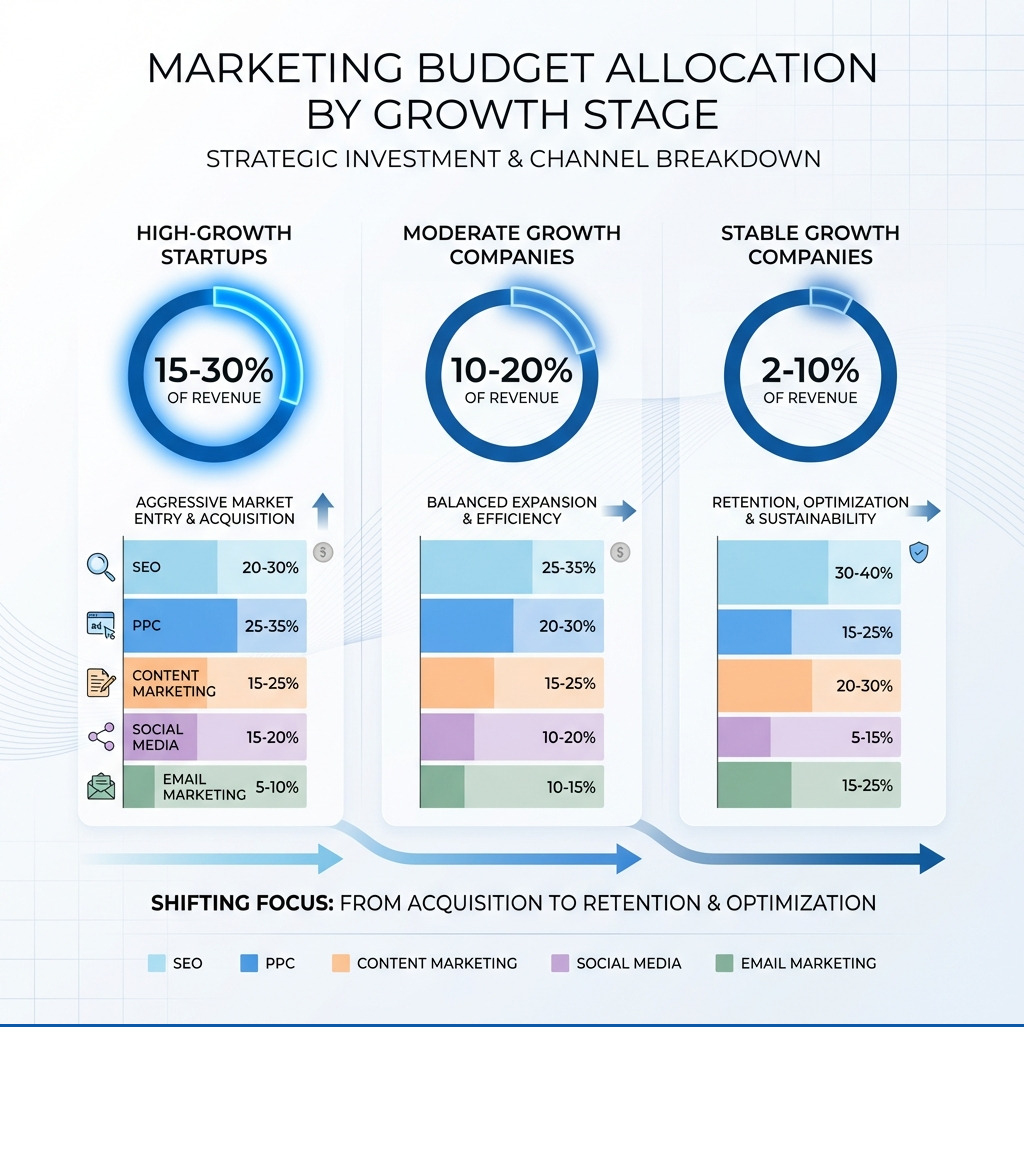
- High-growth startups: 15-30% of revenue
- Moderate growth companies: 10-20% of revenue
- Stable growth companies: 2-10% of revenue
- SEO services: $2,000-$10,000+ per month
- PPC management: 5-20% of your ad spend
- Email marketing: $300-$5,000 per month
- Content marketing: $2,000-$15,000 per month
When most business owners look at their marketing expenses, they see a line item that needs to be minimized. It's easy to understand why. Marketing spend shows up as a clear cost on your P&L statement, while the returns can feel abstract or delayed.
But here's the fundamental shift that successful e-commerce businesses make: they stop thinking about marketing as an expense and start treating it as an investment with measurable returns. If you spend $10,000 on a campaign and it generates $15,000 in additional profit, you're not spending money—you're making it.
The challenge is that marketing budgets are complex. They include everything from your website hosting to your SEO agency fees, from your social media ad spend to your email marketing software. Without a clear framework, it's difficult to know how much to allocate, where to spend it, and whether you're getting a good return.
According to a Gartner survey, publicly traded companies spend about 11% of their total revenue on marketing, with as much as 75% of that budget going to digital channels. But that's just an average. A startup fighting for market share might need to invest 30% or more of their revenue, while an established brand with strong word-of-mouth might operate efficiently at 5%.
The real question isn't "how much does marketing cost?" but rather "how much revenue can this marketing investment generate?" This article breaks down the factors that determine your marketing campaign cost, the typical ranges for different channels, and most importantly, how to think about budget allocation as a strategic decision that drives growth.
I'm Steve Pogson, founder of First Pier, and over the past two decades I've helped e-commerce businesses build marketing strategies that treat Marketing Campaign Cost as a calculated investment rather than a necessary evil. Let me show you a better way to plan and manage your marketing spend.
Know your Marketing Campaign Cost terms:
Marketing as an Investment, Not an Expense
When I advise e-commerce businesses, I always emphasize that marketing is the engine that drives a business forward. It's not a cost to cut when times are tough; it's a strategic investment that fuels sales and long-term stability. The goal is to make every dollar you put into marketing work harder for you, generating a solid return.
Why Marketing Is a Revenue Driver
Marketing directly contributes to your bottom line. It's how new customers find you, how existing customers stay engaged, and how your brand builds recognition and trust. Without marketing, even the best products or services will sit unnoticed.
Consider these points:
- Profit Generation: A well-executed campaign is not an expense. It's the main revenue driver that makes profit possible. If you spend money on marketing and it generates additional profit, you're getting a good deal. My experience shows that businesses that view marketing this way consistently see better financial outcomes.
- Customer Acquisition: Marketing is the process of bringing new customers to your business. This is fundamental to business success and growth. Startup founders, for example, often put a healthy portion of their budget on marketing to grow their client base quickly.
- Market Position and Competitive Advantage: Visibility is everything. Marketing helps you stand out, establish your position in the market, and stay ahead of competitors. This is especially true for e-commerce, where competition is just a click away.
- Brand Equity: Beyond immediate sales, marketing builds brand equity. This refers to the value of your brand's name and reputation. Strong brand equity can lead to customer loyalty, repeat purchases, and a willingness for customers to pay a premium for your products. Research shows that consumers are four to six times more likely to purchase from purpose-driven companies. Building a purpose-driven brand requires consistent and thoughtful marketing.
How to Measure Marketing Return on Investment (ROI)
Measuring ROI is how you know your marketing is working. It's the process of evaluating the financial return from your marketing spend. Without it, you're spending money arbitrarily.
The basic ROI calculation is:((Revenue from Marketing - Marketing Spend) / Marketing Spend) x 100 = ROI %
For example, if a campaign costs you $5,000 and generates $20,000 in new revenue, your ROI is 300%. This simple formula helps you see the direct impact of your marketing efforts. However, a more accurate calculation accounts for organic revenue growth that might have occurred anyway.
To get a clear picture, you need:
- Attribution Models: These help assign credit to the various touchpoints a customer interacts with before making a purchase. Whether it's first-click, last-click, or multi-touch attribution, understanding how customers move through your sales funnel is important.
- Analytics Tools: Platforms like Google Analytics (especially GA4 for e-commerce) are crucial. They provide deep insights into how customers interact with your brand, where they come from, and what actions they take on your site. This data helps you trace sales back to specific marketing activities.
- Tracking Sales: Implement robust tracking for all sales generated through marketing channels. This means using unique discount codes for specific campaigns, setting up conversion tracking in your ad platforms, and asking new customers how they found you.
Here at First Pier, I help businesses set up and interpret these systems. Understanding your e-commerce analytics services is fundamental to making informed decisions about your marketing budget.
How to Determine Your Marketing Budget
Setting your Marketing Campaign Cost is not a one-size-fits-all process. It depends on various factors including your revenue, your growth stage, your company's size, and industry benchmarks. I find that a strategic approach, rather than an arbitrary allocation, leads to better outcomes.

Budgeting by Company Growth Stage
The amount you should spend on marketing often correlates with where your company is in its lifecycle:
- High-Growth (Startup) Companies: These are typically newer companies or those rapidly expanding. They need to build brand awareness, acquire customers, and establish market share quickly. I recommend these companies budget 15%-30% of their projected revenue on marketing. A VC-backed startup, for instance, might allocate 30%-50% of its raised funds to marketing. For a founder aiming for $100K Annual Recurring Revenue (ARR), I suggest allocating $10K-$40K on marketing.
- Moderate Growth Companies: These businesses are established but still seeking to grow and stay competitive. They might scale their marketing budget to keep pace with industry trends. A safe bet for these companies is usually 10%-15% of total revenue. Entrepreneur recommends 12%-20% of projected revenue for moderate growth companies.
- Stable Growth Companies: These are often larger, established enterprises with a strong market presence. Their marketing aims to maintain market position and foster loyalty rather than rapid acquisition. Companies with stable growth typically budget 2%-10% of their revenue towards marketing. According to a Gartner report, these companies' marketing budgets climbed from 6.4% to 9.5% in 2022, showing a continued recognition of marketing's importance.
Budgeting by Industry and Business Model
Your industry and business model also play a big part in determining your Marketing Campaign Cost. Different sectors have different competitive landscapes and customer acquisition strategies.
- B2C vs. B2B Spending: Generally, B2C businesses spend more on marketing than B2B businesses. This is often because B2C companies rely more on broad reach and emotional appeal, especially service businesses which often use organic marketing and paid media. B2B businesses tend to find success through word-of-mouth and referrals, which can be less costly.
- Industry Benchmarks: Marketing spend varies significantly by industry. For example, some industries like healthcare and technology often have higher marketing budgets due to intense competition and rapid innovation.
Here's a table showing average marketing spend as a percentage of revenue across different industries:
| Industry | Average Marketing Spend (% of Revenue) |
|---|---|
| Banking, Finance, Insurance, Real Estate | 8% |
| Communications Media | 10% |
| Consumer Packaged Goods | 9% |
| Consumer Services | 6% |
| Education | 3% |
| Energy | 1% |
| Healthcare | 18% |
| Manufacturing | 13% |
| Construction | 3% |
| Retail Wholesale | 14% |
| Service Consulting | 21% |
| Technology | 21% |
| Transportation | 6% |
This table provides a general guideline. Your specific situation will always require a custom approach.
Breaking Down the Marketing Campaign Cost by Channel
Once you have a general idea of your overall marketing budget, the next step is to allocate it across specific channels. Your Marketing Campaign Cost will largely depend on the mix of digital channels, traditional media, the complexity of your strategy, and whether you work with an agency or rely on in-house staff.
Website Design and Development
Your website is your digital storefront, especially for an e-commerce business. It's often the first impression a potential customer has of your brand, so investing here is critical.
- Digital Storefront: A professional, user-friendly website is non-negotiable. It needs to be responsive, easy to steer, and visually appealing.
- User Experience (UX): Good UX design is essential for converting visitors into customers. If your site is confusing or slow, people will leave. Here at First Pier, I focus heavily on e-commerce UX design services to ensure your customers have a smooth journey.
- E-commerce Functionality: This includes everything from product pages and shopping carts to secure payment gateways and customer accounts.
- Initial Build vs. Ongoing Maintenance: The cost of your website includes the original design and build, as well as monthly hosting and ongoing updates to keep content fresh. A simple brochure-style corporate website might cost less than $10,000, while a complex e-commerce store with unique functionality may require an investment up to $100,000. These costs depend on the number of pages, required functionality, and whether designers use templates or build from scratch.
Search Engine Optimization (SEO)
SEO is a long-term investment that helps your website rank high in search results when people look for terms related to your business. A good SEO company can help you rise through the ranks to star on the first page.
- Long-Term Investment: SEO doesn't offer instant results like paid ads, but its benefits compound over time, providing sustainable organic traffic.
- Key Components: SEO involves keyword research, on-page optimization, technical SEO (site speed, mobile-friendliness), link building, and regular content updates.
- Typical Monthly Cost: Depending on your requirements and the competitiveness of your industry, you can expect to invest anywhere from $2,000 to $10,000+ per month for SEO services. For many businesses, SEO services cost approximately $2,500 per month.
- Specialized Support: I offer SEO services to help e-commerce brands improve their search visibility.
Pay-Per-Click (PPC) Advertising
PPC advertising offers a faster way to the top of search results by buying ads on platforms like Google and Bing. It also includes ads on social media platforms.
- Instant Results: PPC has the advantage of bringing you instant results, driving traffic to your site almost immediately.
- Ad Spend vs. Management Fee: Your Marketing Campaign Cost for PPC includes two main components: the actual cost of the ads themselves (what you pay Google, Meta, etc., per click) and the management fee charged by an agency or specialist to set up, monitor, and optimize your campaigns.
- Keyword Bidding: Costs vary significantly based on the competitiveness of keywords and your desired reach. Monthly expenses can range from $100 to $10,000 or more for ad spend.
- Typical Management Fee: Businesses typically spend 5-20% of their monthly ad budget on PPC management. Agency costs are in addition to the cost of running the ads themselves.
- Expertise Matters: Getting a good ROI from PPC requires expertise. Here at First Pier, I provide paid search (SEM) services to help clients get the most out of their ad spend.
Content, Social, and Email Marketing
These channels are crucial for engaging your audience, building community, and nurturing leads.
- Content Creation Costs: This involves creating and publishing valuable materials like blog posts, e-books, case studies, guides, videos, and graphics. You can expect to spend several thousand dollars a month on content marketing, depending on the type and volume produced. Businesses often spend $550 to $2,000 per piece of content.
- Social Media Management: Through platforms such as Facebook, Instagram, and LinkedIn, you can reach billions of active users. Social media marketing costs range from $250 to $10,000 per month. Agencies can help steer the complexities of each platform and get you the results you want, whether through organic presence or paid social media campaigns.
- Email Software and Copywriting Fees: Email marketing is one of the most cost-effective channels. You should expect to invest $100 to $1000 monthly in your email software, depending on your list size and features. A good copywriter, costing $50-$100 per email written, will help you generate more opens, clicks, and sales, easily justifying the cost. Email marketing delivers an ROI of around $36 for each dollar spent.
- Comprehensive Services: My team offers email & SMS marketing services to help e-commerce businesses build strong customer relationships.
Cost-Effective Strategies and Budget Management
Being cost-effective in marketing doesn't mean finding the cheapest option; it means finding the strategies that deliver the best return for your investment. My focus is always on maximizing your ROI.

Low-Cost, High-Impact Digital Tactics
Even with a limited Marketing Campaign Cost budget, there are many ways to make a significant impact:
- Google Business Profile: Every business can create a public profile on Google that details important information such as your website and phone number. Setting this up only takes a few minutes and lets you engage with customers for free, in a place they're likely to spend time when they're researching.
- Local SEO: This helps you rank better for local search terms. Since 46% of all Google searches are for local information, optimizing for local search is a low-budget practice worth doing to capture your local audience.
- Content Repurposing: This just makes sense. You can give your SEO a boost and delight new audiences without spending money on new content. For example, you can take a single blog post and:
- Turn sections into social media posts.
- Create an infographic summarizing its key points.
- Record a short video explaining the topic.
- Use it as a script for a podcast episode.
- Break it down into a series of email newsletters.
- Organic Social Media: Putting effort into your organic social presence is essential because it's a great way to nurture customers and build a community around your product or service. With creativity, you can make an impact without a big budget.
- Nano-Influencers: While mega-influencers can be expensive, nano-influencers (with smaller follower numbers) have promotional prices that reflect their reach. They are still incredibly effective for spreading the word about your brand and encouraging social sales.
How to Manage and Adjust Your Budget
A budget is not a static document; it's a living plan that needs regular attention and adjustment.
- Formalize the Budget: Create and formalize your small business marketing budget with a concrete marketing strategy. This helps minimize waste and ensures each ad dollar is accountable for driving sales and profits.
- Track Spending: Keep track of your marketing costs line by line. This includes software subscriptions, agency fees, ad spend, and even staff training. Tracking these expenses helps you accurately calculate your ROI.
- Quarterly Review and Annual Assessment: Assess your marketing budget quarterly and annually to see if your projections align with your actual spending. This allows for more accurate budgets over time. My team and I conduct these reviews to ensure our clients' marketing spend is always aligned with their goals.
- Reallocate Funds from Low-ROI Channels: If a particular channel isn't performing, be ready to shift your budget to areas that are showing better returns. This agile approach helps you get the most out of every dollar.
- Use a Marketing Budget Template: A template can help you plan out your marketing budget in detail, no matter how big or small your campaign is. You can download a free marketing budget template to help organize your expenses.
Frequently Asked Questions about Marketing Campaign Cost
What is the average cost of a digital marketing campaign?
There is no single average, as costs depend entirely on the channels used, business size, and goals. However, many businesses allocate 5-25% of their total revenue to marketing. For a company with $1 million in revenue, this could be anywhere from $50,000 to $250,000 annually. For example, SEO costs range from $500 to over $20,000 per month, while email marketing can be $300 to $5,000 per month. The average Marketing Campaign Cost is highly variable.
How much should a small business spend on marketing?
A common rule of thumb is for small businesses or startups to allocate 12-20% of their gross or projected revenue to marketing to build awareness and gain market share. Established small businesses with moderate growth might spend closer to 10-15%. The key is to align this spend with your specific growth goals and continuously measure its effectiveness.
What factors have the biggest impact on the marketing campaign cost?
The three biggest factors that influence your Marketing Campaign Cost are: 1) The competitiveness of your industry and keywords, which drives up advertising costs, particularly in PPC. 2) The complexity of your strategy (e.g., a multi-channel international campaign versus a local SEO effort). 3) The choice between hiring an in-house team versus a specialized agency, as agencies often bring expertise but also command fees.
Build a Smarter Marketing Plan
Thinking about your Marketing Campaign Cost as a strategic investment is fundamental to growing your e-commerce business. Instead of focusing only on the initial expense, concentrate on the potential return and the long-term value each customer brings. By setting a budget based on your growth stage, allocating funds to the right channels, and continuously measuring your ROI, you can build a predictable and profitable marketing engine. Here at First Pier, I help e-commerce brands create and execute these kinds of data-driven marketing plans.





.png)
.png)

