


Summary
- Online digital marketing services use web-based channels such as SEO, paid search, social media, email, and content to help businesses reach customers.
- Effective digital marketing relies on data, with key metrics like Customer Acquisition Cost (CAC) and Lifetime Value (LTV) guiding decisions.
- Businesses should choose a digital marketing partner based on their goals, industry experience, transparency, and track record.
- The digital marketing field changes often due to AI and search engine updates, so service providers must be able to adjust.
- Different business models, such as B2B and DTC, need different digital marketing approaches.
Why Choosing the Right Digital Marketing Partner Matters
Online digital marketing services are the promotional work done through the web to connect a business with its customers. These services generally fall into a few core categories.
Core Service Categories:
| Service Type | Primary Goal | Best For |
|---|---|---|
| SEO | Organic traffic and visibility | Long-term growth |
| Paid Search (PPC) | Immediate leads and conversions | Quick results |
| Social Media Marketing | Brand awareness and engagement | Community building |
| Email & SMS Marketing | Customer retention | Repeat purchases |
| Content Marketing | Authority and education | B2B and DTC brands |
With U.S. businesses spending over $110 billion on digital advertising annually, the stakes are high. The right partner can drive significant revenue growth—some agencies report helping clients achieve 2.6x faster year-over-year revenue growth than industry averages. The wrong choice can mean wasted ad spend and poor results.
Key Selection Factors:
- Industry Experience: Look for proven results in your specific sector.
- Transparency: Clear reporting on where your budget goes and what it returns.
- Data Focus: Decisions based on metrics like CAC and LTV, not guesswork.
- Adaptability: Ability to adjust plans as algorithms and markets change.
The best agencies act as partners, not just vendors. They create plans around your specific goals—whether that's lead generation, brand awareness, or sales growth—and adjust based on real performance data.
I'm Steve Pogson, founder of First Pier, a Shopify Expert Agency in Portland, Maine. Over two decades, I've helped e-commerce brands like Wyman's Blueberries and Hyperlite Mountain Gear grow by using targeted online digital marketing services that combine platform knowledge with practical growth plans. Here's what you need to know when comparing providers.
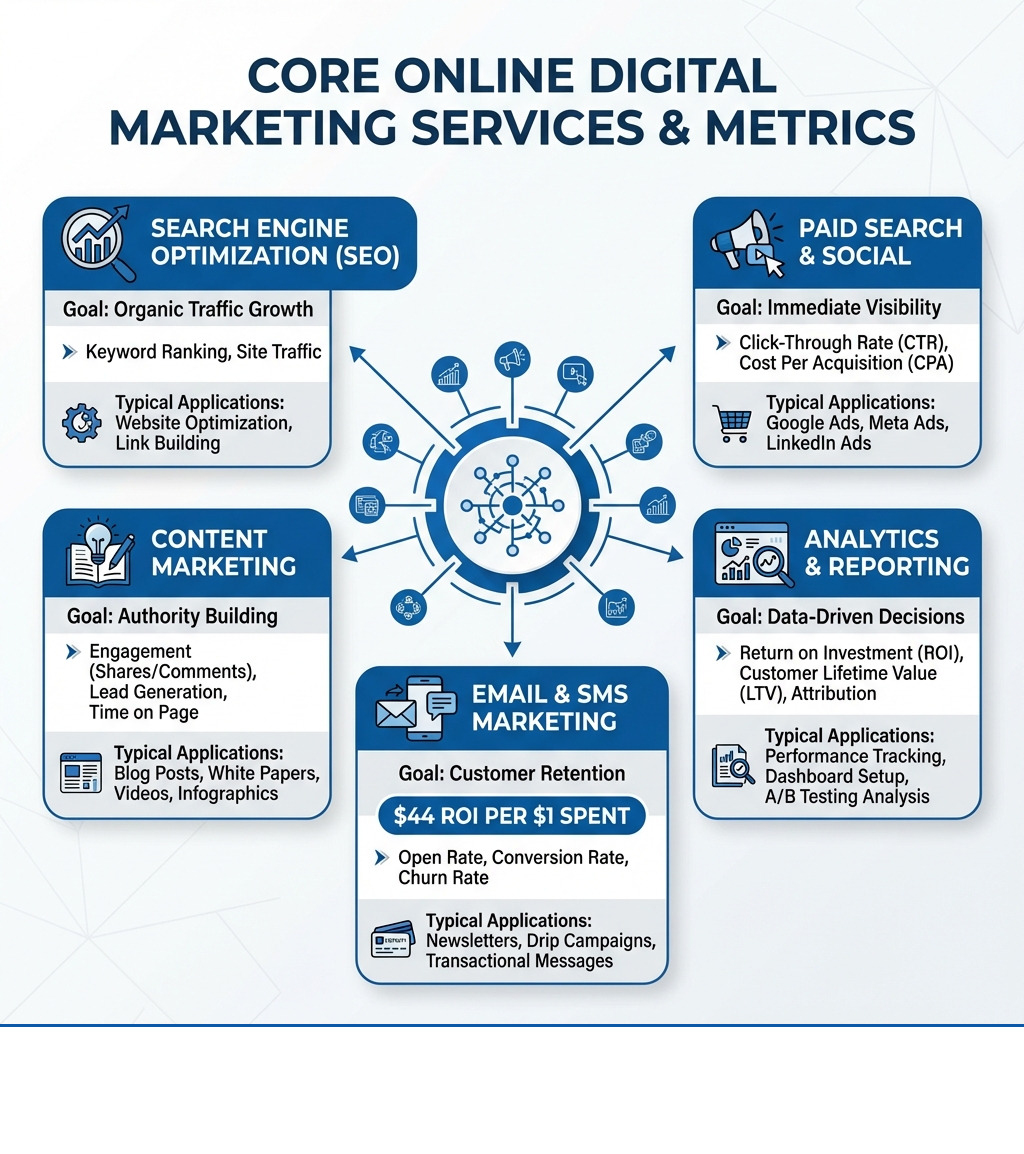
Know your online digital marketing services terms:
Understanding the Core Components of a Digital Strategy
A good digital marketing plan combines different online channels to meet specific business objectives. These components aren't used in isolation; they work together to create a consistent online presence and guide the customer's path to purchase.

Search Engine Optimization (SEO)
Search Engine Optimization, or SEO, is the work of making your website visible in search engine results without paying for ad placement. The goal is simple: when someone searches for products or services you offer, your business should appear high on the list. This matters because 93% of online experiences start with a search engine. If your business wants more website traffic, leads, and sales, you need strong SEO.
SEO involves a few key practices:
- Keyword Research: Finding the words and phrases your potential customers use when searching online.
- On-Page Optimization: Making sure your website's content, structure, and technical elements are search-engine friendly.
- Link Building: Earning high-quality links from other reputable websites, which tells search engines your site is trustworthy and authoritative.
For local businesses, especially here in Portland, Maine, local SEO is particularly important. Studies show that 97% of consumers go online to find local services, and 82% of smartphone users use a search engine when looking for a local business. Good local SEO helps connect your business with these searching consumers.
I find that a well-planned SEO effort brings qualified traffic to your site—people who are already looking for what you sell. It's a long-term project, but the sustained organic traffic and brand authority it builds are a significant asset. If you're looking to improve your organic reach, I often start with a detailed analysis of SEO services.
Paid Search and Social
While SEO builds organic visibility over time, paid search advertising and paid social media ads offer immediate exposure. These methods place your message in front of a specific audience through platforms like Google Ads and social media channels.
- Paid Search (PPC): This involves bidding on keywords so your ads appear at the top of search engine results pages. You pay each time someone clicks your ad (hence, Pay-Per-Click). The main benefit of PPC is its precision. You can target users based on their search intent, location, device, and more. This is an effective way to get instant visibility and generate leads quickly. We often use paid search as a direct path to driving customer acquisition.
- Social Media Ads: Platforms like Facebook, Instagram, LinkedIn, and TikTok allow for highly detailed audience targeting. You can reach people based on demographics, interests, behaviors, and even job titles. Social media ads are effective for building brand awareness, driving traffic, and generating leads. A key tactic here is retargeting, where you show ads to people who have already visited your website but didn't convert. This can bring back potential customers even 7, 45, or 90 days after their initial visit. For those looking to connect with customers through social platforms, I recommend exploring our paid social services. I also help businesses manage their paid search services to ensure every dollar is spent effectively.
Email and SMS Marketing
Email and SMS marketing are direct communication channels that remain very effective for building relationships and driving sales. Unlike broad advertising, these channels allow for personalized messages sent directly to your audience.
- Email Marketing: This is a strong tool for customer retention and lead nurturing. Email marketing generates an average of $44 of revenue for every $1 spent, making its ROI very high. It allows you to stay top-of-mind with prospects and customers, share promotions, announce new products, and build a loyal community. Effective email plans often involve automation, segmenting your audience, and sending targeted campaigns based on user behavior. For e-commerce businesses, especially, having solid email & SMS marketing services is crucial.
- SMS Marketing: For quick, urgent messages or time-sensitive promotions, SMS marketing delivers high open rates. It's an immediate way to reach customers and can be used with email campaigns for a multi-channel approach.
Content and Creative
Content is what you use to communicate your brand's story, educate your audience, and build trust. Creative elements, like design and imagery, are how you present that content.
- Content Plan: This involves planning, creating, and distributing useful and relevant content to attract and keep a clearly defined audience. This can include blog posts, articles, videos, infographics, and more. For B2B businesses, content often builds thought leadership, while for DTC brands, it might focus on product features or lifestyle aspirations.
- Branding and Design: Beyond words, how your brand looks and feels is critical. This includes everything from your logo and website design to the visual style of your ads and social media posts. A strong brand identity helps you stand out. Here at First Pier, we understand how a thoughtful branding identity influences customer perception. We also help with collateral design to ensure all your marketing materials are consistent.
Aligning Services with Business Goals
Every business has unique goals, whether it's getting more eyes on the brand, filling the sales pipeline, or keeping customers coming back. Online digital marketing services are flexible and can be adapted to meet these different objectives.
Driving Customer Acquisition
Acquiring new customers is often a top priority. My approach focuses on plans that bring in qualified leads and convert them into buyers. This means looking at the entire path a customer takes from finding to purchase.
- Lead Generation: This is where many digital marketing channels come together. SEO brings in organic leads, PPC and social ads deliver immediate prospects, and content marketing educates and attracts potential customers. I've seen how a well-planned campaign can deliver results, like one case where a business generated 1,000 new leads a month over a 6-month period by segmenting audiences and creating custom ads.
- Conversion Rate Optimization (CRO): Getting traffic to your site is one thing; getting visitors to take action (like making a purchase or filling out a form) is another. CRO involves analyzing user behavior on your website and making changes to improve conversion rates. This could be anything from refining product pages to simplifying the checkout process. For e-commerce brands, focusing on improving conversion rates is a continuous effort. My team often works on driving customer acquisition by making sure that every step a potential customer takes leads them closer to a purchase.
Building and Refining Your Brand
Beyond immediate sales, building a strong brand makes your business recognizable, trustworthy, and memorable.
- Brand Awareness: This is about making sure your target audience knows who you are. Social media marketing, display advertising, and content marketing are effective for this. By consistently showing up where your audience spends their time online, you build familiarity and recognition.
- Reputation Management: Your online reputation is important. Studies show that 75% of consumers trust a local business more if it has positive reviews, while 60% say negative reviews make them not want to use a business. Monitoring and managing online reviews, social media mentions, and news is crucial. Actively seeking positive reviews and thoughtfully responding to feedback helps build and refine your brand.
Customer Retention and Loyalty
Getting a new customer is often harder than keeping one. Digital marketing plays a significant role in building loyalty and increasing customer lifetime value (LTV).
- Engagement Plans: Keeping customers engaged means offering value beyond just your products. This could be through exclusive email content, interactive social media campaigns, loyalty programs, or personalized recommendations. Social media users spend an average of 3 hours per day on their preferred platforms, offering a significant opportunity for engagement.
- Community Building: Creating a sense of community around your brand can turn customers into advocates. Forums, private social groups, and user-generated content campaigns can help with this. For e-commerce businesses, a strong focus on e-commerce community loyalty can significantly increase repeat purchases and referrals. Building these relationships is important for improving customer retention and loyalty.
The Data-Driven Approach to Online Digital Marketing Services
In my experience, successful online digital marketing services are never based on guesswork. They are built on data. Every campaign, every decision, and every dollar spent should be measurable and accountable.

How to Measure Digital Marketing ROI
Measuring the Return on Investment (ROI) of your digital marketing efforts helps you understand what's working and what isn't. It's how you justify your marketing spend and make informed decisions.
- Key Metrics: I focus on metrics that directly tie back to business goals.
- Customer Acquisition Cost (CAC): How much it costs to acquire one new customer.
- Return on Ad Spend (ROAS): The revenue generated for every dollar spent on advertising.
- Conversion Rate: The percentage of website visitors who complete a desired action.
- Customer Lifetime Value (LTV): The total revenue a business can reasonably expect from a single customer account over their relationship with the business.
- Analytics Tools: Tools like Google Analytics and various platform-specific dashboards are essential. We connect marketing tools so every lead is tracked from start to finish, integrating with CRMs and other platforms like HubSpot or Mailchimp. This allows us to see exactly how ad spend translates into customer acquisition. For e-commerce businesses, reliable e-commerce data analytics are non-negotiable.
The Impact of AI on Digital Marketing
Artificial intelligence (AI) is already changing how online digital marketing services work, and its influence continues to grow.
- Predictive Analytics: AI can analyze large amounts of data to predict future trends, customer behavior, and campaign performance. This helps us make more accurate forecasts and allocate budgets more effectively.
- Personalization: AI allows for highly specific personalization in marketing. From dynamic content on websites to custom email recommendations, AI helps deliver the right message to the right person at the right time, increasing relevance and engagement.
- Ad Campaign Automation: AI helps automate bidding plans, audience targeting, and even ad creative generation in platforms like Google Ads and social media. This can lead to more efficient campaigns and better ROAS.
- AI-Powered Content Creation: Tools using AI can help with generating content ideas, drafting copy, and even improving existing content for SEO and readability. This makes content creation more efficient and data-driven. Semrush, for example, offers an SEO Writing Assistant that provides feedback on SEO, text readability, originality, and tone. I often use tools like Semrush One to get information and make our work more efficient.
Adapting to Algorithm Updates and a Changing Market
The online environment is not static. Search engine algorithms change, social media platforms evolve, and new technologies appear. Effective online digital marketing services must be able to adapt quickly.
- Continuous Monitoring: I constantly monitor industry news, algorithm updates (especially from Google), and platform changes. What worked yesterday might not work tomorrow.
- Plan Adaptation: My team and I are always ready to adjust our plans. This might mean refining SEO tactics, shifting ad spend to new platforms, or experimenting with new content formats. A flexible, scalable marketing plan is one that can withstand these shifts.
- Omnichannel Marketing: An approach that uses multiple channels ensures that if one channel sees a dip in performance due to an update, others can pick up the slack. This resilience is important for consistent growth.
How to Choose a Digital Marketing Agency
Choosing the right partner for your online digital marketing services is a big decision. It’s not just about finding someone who can run ads; it's about finding a partner who understands your business and its goals.
Key Factors for Selecting a Partner
Here in Portland, Maine, I've seen many businesses struggle with finding the right fit. I always advise clients to consider these factors:
- Experience: Look for agencies with a proven track record. While specific numbers like "20 years of experience" or "hundreds of millions of dollars generated for clients" can be impressive, what matters is relevant experience in your industry and with your business model.
- Industry Specialization: Does the agency understand the details of your business? For First Pier, our specific knowledge of e-commerce, particularly with Shopify, means we speak the language of online retailers and understand their specific challenges.
- Client Testimonials and Case Studies: Reputable agencies will have plenty of examples of past successes. Look beyond just the numbers; understand the process they followed and the challenges they overcame.
- Transparency: You should always know exactly where your money is going and what results it's bringing. Ask about their reporting processes and how they communicate performance.
- Communication: A good agency should be responsive and proactive. You need a partner who will keep you informed and is easy to work with.
- Client Retention Rate: A high client retention rate suggests that clients are happy with the services and see ongoing value. Some top agencies boast retention rates as high as 97%, which is a strong indicator of satisfaction.
Questions to Ask a Potential Online Digital Marketing Services Provider
When you're vetting potential partners, don't be shy about asking direct questions. Here are a few I recommend:
- What is your process for a new client? This helps you understand their onboarding, plan development, and execution phases.
- How do you measure and report on success? Ask for examples of their reports and how they define key performance indicators (KPIs) for your specific goals.
- Who will be my point of contact? Understanding the team structure and who you'll communicate with regularly is important for good collaboration.
- What is your experience in my industry? This is crucial. While general digital marketing principles apply broadly, industry-specific knowledge can make a huge difference in planning and execution.
What to Expect from Comprehensive Online Digital Marketing Services
When you partner with a full-service agency for your online digital marketing services, you should expect more than just ad campaigns.
- Plan Development: A thorough initial phase where the agency understands your business, your market, and your goals, then creates a custom plan. This isn't a one-size-fits-all approach; it's custom to you.
- Execution: The actual implementation of campaigns across various channels—SEO, PPC, social media, email, content creation, and more. This includes managing budgets, creating assets, and setting up tracking.
- Reporting: Regular, clear reports on performance against agreed-upon KPIs. This should include information about what's working, what's not, and why.
- Continuous Adjustment: Digital marketing is dynamic. Expect your agency to constantly monitor performance, test new approaches, and adjust plans based on data and market changes.
- Partnership: You're looking for a partner. Someone who is invested in your success, proactive in their recommendations, and acts as an extension of your team. This type of relationship can lead to strong results, including the kind of 2.6x faster revenue growth I've seen.
Frequently Asked Questions about Digital Marketing
What is digital marketing?
Digital marketing is any promotional activity done via the web. It is a broad term that covers all marketing efforts that use an electronic device or the internet. This includes a wide range of online digital marketing services such as Search Engine Optimization (SEO), Search Engine Marketing (SEM), Social Media Marketing (SMM), Pay-Per-Click Advertising (PPC), email marketing, and content marketing. The main idea is to connect with customers online, understand their problems, and provide solutions where they are already looking.
How cost-effective is digital marketing compared to traditional methods?
Digital marketing is much more cost-effective than traditional marketing methods. Here's why:
- Targeted Reach: Digital marketing allows you to target very specific audiences, minimizing wasted spend on people unlikely to be interested in your product or service. Traditional marketing, like billboards or radio ads, often reaches a much broader, less targeted audience.
- Flexible Budgeting: Digital marketing efforts are often flexible with your budget, allowing you to start small and expand. You can often adjust campaigns in real-time.
- Measurable Results: Every impression, click, and conversion in digital marketing can be tracked and measured. This means you get clear metrics that help you make more informed, more profitable decisions, which is much harder to do with traditional advertising. For example, email marketing generates an average of $44 of revenue for every $1 spent, a clear and trackable ROI.
How do digital marketing services help a business grow?
Online digital marketing services help businesses grow in several important ways:
- Increased Visibility: By optimizing for search engines and running targeted ads, your business becomes visible to a much larger and more relevant audience online. As 93% of online experiences start with search engines, being visible there is very important.
- Targeted Audiences: Digital marketing lets you reach exactly who you want to reach. This means your message gets in front of people who are genuinely interested in your products or services, leading to higher conversion rates.
- Customer Engagement: Channels like social media and email allow for direct interaction with your customers. This builds relationships, creates trust, and can turn one-time buyers into loyal advocates. Social media users spend an average of 3 hours per day on their preferred platforms, offering a significant opportunity for engagement.
- Brand Trust: A strong online presence, positive reviews (75% of consumers trust businesses with positive reviews), and useful content build credibility and trust in your brand.
- Scalable Revenue Growth: With precise tracking and the ability to adjust campaigns based on performance, digital marketing allows for plans that can be expanded as your business grows, driving more leads, sales, and revenue.
Finding the Right Partner for Growth
Working with online digital marketing services can feel complex, but finding the right partner makes all the difference. At First Pier, we believe in true partnership, not just providing a service. My team in Portland, Maine, focuses on our e-commerce knowledge and aligning our work with your specific goals. We aim for long-term growth, building successful online businesses on stable platforms like Shopify.
If you're looking for an agency that understands the details of digital marketing and how it applies to your e-commerce business, I invite you to see what we offer. We're here to help you get a custom digital marketing plan that makes sense for your business.





.png)
.png)

