



Why Choosing the Right Platform Migration Partner Matters

Summary
- Platform Migration Services help businesses move data, applications, and workloads from legacy systems to modern cloud-based solutions.
- 94% of companies now use cloud services, with 74% adopting hybrid cloud strategies for business continuity and data protection.
- Key migration types include full cloud migration, hybrid migration, application migration, and data center modernization.
- Migration reduces total cost of ownership by up to 52%, improves scalability, and provides access to advanced analytics and AI capabilities.
- Choosing the right migration partner requires evaluating their experience, security practices, automation capabilities, and post-migration support.
Platform Migration Services are professional solutions that help businesses move their technology infrastructure, applications, and data from one platform to another—typically from outdated, on-premises systems to modern cloud environments like AWS, Google Cloud, or Azure.
Your current platform might be holding you back. Legacy systems struggle with modern data volumes. Infrastructure costs keep rising. Development cycles take too long. Your team spends more time maintaining old technology than building new features.
These are signs you've outgrown your current system.
When to consider migration:
- Rising costs - Your infrastructure expenses increase while performance stays flat or declines
- Limited scalability - You can't handle traffic spikes or seasonal demand without major investment
- Security concerns - Your platform doesn't meet current compliance standards or lacks advanced security features
- Slow innovation - New features take months to deploy instead of weeks
- Technical debt - Your engineering team spends most of their time on maintenance, not growth
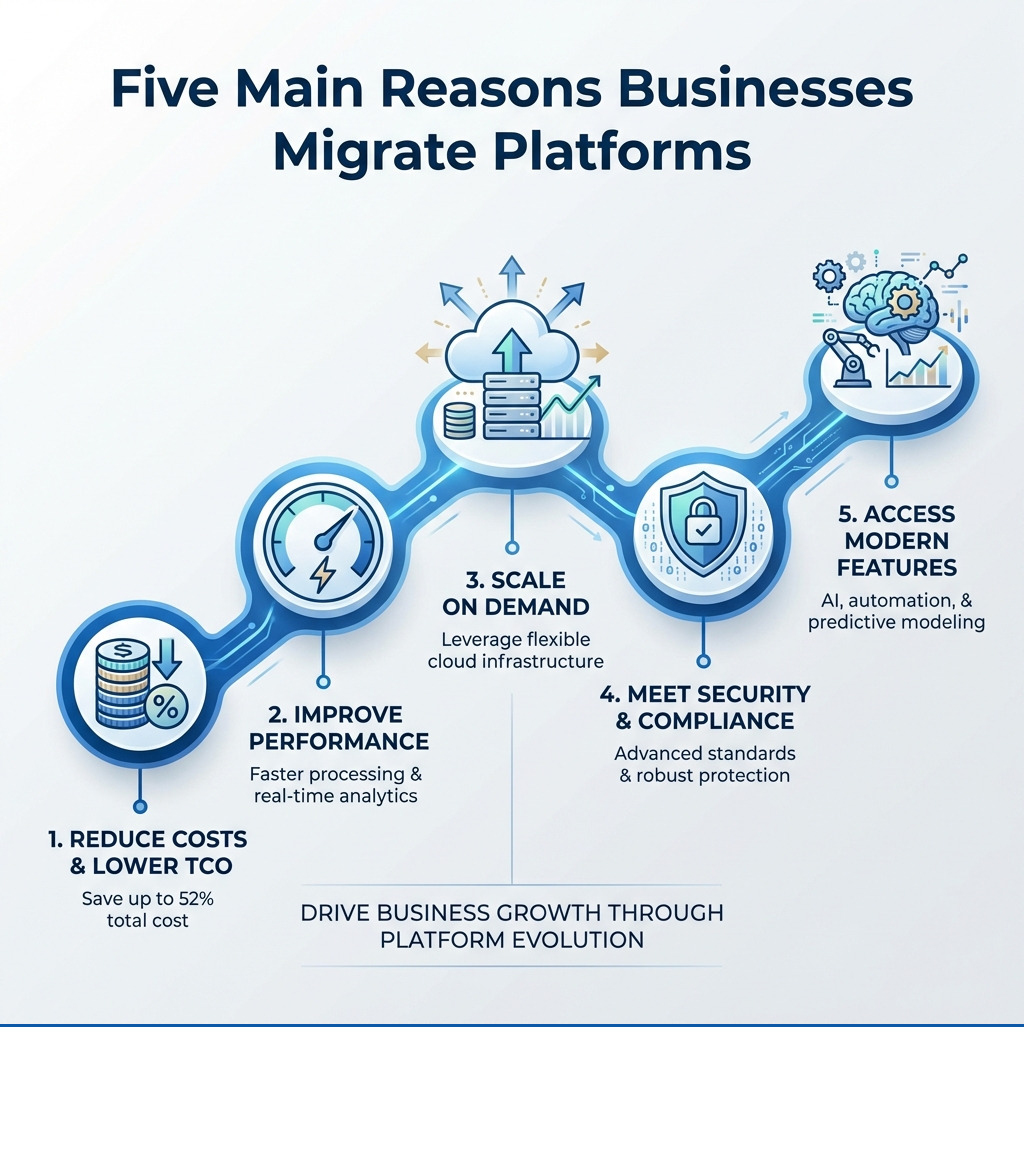
Modern platforms offer real-time data processing, advanced analytics, built-in security, and one-click backup and recovery. Cloud solutions let you scale on demand, simplify management, and access AI capabilities. Migrating to Google BigQuery, for example, can lower your total cost of ownership by up to 52%.
But here's the thing: the migration itself carries risk. Data loss, extended downtime, security breaches, and budget overruns are all possible if you choose the wrong partner.
The question isn't whether you can afford to migrate. It's whether you can afford not to.
That's why asking the right questions before you hire a Platform Migration Service provider is critical. You need a partner who understands your business goals, has deep technical expertise, follows proven methodologies, and will support you long after go-live.
As Steve Pogson, founder of First Pier, I've guided dozens of e-commerce brands through complex Platform Migration Services projects, from legacy systems to modern Shopify solutions, and I've seen what separates successful migrations from failed ones. The following ten questions will help you evaluate potential partners and choose one who will deliver results, not headaches.
Questions 1-3: Checking Experience and Alignment
When you're considering a significant shift like a platform migration, the first thing I check for in a partner is their track record and how well they understand my client's specific situation. It’s not just about technical skills; it’s about alignment with your business vision.

1. What is your experience with our type of platform migration?
This is where you need to get specific. A Platform Migration Service provider might be great at moving databases, but if your core need is to migrate an e-commerce store, their general database expertise might not be enough. For example, here at First Pier, we specialize in e-commerce migrations, particularly transitioning brands from various legacy systems to Shopify. We've seen that Shopify is an ecosystem built for high volume, performance, and flexibility, making it a powerful choice for many businesses.
I look for partners who can show a deep understanding of the specific platform you're moving from and to. This includes experience with common migration types like:
- E-commerce migrations: Moving from platforms like Salesforce Commerce Cloud (SFCC), Adobe Commerce (formerly Magento), BigCommerce, WooCommerce, or custom solutions to a more modern, agile platform like Shopify. This often involves intricate data mapping, integration of third-party apps, and ensuring minimal disruption to sales.
- Cloud migrations: Shifting entire infrastructures or specific applications to public clouds like AWS, Google Cloud, or Azure. This can involve full cloud migration, hybrid cloud models, or hosted application migration.
- Data center migrations: Moving entire physical data centers to a cloud environment.
- Application migrations: Moving specific applications, often modernizing them in the process. This can include migrating VMware workloads, SAP systems, or even modernizing mainframes.
- Database migrations: Moving on-premises databases to managed cloud database services.
A good partner should be able to provide case studies, not just general statements. I want to hear about their experience addressing industry-specific challenges and how they've handled migrations of similar complexity and scale. For instance, moving an enterprise brand from Adobe Commerce to Shopify involves specific technical challenges like managing EAV data and attribute flattening, which require specialized knowledge. My team and I have a lot of experience with this, and you can learn more about our Shopify migration work and how we help brands with these transitions. More about our Shopify migration work.
2. How will you align the migration with our business goals?
A platform migration isn't just a technical project; it's a strategic business move. The service provider should understand why you're migrating and how this change supports your broader business objectives. I always ask how they plan to connect the technical work to tangible business outcomes.
Common business goals that drive migration include:
- Cost reduction: Modern cloud platforms can significantly lower the total cost of ownership (TCO). For example, migrating to Google BigQuery can lower TCO by up to 52%.
- Improved agility: The ability to respond quickly to market changes, deploy new features faster, and experiment with new services.
- Improved customer experience: Faster website performance, more reliable service, and the ability to add new functionalities that improve user interactions. My team knows the importance of a well-designed user experience, and our e-commerce UX design services are built to support this. Our ecommerce UX design services.
- Scalability: The ability to handle increased traffic and data volumes without performance degradation, especially crucial for e-commerce businesses during peak seasons.
- Security and compliance: Moving to platforms with advanced security measures and built-in compliance standards.
A strong partner will start by understanding your specific business goals, not just your technical requirements. They should be able to articulate how their migration strategy will help you achieve these goals, plan for future growth, and define clear success metrics and Key Performance Indicators (KPIs). This alignment ensures the migration delivers a measurable Return on Investment (ROI) and truly moves your business forward.
3. What is your process for assessment and planning?
The foundation of any successful migration is thorough assessment and meticulous planning. I've seen projects go sideways because this critical phase was rushed or overlooked. A reliable Platform Migration Service provider will have a robust, structured methodology for discovery and planning.
This process typically includes:
- Initial discovery: This involves a deep dive into your current environment. It means identifying where information resides, understanding different document types, extraction needs, and metadata possibilities. For e-commerce, it means mapping product catalogs, customer data, order histories, and content.
- Inventory and dependency analysis: This step is about mapping all your applications, databases, and infrastructure components, and understanding their interdependencies. It's crucial to know what talks to what, to prevent unforeseen issues during the move. Tools like AWS Application Discovery Service can help gather configuration, usage, and behavior data from servers to understand workloads and their interdependencies.
- Risk assessment: Identifying potential risks like data loss, security vulnerabilities, or performance issues, and developing mitigation strategies for each.
- Building a migration roadmap: This is the blueprint. It defines the scope of the migration, the timeline, resource allocation, and a detailed budget. It should outline the specific steps, phases, and milestones.
- Defining scope, timeline, and budget: Clearly setting expectations for what will be migrated, when it will happen, and how much it will cost.
The value of a detailed plan cannot be overstated. It minimizes surprises, ensures all stakeholders are aligned, and provides a clear path to success. Without it, you're essentially navigating without a map.
Questions 4-6: Understanding the Migration Process and Technology
Once you're confident in a partner's experience and planning capabilities, the next step is to examine their actual migration process and the technology they employ. This is where the rubber meets the road.
4. What are the main steps in your migration process?
A transparent and well-defined migration process is a sign of a mature Platform Migration Service. I always ask for a clear breakdown of the phases involved, so I know what to expect at every turn. While specific steps can vary depending on the type of migration (data, application, or entire data center), a typical migration process often follows these phases:
- Assessment & Planning: As discussed, this involves discovery, dependency mapping, risk analysis, and creating a detailed migration roadmap.
- Design & Preparation: This includes setting up the target environment, configuring infrastructure, and preparing data for transfer. This phase might involve identifying issues and defining how to convert source data to fit the new system, which could include extracting documents and metadata, updating metadata, and data cleansing.
- Data & Application Migration: The actual movement of data and applications. This can be done in stages to minimize disruption. Services like AWS Database Migration Service (DMS) can help migrate databases easily and securely, keeping the source database operational. AWS Application Migration Service (MGN) allows quick realization of benefits by migrating applications to the cloud without changes and with minimal downtime.
- Testing & Validation: Rigorous testing of the migrated systems to ensure functionality, performance, and data integrity. This involves executing tests and performing verification to ensure the results are adequate, often using automated tools and client-led checks.
- Go-Live & Cutover: The final switch from the old platform to the new one, ideally with minimal downtime. The goal is to keep your business running smoothly throughout this transition.
- Post-Migration Support: Ongoing monitoring, optimization, and support after the new platform is live.
Minimizing downtime is a critical consideration, especially for e-commerce where every minute of outage can mean lost sales. A good partner will have strategies in place, such as continuous data replication and phased cutovers, to ensure business continuity.
5. How do you keep data secure and accurate during migration?
Data is the lifeblood of any business, and its security and integrity during migration are paramount. I can't stress this enough: ask detailed questions about data handling. You need to be assured that your data is protected from start to finish.
Key data security steps I look for include:
- Encryption in transit and at rest: All data should be encrypted while it's being moved and when it's stored in the new environment.
- Access controls: Strict controls over who can access your data during the migration process, with role-based access to limit exposure.
- Meeting compliance standards: For many businesses, adhering to regulations like GDPR, CCPA, HIPAA, or PCI DSS is non-negotiable. The partner must show how they meet these standards throughout the migration lifecycle. Cloud platforms like AWS, Google Cloud, and Azure are designed with advanced security measures to meet various compliance standards.
- Data checks and validation: Implementing checksums, data reconciliation, and other validation processes to ensure that all data is transferred accurately and completely, without corruption or loss.
- Backup and recovery plans: Having robust backups of your data both before and during the migration, along with clear recovery procedures in case of unexpected issues.
Services like AWS DataSync automate moving data between on-premises storage and Amazon S3, handling encryption and data integrity validation. Montrium's migration services, for example, emphasize automated checker scripts and client-led verifications to ensure data element migration and preservation of critical data attributes. Our team at First Pier also understands the importance of data integrity and compliance, especially with sensitive customer information. You can find more information on data migrations here: Data Migrations - Passerelle. And if you're migrating to Shopify, we also cover specific aspects of Shopify accessibility and data compliance. Shopify accessibility and data compliance.
6. How do you use automation or AI in your migration services?
Modern Platform Migration Services increasingly use automation and Artificial Intelligence (AI) to make migrations faster, more efficient, and less prone to human error. This makes a significant difference for complex projects.
How automation and AI help:
- Speeding up tasks: Automated tools can perform repetitive tasks like data extraction, change, and loading much faster than manual methods. Montrium, for instance, uses automated tools and proprietary machine learning technology to accelerate technical migration steps.
- Code analysis and refactoring: AI-driven tools can analyze existing codebases, identify dependencies, and even suggest or perform refactoring to make applications cloud-native. AWS Transform uses specialized AI agents to accelerate enterprise modernization of full-stack Windows, mainframe, and VMware workloads, as well as custom changes of code, APIs, and frameworks.
- Data mapping: For complex data migrations, AI can assist in mapping data fields between disparate systems, reducing the manual effort and potential for errors.
- Automated testing: AI can generate test cases, execute tests, and validate results automatically, ensuring the migrated system functions as expected.
- Lowering human error: By automating routine tasks, the risk of manual mistakes is significantly reduced, leading to a smoother and more reliable migration.
The use of AI and automation can lead to more stable, streamlined operations and help organizations accept broader technological innovations. For my clients, especially those on Shopify, we look for ways to automate processes where it makes sense, improving efficiency and reducing maintenance overhead. You can explore our Shopify automation services to see how we apply these principles. Shopify automation services.
Questions 7-8: Managing Risks and Post-Migration Support
Even with the best planning, migrations can encounter unexpected issues. A good partner doesn't just promise a smooth ride; they prepare for turbulence and offer comprehensive support once you've landed.
7. What are common migration challenges, and how do you address them?
Every migration has its problems. A partner who pretends otherwise isn't being realistic. I want to hear about the typical issues they've encountered and, more importantly, their strategies for overcoming them.
Common migration challenges include:
- Data loss or corruption: This is a major fear. Mitigation involves rigorous data validation, checksums, and rollback plans.
- Extended downtime: While some downtime is often unavoidable, excessive outages can severely impact business. Strategies like phased migrations, continuous data replication (as offered by AWS DMS), and blue/green deployments can minimize this.
- Performance drops post-migration: The new platform might not perform as expected. This can be mitigated by thorough performance testing and optimization during the testing phase.
- Scope creep and budget overruns: Unforeseen requirements or changes during the project can lead to increased costs and delays. Clear scope definition and change management processes are essential.
- Integration complexities: Connecting the new platform with existing third-party systems (ERPs, CRMs, marketing tools) can be challenging. A partner should have expertise in API development and integration.
- Lack of internal team readiness: Your team needs to be prepared to use the new system. Training and change management are crucial.
My team and I emphasize clear communication plans and robust change management strategies. We believe in proactive identification of potential issues and having contingency plans in place. A comprehensive risk reduction analysis, focusing on compliance, security, and performance, is vital to a successful migration.
8. How do you support operations and improvements after migration?
The migration isn't over when the new system goes live. In fact, that's often just the beginning of a new phase. A truly valuable Platform Migration Service partner will offer robust post-migration support to ensure stability and help you get the most out of your new environment.
This support typically includes:
- Hypercare period: An intensified support phase immediately following go-live, where the team is on high alert to address any immediate issues or unexpected glitches.
- Performance monitoring: Continuous monitoring of the new platform to ensure it's meeting performance benchmarks and identifying any bottlenecks.
- Cost checks and optimization: Especially in cloud environments, ongoing monitoring of resource usage and costs is important to ensure you're not overspending. This includes system tuning to maintain efficiency.
- Staff training: Ensuring your internal teams are fully proficient with the new platform and its features.
- Ongoing maintenance: Regular updates, security patches, and general upkeep of the new system.
For e-commerce clients, this ongoing support is crucial for sustained growth. It's about ensuring the new platform delivers on its promise of improved agility, scalability, and improved customer experience. At First Pier, we focus on helping clients continually refine and improve their Shopify experience, which includes services like Shopify Plus optimization to ensure they are getting the most out of their investment. Shopify Plus optimization.
Questions 9-10: Costs, Timelines, and Support
Finally, let's talk about the practicalities: costs and ongoing partnership. These factors often determine the long-term success and satisfaction with a Platform Migration Service.
9. What is the total cost of ownership (TCO), and how do you measure ROI?
Understanding the full financial picture is essential. A good partner will help you look beyond just the migration service fees to calculate the true Total Cost of Ownership (TCO) of your new platform.
When discussing TCO, I consider:
- Service fees: The cost of the migration partner's services.
- Platform licensing: Ongoing costs for software licenses or subscription fees for the new platform (e.g., Shopify Plus fees, cloud service subscriptions).
- Infrastructure costs: For cloud migrations, this includes compute, storage, and networking costs.
- Internal resources: The time and effort your internal team will spend on the project.
- Training costs: Investing in your team's education on the new system.
- Integration costs: Fees for connecting the new platform to your existing tools.
A partner should be able to provide a clear breakdown of these costs and show how they measure ROI. This isn't just about saving money; it's about the value generated. For example, migrating to a modern data warehouse like Google BigQuery can result in a lower TCO by up to 52%, but the ROI also comes from improved data analytics, faster decision-making, and the ability to innovate. Lower TCO up to 52%.
ROI for a platform migration can be measured through:
- Revenue impact: Increased sales, higher conversion rates, or average order value due to improved performance and features.
- Lower operating costs: Reduced infrastructure expenses, less maintenance overhead, and more efficient workflows.
- Improved agility: Faster time to market for new products or features.
- Improved customer satisfaction: Leading to better retention and brand loyalty.
The goal is to ensure the investment in Platform Migration Services pays off through tangible business benefits.
10. What does your support look like during and after the project?
A strong partnership extends beyond the technical execution. You need to know that your chosen Platform Migration Service provider will be there for you, both during the intense migration phase and as you settle into your new platform.
Key aspects of support to inquire about include:
- Dedicated project manager: A single point of contact who understands your project inside and out, keeping communication clear and consistent.
- Communication methods: How will they communicate updates, issues, and progress? (e.g., regular meetings, dedicated chat channels, project management tools).
- Reporting schedule: How often will you receive progress reports, and what will they include?
- Escalation process: What happens if a critical issue arises? Who do you contact, and what are the expected response times?
- Service Level Agreements (SLAs): Clear agreements on response times, resolution times, and system availability.
- 24/7 support: Is round-the-clock support available, especially crucial for global businesses or during critical phases?
- Access to experts: Will you have access to specialized technical experts if needed?
At First Pier, I believe in building lasting relationships with our clients. We offer comprehensive Shopify development services that cover the entire lifecycle of your e-commerce platform, from initial build to ongoing support and optimization. Shopify development services. This continuous partnership ensures that your platform remains high-performing, secure, and aligned with your evolving business needs.
Conclusion
Starting a platform migration is a significant undertaking, but it’s often a necessary step to stay competitive and drive growth. The right Platform Migration Service can turn a daunting challenge into a strategic advantage, paving the way for innovation, efficiency, and a better customer experience.
By asking these ten questions, you'll be well-equipped to evaluate potential partners and choose one that truly understands your business, possesses the technical prowess, and offers the long-term support you need. Careful planning and a strong partnership are the cornerstones of a successful migration.
Here at First Pier, we pride ourselves on our experience in guiding e-commerce brands through complex platform migrations, particularly to Shopify. My team and I are committed to ensuring a smooth transition that aligns with your business goals and sets you up for future success.
If you're considering a platform migration and want a partner who combines deep technical expertise with a clear understanding of your business objectives, I invite you to reach out. Contact us to discuss your platform migration.





.png)
.png)
