



Why a Comprehensive Marketing Approach Matters for Your Shopify Store
Summary
- Shopify marketing methods include foundational SEO, content marketing, email campaigns, social media, influencer partnerships, referral programs, and paid advertising.
- Email marketing has an average return of $42 for every dollar spent, and 75% of search clicks go to the top three organic results.
- Effective Shopify marketing uses a multi-channel plan that combines organic methods like SEO with direct engagement and paid promotion.
- Measurement tools like Shopify Analytics and Google Analytics are used to track conversion rates, customer acquisition costs, and return on investment.
- Nearly two million businesses use Shopify, which requires a distinct marketing strategy to gain visibility.
Shopify marketing tips are important for any online store owner who wants to be seen among the nearly two million businesses on the platform. The most effective approach combines foundational elements like search engine optimization and content creation with direct customer engagement through email and social media, plus paid advertising and promotions. Here's what works:
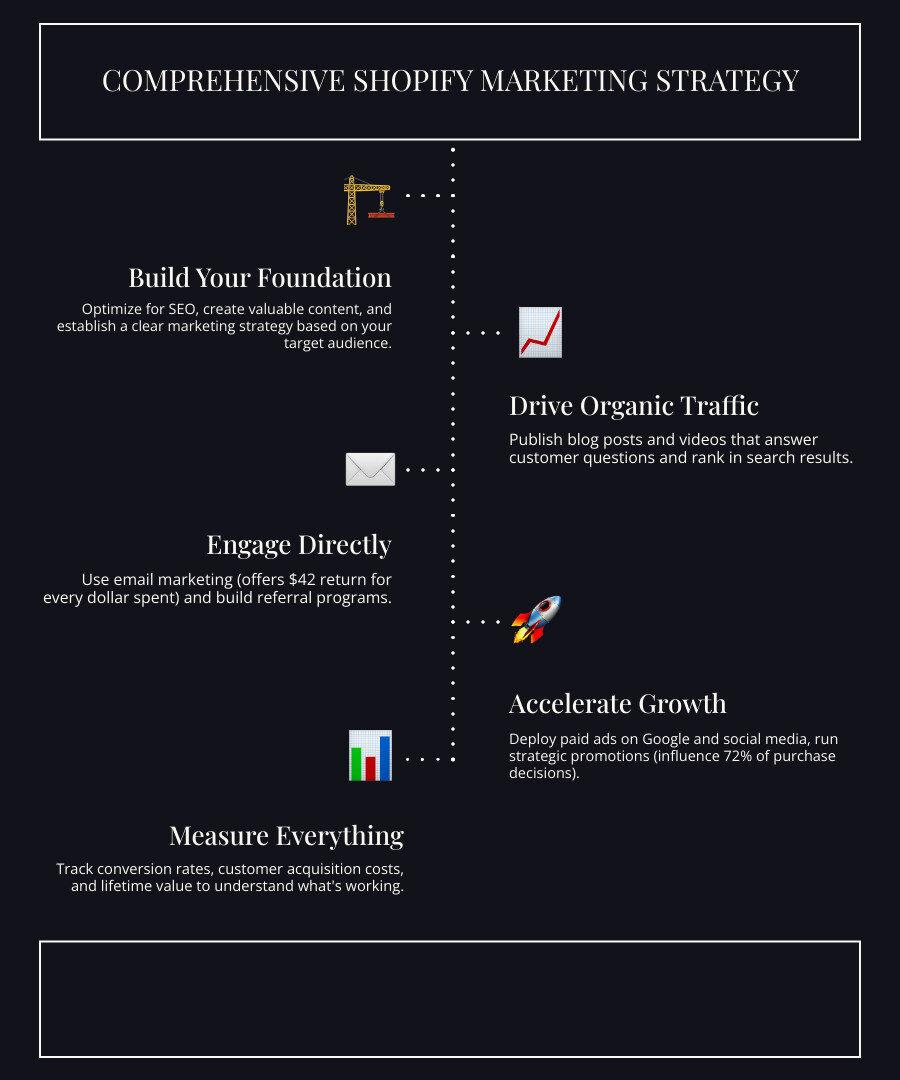
- Build your foundation - Focus on SEO, create useful content, and establish a clear marketing plan based on your target audience
- Drive organic traffic - Publish blog posts and videos that answer customer questions and rank in search results
- Engage directly - Use email marketing (which offers a $42 return for every dollar spent) and build referral programs
- Accelerate growth - Deploy paid ads on Google and social media, run planned promotions (which influence 72% of purchase decisions)
- Measure everything - Track conversion rates, customer acquisition costs, and lifetime value to understand what's working
A coffee roaster might combine excellent product photography with blog content about coffee origins. A toy store could write unique product descriptions to capture organic search traffic while running a referral program to turn happy parents into brand advocates. The brands that win are those that connect their marketing efforts into a cohesive plan.
I'm Steve Pogson, and over two decades, I've helped e-commerce brands apply Shopify marketing tips that produce measurable growth. I've built marketing plans for companies like Wyman's Blueberries and Hyperlite Mountain Gear. The strategies that follow come from that real-world experience working with Shopify stores across different industries and growth stages.
Building Your Foundation: Strategy and SEO
A marketing plan defines your goals, audience, and how you will make your store visible to search engines. This work directs your budget toward activities that bring in customers.
A marketing strategy is an action plan for reaching customers. I've found that a documented strategy improves results. The goal is to connect with your target audience through focused campaigns and invest your budget in activities that convert.
The marketing strategy for an e-commerce business, especially on Shopify, has a few core elements. I always start with defining your unique value proposition – what makes your products different and better? Then, conduct thorough market research to understand your target audience. This includes their demographics, psychographics (values, interests), behaviors (shopping habits), and pain points. You can gather this by analyzing competitors, checking analytics, and interviewing potential customers.
Once you have a clear understanding of your audience and offering, set measurable marketing goals using the SMART framework (Specific, Measurable, Achievable, Relevant, Time-bound). This creates a clear target for all your efforts. Finally, consider the 7 Ps of marketing strategy: Product, Price, Promotion, Place, People, Packaging, and Process. This framework helps you determine how you'll promote your products, reach your target audience, and increase sales. For instance, the "Product" P involves clearly defining its design, features, and problems it solves. The "Packaging" P helps align your product presentation with your brand identity and communicates your unique selling points. Understanding these elements is important for building a strong brand identity.

Optimizing Your Shopify Store for Search Engines
Shopify has built-in SEO features, but you need a deliberate approach to rank. Since 75% of clicks go to the top three organic results, getting SEO right is important. Focus on unique, useful content, like the toy store Milk Tooth, which writes original product descriptions to outrank competitors.
Optimizing your Shopify store for search engines (SEO) is about making it easy for customers to find you when they search for products you sell. This means appearing higher in search results, ideally among those top three organic spots. My experience shows this is often more effective in the long term than relying solely on paid ads for visibility.
The process begins with keyword research. I use tools to find the exact words and phrases your target audience uses when searching for products like yours. Once you have those keywords, you need to add them to your store. This is called on-page optimization. It involves writing unique, detailed product descriptions that speak to your customer's needs and interests, not just copying manufacturer descriptions. Kath Vaughn, owner of Milk Tooth, found that writing unique, parent-focused product descriptions brought in over 45% of her total orders from organic Google traffic. This shows the effect of being specific and helpful.
Beyond product descriptions, on-page SEO also includes page titles, meta descriptions, image alt text, and header tags. Your Shopify store should have a clear site structure, making it easy for both search engines and users to navigate. Site speed is another important factor; a fast-loading website improves user experience and search rankings. Finally, building high-quality backlinks from other reputable websites to your store signals authority to search engines. For more information on making your store rank higher, see our SEO services.
Driving Traffic with Content and Social Media
Content and social media are used to connect with your audience. A blog can show your authority and attract organic traffic, while social platforms allow you to build a community and engage directly with customers. Annual site traffic growth is 7.8 times higher for brands that use content marketing.
Content marketing is a way to promote a Shopify store by giving useful information to your audience. This approach builds trust and shows your brand's expertise. I've seen that brands using content marketing have significant growth in unique site traffic. This is a long-term method that requires consistency and patience, but the rewards are worth the effort.
Social media marketing is also important for connecting with customers. Roughly 33% of consumers use social platforms like Facebook and Instagram to discover or research new products. This makes platforms like Facebook, Instagram, and TikTok useful for brand awareness and finding new customers. My method is to research where an audience is most active and create content for those channels. This might include sharing user-generated content (UGC), which around 40% of US shoppers find important for their purchasing decisions. Livestreaming and social commerce are methods that allow for direct interaction and sales. For expert help in this area, consider our paid social services.

Developing a Content Marketing Plan
Your content should be useful, not just promotional. Create tutorials, guides, and behind-the-scenes looks at your brand. For example, Beardbrand creates men's grooming tutorials on YouTube, targeting specific search queries to attract its ideal audience.
When developing a content marketing plan for a Shopify store, I focus on creating a mix of content types that serve different purposes. Blog posts are effective for targeting educational keywords and showing your brand's expertise. They can cover topics related to your products, industry topics, or customer pain points. For instance, Illuminate Labs publishes health-related blog posts that significantly increased their organic page views.
Video marketing is another part of the plan. Online videos are a large part of consumer web traffic, and YouTube is the second most popular search engine. I recommend creating educational and evergreen video content. Beardbrand, for example, creates men's grooming tutorials on YouTube, which helps them rank for specific search queries. You can also use live video to create direct connections, as Camille Rose did by hosting Instagram Lives with collaborators during the pandemic. When creating video, use YouTube SEO best practices like custom thumbnails, relevant tags, and keyword-rich descriptions to help people find it.
Beyond blogs and videos, consider other forms of content like guides, infographics, or interactive quizzes. These can serve as lead magnets, helping you build your email list by offering useful information in exchange for an email address. This approach focuses on providing genuine use, which in turn builds trust and attracts potential customers. For help in creating marketing materials, see our collateral design services.
Shopify Marketing Tips for Direct Engagement
Direct channels like email and influencer marketing are used for personalized communication and building trust. While social media is crowded, email provides a direct line to your customers with a high ROI. Likewise, working with the right influencers can generate relevant traffic and authentic endorsements.
Email marketing is a key part of effective Shopify marketing tips. It consistently delivers a high return on investment (ROI), with some estimates suggesting a 3,600% return, meaning you could earn $36 for every dollar spent. This is largely because the inbox is a direct line to your customers, unlike social media where organic reach can be limited. My approach involves building your email list through lead magnets like free quizzes or coupon codes, segmenting your subscribers based on their interests or purchase history, and sending personalized, automated email flows. Shopify Magic can even help propose subject lines and body copy, and adjust send times.
Influencer marketing is another method for direct engagement. The statistic that 71% of marketers say the quality of customers and traffic from influencer marketing is better than from other sources is significant. This is because influencer recommendations feel like direct communication, almost like a suggestion from a friend. I advise finding influencers whose audience overlaps with your own. This might include nano or micro-influencers who have highly engaged, niche communities. You can collaborate by sending free products, arranging sponsored content, or inviting them to be affiliates. Tools like TikTok Creator Marketplace and HypeAuditor can help vet creators and check if their audience is authentic.
Building a Customer Referral Program
A referral program encourages word-of-mouth marketing, which is effective because people trust recommendations from friends. Brands like Doe Lashes use apps to create simple programs that reward customers for spreading the word.
A customer referral program is one of the most cost-effective Shopify marketing tips for acquiring new customers. It works because of the trust people have in recommendations from friends and family. In fact, 92% of consumers believe suggestions from friends and family more than advertising.
The best practices for building a referral program involve offering appealing rewards to both the referrer and the referred customer. This could be a discount, store credit, or even a free product. The key is to make it easy for your customers to share their unique referral links. Shopify apps like Referral Candy or Yotpo can help you set up and manage these programs. For example, Beauty Bio's referral program gives both new and existing customers a $25 discount on their next purchase. By turning your satisfied customers into brand advocates, you get them to do your marketing for you, using authentic word-of-mouth. This method not only brings in new customers but also builds loyalty among your existing base. See how we can help with email and SMS marketing and e-commerce community and loyalty programs.
Using Paid Ads and Promotions
Paid advertising and promotions can provide an increase in traffic and sales. These tactics are useful for launching new products, clearing inventory, or reaching specific audiences quickly. With nearly three out of four consumers influenced by discounts, a well-structured promotion can be an effective acquisition tool.
The benefits of paid advertising are clear: rapid visibility, precise targeting, and immediate traffic generation. Platforms like Google Ads and social media ads (Facebook, Instagram, TikTok) allow you to reach specific demographics and interests. For example, Google Ads campaigns can capture potential customers already searching for products like yours. Catherine Wilson of Essential Derma found that a paid brand search campaign can bring good results, averaging a 78¢ cost per conversion. The drawback, however, is the cost. Competition for popular keywords can lead to high cost-per-click, and budgets require careful monitoring.
Promotional tactics like sales and discounts are effective. Nearly three out of four (72%) consumers said discounts influenced their decision of where to buy. I recommend structuring discounts to encourage larger order values or repeat purchases, such as "10% off purchases of $100 or more," rather than blanket discounts. Flash sales can create urgency and increase immediate traffic.
Customer reviews and testimonials are an important marketing asset. 93% of consumers actively look for reviews before trusting a new business. I always encourage businesses to proactively request reviews and show them prominently on product pages and marketing materials. Positive reviews build social proof and trust, helping to convert hesitant shoppers. New Era Factory Outlet, for example, found that referral traffic from local sites like Yelp outperforms organic search in engagement metrics. AI-powered review response generators can even help draft on-brand replies and summarize feedback. For guidance on improving your store's appeal, see our e-commerce UX design services.
Using Paid Advertising for Your Shopify Store
Paid ads on Google or social media can bring in targeted traffic. It is important to have a clear goal, a defined audience, and a relevant landing page. Catherine Wilson of Essential Derma notes that a paid brand search campaign can produce good results once you are established in your space.
When using paid advertising for your Shopify store, I recommend a planned approach. For Google Ads, this includes Search ads, Display ads on the Google Display Network, and Video ads on YouTube. Google's AI-driven Performance Max and Smart Bidding can optimize campaigns across these channels, finding high-propensity shoppers with minimal manual setup. The most effective campaigns target specific keywords and demographics, directing traffic to well-designed landing pages that align with the ad's message.
Social media ads on platforms like Facebook and Instagram are useful for reaching target audiences and building brand awareness. Meta’s Advantage+ uses AI to find look-alike audiences and personalize ads dynamically. Retargeting campaigns are effective, allowing you to reconnect with visitors who previously showed interest but didn't convert. This helps recover abandoned carts, a significant issue with an average global abandonment rate of 70.19%.
A/B testing is important for improving your ad creatives, copy, and landing pages. This continuous testing helps you understand what resonates best with your audience and improves your return on ad spend. Budgeting for paid ads requires careful planning to allocate resources effectively across different platforms and campaigns. For expert assistance in managing your paid advertising, our paid search and SEM services can help.
Advanced Shopify Marketing Tips and Measuring Success
Once you have the fundamentals in place, you can explore advanced tactics and focus on measurement. Collaborating with other brands, trying unconventional methods, and using AI can be effective. You must track your results to understand what's working and where to allocate your resources.
Advanced Shopify marketing tips often involve less common methods. Brand collaborations, for instance, can expand your reach by using another brand's audience. If you sell handmade jewelry, partnering with a local boutique that sells complementary apparel could introduce you to new customers. The goal is to find non-competing brands with similar target audiences, allowing you to split costs and cross-promote.
Guerrilla marketing offers creative, often low-cost ways to get attention. Think about the olive oil company Graza that posted "Wanted" flyers for its limited-edition chips around cities, directing curious people to its newsletter. Or the direct-to-consumer brand Muddy Bites that collaborated with an influencer to video building the world's largest ice cream cone. These unconventional tactics can create memorable experiences and earn media attention.
AI in marketing is now used to improve various methods. From drafting product descriptions in your brand's voice using Shopify Magic to using AI-driven tools to vet influencers like HypeAuditor and CreatorIQ, AI can increase efficiency. It can propose email subject lines, adjust send times, and even initiate quick text conversations to address sales objections. AI-assisted product-finder quizzes, like the one used by Wicked Edge, can offer personalized recommendations, leading to higher conversion rates and average order values. AI also plays a role in paid ads, with platforms like Google and Meta using it to find high-propensity shoppers and personalize ads.
How to Measure Your Marketing Efforts
Use tools like Shopify Analytics and Google Analytics to track key metrics. Monitor website traffic, conversion rate, customer acquisition cost (CAC), and customer lifetime value (CLV). This data is important for making informed decisions and proving the return on your marketing investment.
Measuring the success of your Shopify marketing efforts is important. I rely on data to understand what's working, what needs adjustment, and where to allocate future resources. The core tools for this are Shopify Analytics and Google Analytics 4 (GA4).
Key performance indicators (KPIs) I track include:
- Website Traffic: The number of visitors to your store, segmented by source (organic search, social media, paid ads, email).
- Conversion Rate: The percentage of visitors who complete a desired action, like making a purchase.
- Average Order Value (AOV): The average amount spent per customer order.
- Customer Acquisition Cost (CAC): How much it costs to acquire a new customer through a specific marketing channel.
- Customer Lifetime Value (CLV): The total revenue a business can expect from a single customer account throughout their relationship.
- Return on Investment (ROI) and Return on Ad Spend (ROAS): These metrics tell you the profitability of your marketing investments.
By regularly examining traffic patterns, user behavior, and customer feedback, you can identify pain points and adjust your strategies. For example, a quiz widget on Wicked Edge's site has a 3.6% conversion rate, significantly higher than their site-wide average, showing the impact of the tool. Analyzing this data allows you to make informed decisions and continuously improve your marketing performance. For detailed information about your store's performance, our e-commerce analytics and analysis services are designed to help you make sense of your data. We can also assist with Shopify development services to help your store be built for effective tracking and performance.
Frequently Asked Questions about Shopify Marketing
What are the most effective marketing strategies for Shopify stores?
The most effective methods involve a multi-channel approach. This includes foundational SEO, content marketing, targeted email campaigns, a social media presence, and planned use of paid ads. The ideal mix depends on your product, audience, and budget.
How can I market my Shopify store with no money?
Focus on organic tactics. Improve your store for SEO to attract search traffic. Create useful content like blog posts and videos. Build a community on social media. Encourage customer reviews and user-generated content. Start a basic email list and communicate with subscribers.
How do I measure the success of my marketing efforts?
Track key performance indicators (KPIs) using Shopify Analytics and Google Analytics. Key metrics include website traffic, conversion rate, average order value (AOV), customer acquisition cost (CAC), and customer lifetime value (CLV). Analyzing these numbers will show you which channels deliver the best return on investment.
A Clear Marketing Plan
Marketing a Shopify store requires a clear plan. By combining foundational SEO and content with direct channels like email and social media, you can build a customer base. Paid ads and promotions can then be used to increase growth, while consistent measurement helps make your efforts effective and your budget well-spent.
Building and applying a marketing plan takes expertise. Here at First Pier, we help e-commerce brands create and use plans that produce results. If you want to grow your online business, see how our award-winning Shopify e-commerce agency can help.





.png)
.png)

