


What Brand Identity Elements Really Mean for Your Business
Summary
- Brand identity consists of a business's core purpose, values, voice, and visual assets like logos, colors, and typography.
- A well-defined brand identity builds recognition, trust, and influences customer purchasing behavior.
- Consistency in applying these elements across all platforms is essential and is maintained through brand guidelines.
- Visual components like logos and color palettes create immediate recognition and convey specific emotional cues.
- The development process involves research, strategic definition, visual design, and ongoing management to ensure cohesion.

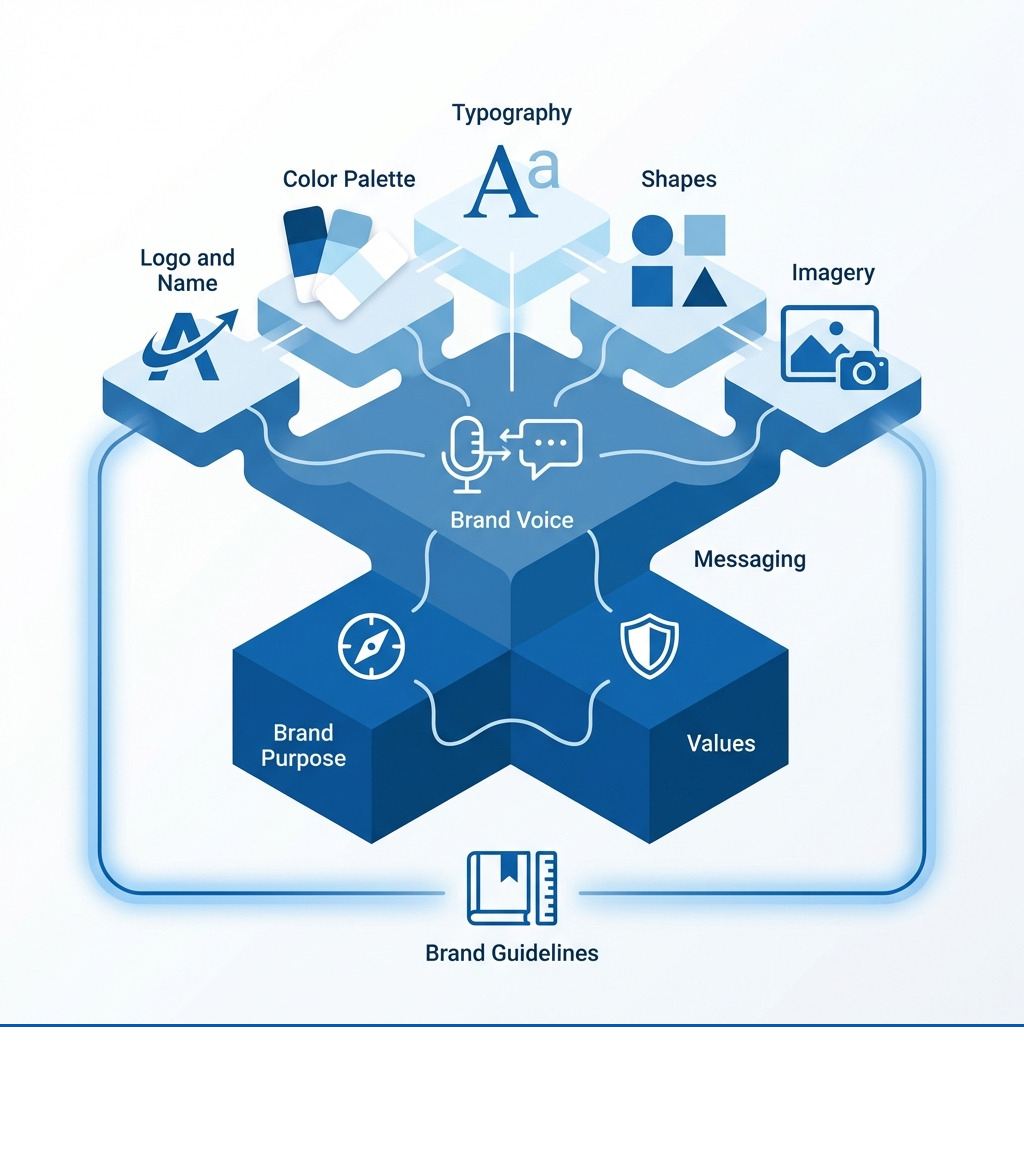
Brand identity elements are the tangible and intangible components that define how your business presents itself to the world. These include:
- Core Foundation: Brand purpose, values, mission statement, and brand voice
- Visual Elements: Logo, color palette, typography, shapes, and iconography
- Verbal Elements: Brand name, tagline, slogans, and messaging
- Experiential Elements: Imagery style, photography, graphics, and packaging design
- Implementation Tools: Brand guidelines and application standards
Think about the Starbucks siren logo. Now picture it in bright orange instead of green. That jarring feeling you get? That's the power of consistent brand identity elements at work. Every element—from color to voice—works together to create instant recognition and emotional connection.
Your brand identity is more than just a logo or a catchy slogan. It's the complete system of visual and verbal cues that shapes how customers perceive your business. When done right, these elements build trust, differentiate you from competitors, and influence purchasing decisions. Research shows that 52% of consumers are willing to pay more for products from brands that communicate their values clearly, with 82% willing to spend up to 30% more.
Here at First Pier, I'm Steve Pogson, and over two decades of building e-commerce brands, I've seen how the right brand identity elements can turn a struggling store into a market leader. We've worked with businesses like Wyman's Blueberries and Hyperlite Mountain Gear to create cohesive brand systems that produce real growth.
The Foundation: Brand Purpose, Values, and Voice
Before any visual design takes shape, a brand's identity is rooted in its core principles and how it communicates. This foundational layer is the 'why' and 'how' of your business, informing every visual and verbal choice you make.
Defining Your Brand's Purpose and Values
Every strong brand starts with a clear purpose. This isn't just about what you sell, but why you sell it, and what problem you are solving for your customers. Your brand's purpose answers the fundamental question: "Who are you to your audience?" It's guided by your value proposition, mission, and vision statements, and it should connect with your target audience. For instance, The Farmer’s Dog, a specialty dog food company, began because one of its founders wanted a better way to feed his dog, Jada, who had stomach issues with processed food. This desire for better pet health ballooned into a billion-dollar company, driven by a clear purpose.
Your core values are the guiding principles that shape your brand's behavior and decisions. They dictate how you operate, interact with customers, and approach product development. When customers see that your brand's actions align with its stated values, it builds trust and loyalty. The Akeneo study on consumer behavior showed that 52% of respondents were willing to pay more for products that communicate their company’s brand values, with 82% willing to spend up to 30% more. This shows the direct financial impact of clearly defined and communicated values.
To begin defining these crucial elements, I recommend reviewing your value proposition, mission, and vision statements. Pinpoint the elements that resonate with your target audience. This internal clarity is the first step in building an effective Digital Branding Strategy.
Finding Your Brand's Voice and Messaging
Once your purpose and values are clear, you need to define how your brand speaks. Your brand voice is the personality that comes through in all your communications. It gives volume and depth to your content and helps your audience interpret your brand's character. Is your brand witty, formal, approachable, or authoritative? Defining your brand voice typically involves choosing three or four descriptive adjectives and learning when and how to apply them across different channels and situations.
Messaging, including slogans and taglines, is how your brand's voice is distilled into memorable phrases. A tagline is a short, memorable phrase that emphasizes what your brand offers, acting as its promise to customers. For example, Subway's "Eat Fresh" tagline promises quality ingredients and a healthy option. It doesn’t need to be complicated; sometimes, the simplest messages are the most enduring. I remember the "Head-On: Apply Directly to the Forehead" commercials. While they might have been annoying, the slogan was simple and undeniably catchy, showing how a basic message can stick.
A brand's voice and messaging can also be a powerful tool for reinvention. Consider Old Spice. For years, it was perceived as a brand for an older generation. But in 2010, they successfully changed how younger audiences perceived them through their "Be like a man, man" advertising campaign. They started using tongue-in-cheek humor to mock men who smelled "like a lady," effectively repositioning the brand as humorous, modern, and self-aware. This shift in tone and messaging completely changed their identity. To see an example of how brand voice can shape perception, look at our work on Branding for Funky Home Goods Shop.
The Visual Toolkit: Your Core Brand Identity Elements
Now that we've established the 'who' and 'why' of your brand, it's time to build the 'what' – the tangible, visual components that customers see and interact with. These are the recognizable elements that form the face of your brand.
Logo, Name, and Tagline: Your Brand's Signature
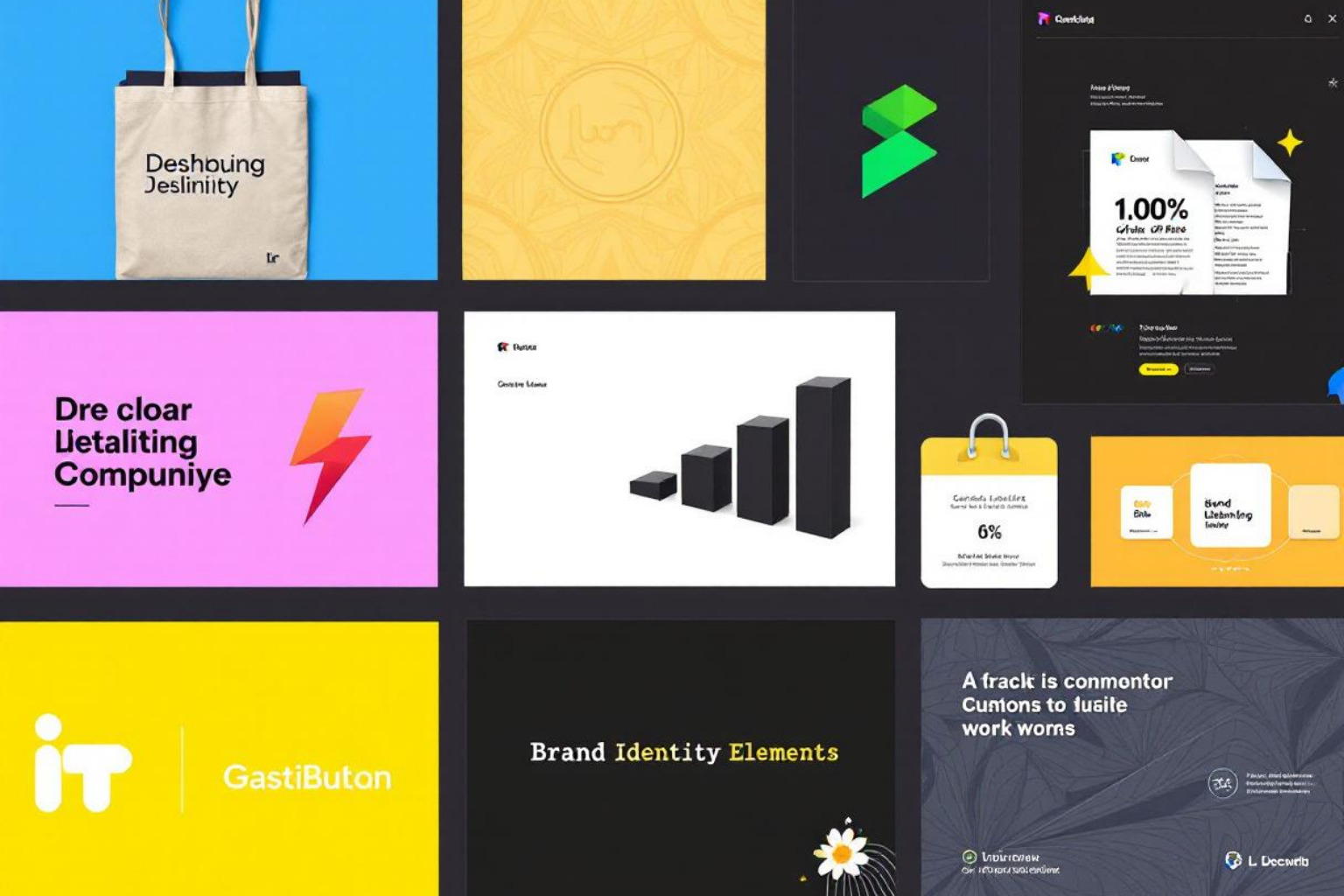
Your brand name is often the first and most direct way a consumer interacts with your brand. A good brand name is easy to remember and distinguishes you from competitors. Research shows that an easier-to-remember brand name has more staying power with consumers than something confusing. Just ask Quibi how that went for them. It's also crucial to consider cultural contexts; what means "full speed" in Swedish, like IKEA's "FARTFULL" desk, might not translate well elsewhere.
The logo is the most important visual element of your brand identity. It appears across countless touchpoints and should be designed for timelessness. Easier said than done, of course, but the best logos are ones that companies commit to for the long haul. Jaguar’s recent logo redesign and subsequent flop are a good reminder of a timeless logo's value. Iconic logos like Nike's, Apple's, and Amazon's are instantly recognizable, which is why many companies invest significant resources into logo design. Pepsi, for example, spent a whopping $1,000,000 to have their logo designed.
Beyond the main logo, you need logo lockups. These are variations of your main logo—horizontal, vertical, black and white, transparent—that ensure your brand maintains its integrity across different marketing materials and platforms. For smaller applications, like social media profile pictures, a streamlined version without text is often essential. For example, our case study on Branding for an Indie Hot Sauce Brand shows how a versatile logo system was developed.
Finally, taglines, as mentioned earlier, serve as verbal logos, succinctly communicating your brand's purpose or benefit. They connect with customers and reinforce your core message.
Color, Typography, and Shape: The Visual Language
Your brand's visual identity makes a key first impression for your buyers. And that happens fast: people make their judgments of your website’s visual appearance in as few as 50 milliseconds.
A strong color palette is fundamental to brand identity. Colors are associated with specific emotions and influence audience perception, contributing to memorability and impact. Blue often expresses calm, while red and yellow can convey passion and energy. The tint or shade you choose can adjust this emotion. It's important to consider cultural differences too; yellow, seen as bright and happy in the US, is linked with mourning in parts of Latin America. Tiffany blue and UPS brown are excellent examples of trademarked colors that are instantly synonymous with those brands. For guidance on color theory, I often refer to general resources like Color Meanings. An important note on color schemes: common accessibility guides, specifically WCAG 2, dictate color schemes that make browsing more accessible for people with disabilities. These guidelines are critical, as accessibility lawsuits are growing in number and scale. Tools like WhoCanUse.com are great for checking contrast.
Typography, the choice of typefaces, spacing, and sizing, also communicates your brand's personality and values. Serif fonts, with their small decorative strokes, often convey tradition or elegance, while sans-serif fonts are generally seen as modern and clean. Many designers feel serif fonts are getting stale, which is why sans-serif fonts are currently popular. Regardless of your choice, pick a web-safe font or include one in your font stack as a fallback to ensure consistency across all platforms.
Shapes are like the body language of your brand. A famous 1929 linguistic experiment found that people consistently associate spiky shapes with "kiki" and rounded, splotchy shapes with "bouba" about 88% of the time, across languages and cultures. This "bouba/kiki effect" shows how shapes factor into your brand’s visual identity more than you might expect. Circles are often perceived as friendly and inclusive, squares as reliable, and triangles as exciting. For instance, a honey brand might use a hexagon-shaped jar, inspired by honeycombs, to connect with nature. These choices are integral to your Ecommerce Branding Kit.
Imagery and Iconography: Telling Your Visual Story
Imagery, whether photography or illustration, tells your brand's story and influences audience perception. Consistency in image style—color palette, subject, style—is crucial for brand recognition. For example, Tesla's imagery often features its cars on open highways, conveying speed and desirability, while Rivian focuses on nature, emphasizing preservation. This consistent visual storytelling helps define their respective identities.
Iconography, the system of icons used across your platforms, also plays a significant role. Icons add to the professionalism and help maintain brand identity, but they too evolve with design trends. When Apple released iOS 7 in 2013, it redesigned its app iconography from a skeuomorphic (realistic, 3D-like) design to the flat, two-dimensional design used today. This shift influenced the entire industry. Another example is Nickelodeon's "splat" logo. The company abandoned it in 2009 for a more minimalist take but resurrected it 14 years later during a major rebranding effort because of its meaningfulness and strong association with childhood memories. This shows the lasting impact of well-chosen shapes and icons. Our case study on Brand Identity for Jewelry Earthly Delights Brand highlights the importance of cohesive imagery.
The Process: Building and Maintaining a Cohesive Identity
Building a strong brand identity is a systematic process, not a one-time event. It requires careful planning, execution, and ongoing management to ensure it remains consistent and effective over time.
A Practical Process for Developing Brand Identity Elements
Creating a cohesive brand identity starts with a deep understanding of your business and its environment.
- Market Research: This is your starting point. You need to understand your target audience, their needs, desires, and how they perceive your industry. It also involves analyzing your competitors' brand identities to find common approaches and identify opportunities for differentiation. If you're new to market research, there's a wealth of content online, and tools like Survey Monkey can be invaluable for gathering information. Also look at available government resources, such as helpful toolkits from the US Small Business Association.
- Define Brand Strategy: Based on your research, define your brand's positioning, personality, and messaging. This involves articulating your unique value proposition and how you plan to communicate it.
- Develop Visual Elements: This is where your logo, color palette, typography, shapes, and imagery are created. These elements should align perfectly with your defined brand strategy.
- Create Brand Guidelines: Document all your design choices and rules for their use. This is essential for maintaining consistency, which I'll discuss next.
- Refinement and Adaptation: A brand identity isn't static. It needs to be monitored, refined, and adapted over time to stay relevant and effective.
This structured approach ensures that every element is intentionally chosen and works together. For more detailed guidance, check out our Branding Strategy for Ecommerce resource.
Using Brand Guidelines to Ensure Consistency
Consistency is critical for a strong brand identity. Without it, your brand messages become diluted, and recognition suffers. Brand guidelines, often compiled into a brand style guide, are a clear, written set of rules for using your logo, colors, fonts, imagery, and voice. They serve as a comprehensive manual for anyone interacting with your brand, from internal teams to external partners.
Imagine the Starbucks siren logo in bright HubSpot orange. How wrong does that feel? That's because Starbucks has carefully documented its brand guidelines, ensuring that the siren graphic, the exact shade of green, and the logo’s round shape are used consistently everywhere. The Burger King style guide is another excellent example of how detailed guidelines ensure consistency across all platforms and touchpoints.
These guidelines are vital for maintaining cohesion across various platforms—your website, social media, packaging, advertising, and even internal communications. They ensure that your brand looks, sounds, and feels the same, no matter where a customer encounters it. This consistent experience builds trust and familiarity.
A brand's identity can also adapt or evolve over time. While timelessness is a goal for elements like logos, the overall brand identity can be refined to stay current or to reflect changes in the business or market. For example, Nickelodeon abandoned its iconic "splat" logo for a more minimalist design but brought it back years later because of its strong brand recognition and emotional connection. The key is to manage this evolution thoughtfully, always referring back to your brand guidelines and updating them as needed. Our Shopify Store Branding Checklist emphasizes the importance of consistent application.
The Business Impact and Legal Guardrails of Brand Identity
A well-crafted brand identity is not just an aesthetic exercise; it has a tangible impact on your business's bottom line and requires careful legal protection.
How Brand Identity Influences Customer Perception and Decisions
Your brand identity shapes customer perception and drives purchasing decisions. When your brand identity elements are clear, consistent, and authentic, they build trust. According to the 2024 Edelman Trust Barometer, trust remains a top-three purchase criterion for consumers. When customers trust your brand, they are more likely to choose your products or services, even over cheaper alternatives.
A strong brand identity also builds instant recognition. Think of the Nike swoosh—you don't need to see the name to know the brand. This recognition translates into brand loyalty. When customers feel a connection to your brand, they become repeat buyers and advocates. They are more likely to forgive minor missteps and recommend your brand to others. This emotional connection, built through consistent experiences and values, leads to long-term customer relationships and sustained business growth. Understanding this impact is key to effective Brand Awareness Campaigns.
Legal and Ethical Considerations in Brand Development
As you develop your brand identity elements, it's crucial to consider legal and ethical implications. Protecting your brand's unique assets through trademarks and intellectual property laws is essential. A trademark protects elements like your logo, brand name, and slogans, preventing others from using them and potentially confusing your customers. Before finalizing a name or logo, always search the trademark database in your country to ensure it's not already in use. In the United States, that means checking the USPTO database.
Beyond legal protection, ethical considerations are vital. This includes ensuring your brand identity is inclusive and accessible. For instance, adherence to WCAG 2 guidelines for color schemes ensures that your digital content is accessible to people with disabilities. Ethical branding also means maintaining honesty, integrity, and transparency in all your practices. Your brand identity should accurately reflect your business and its offerings, avoiding misleading claims or imagery. A brand that is both legally sound and ethically responsible has a stronger foundation and reputation.
Conclusion
A strong brand identity is not just a set of visuals; it's a comprehensive system that communicates your purpose and builds lasting customer relationships. By carefully developing each element—from your core values to your color palette—you create a memorable and trustworthy brand. Here at First Pier, we help e-commerce businesses translate their unique purpose into a cohesive identity that produces real growth. From strategic planning to visual execution, our team in Portland, Maine, works to ensure your brand stands out and connects with your audience. If you're looking to establish or refine your brand's presence, see our services for Building & Refining Brands.





.png)
.png)

