



Why the Best Klaviyo Flows for Ecommerce Are Your Highest-ROI Email Asset
Summary
- Automated Klaviyo flows generate an average of $3.65 revenue per recipient for abandoned checkout sequences, compared to $0.11 for standard campaigns.
- High-performing ecommerce brands typically run 10 or more active flows to cover the entire customer lifecycle.
- Key flows include welcome series, browse abandonment, abandoned cart, abandoned checkout, post-purchase, win-back, VIP, and sunset sequences.
- Combined email and SMS flows consistently drive 25% to 45% of total ecommerce store revenue.
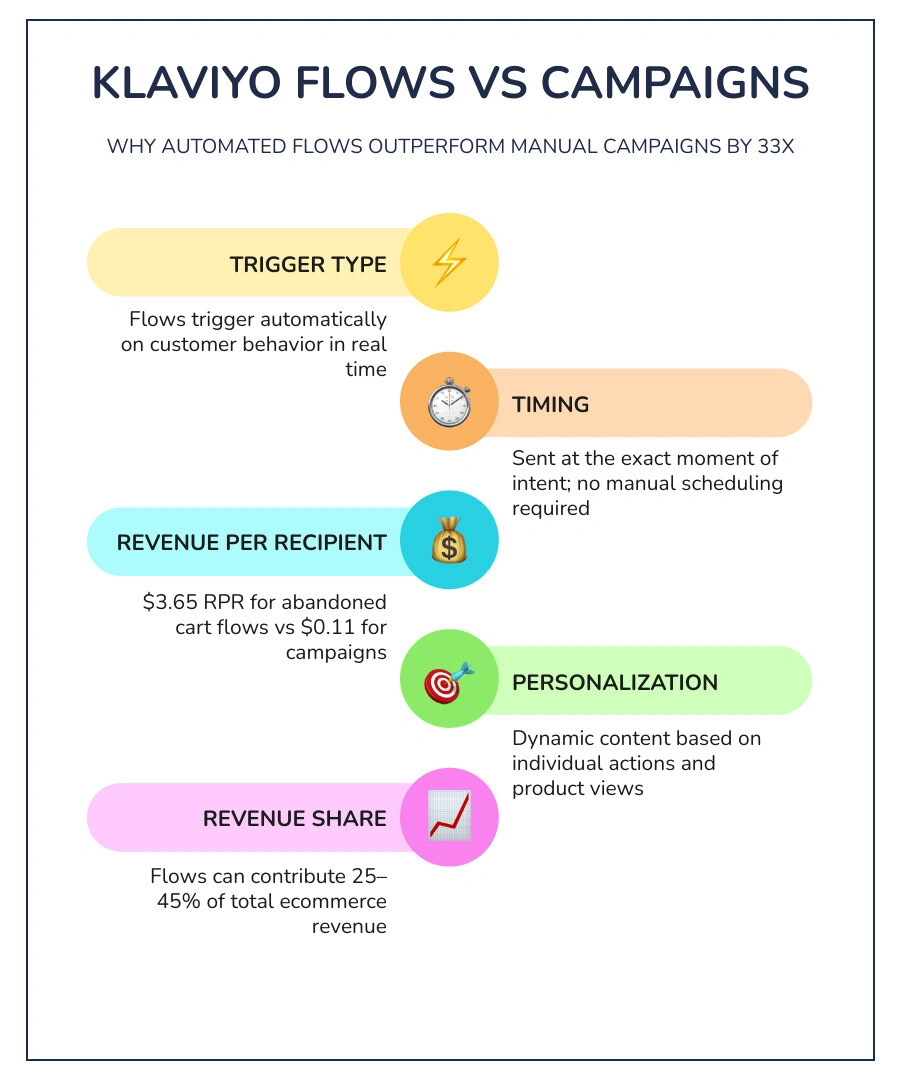
The best Klaviyo flows for ecommerce are automated email and SMS sequences that trigger based on customer behavior. Here at First Pier, we see these automations consistently outperform one-off campaigns. According to Klaviyo benchmark data, automated flows generate an average of $3.65 revenue per recipient for abandoned cart sequences, compared to just $0.11 for standard broadcast campaigns.
Here are the essential Klaviyo flows we set up for our clients:
- Welcome Series — triggered when a new subscriber joins your list; averages $2.65 per recipient
- Abandoned Cart Flow — sent when a shopper leaves items in their cart; recovers 5–15% of abandoned carts
- Abandoned Checkout Flow — triggered after checkout is started but not completed; highest purchase intent
- Browse Abandonment Flow — sent after a visitor views products without adding to cart; averages 5.48% click rate
- Post-Purchase Flow — sent after a completed order to drive reviews, cross-sells, and repeat purchases
- Win-Back Flow — re-engages customers who haven't bought in 90–180 days
- VIP / Loyalty Flow — triggered when a customer crosses a lifetime value threshold
- Sunset Flow — removes chronically unengaged subscribers to protect deliverability
While many Shopify brands run only two or three of these, the brands we work with that generate serious email revenue typically keep 10 or more flows live. This coverage spans every high-intent moment in the customer lifecycle. Combined email and SMS flows can account for 25–45% of total ecommerce revenue, with the split roughly even between flows and campaigns for most stores.
The sections below cover how each flow works, what benchmarks to target, and how to build a flow system that prevents revenue leaks at every stage of the customer journey.
Understanding Klaviyo Flows vs Campaigns
To build a highly profitable email program, you must understand the structural difference between campaigns and flows.
Campaigns are manual, one-off broadcasts sent to a specific list or segment at a scheduled time. Examples include a newsletter sent on a Tuesday morning or a holiday promotion sent on Black Friday. While campaigns are excellent for driving sudden spikes in traffic, they do not account for individual customer timing.
In contrast, Klaviyo automated emails are behavioral infrastructure. They are triggered automatically by real-time customer actions, such as signing up for a newsletter, viewing a specific product page, adding an item to a cart, or completing a purchase.
Because flows respond directly to real-time behaviors, they are highly relevant to the recipient. This relevance is why flows generate up to 30x more revenue per recipient (RPR) than standard campaigns. While a promotional campaign might earn an average of $0.11 per recipient, a targeted behavioral flow reaches the inbox at the exact moment of peak purchase intent.
By using advanced Klaviyo features, such as conditional splits, profile properties, and dynamic data feeds, these automations work continuously in the background to guide shoppers through the purchase funnel without requiring manual intervention for every send.
The Best Klaviyo Flows for Ecommerce Revenue Growth
To grow your store's automated revenue to 25–45% of total sales, you need a complete list of Klaviyo flows running simultaneously. Relying on just a welcome series and a basic cart abandonment email leaves significant money on the table.
Implementing structured Klaviyo email marketing flows ensures that every stage of the customer lifecycle is covered. The table below outlines the core benchmarks, trigger mechanisms, and timing strategies for the highest-performing automations, referencing data highlighted in The Complete Guide to Klaviyo Flows [2026] | BS&Co .
| Flow Type | Primary Trigger | Recommended Timing | Open Rate Benchmark | Conversion Rate Benchmark | Average Revenue Per Recipient (RPR) |
|---|---|---|---|---|---|
| Welcome Series | Joins newsletter list | Email 1: Immediate Email 2: Day 3 Email 3: Day 5 | 45% – 50% | 8% – 12% | $2.65 |
| Browse Abandonment | Views product (no cart add) | 2 hours after view | 35% – 45% | 2% – 4% | $1.00 – $1.50 |
| Abandoned Cart | Adds item to cart (no checkout) | 2 to 4 hours after add | 45% – 55% | 5% – 10% | $2.00 – $3.00 |
| Abandoned Checkout | Starts checkout (no purchase) | Email 1: 1 hour Email 2: 24 hours | 50% – 65% | 8% – 15% | $3.65 |
| Post-Purchase (New Buyer) | Places order (First-time) | Day 3: Care/Thank you Day 14: Cross-sell | 55% – 65% | 1% – 3% | $0.50 – $1.20 |
| Win-Back | Placed order (90–180 days ago) | Day 90, 105, and 120 | 25% – 35% | 1% – 2% | $0.25 – $0.75 |
For a broader perspective on structuring these lifecycle automations, the Ultimate Klaviyo Email Flows Masterclass (Full Training, Tutorial & Strategy!) - Award-Winning Email, SMS & Retention Marketing Agency for Retailers & DTC explains how to build a connected behavioral system rather than treating these flows as isolated templates.
Welcome Series: The Highest Volume Best Klaviyo Flows for Ecommerce
The welcome series is often the single highest-revenue flow in an account due to its sheer volume and high engagement. When a shopper signs up for your newsletter, their interest in your brand is at its peak. Statistically, the first email in a welcome series outperforms all other automated emails in sales generation.
Here at First Pier, we structure the welcome series as a multi-step journey over 7 to 14 days to convert 15–25% of new subscribers into first-time buyers:
- Email 1 (Immediate): Deliver the signup incentive (such as a discount code generated via Klaviyo coupon codes) immediately. Keep the design clean, focus on a singular call to action, and introduce your primary value propositions.
- Email 2 (Day 3): Tell your brand story. Move away from heavy discounting and explain why your brand exists, your manufacturing standards, or your community impact.
- Email 3 (Day 5): Address common buying objections. Showcase customer reviews, social proof, and highlight your bestselling products.
- Email 4 (Day 7): Introduce community elements. Encourage social media follows or promote your loyalty program.
- Email 5 (Day 10): Send a final reminder of the expiring welcome discount to build healthy urgency.
Always use conditional splits to separate buyers from non-buyers. If a subscriber purchases after Email 1, they should immediately exit the welcome flow and enter your post-purchase sequence to prevent redundant discount reminders.
Abandoned Cart and Checkout: High-Intent Best Klaviyo Flows for Ecommerce
Many brands make the mistake of combining cart abandonment and checkout abandonment into a single flow. However, these represent two entirely different stages of customer intent.
An Abandoned Cart Flow triggers when a visitor adds an item to their cart but does not proceed to the checkout page. This requires the "Added to Cart" metric, which is set up via custom code or native integration.
An Abandoned Checkout Flow triggers when a user enters their email address or logs in during the checkout process but does not complete the purchase. This is a much higher-intent action.
To capture these lost sales, use highly personalized Klaviyo abandoned cart emails structured with dynamic product content showing the exact items left behind.
Optimal Timing and Incentives
- Touch 1 (1 Hour Delay): Send a helpful reminder. Frame the message around "Did your connection drop?" or "We saved your cart." Avoid offering discounts in the first email, as this trains customers to abandon carts just to get a coupon.
- Touch 2 (24 Hours Delay): Address friction points. Highlight shipping policies, return guarantees, or show reviews of the specific items in their cart.
- Touch 3 (48 Hours Delay): Introduce a limited-time incentive, such as a discount or free shipping, paired with a clear expiration date.
For high-average order value (AOV) brands, integrating Klaviyo SMS into the checkout abandonment sequence can significantly boost recovery rates. Send an SMS reminder 2 hours after checkout abandonment, but restrict SMS sends to only those who have opted in, and always use Smart Sending to avoid double-messaging subscribers who also received an email.
Browse Abandonment: Capturing Early-Stage Intent
Browse abandonment flows target shoppers who view a product page but leave your site without adding the item to their cart or starting a checkout. These visitors have shown interest, but they are earlier in the buying journey.
To convert this traffic without being intrusive, follow these design and timing guidelines:
- Timing: Send the email 2 to 4 hours after the browse session ends. Sending too quickly can feel overly aggressive, while waiting too long allows their interest to cool.
- Structure: Keep the email light and helpful. Use a dynamic product block to display the exact item they viewed.
- Personalization: Include personalized product recommendations below the main item, displaying complementary products or bestsellers in the same category.
- Design: Maintain a clean, visually focused layout. A minimalist Klaviyo design with high-quality product imagery and a direct button to "Return to Product" ensures a strong click rate, which averages 5.48% for this flow.
Use strict flow filters to ensure visitors only receive this email if they have not started a checkout, added to a cart, or made a purchase since starting the flow.
Post-Purchase and Retention: Increasing Customer Lifetime Value
Getting a customer to make their first purchase is only half the battle. True profitability lies in retention and building repeat purchase behavior. Post-purchase flows boast exceptionally high open rates (55–65%), making them the perfect vehicle for brand education and secondary sales.
Here at First Pier, we design retention systems by segmenting the post-purchase flow into distinct paths for first-time buyers and repeat customers:
First-Time Buyer Path
- Transactional & Thank You (Immediate): Send a clean confirmation and a personal thank-you note from the founder.
- Educational (Day 3–5): Provide product-care guides, video tutorials, or styling tips. Do not sell anything in this email; focus entirely on helping them get the most value out of their purchase.
- Review/UGC Request (Day 10–14): Ask for a product review or user-generated content after they have had sufficient time to use the product.
- Cross-Sell/Upsell (Day 21–30): Recommend complementary products based on what they initially bought.
Repeat Buyer Path
Skip the basic brand introduction. Instead, thank them for their loyalty, offer early access to new collections, or invite them into your VIP program once they cross a specific lifetime value (LTV) threshold.
For consumable goods, implement a Replenishment Flow. If your product lasts 30 days, trigger a friendly re-order reminder at day 25. Use custom-coded, responsive layouts built through professional Klaviyo template design to make the re-ordering process as friction-free as possible.
Flow Architecture, Segmentation, and Testing
As you build out a comprehensive email system, managing how these flows interact becomes critical. Without proper guardrails, a customer could easily receive a welcome email, a browse abandonment email, and an abandoned cart email all on the same day. This leads to list fatigue, high unsubscribe rates, and deliverability issues.
Here at First Pier, we use strict flow filters and Smart Sending features to prevent overlapping messages:
- Smart Sending: Turn on Smart Sending (typically set to a 16 to 24-hour window) for browse abandonment and promotional emails. This ensures that if a user triggers multiple automations, they only receive one message within that timeframe. Keep Smart Sending turned off for high-priority transactional emails and the first abandoned checkout email.
- Flow Filters: Add restrictive filters to your pre-purchase flows. For example, a Browse Abandonment flow should filter out anyone who has placed an order, started a checkout, or added an item to their cart in the last 30 days.
- A/B Testing: Never assume your initial copy or timing is perfect. Use Klaviyo AB testing to systematically test subject lines, discount structures (e.g., 10% off vs. free shipping), and time delays. When we run A/B tests here at First Pier, we test one variable at a time and let tests run until they reach statistical significance.
Additionally, monitor your technical sender reputation. To keep your automated emails landing in the primary inbox, ensure your DNS settings include a dedicated sending domain configured with Klaviyo DKIM and Klaviyo DMARC records. This is essential for meeting modern deliverability standards.
For a deeper look at setting up these technical components step-by-step, review the framework outlined in Klaviyo Flows: The Essential Guide for Beginners (2026) .
Frequently Asked Questions about Ecommerce Email Automations
What is the difference between a Klaviyo flow and a campaign?
A Klaviyo flow is an automated, behavior-triggered sequence that runs 24/7 based on customer actions (such as viewing a product or making a purchase). A campaign is a manual, one-time email broadcast sent to a scheduled list or segment at a specific date and time (such as a weekly newsletter or holiday sale announcement).
What is a good revenue per recipient benchmark for abandoned cart flows?
A healthy abandoned cart flow should generate between $2.00 and $3.00 revenue per recipient (RPR), while high-intent abandoned checkout flows often average $3.65 RPR. If your RPR is below $1.50, look closely at your timing delays, check for broken dynamic product blocks, or test a clearer call to action.
How many flows should an ecommerce store have live?
While most basic stores run only 2 or 3 automations, top-performing ecommerce brands run 10 or more live flows. This includes a welcome series, browse abandonment, abandoned cart, abandoned checkout, post-purchase (split by customer type), replenishment, win-back, VIP, and sunset flows.
Bottom Line
Building a high-performing email program requires moving away from a "set-and-forget" mindset. By implementing these core behavioral flows, structuring them to prevent overlap, and continuously testing your creative and timing, you can establish an automated marketing infrastructure that consistently drives 25% to 45% of your store's total revenue.
If you would like help building, improving, or auditing your automated email and SMS strategy, get in touch with our team here at First Pier.




.png)
.png)

