


Understanding BigCommerce Headless Commerce
Summary
- BigCommerce headless commerce separates the frontend storefront from the backend commerce engine using APIs, letting teams build custom user experiences without changing backend logic.
- BigCommerce provides over 90% API coverage across its platform, including Catalog, Checkout, and Payments APIs.
- Headless setups require developer resources and higher upfront investment than traditional themed storefronts.
- Real brands have reported significant performance and revenue gains after migrating to a headless BigCommerce architecture.
- BigCommerce's Catalyst framework (built on Next.js) reduces the time and cost to launch a headless storefront.
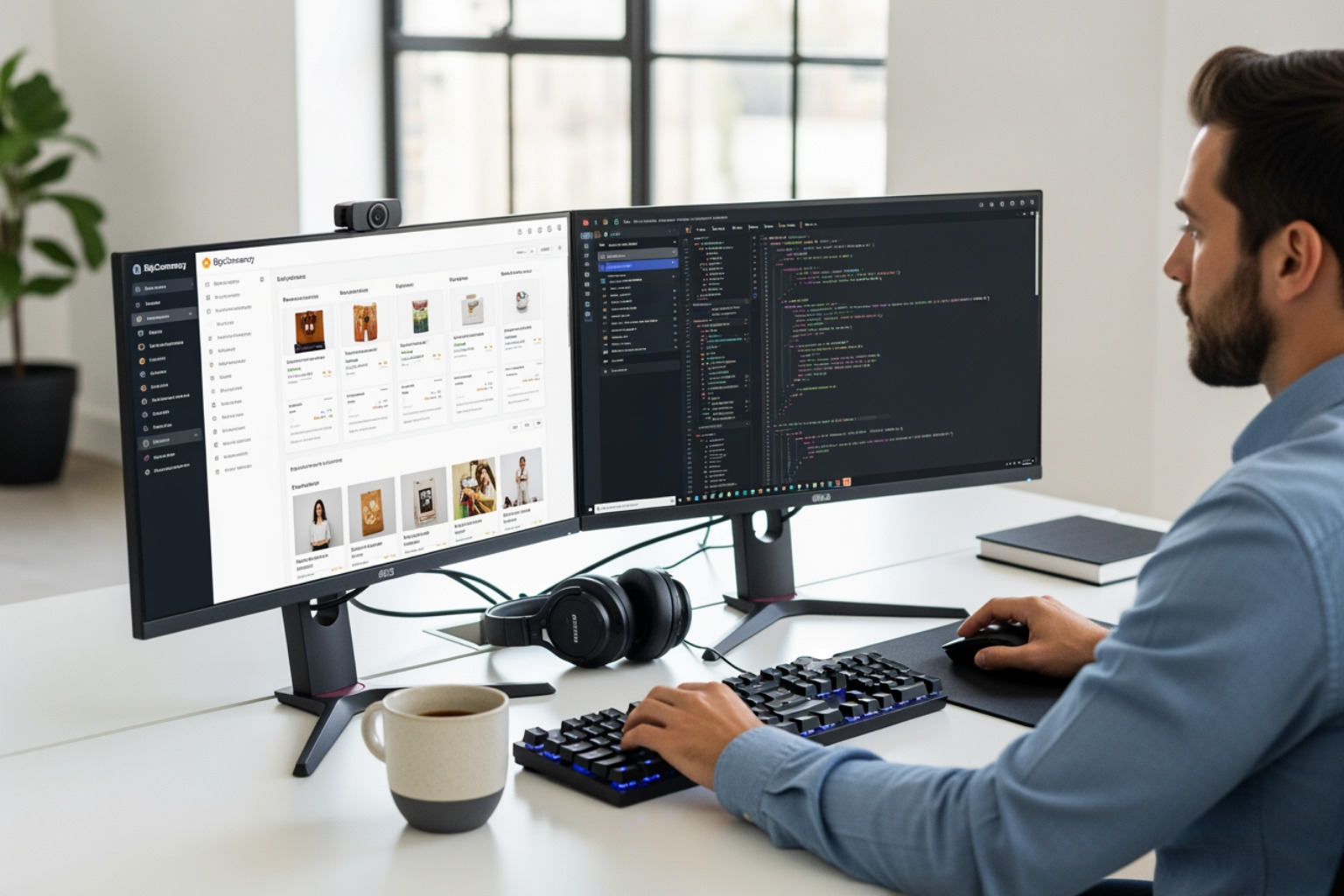
When I talk to store owners about BigCommerce headless commerce, I often start with a simple analogy: think of a restaurant where the kitchen (the backend) is completely separate from the dining room (the frontend). In a traditional "monolithic" setup, the kitchen and dining room are glued together. If you want to change the decor in the dining room, you might accidentally break the stove in the kitchen.
In a headless architecture, these two parts are decoupled. The backend handles the heavy lifting—PCI compliance, order processing, inventory management, and tax calculations. The frontend is the "head" that you can swap out or customize however you like. Whether that head is a standard website, a mobile app, a smart mirror, or a kiosk, it pulls data from the same BigCommerce backend.
This separation is what gives businesses the flexibility to build exactly what they want. You aren't limited by the constraints of a pre-made theme. Instead, you use BigCommerce as a commerce engine that powers whatever experience you can imagine.
How APIs Drive BigCommerce Headless Commerce
APIs (Application Programming Interfaces) are the messengers that make this whole system work. BigCommerce is an "API-first" platform, meaning it was built to share data easily with other software.
BigCommerce provides over 90% API coverage across its platform functions. This is a massive advantage. It means almost anything you can do in the BigCommerce control panel, you can also do through an API call.
- REST APIs: These are used for backend tasks like syncing inventory with an ERP or managing customer data.
- GraphQL Storefront API: This is the star of the show for headless builds. It allows the frontend to request exactly the data it needs (and nothing more), which makes the site much faster.
- Checkout and Payments APIs: These allow you to create custom checkout flows while still relying on BigCommerce to handle the secure parts of the transaction.
By using BigCommerce’s API documentation, developers can connect any frontend technology to the robust BigCommerce engine.
The Role of Microservices in Modern Retail
In a headless setup, we often move away from one giant piece of software toward "microservices." Instead of one platform doing everything, you use specialized tools for specific jobs. You might use BigCommerce for your cart and catalog, Contentful for your blog, and Algolia for your search bar.
This modular approach reduces "tech debt." If you decide you don't like your search provider two years from now, you can swap it out without rebuilding your entire store. It allows for independent scaling; if your frontend is getting slammed with traffic during a holiday sale, you can scale your hosting for the frontend without needing to touch the backend database.
The Business Case for BigCommerce Headless Commerce

Why go through the effort of decoupling your store? For many of the brands we work with here at First Pier, the answer comes down to performance and the bottom line.
According to a 2024 WP Engine study, 79% of businesses using headless architecture rate their scalability as strong. Additionally, 64% of enterprise organizations have already moved to headless to gain a competitive advantage.
The primary business benefits include:
- Extreme Site Speed: By using modern frontend frameworks like Next.js, you can turn your store into a collection of static assets that load almost instantly.
- Higher Conversion Rates: Faster sites simply sell more. When pages load in milliseconds rather than seconds, bounce rates drop and customers stay engaged.
- Total Design Freedom: You aren't boxed in by "what the theme allows." If your brand requires a unique storytelling experience, headless is the way to achieve it.
- Omnichannel Consistency: You can manage your products in one place but sell them across a website, a custom mobile app, and social media channels.
Real-World Success with BigCommerce Headless Commerce
The numbers from real brands back this up. For example, the water bottle brand LARQ saw an 80% increase in conversion rate and a 400% increase in revenue within a year of moving to a headless BigCommerce setup.
The apparel brand White Stuff saw their site load 85% faster overall and doubled their mobile speed. This led to a 37% increase in conversion rates and a 26% increase in average transaction revenue. Another brand, Combat Corner, improved their site performance by 431% and load speed by 604%.
These aren't just marginal gains; they are transformative shifts in business performance. Brands like Yeti Cycles have also moved to headless to solve the "design-first" challenge where a beautiful frontend previously led to a disjointed and difficult-to-manage backend.
Supporting 2025 Retail Trends
As we look toward 2025, the expectations for online shopping are only going up. Customers expect personalized experiences, and research shows that 80% of shoppers prefer companies that offer them. Furthermore, 78% of consumers are more likely to repurchase from brands that personalize their communications.
BigCommerce headless commerce makes this easier by allowing you to integrate AI-driven recommendation engines and personalized content layers directly into your custom frontend. It also supports:
- Voice Commerce: Selling through smart speakers.
- Progressive Web Apps (PWA): Giving your website the feel and speed of a native mobile app.
- IoT Shopping: Placing "buy" buttons on smart appliances or in-store kiosks.
The global headless commerce market is expanding because it allows retailers to be where the customer is, rather than waiting for the customer to come to a traditional website.
Technical Requirements and Challenges
I want to be clear: headless isn't a "magic button." It comes with a specific set of requirements and trade-offs that you need to understand before you start.
| Feature | Stencil (Traditional) | Catalyst (Headless Starter) | Custom Headless |
|---|---|---|---|
| Development Effort | Low | Medium | High |
| Time to Market | Fast | Medium | Slow |
| Flexibility | Limited by Theme | High | Infinite |
| Maintenance | Low (Handled by BC) | Medium | High |
| Performance | Good | Excellent | Best |
Key Challenges to Consider:
- Developer Bandwidth: You will need a developer (or an agency like First Pier) who understands APIs and modern Javascript frameworks. This isn't a DIY project for most store owners.
- Setup Costs: The initial build is more expensive than installing a $300 theme. You are essentially building a custom software application.
- System Management: You now have two distinct parts of your stack to monitor—the BigCommerce backend and your hosted frontend.
- Third-Party Analytics: Traditional BigCommerce analytics sometimes struggle to "see" what's happening on a custom frontend, so you'll likely need to set up server-side tracking or a third-party platform.
For a deeper dive into these differences, you can check out our resource on headless vs non-headless e-commerce.
Security and PCI Compliance in a Headless Setup
One of the best things about using BigCommerce for headless is that they still handle the most sensitive parts of security. By default, BigCommerce headless setups typically redirect the user to a BigCommerce-hosted domain for the final checkout. This ensures that you stay PCI compliant without having to jump through the massive legal hoops of handling credit card data yourself.
For more advanced setups, BigCommerce offers a Trusted Proxy feature. This allows your custom frontend to talk to the BigCommerce backend securely while maintaining the user's original IP address for fraud detection and analytics. Developers use an X-Correlation-Id to group multiple API calls together, making it easier to track a single customer's journey from cart to completion.
Managing the Content Layer
When you go headless, you often lose the "Page Builder" tool found in the standard BigCommerce dashboard. To give your marketing team the ability to update the site without calling a developer, you'll want to integrate a Headless CMS.
Tools like Makeswift, Contentful, or even a headless WordPress setup allow marketers to drag and drop elements, write blog posts, and launch landing pages that then feed directly into your custom frontend. This maintains "marketing autonomy" while keeping the site's performance high.
Building Your Stack with Catalyst and Modern Frameworks
In the past, building a headless store meant starting from a blank page. BigCommerce changed that with Catalyst.
Catalyst is a functional starter kit based on Next.js and React. It provides a pre-built foundation that includes the most common ecommerce features—product grids, search, and cart logic—right out of the box. It allows developers to skip the "boring" parts of the setup and get straight to customizing the unique parts of your brand.
Most modern headless builds on BigCommerce use one of these frameworks:
- Next.js: The industry standard for React-based web applications.
- Vue / Nuxt: A popular alternative known for being developer-friendly.
- Angular: Often used by larger enterprise teams with complex internal requirements.
These frontends are usually deployed on platforms like Vercel or Netlify, which are optimized for speed and global delivery. When choosing the right storefront, Catalyst is often the "sweet spot" for brands that want the power of headless without the six-month development timeline.
Integrating Subscriptions and Custom Logic
If your business relies on recurring revenue, you'll need a way to handle subscriptions in a headless environment. Tools like OrderGroove integrate well with BigCommerce. Because you have control over the frontend, you can create a much more integrated subscription experience than you could with a standard plugin.
For complex B2B needs, we sometimes use middleware (like a Symfony application) to connect the BigCommerce store to a Salesforce OMS or ERP. This allows for real-time order processing and custom pricing logic that would be impossible on a standard platform. You can find out more about how we handle these complex builds on our subscription strategy and execution page.
Data Synchronization and Analytics
In a headless world, data doesn't always flow automatically. You have to be intentional about your analytics. Most of our clients use Google Analytics 4 (GA4) combined with server-side tracking.
We use webhooks to tell other systems when something happens—like when an order is placed or a customer is created. This "event-driven architecture" ensures that your CRM, email marketing tool (like Klaviyo), and data platform (CDP) are always in sync with what's happening on the storefront.
Step-by-Step Migration to a Headless Storefront
Moving to BigCommerce headless commerce is a journey. Here is a high-level look at how we manage that process here at First Pier.
Phase 1: Planning and Architecture
First, we define your goals. Are we solving for speed? Design flexibility? International expansion?
- Tech Stack Selection: We help you choose between Catalyst or a fully custom build.
- Resource Assessment: We look at your internal team and determine what support you'll need.
- API Mapping: We identify every third-party tool (ERP, PIM, CRM) that needs to talk to the new store.
- Security Planning: We set up the Trusted Proxy and secure your API credentials.
Phase 2: Development and Integration
This is where the actual building happens.
- Frontend Build: Developers build the UI using React or Next.js.
- API Connection: We connect the frontend to the BigCommerce "Store Hash" and generate the necessary API tokens.
- Logic Implementation: We build the cart logic and the redirect to the secure BigCommerce checkout.
- Testing: We run extensive tests across devices and browsers, focusing on "Core Web Vitals" to ensure the site is as fast as promised.
If you are currently on Shopify and considering a move, you might find our headless Shopify comparison helpful for context on how the two platforms handle these architectures differently.
Frequently Asked Questions about BigCommerce Headless
Is headless commerce right for small businesses?
Small businesses often find the cost and developer requirements of headless commerce outweigh the benefits. It is generally better for brands with over $5 million in annual revenue or those with complex design needs that traditional themes cannot meet. If you are just starting out, a standard BigCommerce Stencil theme or a Shopify store is usually a more cost-effective choice.
How does BigCommerce handle checkout in a headless setup?
BigCommerce typically handles checkout on its own domain to ensure PCI compliance and security. Developers use the Checkout API to pass cart data to the secure BigCommerce checkout page, though custom checkout builds are possible for enterprise users. This approach gives you the best of both worlds: a custom frontend and a secure, battle-tested checkout.
What is Catalyst and how does it help?
Catalyst is a functional starter kit from BigCommerce based on Next.js. It provides a pre-built storefront foundation that reduces the time and effort needed to launch a headless site while maintaining high performance and SEO standards. It’s designed to make headless commerce accessible to mid-market brands, not just global enterprises.
To Sum Up
Moving to BigCommerce headless commerce is a strategic decision to future-proof your business. It’s about more than just a faster website; it’s about having the scalability to grow and the flexibility to adapt to whatever retail looks like in 2025 and beyond.
At First Pier, we specialize in helping brands navigate these complex technical waters. Whether you are looking to improve your conversion rates through better performance or you need a custom-built experience that a standard theme just can't provide, we have the expertise to help.
If you're ready to see if headless is the right move for your brand, take a look at our services or reach out to us at our Portland, Maine office. We’d love to help you build a high-performance store that truly reflects your brand's story.





.png)
.png)

