




Why Tracking the Right Ecommerce KPIs Matters
Summary
- Cart Abandonment Benchmark: The global average shopping cart abandonment rate is 70.19%, primarily driven by unexpected shipping fees and complex checkout processes.
- LTV to CAC Ratio: A healthy Customer Lifetime Value to Customer Acquisition Cost ratio is 3:1, serving as a baseline for sustainable marketing spend.
- Relational Measurement: Individual metrics like traffic volume or transaction count can mislead unless analyzed alongside conversion rates and average order value.
- Review Cadence: High-velocity sales metrics require daily tracking, while strategic retention metrics like cohort retention and lifetime value are best analyzed monthly or quarterly.
Here at First Pier, we know that the ecommerce KPIs to track for your store determine whether your decisions are grounded in real data or guesswork. With dozens of metrics available in any analytics platform, the challenge isn't finding numbers — it's knowing which ones actually signal growth, and which are just noise.
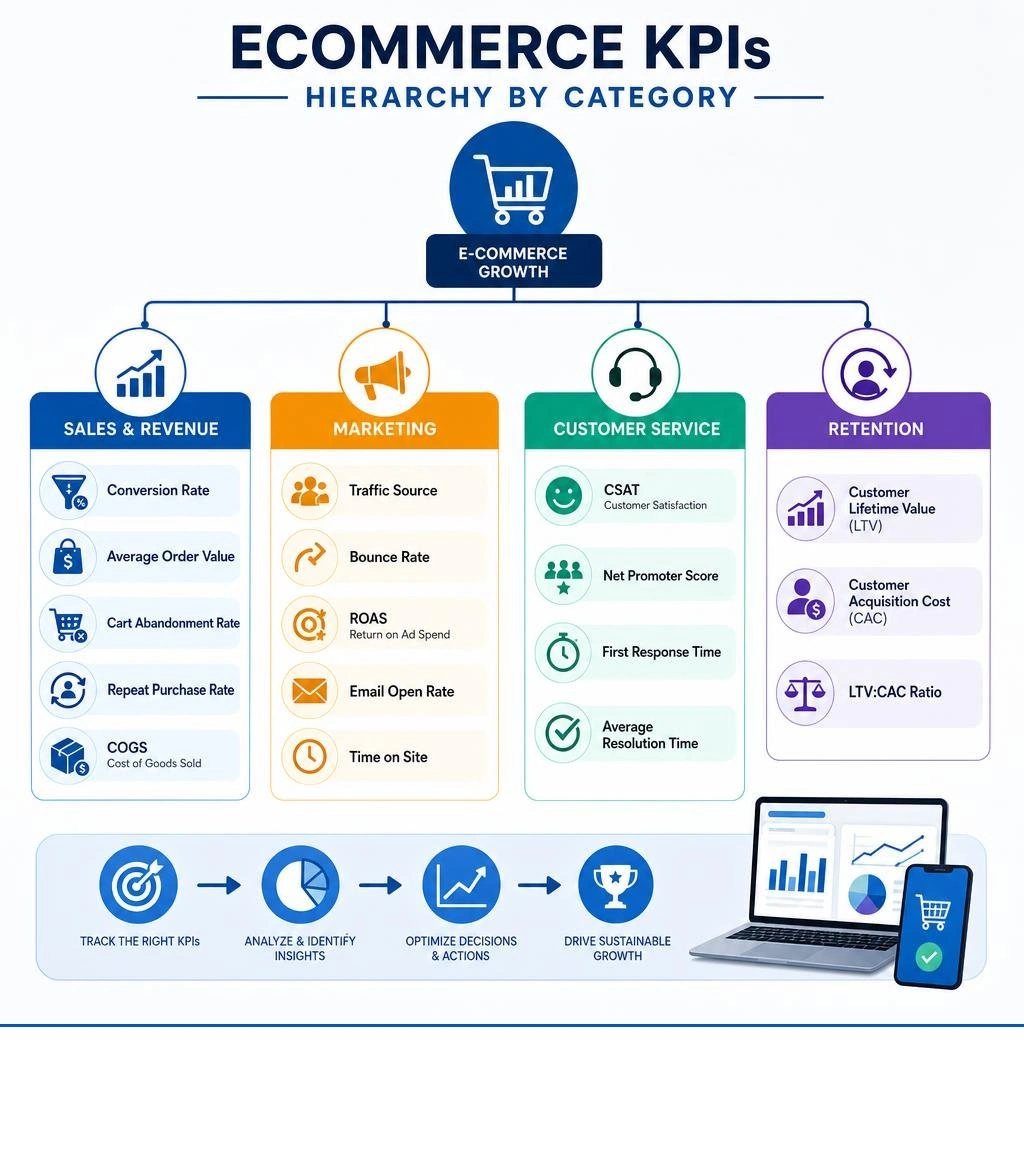
Here are the most important ecommerce KPIs to track, organized by business function:
| Category | Key KPIs |
|---|---|
| Sales & Revenue | Conversion Rate, Average Order Value, Cart Abandonment Rate, Repeat Purchase Rate, COGS |
| Marketing | Traffic Source, Bounce Rate, ROAS, Email Open Rate, Time on Site |
| Customer Retention | Customer Lifetime Value, Customer Acquisition Cost, LTV:CAC Ratio |
| Customer Service | CSAT, Net Promoter Score, First Response Time, Average Resolution Time |
A few facts worth knowing before you dig in:
- The average cart abandonment rate is 70.19% — meaning roughly 7 out of 10 shoppers leave without buying
- The average ecommerce conversion rate sits just above 3%
- 53% of website traffic comes from organic search, making it the dominant acquisition channel
- A healthy LTV:CAC ratio is 3:1 — below 2:1 is a warning sign
- A bounce rate of 25%–40% is considered acceptable for ecommerce sites
Most ecommerce dashboards surface dozens of numbers but highlight none of them. The result is a lot of reporting and very little action. The KPIs below cut through that noise — covering sales, marketing, and customer service — so you know exactly what to measure and what to do when a number moves in the wrong direction.
How to Choose the Right Ecommerce KPIs to Track
Choosing which metrics to monitor depends on your business stage and near-term objectives. If you try to monitor forty different data points at once, you will likely end up acting on none of them. Here at First Pier, we recommend selecting five to seven key metrics for your executive dashboard, matching them to clear, measurable milestones.
For example, if your primary goal is to build customer loyalty, your dashboard should focus on repeat purchase rates and customer lifetime value. If you are focused on improving your checkout flow, your primary indicators will be cart abandonment rates and checkout conversion steps.
When setting up your measurement framework, you can use the structured methodologies discussed in Essential Ecommerce KPIs to Track for Growth (2026) - Shopify to group your metrics into distinct operational areas. For a curated list of the metrics that have the highest impact on profitability, review this guide to the Top 10 KPIs for Ecommerce.
A reliable rule of thumb is to set up a "North Star" metric supported by three or four input metrics. If your North Star is net revenue growth, your input metrics might be weekly traffic, conversion rate, and average order value. If net revenue drops, you can look at the input metrics to identify exactly where the drop occurred.
Core Sales and Revenue Metrics
Sales and revenue metrics form the foundation of your business analysis. However, tracking overall sales volume in isolation can create a false sense of security. A store can generate high sales volume while losing money on every transaction due to high acquisition costs, heavy discounting, or expensive shipping fees.

To understand your true financial health, you must look beyond top-line revenue. By reviewing your performance through the lens of Ecommerce KPIs, you can identify whether your sales growth is sustainable or if you are simply buying revenue at the expense of your margins.
Sales-Focused Ecommerce KPIs to Track
To evaluate sales performance accurately, you should regularly track the following four core metrics:
1. Conversion Rate (CR)
Your conversion rate is the percentage of website sessions that result in a completed purchase. It is calculated with this formula:
$$\text{Conversion Rate} = \left( \frac{\text{Total Transactions}}{\text{Total Sessions}} \right) \times 100$$
While the average ecommerce conversion rate sits slightly above 3%, this number varies by channel and device. Desktop traffic typically converts at 3.5% to 4%, while mobile traffic converts at 1.8% to 2.5%. Because mobile traffic accounts for nearly 60.28% of all web traffic, improving your mobile checkout experience is one of the fastest ways to raise your overall conversion rate.
2. Average Order Value (AOV)
Average Order Value measures the average dollar amount spent by a customer during a single transaction. It is calculated as:
$$\text{Average Order Value} = \frac{\text{Total Revenue}}{\text{Total Number of Orders}}$$
Improving your AOV is often more cost-effective than trying to acquire new traffic because the customer is already on your site with an intent to buy. You can read more about how to track and influence this metric in this resource on Average Order Value. Common tactics to increase this metric include setting free shipping thresholds 20% above your current AOV, offering product bundles, and implementing post-purchase upsells.
3. Cost of Goods Sold (COGS)
Cost of Goods Sold represents the direct costs associated with producing or purchasing the products you sell. This includes manufacturing materials, supplier fees, packaging, and direct labor. Keeping an accurate record of COGS is essential for calculating your gross profit margin:
$$\text{Gross Profit Margin} = \left( \frac{\text{Total Revenue} - \text{COGS}}{\text{Total Revenue}} \right) \times 100$$
Without a clear understanding of COGS, you cannot make informed pricing decisions or determine how much you can afford to spend on customer acquisition.
4. Repeat Purchase Rate (RPR)
The Repeat Purchase Rate is the percentage of your customer base that has made more than one purchase within a specific timeframe. You can calculate it using this formula:
$$\text{Repeat Purchase Rate} = \frac{\text{Number of Customers Who Have Purchased } 2+ \text{ Times}}{\text{Total Number of Unique Customers}}$$
A healthy repeat purchase rate ranges from 25% to 35% for apparel brands, and can reach 40% to 60% for consumable products. Improving your repeat rate has a massive impact on your long-term profitability because repeat customers do not require an additional acquisition cost. To explore how this metric behaves over time, review this definition of Repeat Purchase Rate.
Shopping Cart Abandonment Rate
Shopping cart abandonment is one of the most common issues online retailers face. The average online shopping cart abandonment rate is 70.19%, meaning that nearly three out of every ten shoppers who add an item to their cart will leave without completing their purchase.
To calculate your abandonment rate, use the following formula:
$$\text{Cart Abandonment Rate} = \left( 1 - \frac{\text{Completed Transactions}}{\text{Initiated Checkouts}} \right) \times 100$$
Understanding why customers leave at the final stage of the funnel is critical for improving your checkout flow. You can learn more about tracking and reducing this leak in this guide to the Cart Abandonment Rate.
According to industry data, the primary reasons for cart abandonment include:
- Unexpected shipping costs or taxes (48%): Shoppers often use the cart to calculate the total price, and leave if the final cost is too high.
- Forced account creation (24%): Requiring users to register before buying adds unnecessary friction.
- Complex checkout processes (18%): Too many form fields or pages slow down the transaction.
- Lack of payment options (13%): Not offering modern wallets like Apple Pay, Google Pay, or shop Pay.
Essential Marketing and Traffic Metrics
Marketing metrics help you evaluate whether your advertising spend is actually driving profitable customer actions. Without these metrics, you risk spending your budget on channels that bring high traffic volume but very few paying customers.

To build a sustainable pipeline of new visitors, you must monitor how traffic moves through your acquisition channels. You can analyze this journey using the frameworks outlined in this guide to Ecommerce Funnel Metrics.
Marketing-Focused Ecommerce KPIs to Track
To measure your marketing performance, focus on these five critical metrics:
1. Traffic Source
This metric breaks down where your website visitors come from, such as organic search, paid social, direct traffic, email campaigns, or affiliate links. Because organic search accounts for 53% of all web traffic, maintaining a strong search engine presence is essential for long-term growth. Comparing traffic sources helps you determine which channels deliver the highest-quality visitors.
2. Bounce Rate
Your bounce rate is the percentage of single-page sessions where the visitor leaves your site without interacting with the page. A bounce rate of 25% to 40% is considered acceptable for ecommerce stores. If your bounce rate is higher than 50%, it usually indicates slow page load speeds, poor mobile design, or a mismatch between your ad creative and your landing page content.
3. Return on Ad Spend (ROAS)
ROAS measures the gross revenue generated for every dollar spent on advertising. It is calculated as:
$$\text{ROAS} = \frac{\text{Revenue Attributed to Ads}}{\text{Total Ad Spend}}$$
While ROAS is a common marketing metric, it can be misleading if you do not factor in your gross margins. For a deeper look at how to use this metric safely, refer to this breakdown of Return on Ad Spend (ROAS). For a broader view of how marketing spend relates to long-term revenue, you can also consult Ecommerce KPIs: 14 Metrics That Actually Predict Growth in 2026.
4. Email Open Rate (EOR)
Email marketing remains one of the most cost-effective channels for driving repeat purchases. Your open rate shows the percentage of recipients who opened your email. However, due to privacy updates like Apple Mail Privacy Protection, open rates are best used as a directional trend rather than an absolute truth. Pair them with click-through rates and email-attributed revenue to get an accurate picture of performance.
5. Time on Site / Session Duration
The average amount of time a visitor spends on your site during a single session. Longer session durations typically correlate with higher engagement and a greater likelihood of purchase, while very short durations may indicate that your site is difficult to navigate.
Customer Lifetime Value (CLV) and Acquisition Cost
The relationship between what you pay to acquire a customer and how much that customer spends over their lifetime is the ultimate predictor of your store's long-term survival.
- Customer Acquisition Cost (CAC): The total marketing and sales cost required to acquire a single new customer. It is calculated by dividing your total acquisition spend by the number of new customers acquired during that same period.
- Customer Lifetime Value (CLV): The total net profit a customer contributes to your business over the entire course of their relationship with your brand. You can explore the calculation methods for this metric in this guide to Customer Lifetime Value.
To maintain a healthy business, you should aim for an LTV:CAC ratio of at least 3:1.
$$\text{LTV:CAC Ratio} = \frac{\text{Customer Lifetime Value}}{\text{Customer Acquisition Cost}}$$
If your ratio is 1:1 or lower, you are spending more to acquire customers than they are worth, which will quickly drain your cash reserves. If your ratio is above 5:1, you may be underspending on marketing and missing out on valuable growth opportunities.
Customer Service Metrics for Retention
Acquiring a new customer can cost five to ten times more than retaining an existing one. Excellent customer service is not just about resolving complaints — it is a direct driver of repeat purchase rates and customer lifetime value.
By tracking support performance, you can identify friction points in your fulfillment, product quality, or website usability before they damage your brand reputation. To understand how support impacts loyalty, review the principles of Customer Retention.
Customer Satisfaction (CSAT) and Net Promoter Score (NPS)
To measure customer sentiment, you should track both transactional satisfaction and long-term brand loyalty:
- Customer Satisfaction Score (CSAT): Measured by sending a simple survey immediately after a customer service interaction, asking the customer to rate their experience on a scale of 1 to 5. It provides immediate feedback on your support team's performance.
- Net Promoter Score (NPS): A metric that measures long-term brand loyalty by asking customers how likely they are to recommend your store to a friend or colleague on a scale of 0 to 10. Respondents are categorized into Promoters (9-10), Passives (7-8), and Detractors (0-6).
$$\text{NPS} = \% \text{ Promoters} - \% \text{ Detractors}$$
Your NPS score can range from -100 to 100. A positive score indicates that you have more promoters than detractors, which is critical for driving organic word-of-mouth growth. To learn more about setting up and analyzing this metric, consult this resource on Net Promoter Score (NPS).
First Response Time and Resolution Metrics
Speed and efficiency are the two most important factors in customer support satisfaction. You should regularly monitor the following operational metrics:
- First Response Time (FRT): The average time it takes for a support agent to provide the initial response to a customer query. Because 42% of customers prefer communicating via messaging apps or live chat, keeping your FRT under a few minutes on these channels is critical.
- Average Resolution Time: The average time it takes from when a support ticket is opened to when it is fully resolved and closed.
- Ticket Volume: The total number of support requests received over a given period. Spikes in ticket volume often point to broader operational issues, such as shipping delays, website bugs, or a batch of defective products.
Measuring Metrics Relationally for Holistic Growth
The biggest mistake an ecommerce operator can make is analyzing metrics in isolation. Every metric on your dashboard exists in a delicate balance with the others. If you focus on improving one number without watching how it impacts the rest of your business, you can easily make decisions that damage your bottom line.
Consider these common scenarios where metrics must be read together:
- High Traffic with Low Conversion Rates: If your weekly traffic spikes by 50% but your conversion rate drops by half, your marketing campaigns are likely bringing in unqualified visitors who have no intent to buy. Alternatively, it could mean your site is experiencing technical issues or slow load times.
- High Average Order Value with High Return Rates: Offering aggressive bundles or bulk discounts can raise your AOV, but if those larger orders result in a massive wave of returns, your net profitability will suffer due to return shipping and restocking costs.
- Low Conversion Rates with High Average Order Value: A lower conversion rate is not always a sign of a failing store. If you sell luxury or high-ticket items, you will naturally have a lower conversion rate (often 1% to 1.5%), but your high AOV will keep the business highly profitable.
By looking at your metrics relationally, you can identify the root causes of performance changes and make better business decisions. This holistic approach is the foundation of effective Conversion Rate Optimization (CRO).
Frequently Asked Questions About Ecommerce KPIs
What is the single most important ecommerce KPI?
There is no single metric that fits every business, as the most important KPI depends entirely on your current growth stage. For a newly launched store, your primary focus should be traffic and conversion rate to confirm you have found product-market fit. For an established, scaling business, the LTV:CAC ratio becomes the single most critical indicator of long-term profitability and sustainable growth.
What is a healthy shopping cart abandonment rate?
A healthy shopping cart abandonment rate is typically around 70%, which aligns closely with the global average of 70.19%. While it is impossible to eliminate cart abandonment entirely, you can reduce checkout friction by offering guest checkout options, displaying shipping costs clearly on your product pages, and providing modern, single-click payment methods.
How often should you review your ecommerce metrics?
You should match your review cadence to the velocity of the metrics you are tracking. High-impact operational metrics like daily sales, website traffic, conversion rates, and ad performance should be monitored daily or weekly. Strategic metrics like customer lifetime value, cohort retention curves, and net promoter scores change more slowly and are best reviewed on a monthly or quarterly basis.
To Sum Up
Building a successful online store requires moving away from gut feelings and making decisions based on clear, reliable data. By tracking a focused set of KPIs across sales, marketing, and customer service, you can identify exactly where your store is losing revenue and where you have the greatest opportunities to grow.
Here at First Pier, we help brands set up tracking systems, organize analytics dashboards, and improve Shopify conversion rates. To build a better data setup for your store, get in touch with the team at First Pier. For additional details on building a modern data stack, you can explore More info about ecommerce data analytics.





.png)
.png)

