


Why a Clear Ecommerce Growth Strategy Separates Winners from the Rest
Summary
- General Ecommerce Strategy & Growth covers market research, channel mix, conversion rate, retention, operations, and measurement.
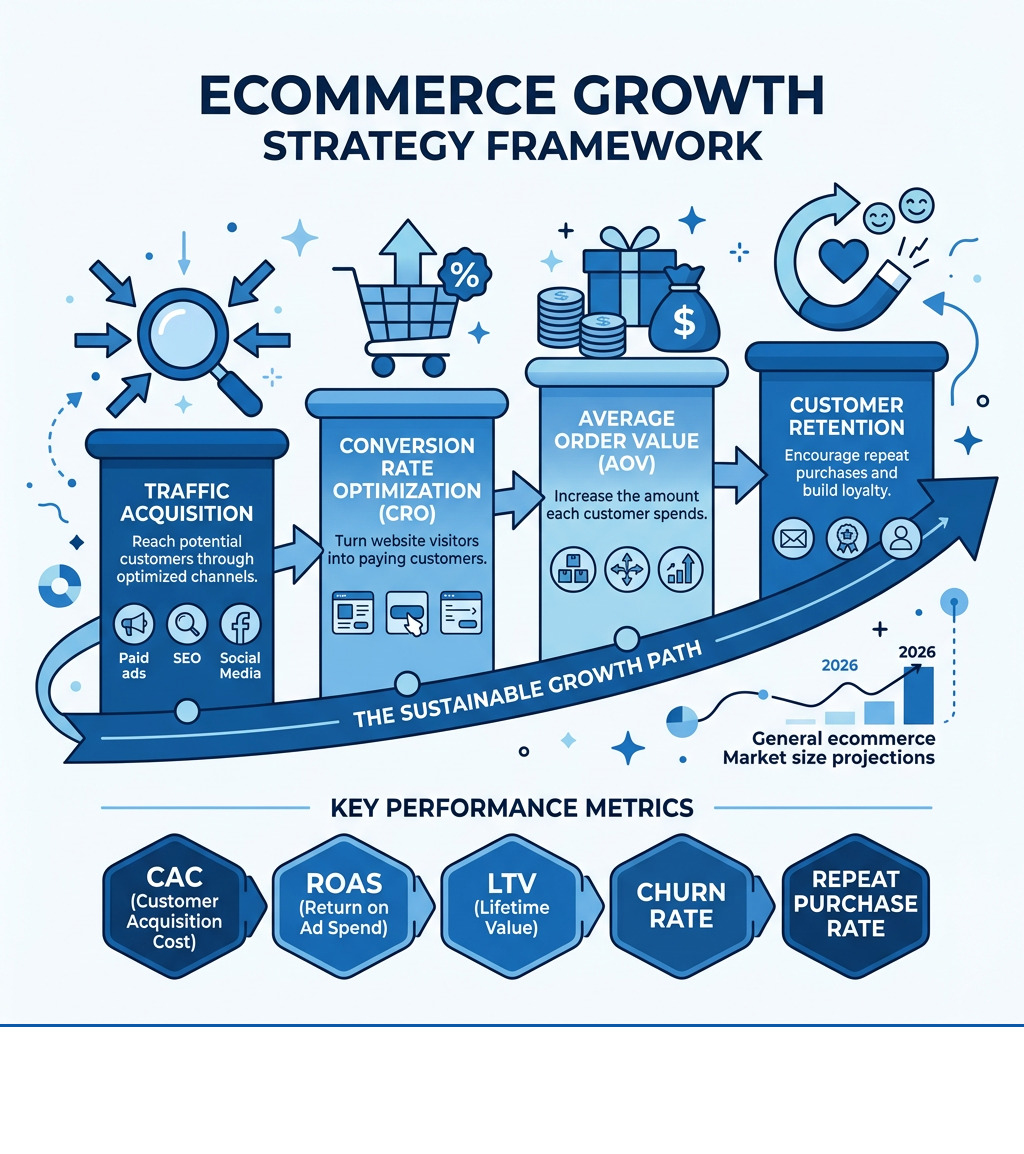
- Ecommerce growth depends on improving traffic quality, conversion rate, average order value, and repeat purchase rate together.
- Retention typically costs less than acquisition and often has a larger effect on profit over time.
- Useful operating metrics include CAC, ROAS, MER, churn rate, and customer lifetime value.
- Site speed, mobile checkout, and inventory accuracy directly affect conversion and margin.
General Ecommerce Strategy & Growth is the structured approach online businesses use to increase revenue, protect margin, and build repeat buying behavior across channels and touchpoints.
The numbers make the stakes clear. Global ecommerce sales are on track to exceed $7 trillion in the next year. More stores, higher ad costs, and tougher customer expectations mean that simply having a Shopify store is no longer enough.
Here is what a strong ecommerce growth strategy covers:
- Foundation – Know your market, your audience, and what makes you different.
- Multichannel sales – Sell where your customers already are, including marketplaces, social, and direct.
- Conversion and revenue – Turn more of your existing traffic into paying customers.
- Retention – Keep customers coming back, since acquiring a new customer costs 5 to 25 times more than keeping one.
- Technical performance – Fast, mobile-ready stores that do not lose sales to friction.
- Measurement – Track the metrics that reflect profit, not just traffic.
Most stores struggle not because they lack traffic, but because they lack a working system. This guide walks through each part of that system, from market research to automation to the metrics that matter.
I'm Steve Pogson, founder of First Pier and a Shopify Expert with more than two decades of hands-on experience building and growing ecommerce businesses. Here at First Pier, general ecommerce strategy & growth is the work I do every day for brands ranging from specialty food companies to outdoor gear retailers. If you want to move past guesswork and build something that compounds, this guide is for you.
The Foundation of a General Ecommerce Strategy & Growth Plan

Before you spend a dollar on ads, you need a solid base. I often see brands rush into short-term tactics without understanding who they are selling to or why a customer should choose them over a giant retailer. A winning Ecommerce Strategy starts with deep market research and a clear view of the competitive landscape.
In my experience here at First Pier, the most successful brands pay attention to where buying behavior is moving, including AI-based product recommendations and voice-driven search. If you are not looking at where the market is going, you are building for the wrong set of customer habits.
Identifying Your Unique Selling Proposition
Your brand vision is more than a logo; it is the reason you exist. Customers do not just buy products. They buy based on fit, trust, price, convenience, and the value behind the product. According to brand mission statistics, having a clear, value-driven identity helps you stand out in a market where price-matching is a race to the bottom. I help clients find that hook, whether it is a unique manufacturing process, better product knowledge, or a strong tie to a specific community.
Understanding the Audience in General Ecommerce Strategy & Growth
If you try to sell to everyone, you usually end up selling to no one. We use buyer personas and customer segmentation to group shoppers by behavior and need. That means looking closely at search intent: what is someone actually trying to solve when they land on your site?
Product research statistics show that 59% of users use Google to find information about products they want to buy. If your content does not answer their specific questions, they will leave and find a site that does. I always suggest starting with the reason behind the search so your product page, collection page, or article matches the job the visitor needs done.
Building a Multichannel Sales Engine
Relying on a single sales channel is a massive risk. If an algorithm changes or an ad account gets flagged, your revenue could vanish overnight. That is why Ecommerce Scaling requires a multichannel approach. By selling across your own website, marketplaces like Amazon, and social platforms, you create redundancy and reach customers where they already spend their time.
Leading brands that operate on three or more marketplaces see a 104% average growth rate in Gross Merchandise Value (GMV). This isn't just about being everywhere; it is about how to create a winning multichannel eCommerce strategy that puts the right product in front of the right person at the right moment.
Creating Unified Experiences in General Ecommerce Strategy & Growth
The biggest challenge with multichannel selling is keeping everything organized. You do not want to sell a product on Instagram that just went out of stock on your Shopify store. This is where a Warehouse Management System (WMS) becomes essential. It provides visibility into all inventory and fulfillment activities in real-time.
A true omnichannel approach means your branding and customer data are unified. Whether someone buys from their phone or a laptop, the experience should feel the same. This consistency is a core part of a modern Digital Marketing Strategy. Here at First Pier, I focus on building these connected experiences so that your operations can keep up with your sales.
Using Social Commerce for Product Discovery
Social commerce is no longer a side project; it is a primary sales driver. Platforms like TikTok Shop and Instagram Shopping allow users to buy without ever leaving the app. Social commerce spending data reveals that TikTok alone generated $10 billion in consumer spending recently.
I've seen how influencer marketing and user-generated content (UGC) drive impulse purchases. For brands targeting younger demographics, social commerce is often the first point of contact. The goal is to turn scrolling into shopping by making the path to purchase as short as possible.
Driving Profit Through the Growth Formula
To grow a profitable store, I use a simple but effective formula: Visitors x Conversion Rate x Average Order Value = Revenue. If you want to increase profit, you have to move one of these levers without letting your costs spiral out of control.
Improving Conversions and Funnel Performance
Many store owners focus entirely on getting more traffic, but if your site doesn't convert, you are just pouring water into a leaky bucket. Conversion Rate Optimization Shopify is often the fastest way to increase revenue. We look at AIDA metrics—Attention, Interest, Desire, and Action—to see where people are dropping off in your funnel.
Cart abandonment research shows that about 70% of shoppers leave their carts before finishing the purchase. Often, this is due to unexpected costs or a checkout process that is too long. By simplifying the checkout and using SKU-specific funnels, we can recover those lost sales. I also recommend looking at your Average Order Value Shopify metrics. Can you add a "frequently bought together" block or a free shipping threshold to get people to spend just $10 more?
Managing Variable Costs for Profitability
Growth is meaningless if it isn't profitable. You must keep a close eye on your variable costs, which include:
- COGS (Cost of Goods Sold): The literal cost to make or buy your product.
- Shipping Costs: These can eat your margins if you aren't careful with packaging and carrier rates.
- Ad Spend: Your Customer Acquisition Cost (CAC) must be lower than the profit from the first purchase, or at least sustainable based on your LTV.
Using smart Ecommerce Growth Tactics, like negotiating with suppliers or optimizing ad targeting, helps protect your bottom line as you scale.
Prioritizing Retention and Customer Lifetime Value
Acquiring a new customer can cost 5 to 25 times more than keeping an existing one. That is why I tell my clients that the real money is made on the second, third, and fourth purchase. Ecommerce Retention Strategies are the engine of long-term growth.
Using Data for Sustainable Scaling
I use the RFM model (Recency, Frequency, Monetary value) to segment customers. This helps identify your "Champions"—the people who buy often and spend a lot—versus "At-Risk" customers who haven't visited in a while. By using first-party data, you can send personalized emails or SMS messages that actually resonate.
Customer retention value is massive; a mere 5% increase in retention can boost profits by 25% to 95%. When you Increase Customer Lifetime Value, you can afford to spend more on acquisition because you know each customer is worth more over time.
Building Community with User-Generated Content
Social proof is the strongest currency in ecommerce. Research shows that up to 98% of consumers read online reviews before making a purchase. I encourage brands to use referral programs and highlight customer photos and videos. When a shopper sees a real person using your product, their trust in your brand jumps. This community-building turns customers into advocates, which is the most cost-effective marketing you can get.
Technical Infrastructure and Automation
A slow or buggy website will kill your growth strategy faster than a bad ad campaign. Your technical foundation must be rock-solid. This includes using AI-powered platforms to automate repetitive tasks and making sure your store is built for mobile users first. A well-planned Shopify Marketing Strategy takes these technical requirements into account from day one.
Improving Site Speed and Mobile Experience
Site speed and conversion research shows that sites loading in just one second convert three times better than those taking five seconds. I focus heavily on Core Web Vitals—metrics that Google uses to measure how users experience the speed and stability of your pages.
To win on mobile, you need:
- Responsive Design: Your site must look and work correctly on every screen size.
- One-Tap Payments: Apple Pay, Google Pay, and Shop Pay remove the friction of typing in credit card numbers on a tiny keyboard.
- PWA (Progressive Web Apps): These provide an app-like experience directly in the mobile browser, keeping users engaged longer.
Using Automation for Operational Efficiency
As you grow, manual work becomes a bottleneck. Here at First Pier, I help brands set up automation for order management and customer support. For example, AI chatbots can handle up to 85% of routine customer questions, freeing up your team to handle more complex issues.
If you are selling to other businesses, a B2B CRM system can centralize all your interactions and help you manage longer sales cycles. Automation isn't just about saving time; it is about making sure your business doesn't break as it gets bigger.
Measuring Performance with Key Metrics
You cannot improve what you do not measure. I see many founders get distracted by "vanity metrics" like Instagram followers or total site visits. While those are fine, they do not tell you if your business is healthy. You need to track Ecommerce KPIs that relate directly to profit.
Key metrics I watch include:
- CAC (Customer Acquisition Cost): How much you spend to get one new customer.
- ROAS (Return on Ad Spend): The revenue generated for every dollar spent on ads.
- MER (Marketing Efficiency Ratio): Your total revenue divided by total ad spend. This gives you a "birds-eye" view of your marketing health.
- Churn Rate: The percentage of customers who stop buying from you. You can find help with churn rate calculation to see if your retention efforts are working.
Tracking the Metrics that Matter
Beyond the big numbers, I look at the "Top 10 KPIs for Ecommerce" to get a full picture of performance. This includes purchase frequency (how often people come back) and the average check (how much they spend per visit). By tracking these over time, you can see exactly which parts of your general ecommerce strategy & growth plan are working and which need to be adjusted.
Frequently Asked Questions about Ecommerce Growth
What is the difference between multichannel and omnichannel ecommerce?
Multichannel involves selling on various platforms independently—for example, having a Shopify store and an Amazon account that do not talk to each other. Omnichannel connects those platforms to provide a unified experience. In an omnichannel setup, your inventory, customer data, and branding are synchronized in real-time across every touchpoint.
Why is retention more important than acquisition in 2025?
Acquisition costs have risen by over 220% in the last decade, making it much harder to turn a profit on a customer's first purchase. Retention is more cost-effective because existing customers already trust your brand. They are 50% more likely to try new products and typically spend about 31% more than new shoppers.
How does site speed affect growth?
Site speed is a direct driver of conversion. Research indicates that a one-second load time can triple your conversion rate compared to a five-second load time. Slow sites frustrate users, increase bounce rates, and hurt your search engine rankings, all of which stifle growth.
To Sum Up
Building a successful online business is not about finding one magic tactic. It is about creating a system that balances a strong foundation, a multichannel sales engine, and a relentless focus on customer retention.
In ecommerce, agility matters more than perfection. You need to be able to look at your data, see what is working, and shift your plan quickly. Whether you are just starting out or looking to scale a multi-million dollar brand, having a long-term plan is what keeps you from getting lost in the noise.
Here at First Pier, I specialize in helping brands work through these complexities. As an award-winning Shopify e-commerce agency based in Portland, Maine, we provide the technical expertise and strategic guidance needed to build high-performance stores. If you are ready to stop guessing and start growing, I am here to help you build a platform that lasts.





.png)
.png)

