



Why Ranking in AI Overviews Is Now a Core SEO Priority
Summary
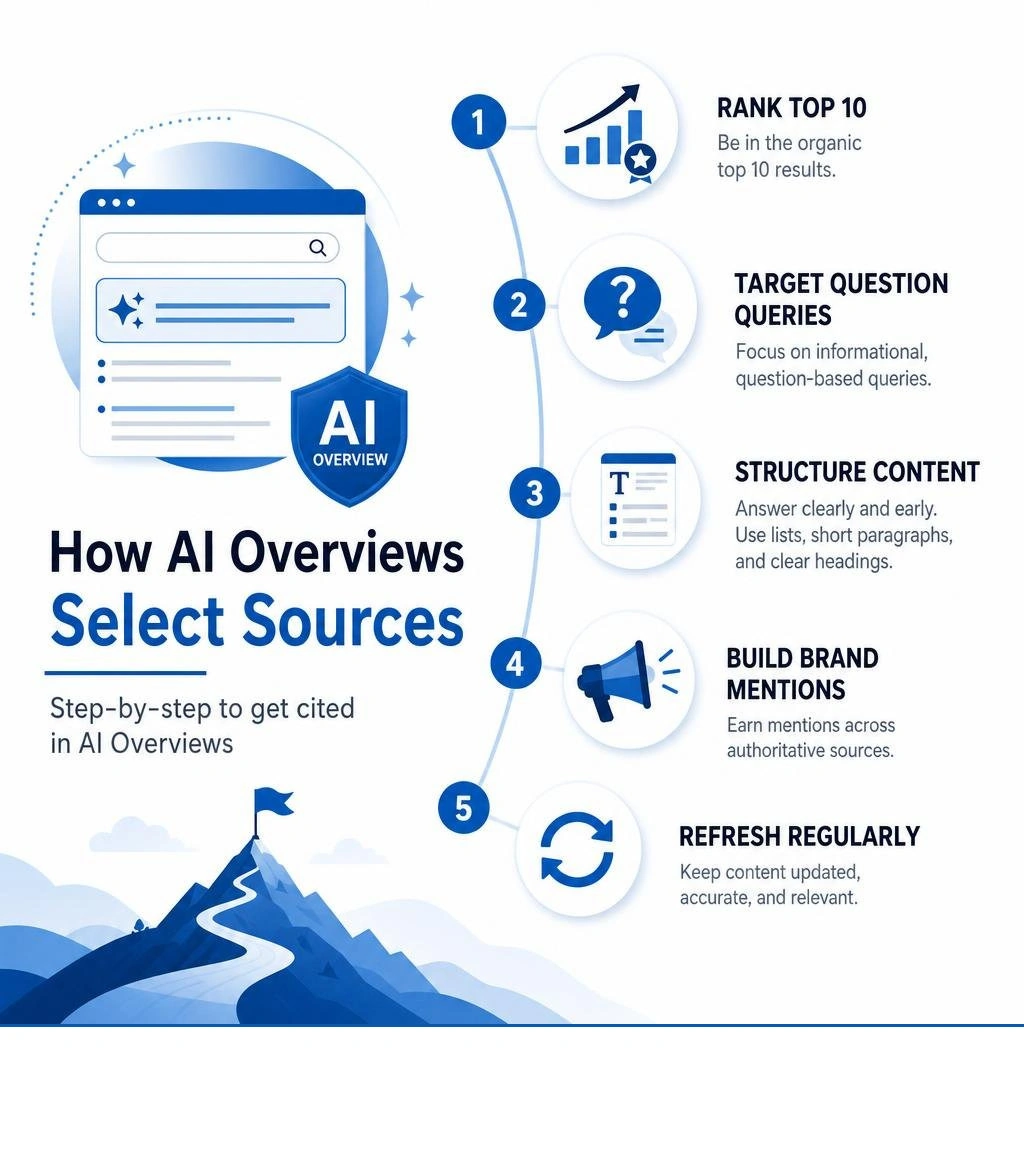
- Organic Rankings Matter: Over 76% of AI Overview citations originate from pages already ranking in the top 10 organic search results.
- Query Targeting: AI Overviews appear on 57.9% of question-based queries, making informational intent the primary driver.
- Content Structure: Direct answers placed in the first paragraph, combined with bullet lists and HTML tables, improve citation rates.
- Authority Signals: Brand mentions across authoritative platforms and YouTube show a strong correlation with AI visibility.
Ranking in Google's AI Overviews requires securing a top-10 organic ranking and structuring content for direct, machine-readable extraction. This guide provides the exact formatting, schema, and authority strategies needed to earn citations in AI-generated search summaries.
Google's AI Overviews now appear at the very top of search results for roughly 1 in 5 queries — and for question-based searches, that number jumps to nearly 6 in 10. For Shopify store owners and ecommerce marketers we work with here at First Pier, this is already reshaping which brands get seen and which get skipped entirely.
The stakes are real. When an AI Overview appears, users click a traditional search result in only 8% of visits, compared to 15% without one. Your content either gets cited in the AI answer — or it effectively disappears for that query.
The good news: ranking in AI Overviews is not a separate game from SEO. It is an extension of it. Google's own guidance confirms that following standard search best practices is the foundation. But there are specific content, structure, and authority signals that meaningfully raise your chances of being cited — and this guide walks through each one.
What Are AI Overviews and How Do They Work?
AI Overviews are combined, multi-source summaries generated by Google's large language models that appear directly at the top of the search engine results page (SERP). Originally developed under the experimental Search Generative Experience (SGE), this feature uses Google's Pathways Language Model 2 (PaLM 2) and Gemini systems to analyze search queries, read web content, and generate natural-language answers.
To understand how to appear in these summaries, you must understand Retrieval-Augmented Generation (RAG). Google does not rely solely on pre-trained database information to answer a user's question. Instead, when a query is made, Google's search algorithms retrieve relevant pages from the live web index. The language model then reads these pages, extracts the key facts, and combines them into a single, cohesive response.
During this process, Google often performs a technique called query fan-out. This means the system breaks a single search query into multiple related sub-queries to gather a wider, more diverse pool of information. Pages that rank across these multiple fan-out queries are 161% more likely to be cited in the final overview.
Because AI summaries answer the user's question immediately, they have contributed to a rise in zero-click searches. In many cases, users find exactly what they need without clicking on any traditional blue links. To capture value in this environment, we advise clients here at First Pier to focus on Answer Engine Optimization (AEO). This practice ensures your content is structured so that search engines can easily extract and cite your pages as primary sources.
According to the Google Search Central Blog, there are no special, hidden technical requirements to qualify for these features. If your site follows foundational guidelines and is accessible to Googlebot, it is eligible to be cited.
The Core Requirements for How to Rank in AI Overviews
To get your content cited in AI summaries, you must understand that the AI's selection pool is drawn directly from the traditional search index. If your page does not rank well in classic organic search, it is highly unlikely to be selected by the generator.
Data shows that 76% of cited URLs in AI Overviews also rank in the top 10 organic results for that query, with the median ranking position for top-cited sources being position 2. Additionally, AI summaries link to at least one domain ranking in the organic top 10 in 92.36% of cases.
This means traditional Search Engine Optimization (SEO) is still the prerequisite. Here at First Pier, we find that you must build search visibility, earn high-quality links, and maintain strong page authority to enter the selection pool. Once your page ranks on the first page of Google, the specific formatting and density of your content determine your final citation rate.
According to comprehensive Ahrefs Data on AI Overviews, there is a near-zero correlation between total word count and AI citations. Longer content does not guarantee visibility. Instead, the system favors concise information density and precise intent matching.
| Optimization Factor | Traditional SEO Focus | AI Overview Focus |
|---|---|---|
| Primary Goal | Rank in positions 1–10 on the SERP | Earn a citation link within the AI text block |
| Content Length | Often favors comprehensive, long-form articles | Favors high density; grounding plateaus at ~540 words |
| Query Types | Short-tail, high-volume head terms | Long-tail, question-based, conversational queries |
| Formatting | General readability, H2/H3 hierarchy | Q&A blocks, tables, lists, scannable summaries |
| Key Authority Signal | Backlink volume and domain rating (DR) | Brand mentions across YouTube, forums, and authoritative sites |
Content Structure and Formatting for AI Extraction
Because Google's generator relies on RAG, it reads your page looking for specific, factual blocks of text to extract. If your content is buried in long, conversational narratives, the AI will likely skip your page in favor of a competitor who states the facts clearly.
To make your pages straightforward for AI models to read, prioritize scannability and use clear definition sections. When a user searches for a term, place a direct answer of 40 to 60 words in the very first paragraph of the page or section. Open with a clear "What is" or "How to" heading, and immediately follow it with a concise, factual definition.
Additionally, structure your content with bullet lists, numbered steps, and tables. AI models prefer structured data because it is easier to combine into a summary.
When Google cites a source, it often links directly to a specific passage on your page using text fragments. These are deep-links that highlight the exact sentence Google used to build its answer. Ensuring your paragraphs are short and address one specific point at a time will improve your chances of earning these deep-link citations. This granular approach is a core element of modern On-Page Optimization that we build into every client campaign.
Formatting Content to Match How to Rank in AI Overviews
To format your pages effectively, use a consistent Q&A structure throughout your content clusters.
- Use Question-Based Headers: Format your H2 and H3 tags as direct questions that real users type into search engines. For example, instead of using a heading like "Attribution Methods," use "What is Marketing Attribution?"
- Write in Short, Clear Sentences: Keep sentences simple and avoid unnecessary filler words. Aim for paragraphs that are only two to three sentences long.
- Present Data in Tables: If you are comparing products, pricing, or features, present this data in a clean HTML table. Google's generator frequently pulls entire tables directly from source sites to display in its summaries.
- Align with Informational Intent: Since nearly all AI-triggered keywords are informational, write content that explains, teaches, or solves a problem rather than pushing a hard sales pitch.
Advanced Strategies: Entities, Brand Mentions, and Schema
Beyond on-page text formatting, Google's systems look at broader authority signals to determine which sources are trustworthy enough to cite. The search engine relies heavily on its entity graph — a map of how different brands, concepts, and topics relate to one another.
To establish your brand as a recognized entity within your niche, you must build consistent brand mentions across multiple high-authority platforms. This is often referred to as "surround sound SEO." When your brand is frequently mentioned alongside specific topics on industry forums, news sites, and comparison lists, Google's AI begins to associate your brand with that topic.
Data indicates that YouTube mentions have an incredibly strong correlation with AI Overview visibility. If your products or guides are featured in popular YouTube videos, Google is much more likely to pull your brand name and link into its search summaries.
Additionally, you should use structured data to help search engines understand the exact meaning of your content. Using Rich Snippets SEO Schema — such as Article, FAQ, HowTo, and Product schema — provides search engines with a clear, machine-readable map of your page's facts.

Technical Optimization to Support How to Rank in AI Overviews
While content and authority are the primary drivers of citations, technical performance remains a critical foundation. If search crawlers cannot easily access or render your pages, your content will not be indexed or cited.
- Improve Page Speed and Latency: Google prioritizes pages that load quickly. Ensure your Core Web Vitals are in the green, with a Largest Contentful Paint (LCP) of under 2.5 seconds.
- Format for Mobile Display: Because mobile searches represent roughly two-thirds of all Google queries, and mobile users see AI summaries frequently, your mobile layout must be clean and fast.
- Ensure Text Crawlability: Avoid relying heavily on client-side JavaScript to render your main content. If the text is not present in the server-side HTML, some AI crawlers may fail to read it.
- Keep Schema Updated: Regularly validate your structured data using Google's Rich Results Test to ensure there are no errors or warnings. This technical diligence is a core part of how we approach SEO Optimized Web Design here at First Pier.
Frequently Asked Questions about AI Overviews
Do AI Overviews hurt organic traffic?
AI Overviews do cause a decline in click-through rates for some traditional search results, with average position-two click-through rates declining by roughly 39% on queries where an AI summary is present. When we analyze client data here at First Pier, we see that the traffic that does click through from an AI Overview tends to be highly qualified. Because the user has already read a summary and decided to click a cited link for deeper context, these visitors show higher engagement, longer session times, and stronger conversion intent than average organic search visitors.
How long does it take to rank in AI Overviews?
Because AI summaries pull information from the top-performing organic search results, the timeline to appear in an AI Overview matches your standard SEO ranking timeline. It can take several weeks or months to build the authority required to rank on the first page of Google. However, once your page is firmly in the top 10 organic results, structuring your content with direct answers and schema markup can result in your page being cited in AI Overviews within days of a recrawl.
Do I need special schema to appear in AI Overviews?
No, Google does not require any unique, AI-specific schema or files (like an LLMs.txt file) to qualify your site for AI summaries. Standard structured data like FAQ, Article, Product, and HowTo schema is highly recommended because it improves machine readability. Using standard schema helps search engines interpret your content accurately, making it much easier for the RAG process to extract your facts and cite your domain.
To Sum Up
The search landscape has shifted from delivering a simple list of links to providing direct, combined answers. To maintain visibility, ecommerce brands must adapt their content strategies to meet the requirements of AI search engines. By ranking in the organic top ten, structuring content with direct answers, building brand mentions, and maintaining strong technical health, businesses can secure valuable real estate at the very top of the SERP.
If you would like help with ranking in AI Overviews, get in touch with our team here at First Pier.





.png)
.png)

