


Why a Strong Online Retail Strategy is Essential in 2026

An online retail strategy is a comprehensive plan that defines how your business will attract, convert, and retain customers across digital channels. It encompasses everything from product selection and pricing to marketing, fulfillment, and customer experience improvement—all working together to drive sustainable growth.
Summary
- An effective online retail strategy integrates SEO, paid advertising, social commerce, and omnichannel fulfillment to create a smooth customer journey.
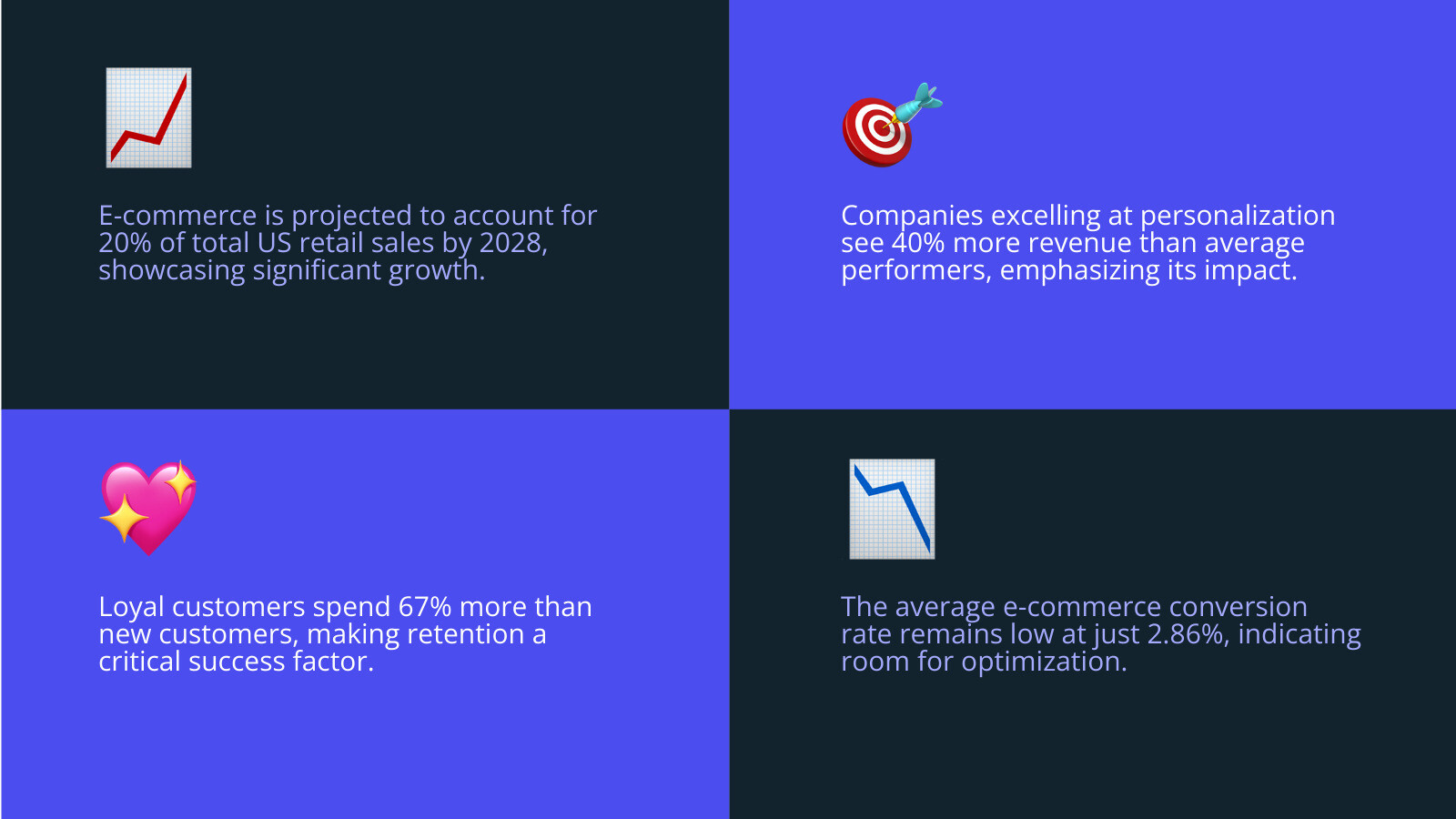
- E-commerce is projected to account for 20% of total US retail sales by 2028, with mobile commerce driving two-thirds of net online sales growth.
- Strategic coherence across product, customer, sales, marketing, and fulfillment components correlates directly with improved total shareholder return.
- Successful retailers prioritize data-driven personalization, with companies excelling at personalization seeing 40% more revenue than average performers.
- The average e-commerce conversion rate remains just 2.86%, while loyal customers spend 67% more than new customers, making retention critical.
The current retail landscape presents what many industry leaders call an "innovate-or-perish" moment. E-commerce sales have more than doubled over the past five years and continue their upward trajectory. Yet despite this growth, only three of the top 10 US retailers from 1990 remain in that position today—a stark reminder that past success offers no guarantee for the future.
The challenge isn't simply being online anymore. It's about creating a cohesive plan that serves customers wherever they are. With consumers now using an average of ten channels to complete buying journeys—up from just five in 2016—the retailers who thrive are those who can deliver consistent, personalized experiences across every touchpoint.
The gap between winners and laggards in online retail is widening, but it's not unbridgeable. Research shows that 27% of retailers qualify as "winners" with post-pandemic growth exceeding 30%, while 21% remain "laggards" with growth at or below 10%. The difference comes down to strategic fit—how well your various business components align and support each other.
Here at First Pier, I've spent over two decades helping brands build and execute winning online retail strategies that drive measurable growth through Shopify improvement and data-driven marketing. Throughout my career working with leading brands across multiple industries, I've seen how a well-crafted online retail strategy changes struggling stores into market leaders.
Essential online retail strategy terms:
Core Components of a Modern Online Retail Strategy
Building a successful online retail strategy starts with understanding that your webstore isn't just a digital catalog; it’s a living ecosystem powered by data. In my experience, the most common mistake retailers make is treating their online presence as a "bolt-on" to their physical business rather than a core driver of value.

According to National Retail Federation trends, retail is about delivering "the right product at the right price to the right customer." However, identifying that "right" customer requires deep ecommerce strategic planning. I always tell my clients that if you aren't using data-driven marketing, you're essentially flying blind.
The foundation of any modern plan is first-party data. This is the information you collect directly from your audience—through email sign-ups, purchase history, and loyalty programs. McKinsey research on personalization shows that companies that do personalization well see 40% more revenue than those that are merely average. By using this data, I can help brands move past generic "email blasts" and toward 1:1 engagement that feels relevant to the shopper.
Using SEO to Support Your Online Retail Strategy
Search Engine Optimization (SEO) is the long-term engine of your online retail strategy. While paid ads provide an immediate boost, organic search builds a sustainable foundation of traffic that doesn't disappear the moment you stop paying for clicks.
Effective SEO begins with deep keyword research to understand search intent. Are users looking to buy right now, or are they just researching? I focus on aligning content with these specific needs. This involves:
- Technical SEO: Ensuring your Shopify store is fast, mobile-friendly, and easy for search engines to crawl.
- Backlinks: Building authority by getting reputable sites to link back to your products.
- Content Value: Creating descriptions and blog posts that actually answer customer questions.
For a deeper dive, I recommend checking out this E-commerce SEO Guide. Here at First Pier, I integrate SEO into every online marketing strategy to ensure my clients are visible when and where their customers are searching.
Expanding Reach Through Marketplaces
If there is one rule I abide by in retail: go to where the shoppers are already browsing. While your own Shopify site is your home base, third-party platforms like Amazon or Walmart can be helpful tools for growth.
However, a multichannel business expansion requires careful management. You must maintain pricing consistency across all channels to avoid confusing your customers or triggering penalties from marketplace algorithms. I help brands protect their identity by ensuring that product listings on Amazon complement, rather than conflict with, their own webstore. This includes using tools like Amazon's Brand Registry to maintain control over how your products are presented.
Driving Traffic Through Multi-Channel Marketing
Connecting with the right customer has never been more difficult. With consumers spending an average of two to four hours daily on social networks, a "one-and-done" marketing approach no longer works.
To drive results, I implement an ecommerce digital marketing strategy that uses a mix of organic and paid channels. Pay-Per-Click (PPC) through Google Ads allows us to reach users at the exact moment they search for a product. Since 80% of internet users can be reached through Google's advertising network, it's a giant you can't afford to ignore. If you're wondering Which Social Network to Advertise On, the answer usually depends on your audience demographics. For example, 55% of Gen Z consumers have purchased through social media in the last six months, making platforms like TikTok and Instagram essential for younger brands.
Influencer Marketing and Content Creation
Influencer marketing has evolved far beyond celebrity endorsements. Today, it’s about finding specialists who share your brand's values. These partnerships provide social proof that is incredibly effective; research shows that 1 out of 2 women based their purchase choices on influencer reviews.
I help brands find the right fit by looking at influencer marketing statistics and engagement rates. A successful marketing strategy for online business often includes user-generated content (UGC). When real customers post photos or videos of your products, it builds a level of trust that a professional photoshoot simply can't match.
Paid Advertising and Retargeting
Paid advertising is most effective when it follows the customer through the entire funnel. I use display ads and contextual targeting to place your products on websites that are relevant to your audience's interests.
One of the most exciting shifts in recent years is the growth of retail media network growth. These networks allow mid-market brands to use a retailer's proprietary data to reach customers closer to the point of purchase. In my work with paid search SEM, I focus heavily on Return on Ad Spend (ROAS). By using retargeting, I can show ads to people who have already visited your site, reminding them of the items they liked and bringing them back to finish the transaction.
Improving Conversion Rates and User Experience
You can drive all the traffic in the world, but if your site is difficult to use, your sales will suffer. The average e-commerce conversion rate is a humble 2.86%. To beat that average, I focus on the user experience (UX).
Mobile commerce (m-commerce) is projected to drive two-thirds of net online sales growth through 2028. This means your site must be improved for a small screen. I prioritize fast loading times, easy navigation, and high-quality product photography. Using multiple angles and lifestyle images helps customers envision the product in their own lives, which is a key part of ecommerce sales funnel optimization.
Recovering Abandoned Carts
Did you know the average online shopping cart abandonment rate is 69%? That represents a massive amount of "lost" revenue that is actually quite easy to recover.
I use automated remarketing emails to bring these shoppers back. A good abandoned cart email should include:
- A personal sender name.
- A catchy subject line.
- Visual reminders of the products left behind.
- A clear call-to-action button.
You can see some great Abandoned Cart Email Examples to get inspired. By refining your shopify sales funnel, I can help you implement conversion tools that automatically trigger these reminders, turning "maybe" into "yes."
Fine-tuning Product Listings
Your product page is your digital salesperson. It needs to be informative and persuasive. I recommend using A+ Content—enhanced images, videos, and comparison charts—to engage customers.
Effective listings also include descriptive copy that highlights benefits, not just features. I also use these pages for cross-selling (showing matching items) and up-selling (showing a premium version). My approach to ecommerce UX design ensures that every element on the page is designed to help the customer make a confident decision.
Building Loyalty and Omnichannel Presence
Acquiring a new customer is five times more expensive than keeping an existing one. Furthermore, loyal customers spend 67% more than new ones. This is why a core part of my online retail strategy is building long-term relationships.
| Strategy Type | Purchase Rate | Customer Retention |
|---|---|---|
| Single-Channel | Baseline | Baseline |
| Multi-Channel (3+ channels) | +287% | +90% |
Brands like Everlane have built massive loyalty by being transparent about their Everlane brand mission, including ethical labor practices and price transparency. I help brands foster this kind of ecommerce community loyalty by creating platforms where customers feel heard and valued.
Creating a Smooth Customer Experience
The gap between online and offline shopping is closing. Customers today expect a smooth experience, whether they are on their phone or in your physical shop.
I help retailers implement shopify POS implementation to unify their sales data. This enables popular services like:
- Click and Collect: Buy online, pick up in-store.
- Curbside Pickup: A service that saw a 500% increase in recent years.
- Cross-channel Returns: Buying online and returning in-person.
These features require real-time inventory visibility, ensuring that if a customer sees an item "in stock" online, it's actually there when they arrive at the store.
Measuring the Success of Your Online Retail Strategy
If you can't measure it, you can't improve it. I track a variety of metrics to ensure a client's strategy is working.
Key metrics I monitor include:
- Conversion Rate: The percentage of visitors who make a purchase.
- Customer Acquisition Cost (CAC): How much you spend to get one new customer.
- Lifetime Value (LTV): The total revenue a customer generates over their lifetime.
By performing regular ecommerce analytics analysis, I can identify where customers are dropping off and adjust the plan accordingly. As noted in Think with Google retail trends, the future of retail belongs to those who can turn these data points into actionable improvements.
Frequently Asked Questions about Online Retail
How can I increase traffic to my online store?
Increasing traffic requires a multi-pronged approach. I recommend a combination of SEO for long-term growth, PPC for immediate results, and content marketing to build authority. Social media is also essential; retailers with at least one social account generate 32% more sales on average. For more specific tactics, see my guide on driving customer acquisition.
What are the best practices for cart recovery?
Timing is everything. I usually set up the first recovery email to go out within an hour of abandonment. Use personalization, offer a small incentive if appropriate, and ensure the email is mobile-friendly. I use shopify automation to handle this process 24/7 without manual effort.
How do I handle data silos in my business?
Data silos happen when your different systems (like your website, your physical store, and your warehouse) don't talk to each other. The solution is to use integrated platforms like Shopify that provide a "single source of truth." I also offer ecommerce data analytics and ERP services to help connect these dots and provide a clear picture of your business health.
To sum up
Here at First Pier, I help brands navigate the complexities of digital sales by building high-performance Shopify stores and data-driven growth plans. Success in the current market requires a clear plan that combines technical performance with a deep understanding of customer needs. Whether you are just starting or looking to scale a boutique, I provide the expertise needed to turn your online retail strategy into a reality. More info about First Pier digital marketing





.png)
.png)

