



Shopify ships platform changes on a near-monthly cadence now, and most of them are worth knowing about for one practical reason: they shift what's possible, what's deprecated, and what requires action on your store. Staying current isn't optional anymore — it's the difference between a store that compounds advantages over time and one that quietly falls behind.
This guide covers the Shopify updates that matter most for merchants and developers heading through 2026: the GraphQL API expansion, the full Checkout API deprecation, the rebuilt Cart APIs, improved B2B infrastructure, Hydrogen's monthly release cadence, App Store changes, and new security requirements. Where action is required, we flag it directly.
Why Shopify Updates Matter for Your Store in 2026
Most merchants under-invest in staying current because the updates feel technical or distant from revenue. The practical reality is that each meaningful Shopify change either creates a new capability that compounds over time (new Cart API supporting bundles and subscriptions natively), or introduces a deprecation that will eventually break something (Checkout APIs retired in 2025). Both matter. Ignoring updates doesn't keep your store where it is — it keeps your store pointed at infrastructure Shopify is actively moving away from.
The updates fall into a few categories worth tracking: API and platform changes (what developers need to migrate), commerce features (what merchants can enable without code), B2B capabilities (expanding what Shopify serves natively), headless tooling (Hydrogen's continuing maturation), and ecosystem changes (App Store, security, data access).
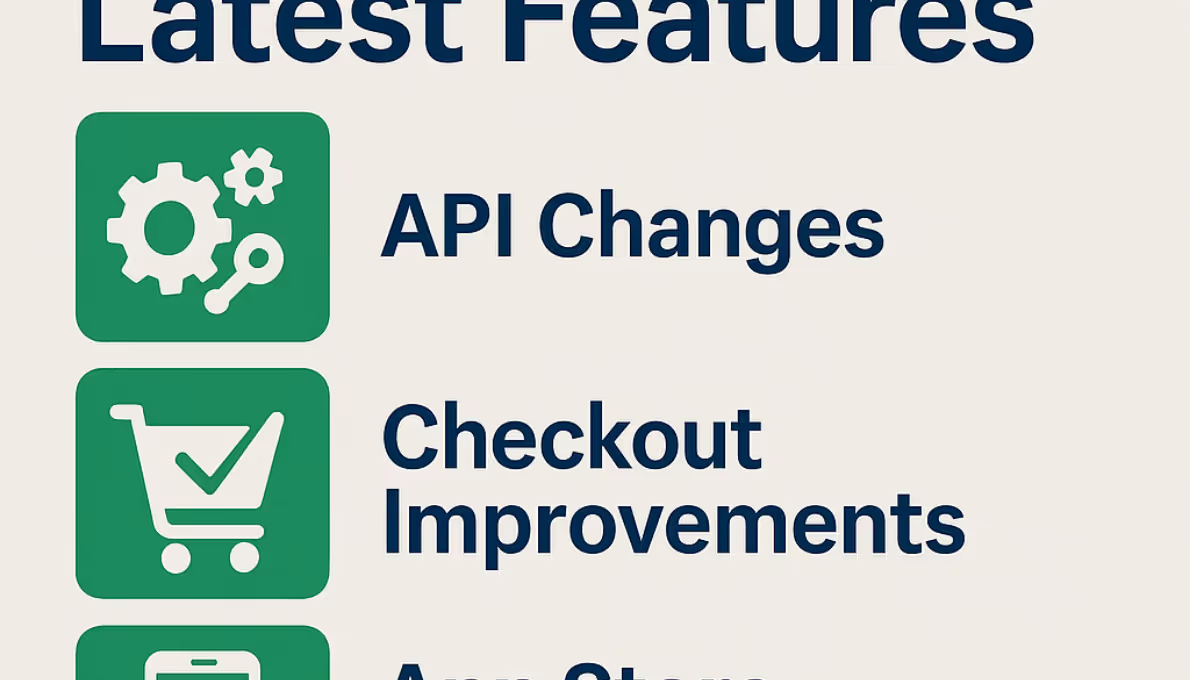
Here's a quick reference to the biggest 2026-relevant changes:
- GraphQL product variants: Support expanded from 100 to 2,000 per product
- Checkout APIs: Fully deprecated as of April 2025 — migrate to Storefront Cart API or Checkout Sheet Kit
- Cart API: Native support for subscriptions, bundles, and contextual pricing
- B2B: Subscription contracts, buyer identity management, automatic discounts, B2B-specific checkout
- Hydrogen: Monthly release cadence, Vite support, expanded commerce primitives
- App Store: Refreshed taxonomy, clearer data access disclosure, faster review process
- Security: Level 2 Protected Customer Data requirements, tightened app data access controls
1. Major Shopify API Changes: What Developers Need to Know
The most significant ongoing shift in Shopify's API surface is the continued consolidation around GraphQL, with REST endpoints steadily deprecated through 2025 and 2026. For any store running custom integrations, apps, or headless storefronts, this is the single most important migration to stay ahead of.
The standout change: Shopify's GraphQL product APIs now support up to 2,000 variants per product, up from the legacy 100-variant cap. For categories with genuine variant complexity — apparel with size/color/fit combinations, configurable hardware, personalized goods — this eliminates the workaround pattern of splitting one conceptual product into multiple listings with duplicated metadata.
Shopify has also restructured the Cart API to handle subscriptions, product bundles, and contextual pricing as first-class concepts rather than as add-on apps layered over a simpler cart model. For developers building custom storefront flows or headless integrations, this substantially reduces the amount of glue code required to support modern commerce use cases.
What the API changes mean in practice
If your store uses vanilla Shopify with no custom apps or integrations, most of this happens transparently behind the scenes. If your store has custom apps, headless integrations, or third-party apps that interact with the Admin or Storefront API, there's real migration work involved. Cart IDs and cart cookies now require a key parameter, count fields have been streamlined, and the GraphQL Admin API has been standardized for consistency — all of which mean hardcoded assumptions in older code need to be updated.
The practical move for any store running custom code is to audit your current Shopify API usage this quarter. Identify which endpoints are REST, which are GraphQL, and which are deprecated or scheduled for deprecation. Shopify's developer changelog is the authoritative source for current deprecation timelines.
2. Checkout API Deprecation: The Migration That's Already Happened
Shopify's legacy Checkout APIs were fully deprecated in April 2025. If you're still reading this and running a custom checkout that relies on the old APIs, that checkout is running on infrastructure Shopify no longer supports. Stores using the standard Shopify checkout are unaffected — this applies specifically to custom checkout implementations built on the deprecated Checkout APIs.
The two replacement paths Shopify directs developers toward are the Storefront Cart API and the Checkout Sheet Kit. The Cart API is the primary modern replacement for most use cases, offering significantly better performance and native support for the commerce patterns (subscriptions, bundles, contextual pricing) that previously required custom implementation.
Shopify's Cart API Migration Guide covers the migration end-to-end. For headless storefronts built on Hydrogen, most of the migration work is already handled by Hydrogen's current components — the issue is stores running older custom implementations that haven't been touched.
What the replacement APIs actually deliver
The new Cart API isn't a like-for-like replacement. It's materially better infrastructure. Performance benchmarks Shopify published show cart loading up to 50% faster, with proportional improvements to checkout button performance. For customers, this is a noticeable reduction in perceived checkout friction.
The functional expansion is bigger than the performance gain. Subscriptions, bundles, and contextual pricing are now native concerns of the Cart API rather than app-layered customizations. Scalability has been meaningfully improved for stores with large or complex carts. Error handling is more specific — errors now include clear codes and actionable messages rather than generic failures, which reduces the diagnostic burden on both developers and support teams.
If your store is still on the old Checkout APIs, the migration is past-due. For most stores, the work is 2-8 weeks of developer time depending on complexity, and the performance gain alone usually justifies the effort.
3. Cart API Capabilities: What's Actually New
The updated Cart API delivers capabilities that required custom development or third-party apps under the previous generation. Three are worth calling out because they change what's practical to build natively:
Subscription support is now a first-class Cart API concern. Recurring orders, subscription selling plans, and hybrid one-time-and-subscription carts can be constructed through the API without the workarounds previously required. For brands using Shopify Subscriptions or third-party subscription apps (Recharge, Bold, Appstle), this infrastructure is what those apps now build on.
Bundle handling is simplified. Product bundles — whether merchandised bundles priced together or dynamic bundles constructed at cart time — are supported through the API without the inventory and pricing workarounds previously required. Bundles become a merchandising lever brands can use to raise AOV without the engineering overhead that previously discouraged them.
Contextual pricing lets pricing respond to customer attributes: location, membership status, account type, purchase history. This is the foundation of what Shopify B2B customers have needed for wholesale pricing tiers, and it extends to consumer use cases like member-only pricing or regional variants without requiring custom pricing apps.
The CartTransform function is the most flexible addition. It applies custom logic to any cart — automatic discounts based on rules, dynamic bundle composition, line-item adjustments, cross-sell insertions. Previously this required custom checkout development; now it's a Shopify function that runs at cart time.
Shopify has also added more specific error handling across the API surface, including a new error code for handling missing payment methods on subscription draft commits. Small-seeming, but meaningful in practice — vague error responses were one of the primary sources of subscription support tickets for stores running Recharge or similar.
4. B2B Commerce: Shopify's Expanded Native Support
Shopify has significantly expanded native B2B capabilities, reducing how often brands serving business customers need to run separate wholesale platforms or heavily customized installations. The 2026-relevant improvements:
Subscription contracts for B2B let wholesale customers set up recurring orders with custom pricing, terms, and delivery schedules. A wholesale coffee supplier can now handle weekly café restocking with contracted pricing and payment terms natively rather than through custom development.
Buyer identity management lets a single corporate account have multiple authorized buyers with different permissions. A restaurant chain's district managers, kitchen supervisors, and corporate procurement team can each have appropriate access — place orders, approve purchases, view history — without sharing credentials or running multiple parallel accounts.
Automatic discounts for B2B checkouts close a long-standing gap. Volume discounts, contract pricing, and promotional offers now apply in B2B checkout flows the same way they apply in D2C. The practical effect is that B2B merchandising has the same lever set B2C merchandising has.
Custom pricing and payment terms — including net-30, net-60, minimum order thresholds — are now configurable at the account level within Shopify. Wholesale customers requiring extended payment terms or $500 minimum orders can be managed in the same admin rather than in a separate wholesale tool.
Company account management handles multi-contact purchase flows, approval workflows, and role-based permissions within corporate accounts. This is the infrastructure that makes Shopify viable for mid-market B2B without external customization.
B2B-specific checkout allows custom fields, purchase order entry, and business-specific shipping and billing flows to live in the same checkout surface without creating a separate, divergent experience.
Combined, these changes mean Shopify is increasingly viable as a unified commerce platform for brands selling both D2C and B2B — without the complexity of running two platforms or heavy custom integration work to bridge them.
5. GraphQL Product APIs: 2,000-Variant Support
The variant-cap expansion from 100 to 2,000 per product deserves its own section because of how much legacy workaround behavior it eliminates for the categories it affects.
Before the expansion, any product with genuine combinatorial complexity — a t-shirt in 8 sizes x 6 colors x 3 sleeve lengths x 5 designs — had to be split across multiple products or rely on metafield-based variant workarounds. Both approaches degraded merchandising (the same product appeared as many different SKUs), complicated inventory (stock sync across duplicated listings), and confused customers (multiple near-identical search results for what was conceptually one item).
Alongside the cap expansion, Shopify introduced the productSet GraphQL mutation, which creates or updates products and variants in a single API call. For stores with large catalogs, this reduces what was previously thousands of API calls into batched operations, meaningfully speeding up catalog management and reducing rate-limit pressure.
What the expanded variant support actually enables
The benefits compound beyond the mechanical limit change. Catalog management gets simpler because complex products stop requiring duplication strategies. Merchandising gets cleaner because search results and collection pages show one SKU per conceptual product. Inventory gets more accurate because there's one variant record per real-world variant rather than synced duplicates.
Performance also improves as a byproduct. GraphQL requests are generally more efficient than equivalent REST calls (fetch exactly the data you need, nothing more), and the productSet mutation further reduces the round-trip cost of catalog operations.
Finally, the expansion is aligned with Shopify's direction of travel: GraphQL is where new capabilities land, and adopting the modern APIs now means new features arrive as upgrades rather than migrations. Shopify's changelog entry on the variant expansion covers the full technical context for developers.
6. App Store Updates: Taxonomy, Reviews, and Transparency
Shopify has restructured the App Store with a refreshed taxonomy, clearer data access disclosure, and faster developer review cycles. Three effects worth knowing about:
Better app discovery. The refreshed category taxonomy is more specific than the legacy version, which makes it easier for merchants to find apps matching a concrete need rather than browsing broad categories. Developers who update their category placement to match the new structure get more relevant installs; ones who don't get progressively less visibility.
Clearer data access transparency. Apps now show a plain-language explanation of what customer data they access and why at install time, not buried in privacy policies. For merchants, this makes it substantially easier to audit what your installed apps are doing with customer data — which matters both for operational trust and for regulatory compliance (GDPR, CCPA, evolving state-level US laws).
Faster developer review cycles. Shopify has improved the app submission and resubmission process with more specific feedback and a clearer path for revisions. For merchants, this translates to newer apps reaching the App Store faster and higher overall quality in reviewed apps.
The practical action here is a periodic app audit — most stores accumulate apps over time, and most apps either aren't actively used or access more data than they need. The improved transparency makes that audit significantly easier to conduct.
7. Checkout UI Extensions: What's New
Shopify has expanded the UI extension API for checkout customization, enabling capabilities that previously required custom checkout development or checkout.liquid modifications.
The most commercially significant addition is split shipping support — customers can send individual items in an order to different addresses within a single checkout. For gift-giving categories, corporate gifting programs, and B2B buyers placing orders for multiple locations, this removes the "place two separate orders" friction that previously killed larger baskets.
New extension targets for shipping method option lists and item targets let developers customize how shipping options are presented, grouped, and calculated. A specialty food retailer with both perishable and shelf-stable items can present separate shipping options for each group; a furniture brand with white-glove delivery requirements can surface specialized shipping paths clearly. The technical documentation covers the extension points in detail.
Visual customization has also expanded. Checkout now supports up to four distinct color schemes, enabling brands with multi-context selling (consumer, wholesale, subscription) to maintain appropriate visual identity across contexts without separate checkout implementations.
These extensions strike the productive balance Shopify has been working toward: meaningful customization available to merchants without forfeiting the speed, security, and conversion optimization of Shopify's managed checkout. For stores that previously had custom checkout flows to handle edge cases like split shipping, these extensions often let those flows be retired in favor of native functionality.
8. Security and Customer Data Protection
Shopify's 2025-2026 updates include meaningful security improvements that affect both merchants and developers. The relevant changes:
Level 2 Protected Customer Data requirements apply additional review and security standards to apps that access sensitive customer information. Apps meeting these standards go through more rigorous vetting; apps that don't qualify can't access the protected data categories. For merchants, this raises the baseline security of the app ecosystem.
Order status page timeout parameters automatically log customers out of order status pages after inactivity, reducing the risk of order details being exposed on shared or public devices. Small change with meaningful customer-trust implications, especially for categories where order contents are sensitive (medical products, subscriptions to curated content, high-value electronics).
Customer Privacy settings in admin give merchants more direct control over data collection and sharing — particularly around custom pixels and tracking technologies. For compliance with GDPR, CCPA, and the expanding patchwork of US state privacy laws, these controls move from being a headache to being a manageable admin setting.
Tightened app data access controls require apps to clearly disclose what they access and let merchants revoke permissions granularly. Developers get more detailed audit capabilities for their own apps, helping them confirm they're operating within policy.
Combined, these changes raise the security baseline without requiring merchant action for most stores — the burden falls on app developers and Shopify's platform infrastructure. Stores running custom apps or integrations should confirm their implementations align with the current security standards, particularly around protected customer data categories.
9. Hydrogen: Monthly Releases and What's Shipping
Shopify's Hydrogen framework for headless commerce has moved to a monthly release cadence, with updates landing in the first week of each month. For brands running Hydrogen storefronts or considering a move to headless, this predictable release rhythm meaningfully reduces the uncertainty of working with a still-maturing framework.
Recent Hydrogen releases have included several practical improvements worth knowing about. Vite support accelerates local development with significantly faster build and hot-reload times — a quality-of-life change that compounds over hundreds of daily iterations. Improved developer tooling delivers clearer error messages and more targeted debugging, reducing the time-to-diagnosis on common issues.
On the capability side, Hydrogen has added hooks and components for gift cards, localized consent management, and improved sitemap generation. These are the kinds of commerce primitives that previously required custom implementation on headless storefronts; moving them into the framework reduces the ongoing maintenance burden for Hydrogen-powered brands.
The OptimisticVariant hook is worth specific mention. It provides faster perceived performance when customers switch between variants on a product page — the variant change reflects immediately in the UI while actual data updates follow. For stores with variant-heavy categories (apparel, configurable products, personalization), this is directly visible to customers as a smoother experience.
Custom environment file support simplifies configuration management across development, staging, and production environments — reducing one of the more common sources of deployment errors for headless storefronts.
The strategic read on Hydrogen for 2026: it's becoming more viable as a production framework for mid-market brands, not just enterprise engineering teams. For most stores under $10-20M in annual revenue, the case for going headless still requires specific justification (meaningful performance needs, significant mobile app investment, specialized design requirements) — but the operational cost of running Hydrogen has dropped substantially over the past 12 months.
10. App Store Taxonomy: Why It Matters
The refreshed App Store taxonomy is less visible than API changes but has real effects on how merchants find apps and how app developers reach users.
Previously, the App Store's broad categories forced merchants to scroll through long lists of loosely-related apps to find something specific. The new structure uses more specific categories and subcategories — "email capture" instead of just "marketing," "international shipping" instead of just "shipping" — which reduces the time cost of finding apps that actually match a concrete need.
Shopify's statement on the change is direct: the taxonomy was refreshed specifically to make apps easier to find. The category page ads feature, operating on cost-per-click, lets app developers highlight relevant solutions directly to merchants actively browsing the matching category — more efficient than broad-audience advertising.
App search has improved alongside the taxonomy change, with smarter algorithms, better filtering, and side-by-side comparison of up to four apps. For merchants evaluating new apps, this compresses the evaluation cycle from hours of tab-switching to a focused side-by-side comparison.
The practical merchant action here is twofold: run an app audit at least annually (most stores accumulate unused apps), and when evaluating new apps, use the comparison feature rather than evaluating apps one at a time. For developers, reviewing app category placement and listing descriptions against the new taxonomy is usually a 1-2 hour exercise that meaningfully improves discoverability.
Frequently Asked Questions About Shopify Updates
What's the most important Shopify update to act on right now?
For stores running custom apps or integrations, confirming Checkout API migration is complete is the non-negotiable item — the legacy APIs were retired in April 2025, and stores still on them are running on unsupported infrastructure. For stores without custom code, the most valuable 2026 update is usually the expanded B2B capabilities (if applicable) or the Cart API-powered bundle and subscription features (if you sell in those categories). The App Store audit is the lowest-effort high-value action for any store.
How often does Shopify release updates?
Cadence varies by area. Hydrogen releases monthly (first week of each month). The Shopify Admin and Storefront APIs follow a quarterly version cycle (e.g., 2026-04, 2026-07) with backward compatibility windows. Commerce features (checkout, B2B, apps) ship continuously without a fixed cadence. Shopify's developer changelog is the authoritative source for tracking ongoing changes.
Do Shopify updates break things automatically?
Rarely for standard stores. Shopify maintains compatibility windows and deprecation notices for API changes, and commerce-side updates generally don't require merchant action. The exceptions are stores running custom code, heavily customized themes, or apps that haven't been updated in years — those can break when underlying APIs change. A periodic audit of custom code against the current API version is the safe practice.
How do I track Shopify updates that affect my store specifically?
The Shopify developer changelog covers all platform-level changes. Shopify's Editions site covers major feature releases. For merchants without development teams, working with a Shopify Partner agency to do a quarterly update review is usually more efficient than trying to track the changelog directly — Partners surface the changes that affect your specific stack rather than requiring you to filter through all of them.
Is it worth moving to Hydrogen in 2026?
Depends on the reason. For stores with specific performance, customization, or multi-surface needs (web + mobile app + in-store), Hydrogen is increasingly viable and the tooling has matured meaningfully. For stores on Shopify's standard theme system that convert well and have no specific friction, the engineering overhead of Hydrogen rarely justifies the switch. The question worth asking is what specific capability or performance gain headless would unlock that justifies the ongoing maintenance cost.
The Bottom Line
Shopify's 2026 updates aren't individually transformative — they're a collection of compounding improvements across APIs, commerce features, B2B infrastructure, headless tooling, and the app ecosystem. The brands that benefit most are the ones treating Shopify updates as an ongoing operational discipline (quarterly review, targeted adoption of relevant changes, staying current on deprecations) rather than as occasional catch-up work.
The three actions worth prioritizing this quarter: audit any custom code against current API versions, confirm the Checkout API migration is fully complete if you were ever on legacy custom checkout, and conduct an App Store audit to identify unused or redundant apps now that the refreshed taxonomy makes category-appropriate alternatives easier to find.
If you're managing a Shopify store and want help sorting which 2026 updates actually affect your specific stack, First Pier offers a free consultation to walk through what's changed, what needs action, and where opportunities exist to unlock new capabilities that compound over time.
First Pier is a Shopify agency based in Portland — see our work with Shopify brands across Maine.





.png)
.png)

