




Why B2B Ecommerce Matters More Than Ever

Summary
- Shopify B2B & Wholesale is a feature suite for selling in bulk to other businesses on the Shopify platform.
- B2B buyers increasingly prefer self-service online purchasing, expecting features like custom pricing and payment terms.
- Shopify Plus allows businesses to manage both B2B and direct-to-consumer (D2C) sales from a single admin panel.
- The global B2B market is projected to reach $35 trillion by 2027, with a majority of transactions occurring online.
Shopify's B2B & Wholesale tools provide native features for selling in bulk to other companies. Here's what you need to know:
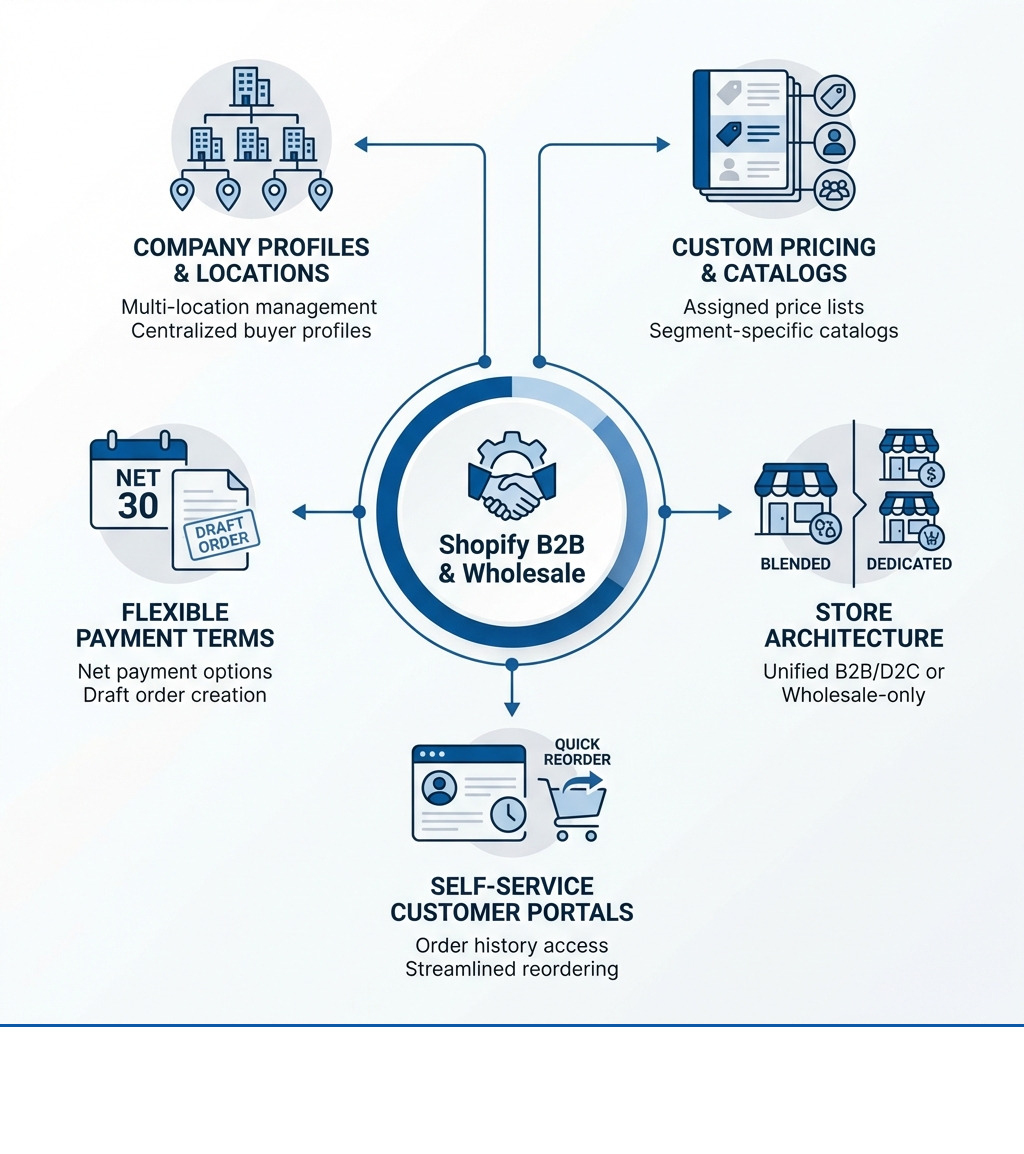
- Company Management: Create wholesale customer profiles with custom pricing, payment terms, and tax exemptions
- Custom Pricing: Set up price lists, volume discounts, and quantity rules for different buyer segments
- Flexible Payments: Offer net payment terms (Net 15, Net 30, etc.), draft orders, and purchase order numbers
- Store Options: Run a blended B2B/D2C store or create a dedicated wholesale-only storefront
- Self-Service Portal: Let buyers place orders, view history, and manage accounts without sales rep involvement
The global B2B market is projected to reach roughly $35 trillion by 2027. Eight out of ten domestic B2B transactions already happen online, and 56% of B2B revenue flows through digital channels. Business buyers now operate differently. They expect the same straightforward process they get from consumer shopping, but with the complexity of wholesale pricing, payment terms, and bulk ordering built in.
The data shows that when B2B buyers use self-service online stores, 65% complete what they consider high-quality deals, compared to just 24% when purchases are conducted through sales reps. Orders over $500,000 now close via self-service online, and 89% of procurement teams use generative AI at some stage of the buying process. The traditional model of sales rep-driven transactions is being replaced by digital-first buying.
Shopify recognized this and overhauled its B2B functionality in 2022, integrating wholesale features directly into Shopify Plus. This allows businesses to run both D2C and wholesale operations from a single admin, avoiding the need for separate third-party solutions. For businesses already on Shopify, this is a way to add a wholesale channel without rebuilding their tech stack.
I'm Steve Pogson, and I've spent over two decades helping businesses scale their ecommerce operations, with a particular focus on Shopify B2B & Wholesale implementations for brands that need sophisticated wholesale channels alongside their retail presence. Here at First Pier, we've built B2B systems for companies ranging from small manufacturers expanding into wholesale to established distributors moving from legacy platforms to Shopify Plus.
The Shift to Digital: Understanding B2B vs. B2C Ecommerce
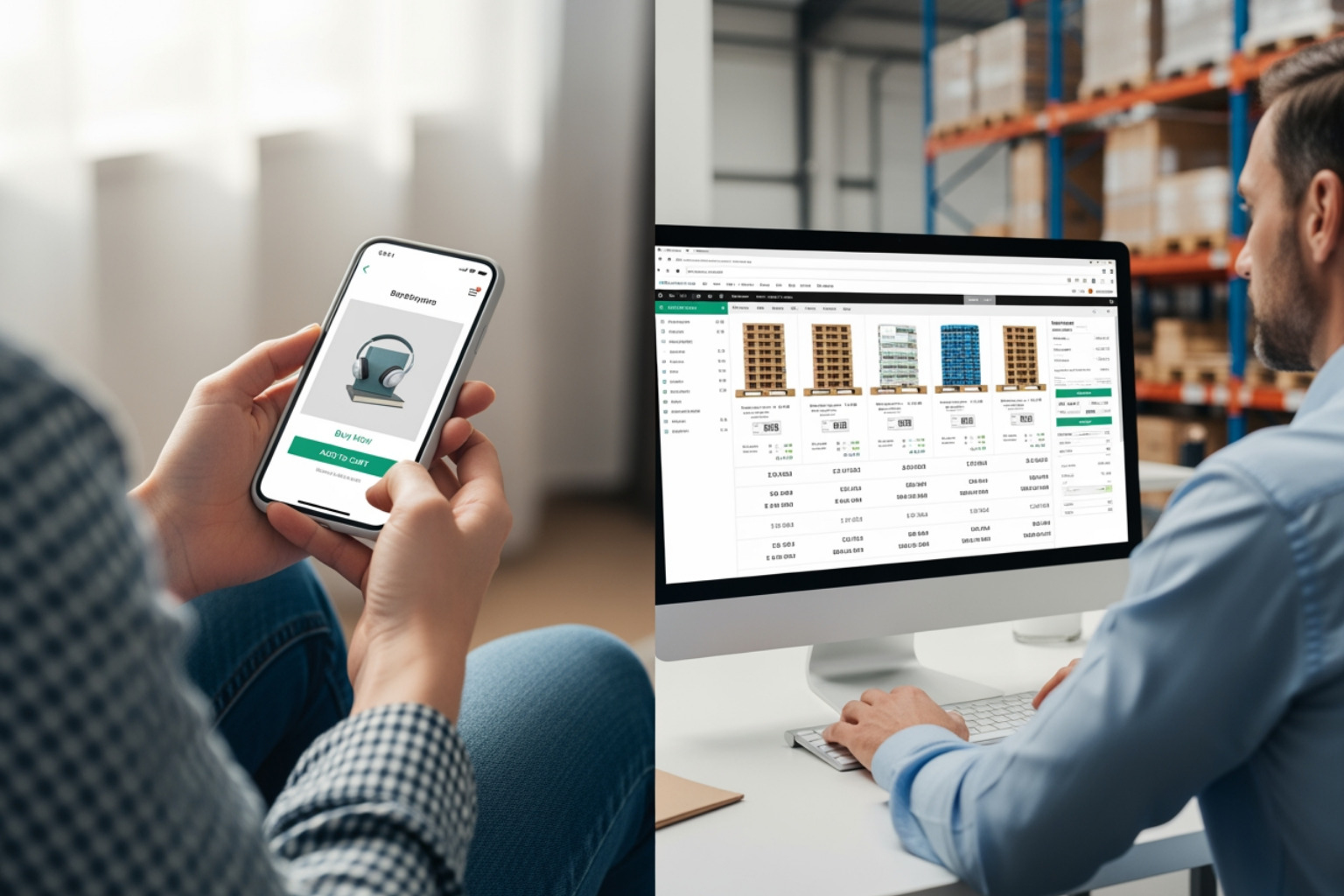
B2B and B2C ecommerce have distinct customer expectations and operational needs. While both involve selling products, the underlying dynamics are different.
B2C ecommerce, which many Shopify merchants are familiar with, involves selling directly to individual shoppers. The focus is often on emotional appeal, instant gratification, and high-volume, low-value transactions. The customer path is typically short, and pricing is generally uniform for all buyers.
B2B ecommerce means selling goods or services to other businesses. This market is vastly different. The target audience consists of professional buyers who make purchasing decisions based on logic, budget, and long-term business needs. Order volumes are typically larger, and pricing is almost always customized, often involving complex tiered structures or negotiated terms. Relationship management is important in B2B, as these are often ongoing partnerships rather than one-off sales.
The shift to digital sales has had a significant impact on B2B. As the introduction highlighted, a large portion of B2B transactions now happen online. This change is driven by B2B buyers who increasingly prefer the convenience and efficiency of digital self-service. They want to research products, compare prices, and place orders independently, mirroring their B2C shopping habits but with the added complexity of wholesale requirements.
Because of this change, B2B platforms must offer features for these specific needs. For more detail on the foundational aspects of setting up your online business for wholesale, I recommend our B2B E-commerce Web Development Complete Guide.
Core Features of Shopify B2B & Wholesale
Shopify's suite of B2B features is designed to manage the specific complexities of wholesale transactions directly within your store's admin. This means you can keep your B2B operations organized and efficient.
Company & Customer Management
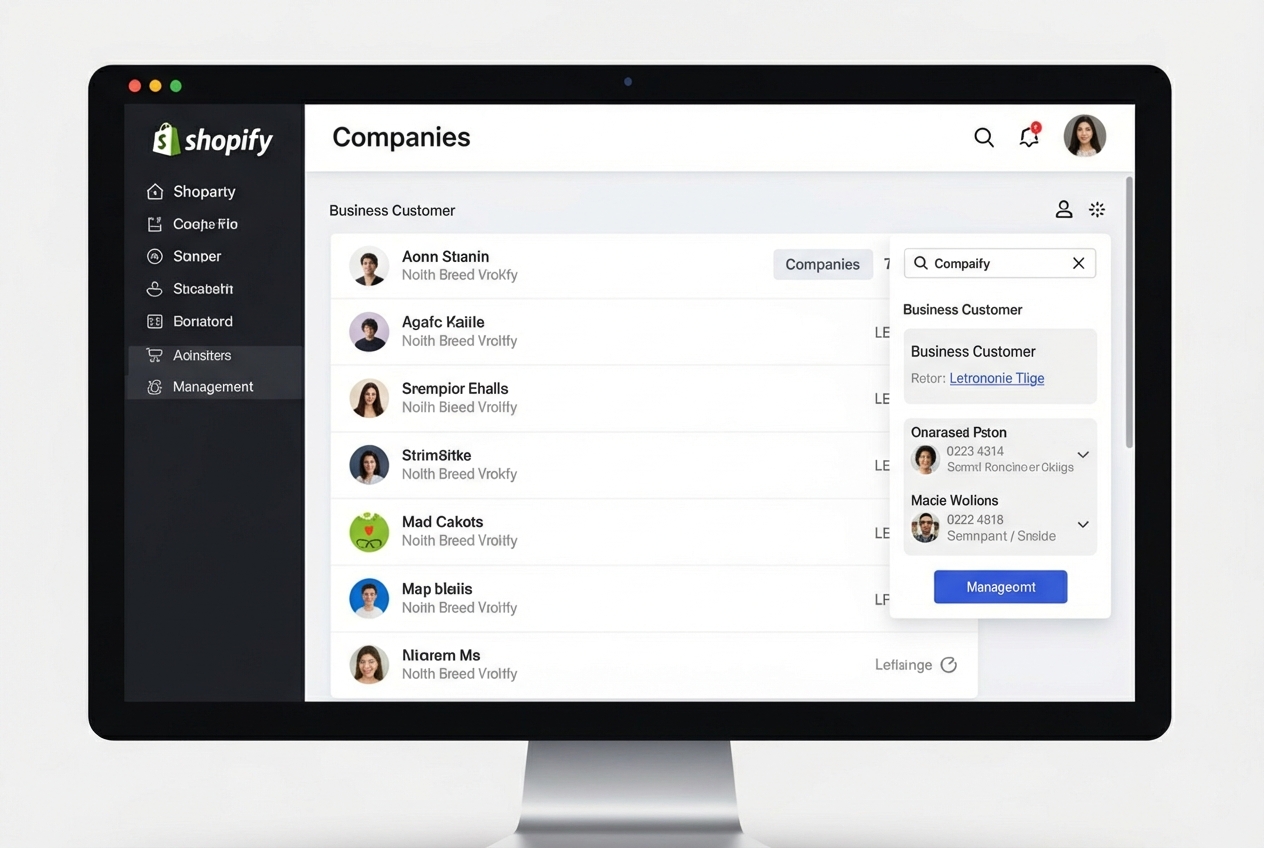
A core part of Shopify B2B & Wholesale is the "Companies" feature. This allows you to create profiles for each of your wholesale clients, which can include multiple locations and associated buyers. Each company can have unique settings for everything from payment terms to tax exemptions. This detail allows you to apply specific settings for each business customer.
Customers can also engage in self-serve purchasing. Once logged in, they see their specific pricing and product catalog. They can view their order history, easily reorder past purchases, and manage their account details. This self-service model reduces the administrative work for your sales team.
For larger organizations, you can assign different sales staff members specific permissions, allowing them to manage only their assigned customer accounts or locations. This provides a structured approach to B2B sales operations. To add more self-service functions, Customer account UI extensions allow you to add third-party or custom apps with new features for B2B customers. For more insights on how these features come together, I often refer to our B2B on Shopify resource.
Custom Pricing, Catalogs, and Discounts
One of the most critical aspects of wholesale is flexible pricing. Shopify B2B & Wholesale handles this through custom catalogs and price lists. You can create different price lists for various customer segments, offering product-specific pricing for SKUs, percentage adjustments across entire collections, or fixed-price discounts.
This flexibility extends to volume-based pricing and quantity rules. You can set up tiered pricing where the price per unit decreases as the order quantity increases. This encourages larger orders and helps you manage inventory. For example, you might offer a 10% discount for orders over 100 units and a 20% discount for orders over 500 units.
The platform also supports custom discounts using Discount Functions, which can be used in a blended store to separate B2B and D2C discounts. This means you can run promotions for your retail customers without affecting your wholesale pricing agreements. For more information on these capabilities, our guide on Shopify Plus B2B Features offers more detail.
B2B Checkout and Payment Options
The B2B checkout process needs to be as efficient as the B2C process, but with the added functionality required by business transactions. Shopify B2B allows you to offer flexible payment options, including net payment terms (e.g., Net 15, Net 30, Net 60), which are important for many wholesale relationships. This allows your customers to receive goods before payment, based on pre-approved credit.
Draft orders are another essential feature, allowing buyers or your sales team to create orders that can be reviewed, modified, and approved before final processing. This is particularly useful for complex orders or when negotiation is involved. The system also supports the capture of Purchase Order (PO) numbers, which are standard in B2B procurement and essential for tracking and reconciliation.
For recurring customers, vaulted credit cards provide a secure way to store payment information, making reordering quicker and easier. You can also require deposits for new customers or large orders, helping manage cash flow. Customized checkout flows can be built using tools like the Payment Customization Function API, giving you specific control over the payment process. To learn more about navigating these options, our Shopify Plus Wholesale Channel Guide is an excellent resource.
Storefront Customization and Experience
Whether you run a blended store (serving both B2C and B2B customers from a single storefront) or a dedicated B2B store, Shopify offers extensive customization options. In a blended setup, customers are authenticated upon login, and the store content, pricing, and available products adapt to their profile. This means your retail customers see standard pricing, while your wholesale clients see their specific negotiated rates.
For businesses that prefer a distinct separation, a dedicated B2B store can be created, often with password protection to ensure only authorized business customers can access it. Shopify provides the B2B flagship Trade theme, specifically designed for B2B businesses, with features like hidden product prices for logged-out users.
For more control or a specific buying process, you can use headless commerce, building a custom frontend with Shopify's APIs and using its backend for commerce operations. This is a common path for businesses with specific brand requirements or complex integrations. Additionally, quick order forms allow B2B customers to rapidly add multiple products and quantities to their cart, which simplifies the bulk ordering process. Building this type of storefront is something we specialize in here at First Pier, as detailed in our B2B E-commerce Web Design services.
How to Set Up Your Shopify B2B Store
Setting up a Shopify B2B & Wholesale store can take various forms, depending on your business size, budget, and specific needs. I've seen businesses succeed with all approaches, and the right choice is always the one that best fits your operational requirements.
The Native Solution: B2B on Shopify Plus
For larger businesses and those with high-volume wholesale operations, the native B2B features included with Shopify Plus are the most integrated and capable solution. Shopify Plus itself starts at $2,000/month, and the B2B functionality is included at no extra cost if you're on this plan. This means you get a comprehensive suite of tools built directly into your Shopify admin, allowing you to manage both your B2C and B2B sales from a single platform.
The native B2B features on Plus are designed for large-scale operations, providing advanced customization for themes, pricing, and checkout. It's ideal for merchants who need detailed control over customer accounts, custom catalogs, flexible payment terms, and deep integration capabilities. If you're considering this path, I recommend reviewing our Shopify Plus Benefits and asking yourself, Is Shopify Plus Worth It? for your specific business context.
Building a Shopify B2B & Wholesale Store without Plus
Not every business needs all the features of Shopify Plus to start selling wholesale. If your business is growing and you're not yet ready for the Plus plan, you can still build a functional Shopify B2B & Wholesale store using third-party apps. These apps generally start at around $30/month, making them a more budget-friendly option.
These apps can add essential B2B features like custom pricing, volume discounts, minimum order quantities, quick order forms, and restricted access for wholesale customers. While they might require a bit more setup and management compared to the native Plus features, they are a functional way to serve business clients. Many of our clients here in Portland, Maine, have started their wholesale operations this way, gradually adding to their operations. For a general overview of this approach, our Shopify Wholesale guide provides a helpful starting point.
Custom Development with a Shopify Agency
For businesses with highly unique requirements, complex workflows, or specific integrations that aren't met by off-the-shelf apps or even native Shopify Plus features, custom development is often the answer. This path involves hiring experienced developers or a specialized Shopify agency like First Pier.
A Shopify agency can build custom solutions for your specific business processes. This might include custom product search, advanced customer account management, unique checkout flows, or integrating with specialized ERP or CRM systems. While this option typically involves a higher initial investment due to the custom nature of the work, it provides a high degree of flexibility and allows you to create a B2B store specific to your business. As a trusted Shopify agency / Service partner, I've seen how custom solutions can improve a business's wholesale operations. This level of custom support is a core part of our Shopify Plus Optimization services.
Advanced Capabilities: Integrations, Automation, and Future Trends
Beyond the storefront, a successful Shopify B2B & Wholesale operation integrates with other business systems and automates repetitive tasks. This improves efficiency.
System Integrations with B2B APIs
For any serious B2B operation, integrating your ecommerce platform with your other core business systems is essential. This includes ERP (Enterprise Resource Planning) systems for inventory, order management, and accounting; CRM (Customer Relationship Management) for sales and customer data; and PIM (Product Information Management) for managing extensive product catalogs.
Shopify provides comprehensive B2B APIs that allow for direct data exchange between your Shopify store and these external systems. This means real-time inventory updates, automated order processing, and unified customer data, reducing manual data entry and errors. Shopify also works with global ERP partners to simplify these integrations. Here at First Pier, we frequently assist businesses with these complex connections, ensuring all their business systems work together, a service we detail in our Shopify ERP Services.
Automating Workflows with Shopify Flow
Shopify Flow is an automation tool that can streamline your Shopify B2B & Wholesale operations. It allows you to build custom workflows that trigger actions based on specific events in your store. For instance, you can use Flow to:
- Customer Tagging: Automatically tag new wholesale customers for specific pricing tiers or marketing segments.
- Order Review Notifications: Notify your team to review B2B orders over a certain value or from new customers.
- Payment Reminders: Send automated reminders for invoices with Net payment terms that are nearing their due date.
- Inventory Alerts: Trigger alerts when a wholesale order depletes stock below a certain threshold.
These automations save time, reduce manual effort, and ensure consistency in your B2B processes. I've seen clients improve their backend operations by implementing Flow. To learn more about how this tool can work for you, check out Shopify Flow and our services for Shopify Automation.
The Future of B2B Ecommerce
B2B ecommerce continues to change with new technology and buyer expectations. Current trends show a move toward more self-service, customer-specific pricing and catalogs, and integrated systems.
- Self-Service Preference: B2B buyers increasingly prefer to self-steer and complete purchases online. This means platforms must offer easy-to-use interfaces, comprehensive product information, and efficient checkout processes that meet this preference.
- AI in Procurement: Artificial intelligence is already playing a role, with 89% of procurement teams using generative AI at some stage of the buying process, from supplier finding to RFP scoring. This indicates a future where AI assists both buyers and sellers in improving B2B transactions.
- Omnichannel Approach: Buyers still toggle across multiple touchpoints—in-person, remote, and pure self-service. A successful Shopify B2B & Wholesale plan must account for this omnichannel approach, providing consistent information and purchasing options across all channels.
- Personalization: Tailoring the store to individual customers or company profiles is becoming more important. This includes dynamic pricing, customized product recommendations, and relevant content.
These trends show that platforms need to be adaptable and have a full set of features. As a Gartner report on B2B sales stated, 80% of B2B sales interactions will occur through digital channels by 2025. This means that using these digital tools is necessary for growth. McKinsey’s 2024 B2B Pulse further reinforces this, showing that data-driven commercial teams that combine personalized customer interactions with GenAI are 1.7 times more likely to expand market share.
Frequently Asked Questions about Shopify B2B & Wholesale
Do I need Shopify Plus for B2B sales?
Shopify Plus is not strictly required to conduct B2B sales, but it offers the most integrated and comprehensive B2B feature set directly within the Shopify admin. For businesses not on Plus, a combination of custom solutions and third-party apps can provide wholesale functionality. These apps can add features like custom pricing, order forms, and access control for wholesale customers on any standard Shopify plan. However, for serious wholesale operations that demand scalability, deep customization, and direct integration with other systems, Shopify Plus is the recommended path.
Can I run both B2B and D2C from one Shopify store?
Yes, with Shopify B2B & Wholesale on Plus, you can run a "blended" store. This allows you to manage both direct-to-consumer (D2C) and business-to-business (B2B) sales from a single Shopify admin. The system uses customer accounts and catalogs to present different products, pricing, and payment options to each customer type once they log in. This approach simplifies store management and inventory, but requires careful configuration to show the correct information to each customer segment. Alternatively, you can opt for a dedicated B2B store on an expansion store to keep operations completely separate.
What features are turned off by default in Shopify B2B?
Several standard Shopify features are turned off by default for B2B checkouts to avoid conflicts with wholesale logic and specific B2B requirements. These commonly include standard discounts (as B2B relies on specific price lists and quantity rules), gift cards, abandoned checkout notifications, and local pickup options. While some of these can be enabled by contacting Shopify Support, it requires careful consideration of how they might affect your B2B workflow and pricing structures. It's important to review these settings to make sure they fit your business model.
Launching Your Wholesale Channel
The tools available for Shopify B2B & Wholesale make it a flexible platform for managing a hybrid or dedicated wholesale business. Whether you use the native features in Shopify Plus or build a custom solution, you can build an efficient store for your business customers. The key is to choose technology that fits your business goals and customer needs. Here at First Pier, we specialize in designing and building these exact types of B2B systems. If you need a partner to help plan and build your wholesale channel, we're here to help.Develop your Wholesale Strategy.





.png)
.png)

