




Search Is No Longer About Rankings — It's About Being the Answer
Summary
- Answer Engine Optimization (AEO) is the practice of structuring website content so AI models can easily retrieve and cite it as a direct source.
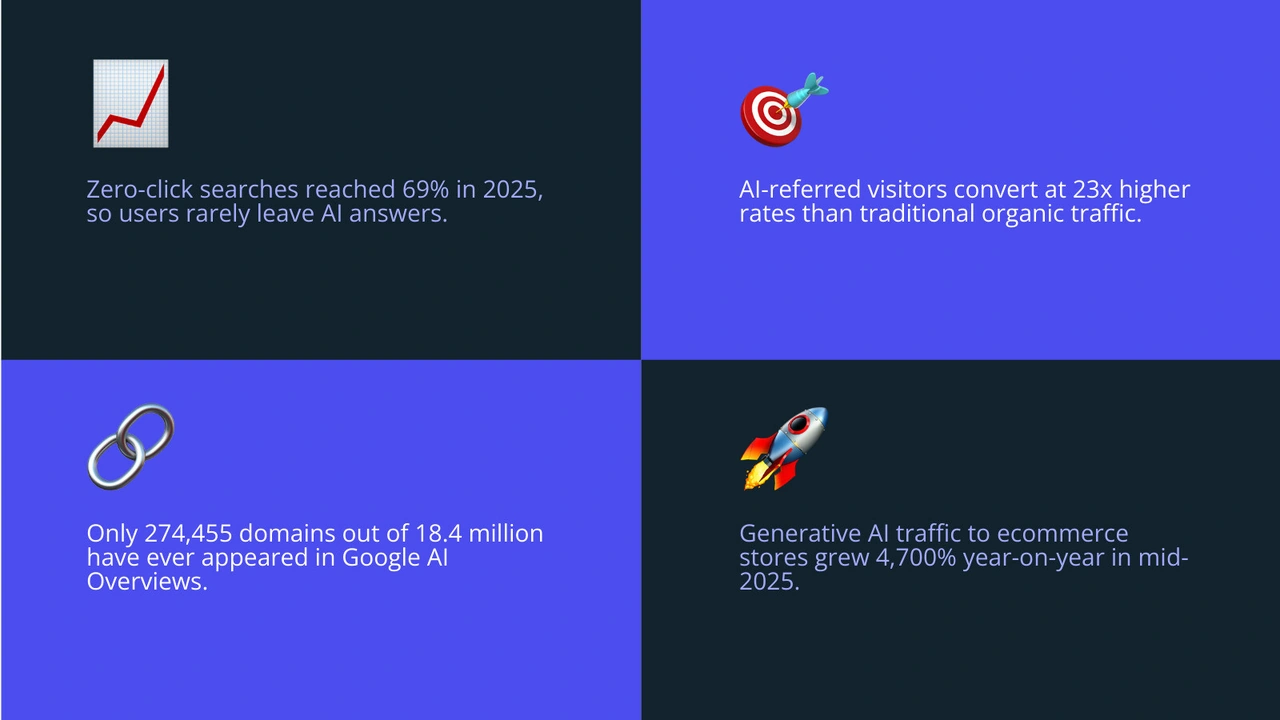
- In 2025, zero-click searches reached 69%, meaning the majority of search engine users obtain answers directly on the results page without clicking through to websites.
- Visitors who click through from AI citations convert at up to 23 times the rate of traditional organic search visitors due to higher initial purchase intent.
- Traffic from generative AI platforms to e-commerce stores grew by 4,700% year-over-year in mid-2025, with nearly 60% of shoppers using AI tools for product research.
Searches for an answer engine optimization guide are rising because the rules of search visibility have changed, and most Shopify operators have not adapted yet.
The shift is straightforward to describe but significant to act on. When someone types "best CRM for small business" into ChatGPT or asks Google's AI Mode for a product recommendation, a single combined answer comes back — with two or three named sources, not ten blue links. Either your brand is cited, or it isn't.
Traditional SEO focuses on position. AEO focuses on inclusion. These are fundamentally different goals that require different tactics.
For Shopify merchants, the stakes are concrete. Most Shopify brands are already seeing ChatGPT referral traffic grow over 1,000% year-on-year. The brands capturing this traffic are not necessarily the ones with the highest domain authority. Instead, they are the ones whose product data, content structure, and schema markup make it easy for AI systems to extract and cite them confidently.
Here at First Pier, we help merchants structure their stores to capture this high-intent traffic. This article outlines the exact technical and content steps required to make your store AI-ready.
What is Answer Engine Optimization and How It Differs from SEO
Answer Engine Optimization (AEO) is the practice of structuring and formatting a website’s information so that artificial intelligence models can easily parse, retrieve, and cite it. When an engine like ChatGPT, Claude, Perplexity, or Google AI Overviews answers a user’s prompt, it relies on real-time retrieval systems to pull facts from the web. AEO is the process of preparing your content to be the specific "chunk" of information those systems select.
This discipline sits directly alongside traditional search engine optimization, but the target audience has changed. While traditional SEO focuses on human searchers browsing a list of results, AEO focuses on AI Search Optimization and LLM Optimization to satisfy the machine learning crawlers that act on behalf of those users.
| Optimization Element | Traditional SEO | Answer Engine Optimization (AEO) |
|---|---|---|
| Primary Goal | Rank on page one to drive organic clicks | Earn citations and direct mentions inside AI answers |
| Target Audience | Human searchers reading a list of options | Large Language Models retrieving information |
| Primary Input | Short, keyword-focused queries | Natural language prompts and multi-turn conversations |
| Success Metric | Click-through rate, impressions, organic traffic | Share of search, citation frequency, conversion rate |
| Content Unit | Comprehensive, long-form pages | Highly structured, self-contained "content chunks" |
| Core Technical Focus | Page speed, backlink profile, keyword density | Clean JSON-LD schema, API-like data, crawlability |
By looking at these core differences, it becomes clear that AEO is not a replacement for standard search practices. Instead, it is a specialized layer built on top of your existing SEO foundation. If a site does not rank on page one of Google for a target query, it has less than a 1% chance of being selected as a source by an AI engine. AEO takes that established authority and shapes it so an AI model can use it.
Core Differences in the Answer Engine Optimization Guide
To understand the core differences, you must look at how the user experience has evolved. In traditional search, a user types "waterproof boots Portland Maine" and receives a list of storefronts. The user must click three different links, compare the materials, and find the pricing.
With an answer engine optimization guide strategy, the content is structured so that when a user asks ChatGPT, "What are the best waterproof boots available in Portland, Maine for under $150?", the engine can immediately pull the exact price, material specifications, and store location from your site.
This changes three main areas:
- Ranking vs. Citation: Traditional SEO competes for a spot in the top ten blue links. AEO competes for trust and clarity. An answer engine typically selects only one to three sources to cite for a specific claims block. If your page contains vague, generalized language, the retrieval model will bypass it in favor of a site that states direct facts clearly.
- Click-Through Realities: Because the AI system combines the answer directly on the screen, the overall number of clicks to websites is dropping. In 2025, zero-click searches rose to 69%. However, the visitors who do click through from an AI citation are much closer to a buying decision. They have already read a curated summary and clicked your link to complete a transaction, leading to conversion rates that are up to 23 times higher than standard organic traffic.
- User Intent Handling: Traditional search queries are static. AEO queries are conversational and highly specific. Users frequently ask multi-part questions or follow up on previous answers. Content optimized for AEO must answer these complex, semantic prompts by addressing related subtopics in a logical, step-by-step format.
Why AEO is Critical for Ecommerce in 2026
The rise of conversational commerce has changed how consumers buy products online. Instead of browsing page after page of collections, shoppers are increasingly turning to AI assistants to build their shopping shortlists. Nearly 60% of shoppers now use ChatGPT, Gemini, or Perplexity to help them make purchase decisions.
This behavioral shift has created a zero-click environment where the traditional top-of-funnel research phase occurs entirely within the chat interface. If your store's products are not recommended in that initial conversation, you are excluded from the purchase journey before the customer ever visits a website.

This makes AI for Ecommerce and Generative AI Ecommerce necessary strategies for survival. When OpenAI or Google processes a product search, they are not just looking at keywords. They are assessing real-time inventory, customer reviews, pricing, and specific product attributes to match the user's highly detailed prompt. If your product data is incomplete or unstructured, your store remains invisible to these automated shoppers.
How to Use This Answer Engine Optimization Guide for Shopify
Shopify merchants are in a unique position to benefit from AEO. Because Shopify stores run on a standardized database structure, setting up sitewide data optimizations is highly systematic.
To prepare your store for AI search, you must focus on how your product catalog is presented to search engines. Platforms like OpenAI are actively building integrations that allow users to browse and buy Shopify products directly within chat interfaces. Code leaks have shown direct checkout integrations using identifiers like product IDs and checkout URLs.
To align with AI in Shopify capabilities and optimize ChatGPT for Shopify search, here at First Pier we recommend focusing on these three areas:
- Ditch Generic Descriptions: AI crawlers ignore generic marketing copy. Instead of writing "Our high-quality jacket is perfect for cold weather," write "This water-resistant winter coat features a 600-fill-power down insulation, suitable for temperatures down to 10°F."
- Organize Collections Logically: Name your collections based on how people naturally speak. Instead of naming a collection "Winter Outerwear - Men's," use conversational groupings like "Men's Warm Winter Jackets for Wet Weather."
- Make Customer Reviews Crawlable: AI search tools heavily rely on user-generated content to verify quality claims. If your customer reviews are locked behind JavaScript widgets that search crawlers cannot read, the AI model cannot use those positive ratings as a trust signal. Ensure your reviews are rendered in plain HTML on your product pages.
Technical Checklist: Structuring Your Site for AI Crawlers
For an answer engine to cite your content, its crawlers must first be able to access and interpret it. Many brands make the mistake of blocking AI crawlers in their robots.txt files out of concern for data scraping. However, blocking these bots means your products and brand will never be recommended in conversational search.
To ensure your technical setup is ready, you need to verify your crawler access, minimize client-side rendering issues, and deploy structured schema. This is the core of Generative Engine Optimization GEO Services, ensuring that a Large Language Model LLM can pull your data without friction.
First, check your robots.txt file. Ensure you are not blocking the primary crawlers used by major answer engines:
Second, address how your page content is rendered. While Googlebot has gotten better at executing JavaScript, many AI crawlers still struggle with heavy client-side JavaScript. If your product details, pricing, or reviews only load after JavaScript executes, these bots may crawl an empty page. Use server-side rendering (SSR) or static site generation where possible to ensure all critical text is present in the raw HTML.
Schema Markup Requirements
Structured data is the primary language AI engines use to verify facts. By implementing comprehensive JSON-LD schema, you tell the crawlers exactly what your data means, leaving no room for interpretation or hallucination.
For ecommerce sites, three schemas are mandatory:
1. Product Schema
Your product schema must be highly detailed and updated in real time. It should include:
- Name and Brand: Clear, text-based identifiers.
- Offers: Current price, currency, price validity dates, and stock availability.
- SKU and GTIN: Global trade identifiers are critical because AI search engines use them to compare prices across different retailers.
- AggregateRating: Cumulative review scores and total review counts.
- Images: High-resolution, direct image URLs.
2. FAQ Schema
FAQ schema helps your informational content win citation blocks. When you structure questions as H2s or H3s and pair them with FAQPage schema, you make it incredibly simple for an AI model to extract the exact answer block for a user's conversational query.
3. Organization Schema
Organization schema establishes your brand's identity in the global entity graph. It should live on your homepage and include your official name, physical address (such as Portland, Maine), social media profiles, logo, and official contact information. This helps AI engines connect your website to external mentions across the web.
Content Strategy: Becoming the Cited Source
To win citation slots, your content must be structured to match how retrieval systems pull data. AI engines do not read your entire page to find an answer; they retrieve specific "chunks" of text that closely match the user's prompt. This requires a shift from whole-page optimization to chunk-based optimization.
To make your content highly extractable, structure your pages with clear, logical hierarchies. Use your H2 and H3 headings to mirror the exact questions your customers ask. Immediately following the heading, provide a direct, factual answer in the first 40 to 60 words. Once you have provided the direct answer, you can use the rest of the section to provide supporting details, bullet points, and data tables.
This structure is highly effective because it aligns perfectly with how Prompt Engineering and retrieval-augmented generation work. The system retrieves the highly concise paragraph right below your heading to use as the direct citation.
To ensure your content is selected over competitors, apply these content guidelines:
- Create Non-Commodity Content: Do not write generic summaries of information that already exist across the web. Write from a position of direct experience. For example, instead of writing "How to Care for Leather Boots," write "How We Clean and Oil Full-Grain Leather Boots in Our Portland, Maine Workshop."
- Lead with Specific Data: AI engines favor factual precision. Use specific numbers, concrete dimensions, exact temperatures, and clear pricing ranges. Phrases like "very light" are ignored in favor of "weighs exactly 12 ounces."
- Use Tables and Lists: For comparison queries (e.g., "Brand A vs. Brand B"), use clear markdown tables. AI models routinely extract tables and bulleted lists to display directly in chat interfaces because they are easy to read.
- Build Strong E-E-A-T Signals: Establish clear author credentials. Include detailed author bios, links to professional profiles, and clear citations to primary sources. If an LLM cannot verify the trustworthiness of the writer, it will avoid citing the page to prevent generating inaccurate information.
Measuring Success in a Zero-Click Environment
As answer engines handle more queries directly on the search results page, traditional metrics like keyword rankings and raw organic sessions will likely decline. If you judge your marketing success solely by website traffic, you may believe your strategy is failing even as your revenue increases.
To evaluate performance in this new landscape, you must monitor new visibility indicators. Here at First Pier, we use AI Solutions for Ecommerce to help clients track how their brands are represented across conversational platforms.
Focus on these three key areas to measure your AEO performance:
- Share of Search and Brand Mentions: Track how often your brand or products are recommended when users ask category-level questions on ChatGPT, Perplexity, and Gemini. You can run manual checks or use specialized monitoring tools to track your "citation share" for your primary product terms.
- AI Referral Traffic Quality: While the volume of traffic coming from AI engines may be lower than traditional organic search, the quality is significantly higher. Monitor your analytics for referrals from sources like
android-app://com.openai.chatorperplexity.ai. Track the conversion rates and average order value of these specific visitors. - Assisted Conversion Paths: Many customers will research a product using an AI assistant, note your brand name, and then navigate directly to your site via a direct search or branded paid ad. Look for increases in direct traffic and branded search volume as you improve your off-site AI visibility.
Frequently Asked Questions About This Answer Engine Optimization Guide
How do AI engines select which websites to cite?
AI engines use a process called Retrieval-Augmented Generation (RAG) to ground their answers in real-time web data. When a user enters a prompt, the engine does not just rely on its static training data. Instead, it expands the user's query into multiple sub-queries and runs a real-time search to retrieve the top 35 to 40 relevant URLs.
The system then evaluates these candidate pages, disqualifying up to 83% of them based on slow loading times, poor content structure, or a lack of clear facts. From the remaining high-quality pages, the model extracts specific sentences that directly answer the prompt, combines them into a single response, and appends inline citations linking back to the source pages.
Will optimizing for answer engines hurt my organic traffic?
While optimizing for direct answers can increase zero-click searches for simple informational queries, it generally improves the quality of the traffic that does click through to your site. High-intent buyers who are looking for specific product recommendations or detailed solutions will use the citations to navigate to your store.
Because these users have already had their initial questions resolved by the AI assistant, they arrive on your site with a much higher purchase intent. This results in significantly higher conversion rates and lower bounce rates compared to traditional organic search traffic.
What is the difference between AEO and GEO?
AEO (Answer Engine Optimization) and GEO (Generative Engine Optimization) are closely related terms that are often used interchangeably, but they have slightly different focuses. AEO is the broader, user-centric discipline of optimizing content to serve as direct answers across all answer-delivery platforms, including voice assistants, smart home devices, and search snippets.
GEO is a subset of AEO that specifically focuses on optimizing content for generative AI models and large language model search features, such as Google's AI Overviews, ChatGPT Search, and Perplexity, by aligning with the technical retrieval mechanics of those specific systems.
To Sum Up
The transition from traditional search engines to conversational answer engines is well underway. To maintain visibility, brands must adapt their technical structures and content formats to match how AI models retrieve information. By ensuring your site is fully crawlable, deploying precise JSON-LD schema, and structuring your content to provide direct, factual answers, you position your brand to be the trusted source that AI engines cite.
Here at First Pier, we help merchants navigate these technical and content shifts to ensure their products remain visible in conversational search.
If you want help with answer engine optimization, get in touch.





.png)
.png)

