



Building a Better B2B Checkout Process
Summary
- B2B checkouts require multi-user permissions and approval workflows to match corporate procurement structures.
- Flexible payment options like net terms and purchase orders are essential for high-value business transactions.
- Integration with ERP and CRM systems reduces manual data entry and improves order accuracy.
- Personalized pricing and custom catalogs drive higher conversion rates and customer retention.
The B2B checkout process looks nothing like the consumer checkout you're used to seeing. When a procurement manager from a Fortune 500 company adds $250,000 worth of components to their cart, they're not pulling out a credit card. They need a purchase order number field. They need approval from finance. They need net 60 payment terms that match their existing contract. If your checkout can't handle that, they'll call your sales team to finish the order manually—or worse, they'll find a competitor whose system can.
The numbers back this up. 93% of B2B buyers now use digital channels for procurement, yet 74% would switch to a competitor if the digital experience doesn't meet their needs. That switch happens most often at checkout, where friction costs you deals you've already won. Over one-third of B2B buyers are now comfortable spending $500,000 or more online, but only if the checkout process actually works for how businesses buy.
The gap between B2C and B2B checkout isn't just about order size. B2B transactions involve multiple stakeholders, custom pricing negotiations, and payment cycles that stretch 30 to 90 days. Your checkout needs to accommodate bulk orders, validate against credit limits, route approvals to the right departments, and sync data with your ERP system—all while moving fast enough that buyers don't abandon their carts.
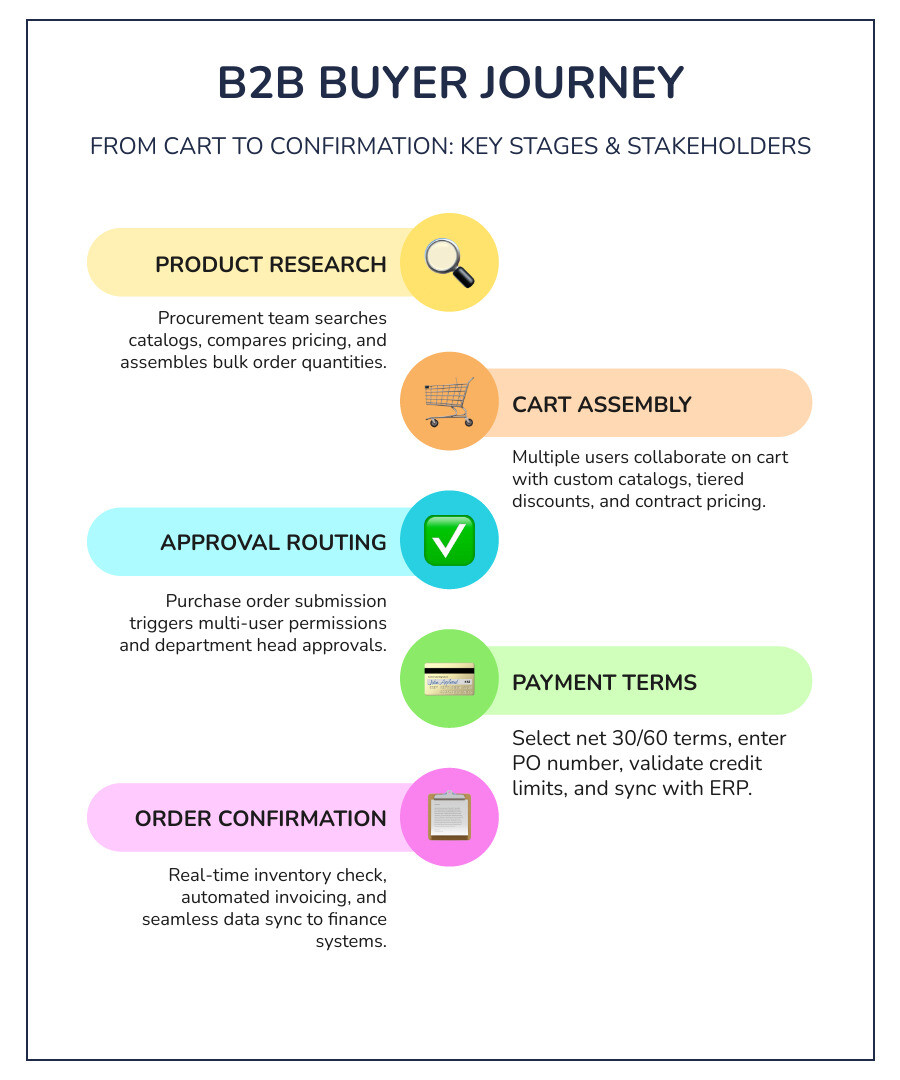
When I look at the B2B ecommerce market forecast, which projects a $36 trillion market by 2026, I see a massive opportunity for businesses that can simplify complex buying. To build a better process, you first have to acknowledge that your buyer isn't just one person. It's often a procurement officer who fills the cart, a department head who approves the budget, and a finance team that processes the payment.
Unlike B2C, where the goal is to get a single user to click "Buy" as fast as possible, B2B is about helping a team complete a task. This means the B2B checkout process must handle bulk purchasing—often hundreds of SKUs at once—and multi-layered decision-making. If your system forces a user to manually enter 50 line items or doesn't allow them to save a cart for approval later, you’ve already lost.
| Feature | B2C Checkout | B2B Checkout |
|---|---|---|
| Pricing | Static/Public | Negotiated/Contract-based |
| Payment | Instant (Card/Wallet) | Net Terms, PO, ACH, Wire |
| User | Individual Consumer | Multiple Roles (Buyer, Approver) |
| Order Volume | Low (1-5 items) | High (Bulk/Wholesale) |
| Approval | None | Multi-step Workflow |
Flexible Payment Options in the B2B Checkout Process
One of the biggest reasons for cart abandonment in the business world is a lack of preferred payment methods. Research shows that 83% of B2B buyers prefer ordering or paying through digital commerce, but they don't want to use a corporate credit card for every transaction.
At First Pier, I often help clients implement Shopify B2B features that allow for:
- ACH and Wire Transfers: Essential for high-value orders where card fees would be prohibitive.
- eChecks: A common choice for cross-border accounts receivable, used by 56% of US B2B companies.
- Trade Credit and Net Terms: Offering Net 30, 60, or 90 days allows your customers to manage their cash flow while still placing large orders.
Providing these choices isn't just about convenience; it's about matching the way your customers' finance departments operate. If they only pay via ACH on the 15th of the month, your checkout needs to support that reality.
Personalization and Dynamic Pricing
Personalization in B2B isn't about showing "Recommended for You" products. It’s about ensuring that when a logged-in buyer hits the checkout, they see the specific contract pricing and terms they negotiated with your sales team.
Using gated catalogs and tiered discounts ensures that your high-volume partners get the benefits of their loyalty without you having to manually adjust every invoice. If a customer has a contract for $10 per unit but your public price is $15, the B2B checkout process must reflect that $10 price automatically. This level of accuracy builds trust and prevents the back-and-forth emails that slow down the sales cycle.
Solving Common Friction Points in Business Transactions
Friction in B2B is a silent killer. While a consumer might get annoyed by a slow site, a business buyer who is trying to place a critical order for their production line will simply leave. 91% of B2B buyers abandon carts when the experience is poor, especially when order values are high.
Common pain points include complex navigation, slow load times, and a lack of transparency regarding shipping costs or taxes. To combat this, I recommend using a Shopify Plus checkout that allows for deep customization. You can remove unnecessary fields, add progress bars to show exactly where the buyer is in the process, and ensure that all costs are surfaced early.
Streamlining the B2B Checkout Process with Multi-User Accounts
In a business setting, the person who builds the order might not have the authority to pay for it. This is where multi-user accounts and role-based permissions become vital. Here at First Pier, we look at Shopify B2B strategies that enable "Buyer" roles to build carts and "Approver" roles to finalize them.
Approval workflows should be integrated directly into the checkout. Instead of the buyer having to print a PDF of their cart and email it to their boss, the system should automatically notify the approver. This keeps the transaction within your digital ecosystem and drastically reduces the time-to-purchase. Saved carts and order templates also help repeat buyers who need to restock the same items every month with just two clicks.
Mobile Performance and Omnichannel Support
Don't assume your B2B buyers are only working from desktops. Many procurement managers are on the warehouse floor or traveling between job sites. They expect a responsive design that works perfectly on a smartphone.
I've found that implementing a Shopify one page checkout can significantly improve mobile completion rates. By condensing the process and using auto-fill for addresses and payment info, you make it easy for a buyer to finish an order while on the move. Furthermore, 79% of B2B customers expect uniform interactions across all channels. Whether they start an order on their phone and finish it on a laptop, or talk to a sales rep and then check out online, the experience must be consistent.
Technical Integrations to Improve Operational Efficiency
The B2B checkout process doesn't exist in a vacuum. It needs to talk to the rest of your business. If your ecommerce platform isn't synced with your warehouse or your accounting software, you're going to have a bad time.
Real-Time Inventory and Fraud Protection
There is nothing worse than a business customer placing a bulk order for 500 units, only to find out three days later that you only have 200 in stock. This ruins your reputation and their production schedule. Real-time inventory checks during the checkout process are a must. If stock is low, the system should suggest alternatives or provide an accurate lead time for backorders.
Fraud protection is also different in B2B. While you still need to watch for stolen credit cards, you also need to verify that the business placing the order is legitimate. Trust signals, such as SSL certificates and clear business verification steps, help both parties feel secure in high-value transactions.
Automating Tax and Compliance
Handling taxes for B2B can be a nightmare, especially when dealing with different states or international VAT. Many of your buyers may also have tax-exemption certificates. Manually verifying these for every order is a waste of your team's time.
I suggest using Shopify checkout extensions to automate this. These tools can validate tax IDs in real-time and apply the correct exemptions automatically. This ensures compliance with regional regulations without adding friction to the buyer's journey. If you need help setting up these complex flows, our Shopify ERP services can help bridge the gap between your store and your back-office systems.
Measuring Success with Key Performance Indicators
You can't improve what you don't measure. In B2B, the standard ecommerce metrics like conversion rate are important, but they don't tell the whole story. You need to look at data that reflects the complexity of the business relationship.
According to McKinsey, companies using data-driven B2B strategies see growth and EBITDA gains of 15% to 25%. I recommend tracking:
- Average Order Value (AOV): Are your B2B customers buying more over time?
- Cart Abandonment Rate: Where specifically are they dropping off? Is it at the payment terms stage?
- Customer Lifetime Value (CLV): This is the ultimate metric for B2B success.
Tracking Completion Rates and Time-to-Purchase
In B2C, a fast checkout is a few minutes. In B2B, a "fast" checkout might take three days due to internal approvals. You need to track the time from when an item is first added to the cart to when the order is finalized. If this window is too long, it might indicate that your approval workflow is too clunky.
Monitoring user behavior during the checkout can show you if buyers are struggling with specific forms or fields. By using Shopify Plus B2B features, you can A/B test different checkout layouts to see which one gets your customers to the finish line faster.
Frequently Asked Questions about B2B Checkouts
Why do B2B buyers abandon their carts?
The most common reasons include unexpected extra costs (like shipping or taxes shown too late), a complex or multi-step navigation that doesn't save progress, and a lack of preferred payment methods like net terms or ACH. Slow loading speeds also play a major role; if the page takes too long to calculate a bulk discount, the buyer may lose patience.
How do net terms work at checkout?
Net terms allow a business to buy now and pay later, typically within 30, 60, or 90 days. At checkout, an approved buyer selects "Net Terms" as their payment method. The system checks their pre-approved credit limit and, if valid, allows the order to proceed without an immediate payment. The platform then generates an automated invoice that is sent to the buyer's finance department.
What is the role of a PO number in checkout?
A Purchase Order (PO) number is a critical internal tracking tool for the buyer. It aligns the order with their procurement and accounting systems, ensuring that the purchase was authorized and can be reconciled when the invoice arrives. Including a dedicated, mandatory PO number field in your B2B checkout process is one of the easiest ways to make your business customers' lives easier.
To sum up
The B2B checkout process is the "moment of truth" for your digital strategy. It’s where all your marketing, sales negotiations, and product development finally turn into revenue. If you treat it like a simple B2C transaction, you're leaving money on the table and pushing your best customers toward the competition.
By focusing on flexible payments, multi-user workflows, and deep technical integrations, you can turn your checkout from a point of friction into a competitive advantage. Whether you are looking to move to Shopify Plus or want to refine your existing setup, we can help. At First Pier, we specialize in building high-performance B2B experiences that respect the complexity of how businesses buy.
If you're ready to see how a customized checkout can help your business grow, take a look at more info about our services or reach out to us here in Portland, Maine. We’ve helped brands and boutiques all over the country turn their digital procurement into a growth engine, and we can do the same for you.





.png)
.png)

