




Why Content Email Marketing Delivers Results Other Channels Can't
Summary
- Content email marketing uses educational and helpful information to build trust instead of relying on direct sales pitches.
- Email serves as a stable distribution channel where brands own their audience data without interference from social media algorithms.
- Personalization through behavioral triggers and zero-party data increases engagement rates and return on investment.
- Success is measured by tracking revenue per email, click-through rates, and long-term subscriber retention.

Content email marketing is the strategy of building and sending emails that lead with value — educational guides, curated insights, product tips, and brand stories — rather than leading with a pitch.
Here is a quick breakdown of what it is and why it works:
| What it is | What it does |
|---|---|
| Value-first email communication | Builds trust before asking for a sale |
| An owned distribution channel | Reaches your audience without algorithm interference |
| A personalization platform | Delivers the right message to the right person |
| A measurable revenue driver | Median ROI of $36 per $1 spent |
Most brands already send emails. The difference with a content-driven approach is what those emails contain and why subscribers open them. Instead of a constant stream of promotions, content emails give people a reason to stay subscribed — and to keep coming back.
The numbers back this up. Email accounts for nearly 20% of all digital transactions, trailing only paid search and organic traffic. And according to research from Salesforce, 93% of people say email is their primary channel for engaging with brands digitally. That is not a channel you want to treat as an afterthought.
Social media reach has dropped significantly — organic Facebook posts now reach roughly 5% of followers on average. Email open rates, by comparison, average around 34% across industries. When you own your list, you are not at the mercy of a platform's decisions.
I'm Steve Pogson, founder of First Pier. With over twenty years of experience helping e-commerce brands grow, our team here at First Pier builds and refines content email marketing programs that drive revenue for stores of all sizes. Let's walk through the process.
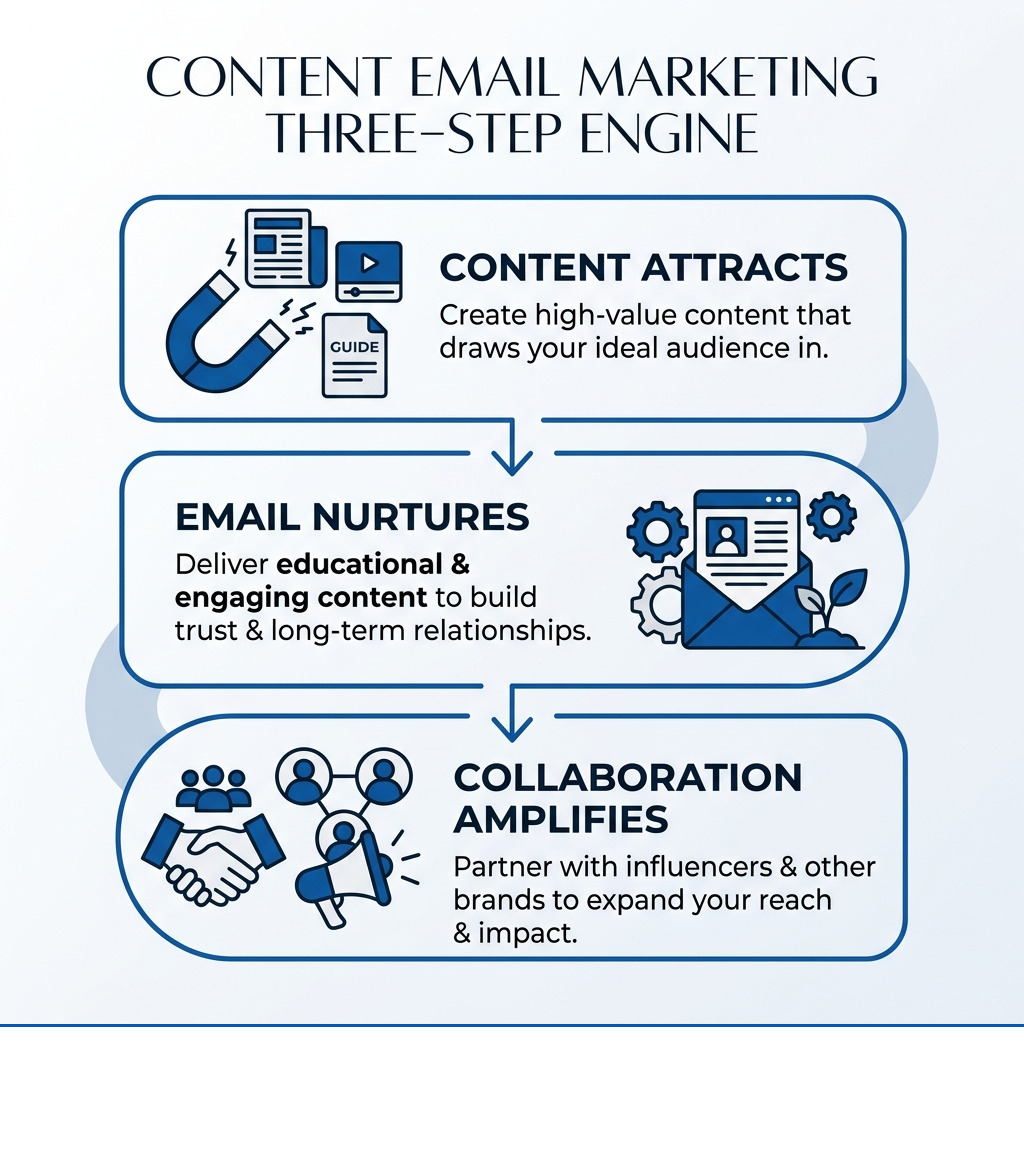
Defining Content Email Marketing
To understand content email marketing, I find it helpful to look at it as a "value-first" philosophy. It is not just about sending an email; it is about using email as a vehicle to deliver the high-quality content you are already creating. This approach turns your inbox presence from an intrusion into a resource.
When I talk about Email Marketing In Digital Marketing, I’m referring to a strategy where the email itself provides utility. This could be a "how-to" guide for a product the customer just bought or an industry trend report. By providing this value, you earn the right to occasionally ask for a sale. This is a core part of any Email Marketing Complete Guide (2026).
Difference Between Content and Promotional Emails
Promotional emails have one goal: a transaction. They are "Buy Now" or "Sale Ends Tonight" messages. While these have a place, relying on them exclusively leads to list fatigue and high unsubscribe rates.
Content emails, on the other hand, focus on the brand narrative and relationship building. They use storytelling to connect with the reader. For instance, instead of a 20% off coupon for coffee beans, a content email might explain the ethical sourcing of those beans or provide a recipe for the perfect pour-over. You can see more of these distinctions in our Email Marketing Strategy Examples.
Why Email is a Primary Distribution Channel
I often tell my clients here at First Pier that email is the only channel you truly own. If a social media platform changes its algorithm tomorrow, your reach could drop to zero. With email, you have direct access to your audience's inbox.
This "algorithm independence" makes email the perfect home for Content Marketing Strategy for Email Growth. It allows you to nurture leads over time without paying for every single impression. It is owned media at its most effective.
Building and Segmenting Your Audience
The days of sending the same email to every person on your list are over. In 2026, success depends on your ability to group your subscribers based on what they actually care about.
| Static Lists | Dynamic Behavioral Segments |
|---|---|
| Everyone gets the same content | Content changes based on user action |
| Based on sign-up date | Based on purchase history and clicks |
| Lower engagement over time | 50-100% higher click-through rates |
| Harder to personalize | Updates automatically in real-time |
Collecting Zero-Party Data Ethically
Zero-party data is information that your customers voluntarily share with you. This is the "gold standard" for Klaviyo Personalization. I recommend using welcome surveys, preference centers, or interactive quizzes to learn about your audience.
For example, a beauty brand might ask a new subscriber about their skin type. This allows the brand to send relevant skincare advice rather than generic makeup tips. It builds trust because the customer sees that you are listening to their specific needs.
Advanced Segmentation Techniques
Once you have the data, you can use Email Segmentation Strategies (2026) to create high-performing groups. I look at three main areas:
- Purchase History: Are they a one-time buyer or a loyal VIP?
- Engagement Levels: Have they opened an email in the last 30 days?
- Lifecycle Stage: Are they a new lead or someone who hasn't bought in six months?
Using these Email Personalization Techniques ensures that your content is always timely and relevant.
Creating High-Impact Content for Emails
Writing for email is different from writing a blog post. You have roughly three seconds to capture a reader's attention before they move on.
Best Practices for Content Email Marketing
I follow a few strict rules for Klaviyo Email Design. First, design for mobile. Over 60% of emails are opened on phones, so a single-column layout is a must.
Use the "F-pattern" for reading. People scan emails in an F-shape, so put your most important information at the top and use clear headings. Keep paragraphs short and use plenty of white space to make the text scannable. These Klaviyo Email Tips help keep your readers engaged until they reach your call to action (CTA).
Another tip from our How to Write Engaging Email Marketing Content (7 Tips) is to stick to one primary message and one clear CTA per email. Too many choices lead to "decision paralysis," and the reader ends up doing nothing.
Main Types of Content Emails to Send
To keep your strategy balanced, I suggest a mix of these email types:
- Newsletters: Regular updates that curate your best recent content.
- Welcome Series: A multi-step Klaviyo Welcome Series Flow that introduces your brand and sets expectations.
- Lead Nurturing: Educational sequences designed to move a prospect closer to their first purchase.
- Behavioral-Based Messages: Emails triggered by specific actions, like viewing a product category or abandoning a cart.
Automation and AI in Content Email Marketing
Automation is what allows a small team to perform like a massive marketing department. By setting up "always-on" workflows, you ensure that your brand stays top-of-mind without manual effort.
Using AI to Support Content Email Marketing
AI has become a massive help for Klaviyo Features. I use it for:
- Content Curation: Automatically recommending products or articles based on what a subscriber has clicked before.
- Send-Time Timing: Ensuring the email hits the inbox exactly when that specific person is most likely to check their phone.
- Personalized Variants: Using AI to draft multiple subject lines and testing them to see which one performs best.
This is the core of an AI-powered Email Marketing Strategy For 2026.
Turning Campaigns into Behavioral Flows
One of my favorite tactics is turning one-time campaigns into perpetual Klaviyo Email Marketing Flows. If you sent a great educational email about "How to Style Summer Linens," don't let it die after one send.
Instead, turn it into a flow triggered when someone browses your linen collection. This way, every new person who shows interest gets that high-value content at the exact moment it is most relevant to them. It turns your Klaviyo Automated Emails into a constant revenue engine.
Measuring Success and Compliance
You cannot improve what you do not measure. In 2026, I look beyond simple open rates, as privacy changes (like Apple's Mail Privacy Protection) have made them less reliable.
Key Metrics for Performance
Instead, I focus on these KPIs within Klaviyo Reporting:
- Click-Through Rate (CTR): The percentage of people who clicked a link. This shows if your content was actually interesting.
- Click-to-Open Rate (CTOR): This measures how effective the content was for the people who actually opened the email.
- Revenue Per Email: The total revenue generated by a campaign divided by the number of emails sent. This is the ultimate measure of ROI.
- Subscriber Lifetime Value: How much a subscriber is worth to your brand over the entire time they are on your list.
I also recommend regular Klaviyo A B Testing for subject lines and CTAs to keep improving these numbers.
Sustainable List Building and Compliance
None of this matters if your emails land in the spam folder. List hygiene is critical. I suggest removing unengaged subscribers after 90 days of inactivity. It might feel painful to see your list size shrink, but your deliverability will improve.
Make sure you are following all regulations, including CAN-SPAM in the US and GDPR if you have customers in Europe. This includes having clear opt-in consent and a "one-click" unsubscribe link. Using proper authentication protocols like SPF, DKIM, and DMARC is also essential for bulk senders in 2026. You can find more details in our Shopify Email Marketing Guide.
Frequently Asked Questions about Content Email Marketing
How often should I send content emails?
For most brands, a weekly cadence is the "sweet spot." It is frequent enough to stay top-of-mind but not so frequent that it becomes annoying. The key is consistency. If you commit to a weekly newsletter, stick to it. Use a preference center to let subscribers choose if they want to hear from you more or less often. This is a foundational Strategy For Email Marketing.
How do I improve my email open rates in 2026?
Focus on your sender reputation first. If your emails aren't landing in the inbox, no one can open them. Beyond that, use these Klaviyo Email Tips: write curiosity-driven subject lines, use preview text effectively, and try predictive sending to hit the inbox at the right time.
What is the best way to grow an email list organically?
Create high-value lead magnets. This could be a PDF guide, a discount code, or access to a gated video. Promote these on your site using Shopify Blog Marketing and social media. Never buy a list; it will only damage your reputation and deliverability.
To sum up
Content email marketing is about more than just selling; it is about building a community of people who trust your expertise. By leading with value and using the tools available in 2026 — like AI-driven flows and advanced segmentation — you can turn your email list into your brand's most valuable asset.
If you are looking to build a high-performance online business, our team here at First Pier is ready to help. Based in Portland, Maine, First Pier is a team of Shopify experts dedicated to helping brands and boutiques grow. We specialize in everything from platform development to sophisticated email strategies.
Ready to take your email marketing to the next level? More info about email sms marketing services can be found on our site, or you can reach out to us directly to start a conversation.




.png)
.png)

