


Why Ecommerce Attribution Models Matter for Your Marketing Budget
Summary
- Definition: Ecommerce attribution models are analytical frameworks that assign conversion credit to the various marketing channels and touchpoints along a buyer's path to purchase.
- Data Discrepancies: Traditional single-touch tracking models can undervalue early-stage marketing channels by as much as 50%, leading to skewed budget decisions.
- Modern Complexity: The average online shopper interacts with 27 touchpoints across 9 different channels before buying, making multi-touch or data-driven attribution necessary.
- Signal Gaps: Privacy changes, Safari's 7-day cookie limits, and iOS tracking opt-outs mean that 40% to 60% of conversion data is lost before reaching standard analytics tools.
- Solutions: Moving to server-side tracking, position-based modeling, and machine-learning attribution helps merchants reclaim accurate performance data.
Ecommerce attribution models explained simply: they are frameworks that assign credit to the marketing touchpoints a customer interacts with before making a purchase.
When someone buys from your store, they rarely found you in one step. They might have seen a TikTok ad, read a blog post, clicked a Google search result, and then converted through an email. Attribution models answer the question: which of those steps gets credit for the sale?
The model you use shapes how you read performance data — and how you spend your budget.
Here are the main attribution models at a glance:
| Model | How Credit Is Assigned |
|---|---|
| First-touch | 100% to the first interaction |
| Last-touch | 100% to the final interaction before purchase |
| Linear | Divided equally across all touchpoints |
| Time-decay | More credit to touchpoints closer to conversion |
| Position-based (U-shaped) | 40% first, 40% last, 20% split across middle |
| Data-driven | Machine learning assigns credit based on actual patterns |
The stakes are real. Over 70% of digital marketers have historically defaulted to last-click attribution — a model that can undervalue awareness-driving channels by as much as 50%. Meanwhile, research from Forrester shows buyers touch an average of 27 interactions across 9 different channels before converting.
If your attribution model only credits the final click, you are likely underfunding the channels that started the conversation and over-rewarding the ones that simply closed it.
This guide breaks down each model, compares their strengths and weaknesses, and helps you choose the right framework for your store's customer journey.
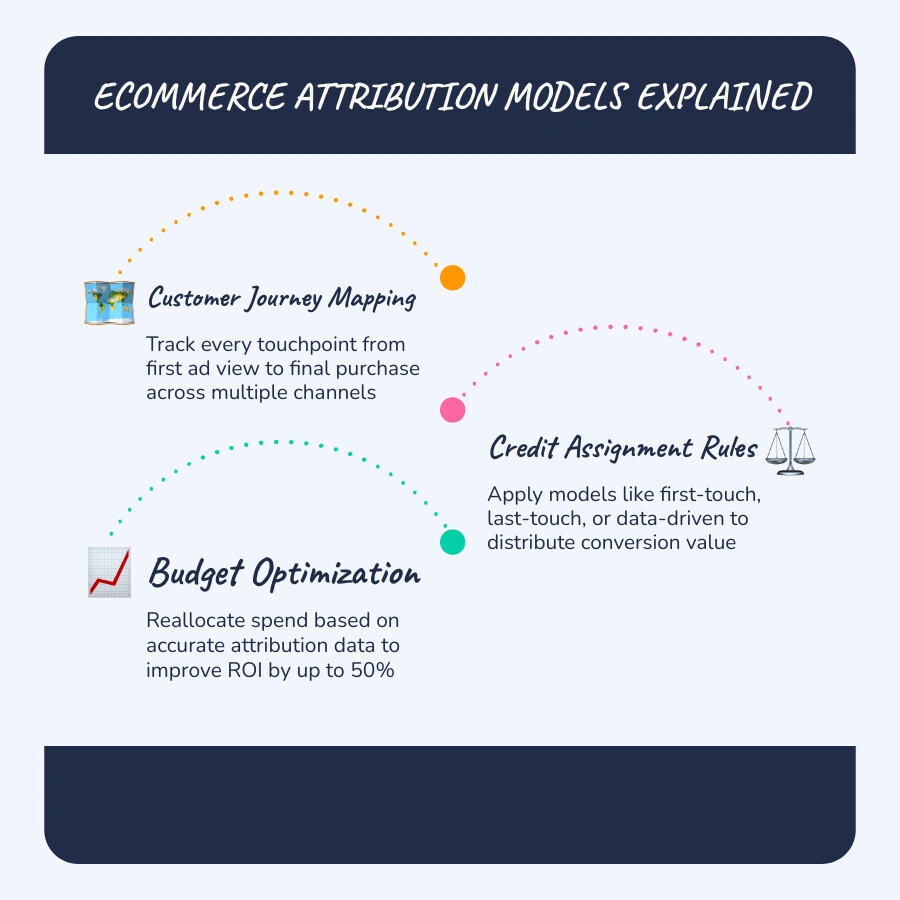
Ecommerce Attribution Models Explained: The Core Frameworks
To choose how to distribute your marketing budget, you must first understand how your customers move from strangers to buyers. The customer journey is rarely a straight line. It is a web of interactions across search engines, social media feeds, email inboxes, and direct site visits.
Every interaction is a marketing touchpoint. If you run a paid Meta campaign, publish SEO blog content, send weekly email newsletters, and run Google Search ads, a single customer might touch all of these channels before buying. Without a clear framework for Digital Marketing Attribution, you are forced to make budget decisions based on incomplete data. Here at First Pier, we help merchants set up these frameworks to avoid flying blind.
An attribution model acts as the rulebook for your data. It tells your analytics software how to weigh each of these touchpoints. For example, if a customer buys a $100 pair of running shoes, does the initial Meta ad that introduced them to your brand get the credit, or does the final promotional email they clicked right before purchasing get the credit?
According to EcomEfficiency - What Is Attribution Modeling A Guide for E-Commerce, understanding these backstories prevents you from turning off top-of-funnel campaigns that are quietly driving your store's growth.
How Single-Touch Ecommerce Attribution Models Explained Early Journeys
Single-touch models are the most basic forms of attribution. They give 100% of the conversion credit to a single point in the buyer's journey, completely ignoring all other interactions. While easy to set up, they offer a highly narrow view of your marketing performance.
First-Touch Attribution
First-touch attribution gives all the credit to the very first interaction a customer has with your brand. If a user clicks an influencer's link on Instagram, leaves your site, and returns three weeks later via a direct search to buy, the influencer campaign gets 100% of the credit.
- Pros: It is highly effective for identifying which channels excel at driving brand awareness and filling the top of your marketing funnel.
- Cons: It completely ignores the middle-of-funnel nurturing and bottom-of-funnel conversion efforts. You cannot see which campaigns actually convinced the user to complete the purchase.
Last-Touch (or Last-Click) Attribution
Last-touch attribution gives all the credit to the final touchpoint before the purchase. If a customer researches your products for weeks, clicks five different ads, and finally buys after clicking a retargeting ad on Google, that Google ad gets 100% of the credit.
- Pros: It is highly accurate at tracking the exact action that triggered the sale. It requires no complex tracking setups and is the historical default for platforms like Google Ads and Meta.
- Cons: It creates a severe bias toward bottom-of-funnel remarketing and brand search campaigns. It tells you nothing about how the customer found you in the first place, leading you to starve your top-of-funnel channels of budget.
Relying on these single-touch methods is a common pitfall. To build a balanced marketing strategy, merchants must look at how different touchpoints work together, which is why understanding Attribution Models in Digital Marketing is so critical.
Why Multi-Touch Ecommerce Attribution Models Explained Complex Paths Better
Multi-touch attribution (MTA) models acknowledge that a purchase is a team effort. Instead of giving all the credit to one interaction, they distribute the value of a sale across multiple touchpoints.
Linear Attribution
The linear model splits conversion credit equally among all interactions. If a customer touches four channels before buying a $100 product, each channel receives 25% of the credit ($25).
[Meta Ad] (25%) ---> [Blog Post] (25%) ---> [Google Ad] (25%) ---> [Email] (25%) = $100 Sale- Pros: It provides a balanced view of the entire path to purchase and ensures no active channel is ignored.
- Cons: It treats all interactions as equally important. In reality, a quick accidental click on a banner ad does not have the same impact as a 10-minute visit to an educational blog post or a highly targeted email offer.
Time-Decay Attribution
The time-decay model uses a mathematical formula to give more credit to the touchpoints that occurred closest to the time of purchase. An interaction that happened two hours before the sale gets significantly more credit than an interaction that happened two weeks prior.
- Pros: This model is highly effective for businesses with long sales cycles where nurturing is vital. It realistically assumes that the closer an interaction is to the purchase, the higher its influence was on the buying decision.
- Cons: It naturally undervalues your initial discovery channels. If your brand awareness campaigns do their job well but happen weeks before the sale, they will receive almost no credit under this model.
Position-Based (U-Shaped) Attribution
The position-based model attempts to combine the best aspects of first-touch and last-touch attribution. It assigns 40% of the credit to the first touchpoint, 40% to the last touchpoint, and splits the remaining 20% equally among the middle touchpoints.
[First Touch] (40%) ---> [Middle Touch 1] (10%) ---> [Middle Touch 2] (10%) ---> [Last Touch] (40%)- Pros: It rewards the channel that introduced the customer to your brand and the channel that closed the deal, while still acknowledging the supporting role of middle nurturing steps.
- Cons: It can over-attribute value to weak middle touchpoints or arbitrary first clicks that had little to do with actual purchase intent.
As discussed in the guide on Multi-Touch Attribution for E-commerce | Blog | Enalitica, multi-touch models offer a far more realistic view of modern consumer behavior, helping you avoid cutting budgets for channels that are essential to your overall growth.
Comparing the 6 Core Attribution Models
To help you decide which model fits your store's operational goals, here is a direct comparison of the six core frameworks.
| Attribution Model | Primary Focus | Best Used For | Major Drawback |
|---|---|---|---|
| First-Touch | Brand Discovery | High-growth brands focused purely on awareness and new customer acquisition. | Ignores all middle and bottom-of-funnel actions. |
| Last-Touch | Conversion Trigger | Stores with very short buying cycles (under 24 hours) or low-consideration products. | Starves top-of-funnel channels of budget and data. |
| Linear | Whole-Journey Equality | Broad campaign overviews where you want to see every contributing channel. | Overvalues passive clicks and undervalues high-intent actions. |
| Time-Decay | Momentum & Nurturing | High-ticket items or stores with long consideration periods (weeks to months). | Heavily discounts the initial brand-discovery touchpoint. |
| Position-Based | Discovery & Conversion | Most multi-channel ecommerce stores looking for a balanced, rule-based setup. | Can award too much credit to minor middle interactions. |
| Data-Driven | Algorithmic Accuracy | Large stores with high conversion volume and clean, integrated data sets. | Requires high data volume and acts as a "black box." |
Using resources like Attribution Models Explained: The Complete Guide to Choosing What Actually Works - PantoSource can help you understand how these models perform under real-world testing. For a deeper look at custom setups, you can also explore Ecommerce Attribution Models Explained: How To Choose Right? to see how different platforms handle these rules.
Rule-Based vs. Data-Driven Attribution
The five models listed above (first-touch, last-touch, linear, time-decay, and position-based) are all rule-based models. They rely on static, human-defined rules to distribute credit. While predictable, they do not adapt to your store's actual customer behavior.
Data-driven attribution (DDA) uses machine learning algorithms to analyze all of your converting and non-converting customer paths. By comparing these paths, the algorithm determines which touchpoints are truly incremental to a sale. For example, if paths that include an SMS message convert at a 5% higher rate than identical paths without SMS, the system automatically assigns more credit to your SMS campaigns.
Google Analytics 4 (GA4) has made data-driven attribution its default setting. As outlined in Google Analytics 4 for Ecommerce, this shift helps merchants move away from rigid rules.
However, data-driven attribution has its own challenges. It requires a high volume of conversions to train the model effectively, and because the algorithm is proprietary, it can feel like a "black box" where you cannot see exactly how the math is calculated. According to Get started with attribution - Analytics Help, DDA works best when combined with clean tracking setups that feed accurate data into the system.
The Impact of Privacy Changes and Signal Loss on Attribution
Ecommerce tracking has changed dramatically. Due to Apple's App Tracking Privacy (ATT) updates, Safari's Intelligent Tracking Prevention (ITP), and the deprecation of third-party cookies, traditional browser-based tracking is no longer reliable.

When Apple introduced iOS ATT, opt-out rates skyrocketed, with 75% to 85% of iPhone users choosing to block cross-app tracking. At the same time, Safari capped the lifespan of client-side cookies to just 7 days (and in some cases, 24 hours). If a customer clicks an ad on Monday but does not return to purchase until the following Tuesday, browser-based tools will treat them as a completely new user, destroying your multi-touch attribution path.
Furthermore, ad blockers are now used by 30% to 40% of desktop users, preventing standard tracking pixels from firing at all. This means that 40% to 60% of conversion data never reaches traditional attribution systems.
To combat this signal loss, modern ecommerce stores are moving away from browser-side tracking and adopting advanced solutions:
- Server-Side Tracking: By sending conversion data directly from your server (such as Shopify) to the marketing platform (such as Meta or Google) rather than relying on the user's browser, you bypass ad blockers and browser cookie limits.
- Enhanced Conversions: Tools like Enhanced Conversions Google Ads use hashed, first-party user data (like email addresses) to match conversions back to ad clicks securely.
- Advanced Reporting Systems: Setting up dedicated Attribution Reporting pipelines allows you to centralize your first-party data.
By using server-side tracking and robust Digital Marketing Attribution Tools, brands can reclaim lost signals and build a reliable foundation for Marketing Attribution Reporting.
Frequently Asked Questions about Ecommerce Attribution
What is the best attribution model for ecommerce?
There is no single "best" model, as it depends entirely on your business model and sales cycle. However, for most multi-channel ecommerce stores, a position-based (U-shaped) or data-driven model is the most effective starting point.
If you sell low-cost, impulsive items where the buying cycle is under 24 hours, last-touch attribution may be perfectly adequate. But if you sell high-ticket products where customers spend weeks researching, you need a model that values top-of-funnel discovery. For a detailed breakdown of how to choose based on your specific catalog, see [Choosing the Right eCommerce Attribution Model Guide + Case ....
Why do Google Analytics and Shopify conversion numbers mismatch?
It is incredibly common to see Shopify report 100 sales while Google Analytics 4 only shows 80. These discrepancies happen for several reasons:
- Direct Traffic Exclusions: GA4 attribution models generally exclude direct visits from receiving credit unless the entire path was direct.
- Privacy and Ad Blockers: Browser extensions and browser privacy settings can block GA4 scripts while Shopify's server-side system still records the transaction.
- Session Timeouts: GA4 sessions naturally expire after 30 minutes of inactivity, which can split a single user's journey into multiple sessions.
Ensuring your Shopify Google Analytics Conversion Tracking is correctly configured is the first step to minimizing these gaps. For holistic business planning, merchants should integrate these tools into a broader Ecommerce Analytics and Ecommerce Reporting framework to reconcile the data.
How does last-click attribution affect ad spend?
Last-click attribution creates a heavy bias toward bottom-of-funnel channels like branded search, retargeting ads, and email campaigns. Because these channels are the final step before a purchase, last-click awards them 100% of the credit.
This leads to a dangerous cycle: you allocate more budget to retargeting because it looks highly profitable, while cutting spend on top-of-funnel channels like Meta prospecting or Pinterest ads because they show poor direct ROAS. Over time, your pool of new prospects dries up, and your overall sales decline.
As explained in Attribution Models for Ecommerce - Practical Ecommerce, moving away from last-click helps you see the true value of your prospecting campaigns. To learn more about balancing prospecting and retargeting, check out the eCommerce Attribution Models: Multi-Touch, & MMM Guide.
To Sum Up
Understanding ecommerce attribution models explained is not just an academic exercise; it is a fundamental requirement for scaling a modern online store. Relying on outdated tracking methods or default last-click settings leaves your business vulnerable to rising ad costs and inaccurate performance metrics.
By implementing first-party data tracking, setting up server-side connections, and moving toward position-based or data-driven attribution models, you can make clear budget decisions that support both brand discovery and final conversions.
If you want to build a highly accurate, future-proof measurement setup for your Shopify store, get in touch with the team at First Pier for our ecommerce data analytics services.





.png)
.png)

