




Why Your Klaviyo Segmentation Strategy Determines Your Email Revenue
Summary
- Klaviyo segments are dynamic groups that update automatically in real time based on customer behavior, purchase history, and profile properties.
- Segmenting email campaigns by engagement levels protects sender reputation and increases revenue per recipient compared to unsegmented list blasts.
- Core ecommerce segments include engagement tiers (30-day and 90-day active users), customer value groups (VIPs and repeat buyers), and behavioral groups (browse abandoners).
- Predictive analytics in Klaviyo forecast customer lifetime value, churn risk, and next purchase dates to target customers before they lapse.
A strong Klaviyo segmentation strategy is the single biggest lever you can pull to increase email and SMS revenue — more than subject lines, send frequency, or design.
The data backs this up: highly segmented campaigns return more than 3x the revenue per recipient compared to unsegmented sends. Yet the majority of Shopify stores still blast their full list with every campaign, leaving significant revenue on the table and quietly damaging their sender reputation in the process.
Here's the short version of what a solid Klaviyo segmentation strategy looks like:
- Split your list by engagement — separate active subscribers (opened or clicked in the last 30–90 days) from unengaged ones before every send.
- Identify high-value customers — build VIP and repeat-buyer segments to protect and grow your top revenue drivers.
- Target by behavior and intent — create segments based on browse activity, cart abandonment, purchase history, and predicted next order date.
- Use AI and predictive data — Klaviyo's built-in predictive analytics can flag churn risk, estimate customer lifetime value (CLV), and forecast next purchase dates.
- Activate across channels — sync segments to SMS, paid social, and on-site forms for consistent, coordinated messaging.
- Suppress the right people — exclude recent buyers, unengaged subscribers, and soft bounces from campaigns to protect deliverability.
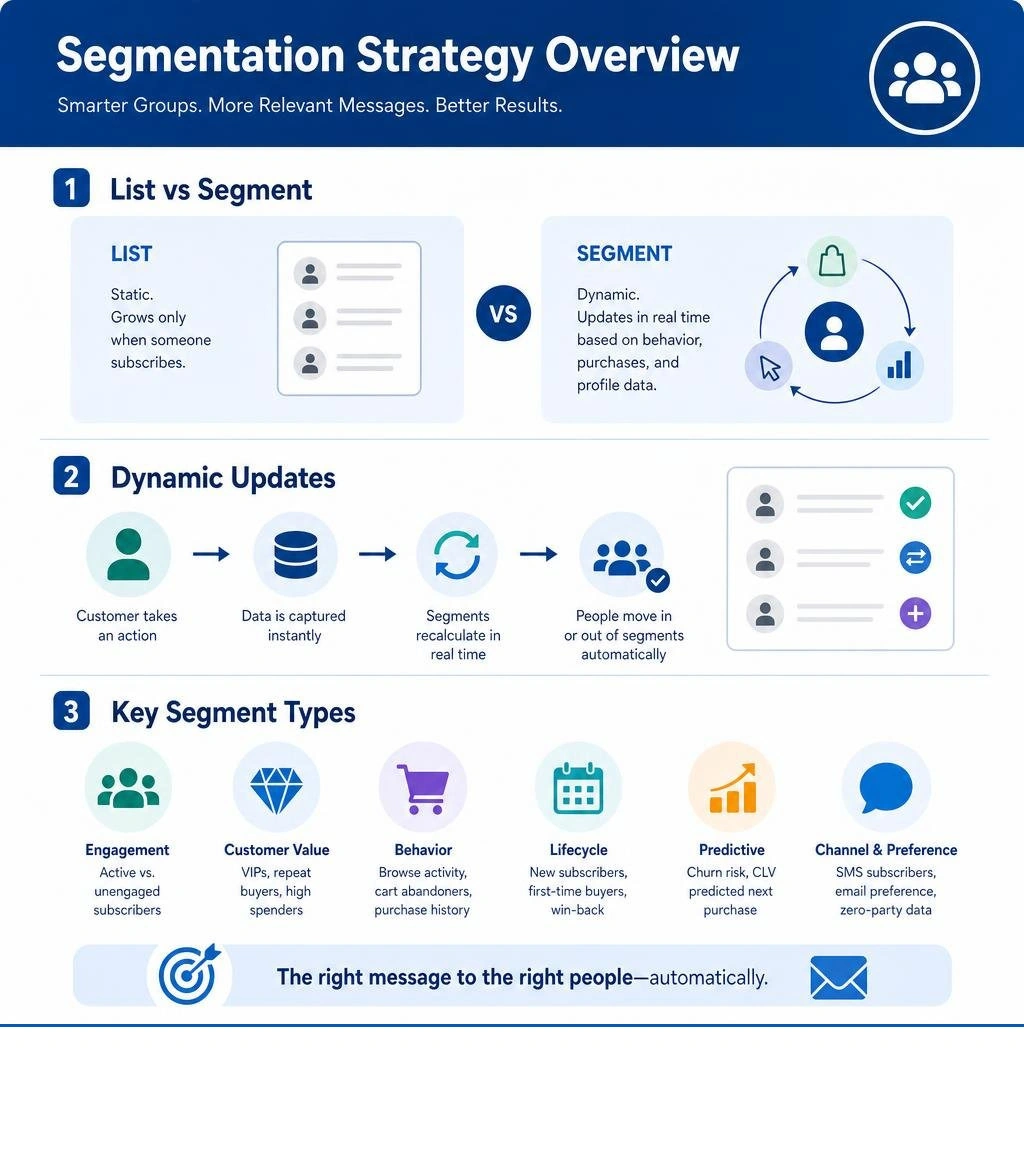
Unlike static lists — which only grow when someone subscribes and never change on their own — Klaviyo segments are dynamic. They recalculate in real time based on customer behavior, purchase history, and profile data. That means the right people are always in the right group, automatically.
The sections below walk through exactly how to build, validate, and activate these segments across your Klaviyo account.
Explore more about klaviyo segmentation strategy:
What is a Klaviyo Segmentation Strategy?
A klaviyo segmentation strategy is a systematic plan for dividing an ecommerce audience into distinct, targeted groups based on shared characteristics. Instead of treating every subscriber on a master list the same, this strategy uses real-time behavioral data, purchase history, demographic traits, and geographic targeting to send highly relevant messages.
According to The Comprehensive Guide to B2C Audience Segmentation for Marketing - Klaviyo, audience segmentation has evolved from simple groupings based on age or location to real-time dynamic cohorts. This evolution is critical because 74% of consumers expect brands to provide personalized experiences, and 66% want brands to make them feel valued and understood.
When we set up email marketing here at First Pier, we quickly realize that who receives your message is far more important than the design or copy. In fact, industry data shows that about 70% of a campaign's financial impact is determined by your audience selection. Sending a promotion to the wrong audience leads to high unsubscribe rates, spam complaints, and damaged sender reputation.
Core Components of a Klaviyo Segmentation Strategy
To build a reliable targeting framework, you must combine different types of data collected directly from your store.
- First-Party Data: This includes behavioral actions tracked automatically by your integration, such as pages viewed, items added to a cart, order frequency, and total lifetime spend. To understand the depth of these data tracking capabilities, look at Klaviyo What Is It.
- Zero-Party Data: This is information that customers share with you willingly and directly. Examples include answers to fit-finder quizzes, product preference surveys, and birthday inputs. Collecting this data is one of the most useful Klaviyo Features because it allows you to market based on explicit preferences rather than guesses.
- Geographic and Demographic Data: Location-based details (country, state, or proximity to a physical store) and predicted demographic traits help localize your messaging.
How to Build and Validate Your Klaviyo Segmentation Strategy
The logic engine in Klaviyo relies on joining conditions together using AND and OR operators. Misunderstanding how these operators function is a major source of targeting errors.
- The "AND" Operator is Exclusive: All joined conditions must be true for a profile to enter the segment. For example, if you target people who have placed an order AND live in Maine, a subscriber who bought from you but lives in Massachusetts will be excluded.
- The "OR" Operator is Inclusive: Only one of the joined conditions needs to be true. For example, if you target people who live in Maine OR live in Massachusetts, subscribers from both states will enter the segment.
- Negative Conditions: When excluding groups (e.g., "has not placed an order"), use the AND operator to chain exclusions together. Using OR with negative conditions can accidentally pull in your entire list.
For a deeper dive into complex logic setups, consult the Advanced segmentation reference | Klaviyo Help Center. Once you build a segment, always validate it. You can do this by running a quick spot check on a few random profiles within the segment to confirm they meet the exact criteria. You should also check How to Send a Test Email in Klaviyo to make sure your campaign renders correctly for different test recipients before sending it to your live audience.
12 Essential Klaviyo Segments for Shopify Stores
Every Shopify merchant should establish a core set of dynamic segments to manage daily campaigns and automated flows. Setting up a tight Klaviyo Shopify Integration ensures that all purchase, checkout, and product data flows into these segments in real time, which powers your Klaviyo Automated Emails.
The table below outlines the 12 essential segments every store needs, along with their exact setup logic:
| Segment Name | Purpose | Exact Klaviyo Conditions |
|---|---|---|
| 1. Engaged 30 Days | Daily campaigns, high deliverability | What someone has done: Opened Email at least once in the last 30 days OR Clicked Email at least once in the last 30 days OR Active on Site in the last 30 days |
| 2. Engaged 90 Days | Major announcements, product launches | What someone has done: Opened Email at least once in the last 90 days OR Clicked Email at least once in the last 90 days OR Active on Site in the last 90 days |
| 3. Unengaged 90+ Days | Re-engagement flows, list cleaning | What someone has done: Opened Email zero times in the last 90 days AND Clicked Email zero times in the last 90 days AND Placed Order zero times in the last 90 days |
| 4. VIP Customers | Exclusive rewards, early product access | What someone has done: Placed Order is at least 3 times over all time OR Revenue is at least $300 over all time (adjust threshold to top 10% of spenders) |
| 5. Repeat Customers | Post-purchase cross-sells, retention | What someone has done: Placed Order is at least 2 times over all time |
| 6. First-Time Buyers | Nurturing toward the second purchase | What someone has done: Placed Order equals 1 over all time |
| 7. High AOV Spenders | Upselling premium products | What someone has done: Placed Order is at least 1 over all time AND Average Order Value is at least $150 over all time |
| 8. Non-Purchasers | First-purchase conversion campaigns | What someone has done: Placed Order zero times over all time AND Properties about someone: $consent contains "email" |
| 9. Browse Abandoners | Abandonment campaign targeting | What someone has done: Viewed Product at least once in the last 7 days AND Placed Order zero times in the last 7 days AND Added to Cart zero times in the last 7 days |
| 10. Local/Regional | Geotargeted events, shipping updates | Properties about someone: State/Region equals Maine (or specific shipping zones) |
| 11. Win-Back Targets | Automated win-back campaigns | What someone has done: Placed Order at least once over all time AND Placed Order zero times in the last 120 days |
| 12. At-Risk Customers | Churn prevention messaging | What someone has done: Placed Order at least once over all time AND Churn Risk is High (using predictive analytics) |
Engagement-Based Segments
Maintaining clear engagement segments is the foundation of email deliverability. Inbox providers like Gmail and Yahoo track how recipients interact with your emails. Sending campaigns to unengaged users signals that your content is unwanted, which can land your messages in the spam folder.
To protect your reputation, split your list into distinct engagement tiers:
- Engaged 30 Days: This is your primary send list. It typically represents 15% to 25% of your total database. Use this segment for your regular weekly Klaviyo Campaigns.
- Engaged 90 Days: This broader group is useful for larger promotions, sales, and major brand announcements.
- Unengaged 90+ Days: This group should be excluded from regular campaigns. Instead, route these profiles through a sunset flow to attempt a final re-engagement before suppressing them.
Apple Mail Privacy Protection (MPP) pre-fetches tracking pixels, which inflates open rates. Because of this, it is best to include click-based conditions and on-site activity in your engagement definitions rather than relying on email opens alone.
Customer Value and Lifecycle Segments
The transition from a first-time buyer to a repeat customer is the hardest conversion in ecommerce. Repeat customers spend 67% more per order than first-time buyers and convert at 2x to 3x the rate.
- First-Time Buyers: Target this group with product education, usage guides, and brand story emails to build trust shortly after their purchase.
- Repeat Customers: These individuals have bought at least twice. Treat them as a reliable audience for new arrivals and category cross-sells.
- VIP Customers: This segment represents the top 10% of your customer base, yet they typically drive 40% to 60% of your total revenue. Offer them early access to sales, exclusive products, and dedicated customer service.
- High AOV Spenders: Target these customers with premium product bundles and high-ticket items, while keeping discount-heavy campaigns to a minimum.
You can introduce these concepts early in the customer relationship through a personalized Klaviyo Welcome Series Flow that changes its messaging based on whether the subscriber has already placed an order.
Behavioral and Intent Segments
Behavioral segments group subscribers based on their real-time actions on your site, allowing you to send highly relevant, timely messages.
- Browse Abandoners: These are visitors who viewed a product page but did not add the item to their cart or check out. Sending a helpful, product-specific email within 24 hours helps answer common questions and brings them back to your store.
- Subscribers Only (Non-Purchasers): These profiles are on your list but have never bought anything. They need educational content, social proof, and perhaps a welcome discount to nudge them toward their first purchase.
- Win-Back Targets: These are past buyers who have not purchased in a set period (such as 120 days). A automated sequence with a tailored discount can win them back before they churn completely.
Setting up these behavior-based segments within automated Klaviyo Flows ensures that your store automatically follows up with customers at the perfect moment.
Advanced and AI-Powered Segmentation Tactics

Using predictive analytics and machine learning allows you to move from reacting to past customer actions to anticipating future behavior.
According to 13 Effective Email Segmentation Strategies & Ideas - Klaviyo, predictive properties use historical patterns to forecast how individual customers will act over the next year. This approach helps you build highly targeted segments:
- Predicted Customer Lifetime Value (CLV): This metric estimates how much a customer will spend with your brand over the next 12 months. You can use this data to separate future high-value buyers from low-value, discount-driven shoppers.
- Predicted Churn Risk: Klaviyo calculates the probability that a customer will stop buying from you. You can build a segment of "High Churn Risk" customers who have purchased in the past and target them with aggressive retention campaigns before they lapse.
- Predicted Next Order Date: This feature forecasts the exact window when a customer is likely to purchase again. Sending a campaign to subscribers in their predicted next order window yields 4x higher revenue per recipient than standard campaigns.
You can also use natural language tools like Segments AI to build complex segments quickly. Simply describe the audience you want to target (e.g., "Customers in Maine who bought twice last year but haven't opened an email in 30 days") and the AI will generate the correct logic conditions for you.
When we manage client accounts here at First Pier, we use these predictive data points to coordinate email and Klaviyo SMS messaging, ensuring that high-value customers receive urgent updates on their preferred channel without being over-messaged.
Cross-Channel Activation and Exclusion Strategies
A great segmentation strategy is just as much about who you exclude as who you include. Over-sending to the wrong people leads to high opt-out rates and damages your sender reputation.
- Exclusion Segments: Always exclude recent buyers (e.g., purchased in the last 7 to 14 days) from active promotional campaigns to avoid annoying them right after they spent money. You should also exclude unengaged profiles and chronic soft bounces.
- SMS Coordination: Use segments to identify email subscribers who have also opted in to SMS. Coordinate your sends so you do not send an email and a text message with the same promotion at the same time.
- Paid Social Syncing: Sync your Klaviyo segments directly to ad platforms like Meta. You can target your VIP segment with retention ads, exclude recent buyers from acquisition campaigns, or build lookalike audiences based on your highest-CLV customers.
To measure how well these strategies are performing, check your Klaviyo Reporting dashboards regularly. Monitor metrics like Revenue per Recipient (RPR) and list growth rates to ensure your segments are driving profitable results.
Frequently Asked Questions about Klaviyo Segmentation
What is the difference between a list and a segment in Klaviyo?
A list is a static collection of profiles that only grows when people manually subscribe or are added. A segment is a dynamic group defined by set rules and conditions. Segments recalculate automatically in real time, meaning profiles enter or leave the group as soon as their behavior or properties change.
How many active segments should a Shopify store maintain?
A healthy Shopify store should maintain between 10 and 15 active operational segments. Having fewer than 10 segments usually means you are missing key personalization opportunities. Having more than 15 segments can make your account chaotic, lead to overlapping audiences, and make campaign management difficult.
How does Apple Mail Privacy Protection affect engagement segments?
Apple Mail Privacy Protection (MPP) automatically pre-loads tracking pixels on iOS devices, which artificially inflates open rates. To keep your engagement segments accurate, do not rely on email opens alone. Instead, build your segments using a combination of email clicks, active website visits, checkout starts, and purchase history.
To Sum Up
Building a clear, organized segmentation strategy is the most reliable way to grow your email and SMS revenue, protect your deliverability, and build lasting relationships with your customers. By moving away from full-list blasts and focusing on engagement, customer value, and behavioral intent, you can ensure that every message you send is highly relevant.
If you would like help building, refining, or managing your customer segments, get in touch with First Pier, an ecommerce agency based in Portland, Maine, specializing in Shopify development and Email and SMS Marketing Services.




.png)
.png)

