




What Is Paid Social Media Advertising (And Why It Matters for Shopify Brands)
Summary
- Definition: Paid social media advertising involves paying platforms like Meta, TikTok, and LinkedIn to display content to targeted audiences beyond existing followers.
- Core Difference: Unlike organic reach, which is limited and declining, paid campaigns guarantee placement in user feeds based on demographics, behaviors, and intent.
- Pricing Models: Advertisers are typically charged via cost-per-click (CPC), cost-per-thousand impressions (CPM), or cost-per-action (CPA).
- Strategic Focus: Success requires balancing automated platform tools with continuous creative testing and precise tracking.
Paid social media advertising is the practice of paying social platforms — Meta, TikTok, LinkedIn, Pinterest, and others — to show your content to a defined audience beyond your existing followers.
Quick answer:
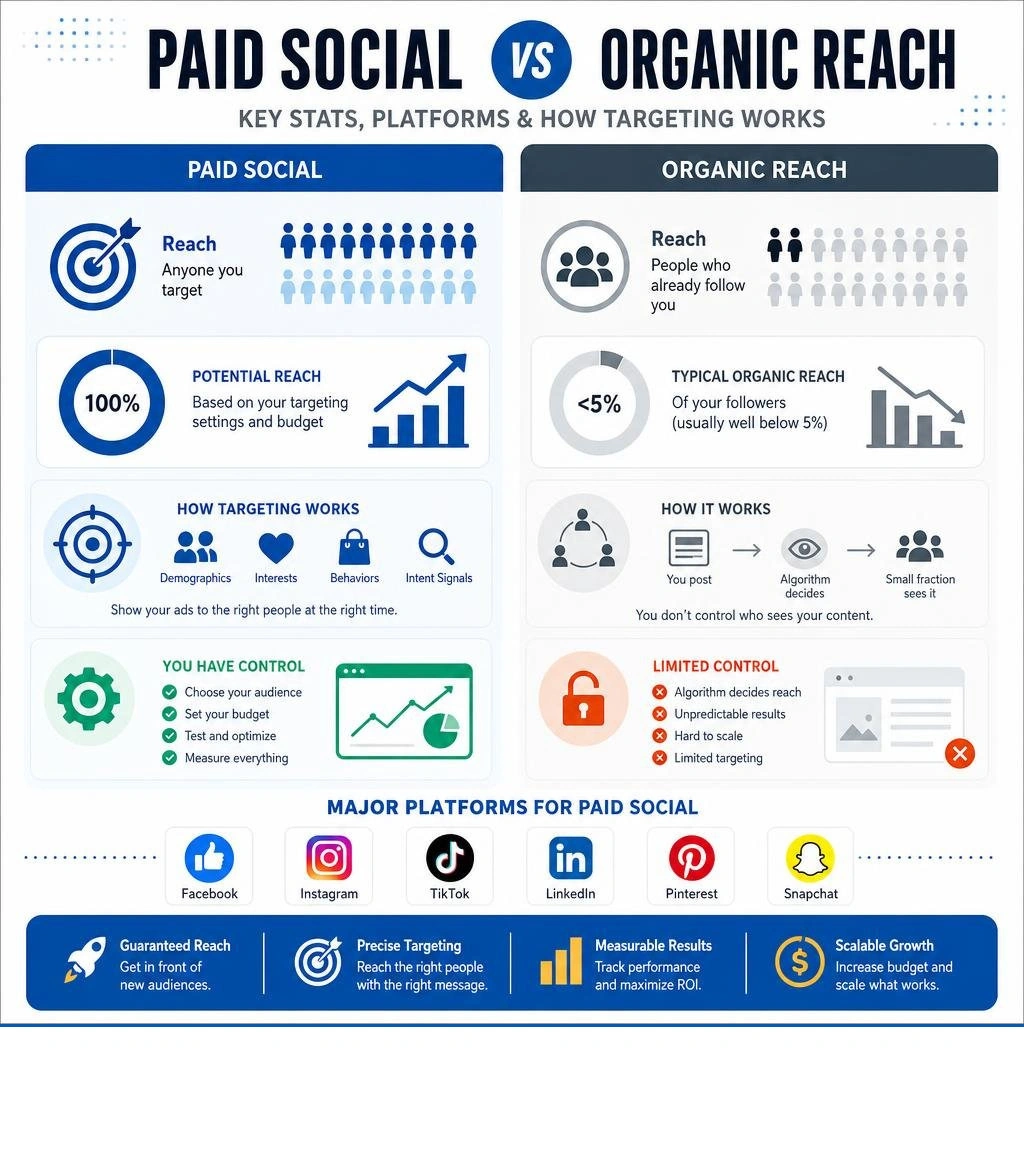
- What it is: You pay a platform to place your ads in front of targeted users based on demographics, interests, behaviors, and intent signals.
- How it differs from organic: Organic posts reach only people who already follow you (and a shrinking fraction at that). Paid ads reach anyone you choose to target.
- Main platforms: Meta (Facebook + Instagram), TikTok, LinkedIn, Pinterest, Snapchat.
- How you're charged: Typically cost-per-click (CPC), cost-per-thousand impressions (CPM), or cost-per-action (CPA).
- Why it works: Paid social delivers guaranteed reach, precise targeting, and measurable results — unlike organic, which depends on algorithms you don't control.
Organic reach on social media has been declining for years. Facebook's organic reach for brand pages now sits well below 5% of followers. For Shopify brands trying to reach new customers in large numbers, waiting for the algorithm to do the work is not a viable growth strategy. Here at First Pier, we have found that relying solely on organic reach is no longer enough to sustain growth.
That's where paid social comes in. With over 3 billion monthly active users on Facebook alone, and 1 in 3 TikTok users reporting they've bought a product after seeing it on the platform, the addressable audience is enormous. The question isn't whether to advertise on social — it's how to do it in a way that actually drives revenue rather than just impressions.
This guide breaks down every layer of paid social: the platforms, the ad formats, the cost benchmarks in 2026, how AI is changing campaign management, and what it takes to run campaigns that generate real return on ad spend.
Explore more about paid social media advertising:
The Fundamentals of Paid Social Media Advertising
At its core, paid social media advertising involves paying a platform to distribute your marketing messages directly to users who fit your ideal customer profile. Here at First Pier, we analyze these delivery systems daily to ensure our clients' budgets are spent efficiently.
When you use organic social media, you publish content on your profile for free. The platform's algorithm determines who sees that content based on engagement signals from your existing followers. If your followers do not interact with the post immediately, its reach stops.
Paid social bypasses this restriction. By allocating an advertising budget, you buy guaranteed placement in user feeds, stories, reels, and search results. Instead of relying on passive follower growth, you actively target users based on their demographics, behaviors, and interests. The platform's machine learning models then work to show your ads to the users within your target audience who are most likely to take your desired action.
To learn more about setting up your store for these campaigns, check out the Shopify Paid Social Guide.
How Paid Social Media Advertising Differs From Organic Social
The differences between paid and organic social media go far beyond whether you pay for placement. They represent two entirely different marketing strategies with distinct goals, targeting options, and user intent.
Organic social media is built for brand community and customer service. It is where you talk to your existing customers, share brand updates, and build long-term loyalty. However, because platforms want to keep users engaged with content from friends and family, organic business posts face a steep decline in visibility.
Paid social media advertising is designed for direct response and customer acquisition. It allows you to target users who have never heard of your brand but possess the exact demographic or behavioral traits of your buyers. You can read more about how these dynamics compare in this detailed breakdown of Facebook Ads vs Boosted Posts.
- Targeting Parameters: Organic posts only target your current followers. Paid ads can target users based on job titles, purchase history, geographic location, and even offline behaviors.
- Audience Intent: Organic viewers are browsing their feeds passively. Paid ads can target users who are actively showing signals of commercial intent, such as adding products to a cart or visiting competitor websites.
- Algorithm Optimization: Organic algorithms reward quick engagement (likes and comments). Paid ad algorithms optimize for business outcomes, finding users most likely to complete a purchase or submit a lead form.
Paid Reach vs Boosted Posts
Many business owners get started with paid social by clicking the "Boost Post" button on an existing Facebook or Instagram post. While this is technically a form of paid reach, it is highly limited compared to running structured campaigns in Ads Manager.
The "Boost Post" button is designed for simplicity. It takes your organic post and pays the platform to show it to a wider audience. However, the algorithm optimizes boosted posts almost exclusively for engagement—meaning likes, comments, and shares. If your goal is to generate sales or leads, boosting posts is often an inefficient use of budget.
Using a full Ads Manager account allows you to choose specific campaign objectives, such as "Conversions" or "Leads." It also enables advanced conversion tracking via tracking pixels and APIs, allowing the platform's machine learning model to find users who will actually buy your products rather than those who simply double-tap images.
Core Benefits and Ad Formats Across Major Platforms
Using paid social media advertising allows brands to build consistent customer acquisition funnels. By choosing the right ad formats and using precise targeting, businesses can move prospects from initial brand awareness to final conversion.
To ensure your visuals display correctly across all devices, refer to the Instagram Ad Creative Size Guide.
Key Benefits of Paid Campaigns
- Guaranteed Reach: Your visibility is no longer held hostage by organic algorithm updates. If you pay for impressions, your target audience will see your ads.
- Precise Targeting: You can target users based on custom data, lookalike audiences, and granular demographic profiles.
- Rapid Results: Unlike search engine optimization (SEO), which can take months to build authority, paid social campaigns can generate traffic and conversions within hours of launch.
- Detailed Analytics: You receive exact data on how much it costs to acquire a customer, which creatives perform best, and where your budget is being spent.
- Full-Funnel Support: You can run different campaigns simultaneously to introduce your brand to cold audiences, nurture warm leads, and retarget abandoned carts.
Common Ad Formats
Choosing the right format is critical to stopping users from scrolling past your content. The most common formats include:
- Image Ads: Single, high-quality images featuring a clear product focus and a direct call to action. These account for a large portion of social campaigns due to their simplicity and high conversion efficiency. For exact technical requirements, review the Facebook Ad Specs.
- Video Ads: Short, engaging videos designed for mobile viewing. These are highly effective for showing product utility, telling brand stories, and capturing attention in the first three seconds.
- Carousel Ads: Ads that allow users to swipe through multiple images or videos, each with its own link. This format is ideal for showcasing product collections or explaining step-by-step processes.
- Native Ads: Sponsored posts designed to look exactly like organic user-generated content (UGC). These often perform well because they feel less disruptive to the user experience.
- Dynamic Product Ads: Highly personalized ads that automatically show products to users who have previously viewed them on your website. To understand how these work, read the guide on What are Dynamic Product Ads?.
Platform Breakdown: Where to Run Your Campaigns
Each social media platform attracts a unique demographic and operates on its own pricing structure. Diversifying your campaigns across the right channels prevents over-reliance on a single platform.
The table below outlines the average cost-per-thousand impressions (CPM) and primary demographics for the major advertising networks based on data heading into 2026:
| Platform | Average CPM (Q4 2025/2026) | Primary Demographic | Best For |
|---|---|---|---|
| $10.48 | Ages 18–34 (Millennials & Gen Z) | Visual products, influencer creative, lifestyle brands | |
| TikTok | $9.86 | Ages 13–29 (Gen Z & Young Millennials) | Short-form video, impulse purchases, UGC |
| $9.06 | Ages 25–54 (Broad adult demographic) | Detailed targeting, older demographics, lead generation | |
| $8.09 | Ages 18–49 (High concentration of women) | Home decor, fashion, DIY, high-intent planning | |
| Snapchat | $4.89 | Ages 13–24 (Teens & Gen Z) | Mobile-first apps, local promotions, youthful brands |
Meta Platforms: Facebook and Instagram
Meta remains the foundation of most paid social strategies. With over 3 billion monthly active users worldwide, its reach is unmatched. Here at First Pier, we manage these campaigns daily to help brands scale their customer acquisition.
While Facebook appeals to a slightly older demographic, Instagram dominates visual and lifestyle marketing. Meta’s advertising ecosystem is highly unified, allowing you to manage campaigns for both platforms from a single interface.
A major shift in recent years is the transition to Meta's Advantage+ campaigns, which use machine learning to automate targeting, creative variations, and budget placement. For a complete strategy on how to navigate this ecosystem, explore the Meta Ads Playbook. If you are running an online storefront, you can also read about implementing Facebook Ads for Shopify Store to sync your product catalogs directly.
Professional and B2B Targeting on LinkedIn
For business-to-business (B2B) marketers, LinkedIn is the premier channel. With an audience of over 950 million professionals, it allows you to target users by job title, industry, company size, and professional seniority.
While LinkedIn offers highly precise targeting for reaching decision-makers, it comes with a premium price tag. The average cost-per-click (CPC) on LinkedIn is often four to five times higher than Facebook, meaning your campaigns must focus on high-value leads and clear business solutions to maintain a positive return on investment.
Short-Form Video on TikTok
TikTok has quickly become an essential channel for direct-to-consumer (DTC) brands. The platform is built entirely around highly engaging, short-form video content.
TikTok's user behavior is uniquely commerce-friendly; 1 in 3 users have purchased a product after seeing it on the platform. To succeed here, ads must look like organic, user-generated content. Polished corporate videos often fail, while raw, authentic reviews and product walkthroughs thrive. TikTok also provides automated creative tools, such as the TikTok Symphony suite, to help brands generate and translate video variations.
Strategy, Budgeting, and Cost Benchmarks in 2026
Running a profitable campaign requires a structured plan, realistic budgeting, and accurate tracking. Without these elements, advertising spend can quickly turn into wasted budget. Here at First Pier, we build custom frameworks to keep acquisition costs predictable.
For a deeper dive into managing your campaigns, review the Paid Social Resources.
Setting Goals for Paid Social Media Advertising
Before spending money, you must define clear, measurable goals using the SMART (Specific, Measurable, Achievable, Relevant, Time-bound) framework. Your goals will dictate your campaign objectives in Ads Manager:
- Top-of-Funnel (Awareness): Focuses on impressions, reach, and video views to introduce your brand to cold audiences.
- Middle-of-Funnel (Consideration): Focuses on traffic, landing page views, and lead form submissions to warm up interested prospects.
- Bottom-of-Funnel (Conversion): Focuses on catalog sales, purchases, and add-to-cart actions to drive direct revenue.
Once your goals are set, you can build target audiences. These typically fall into three categories: core audiences (based on interests and demographics), custom audiences (built from your own customer lists or pixel data), and lookalike audiences (users who share characteristics with your best customers).
Budget Allocation and Cost Metrics
Understanding how your budget translates to performance requires tracking several key metrics:
- Cost Per Click (CPC): The average amount you pay each time a user clicks your ad.
- Cost Per Acquisition (CPA): The total cost to acquire one paying customer or lead.
- Return on Ad Spend (ROAS): The amount of revenue generated for every dollar spent on advertising.
- Return on Investment (ROI): The overall profitability of your campaign after accounting for all business costs.
When deciding how to split your budget, it is helpful to look at historical data. For example, a detailed Google Ads vs Meta Ads Cost 2026 analysis shows that while Google search ads capture high-intent buyers, Meta ads are highly efficient for finding new audiences and building initial demand.
You can also use industry standards like the Facebook Ads Benchmarks to see how your metrics compare to competitors, and review the Facebook Ad Pricing Breakdown to understand how the auction system prices your impressions.
Retargeting and Pixel Tracking
Retargeting is one of the most profitable components of a paid social strategy. It allows you to show tailored ads to users who have already interacted with your brand but did not complete a purchase.
To run retargeting campaigns, you must install a tracking pixel (such as the Meta Pixel) and set up server-side tracking like the Conversions API (CAPI). This setup tracks actions on your website, such as product views and cart additions, and matches them back to social media profiles.
- Cart Abandonment: Target users who added items to their cart but left before checkout, offering a small incentive or highlighting product reviews.
- Engagement Retargeting: Target users who watched 50% or more of your social videos or interacted with your Instagram page.
- Audience Exclusions: Always exclude recent purchasers from your prospecting campaigns to avoid paying for unnecessary impressions.
AI Automation and Brand Safety Challenges
The paid social market in 2026 is heavily shaped by two major forces: the rapid integration of artificial intelligence and an increased focus on brand safety.
For a strategic look at how these trends affect modern campaigns, refer to the FAQ on paid social: AI tools, platform costs, and brand safety in 2026.
AI Tools and Automation
Major platforms have integrated machine learning directly into their ad managers. Tools like Meta Advantage+ and TikTok Symphony can automate audience targeting, test creative combinations, and adjust bidding strategies in real time.
While these tools are highly efficient at finding buyers, they require a steady stream of high-quality creative assets to prevent creative fatigue. If the algorithm shows the same image to the same user too many times, performance will drop. To combat this, brands must run continuous Facebook Ads Creative Testing to find new winning formats before scaling their budgets.
Brand Safety and Ad Optimization
As platforms automate more of their ad placements, brand safety has become a key priority for advertisers. When using broad targeting and automated placements, your ads can occasionally appear next to controversial or low-quality content.
To protect your brand reputation and optimize performance, follow these best practices:
- Contextual Exclusions: Use platform settings to opt out of showing your ads on sensitive content categories, specific publisher networks, or unverified video streams.
- Creator Vetting: When working with influencers or boosting user-generated content, thoroughly audit the creator's historical posts and audience demographics.
- Ad Frequency Control: Monitor your ad frequency (the average number of times a user sees your ad) to prevent ad fatigue and negative brand sentiment.
Frequently Asked Questions
How do you measure the ROI of social ads?
To measure your return on investment, divide the net profit generated from your social campaigns by the total ad spend. For direct-response campaigns, return on ad spend (ROAS) is a helpful proxy metric, calculated as total revenue divided by ad spend. Because modern privacy updates have made last-click attribution less reliable, here at First Pier we use a mix of platform pixel data, Google Analytics 4, and post-purchase customer surveys to get a clear view of performance.
What is the minimum budget to start advertising on Meta?
While Meta technically allows daily budgets as low as a few dollars, a practical starting budget is typically higher. To exit the platform's initial "learning phase," Meta's algorithm needs roughly 50 optimization events (such as purchases or leads) per ad set, per week. If your target cost-per-acquisition is $20, you should aim for a testing budget of at least $150 to $200 per day to gather enough data for the algorithm to optimize your campaigns effectively.
How does the Meta ad auction work?
Meta's ad delivery system uses a real-time auction that evaluates more than just the highest financial bid. The system determines the winning ad based on a "Total Value" formula: Total Value = Advertiser Bid x Estimated Action Rate + Ad Quality. This means an ad with high-quality creative and a high estimated conversion rate can win placements over a competitor with a much higher bid but poor ad relevance.
The Bottom Line on Paid Social Success
Paid social media advertising is a core revenue driver for growing ecommerce brands. By moving away from simple boosted posts and embracing structured campaigns in Ads Manager, businesses can build predictable pipelines for customer acquisition.
Success in 2026 requires a balanced approach: allowing platform machine learning to handle targeting, while maintaining strict control over creative testing, tracking implementation, and brand safety.
If you are looking to build or optimize your store's campaigns, partnering with a specialized Paid Social Shopify Agency can help you scale efficiently.
If you would like help with paid social media advertising, get in touch.




.png)
.png)

