


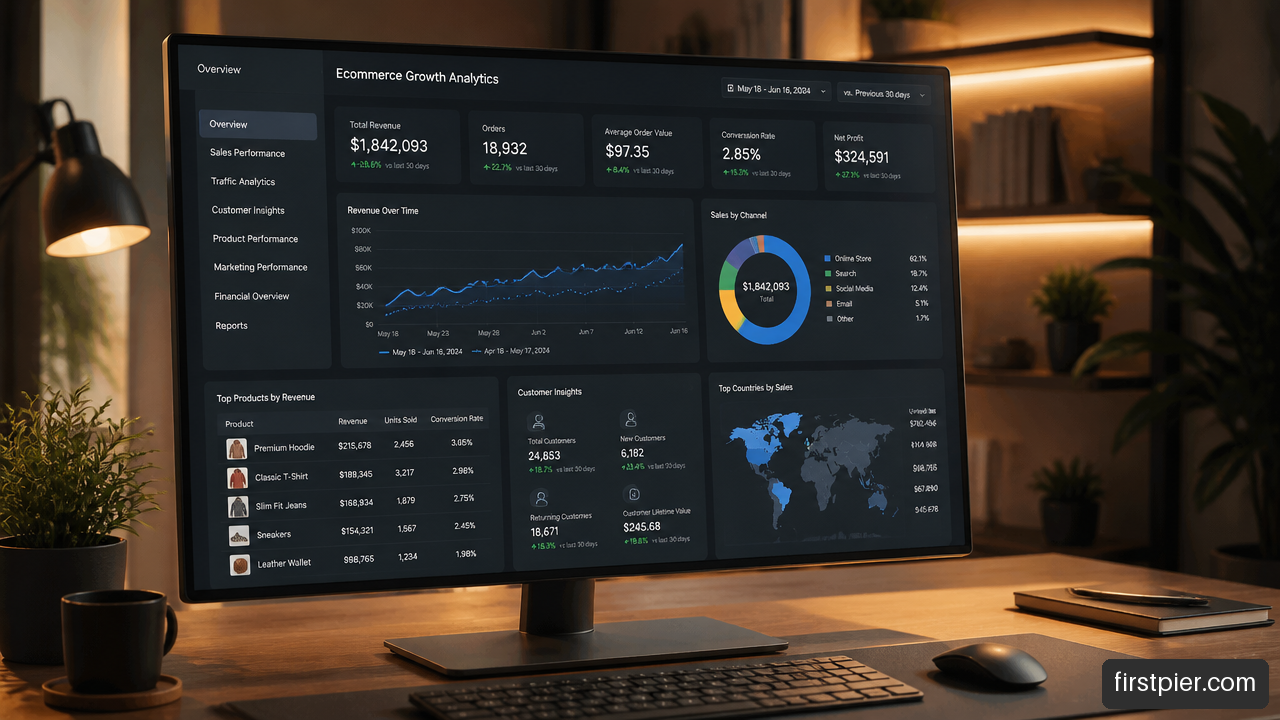

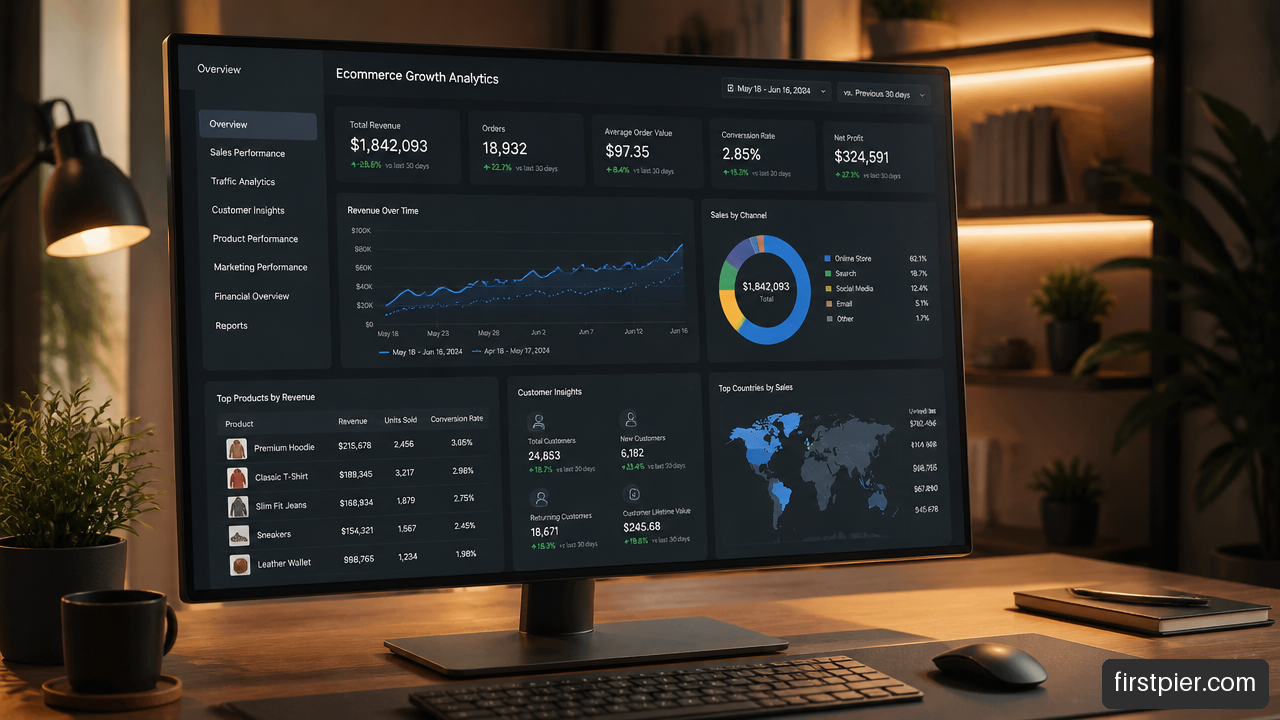
Building a repeatable Shopify growth strategy framework for a growing product business requires moving away from isolated tactical wins and focusing on system-level economics. Growing beyond early product validation into a multi-million dollar brand creates operational strain, rising acquisition costs, and complex tracking requirements. We need an actionable blueprint that connects store architecture, data analytics, conversion rate optimization, inventory planning, and retention channels into a clear growth system.
Key Takeaways
• Sustainable revenue growth relies on balancing four interconnected levers: qualified traffic, conversion rate, average order value (AOV), and repeat purchase frequency.
• Scaling ad spend before establishing conversion baseline health wastes margin and distorts customer acquisition cost (CAC) metrics.
• A complete growth framework integrates unit economics, ensuring that gross margin, contribution margin, and stock turn drive media budget decisions.
• Measurement requires tracking cohort lifetime value (LTV) and CAC payback windows rather than relying solely on platform-reported ROAS.
• Channel expansion into wholesale, marketplaces, or international markets should follow strict performance triggers rather than arbitrary timeline goals.
Table of Contents
• Diagnosing Store Performance Before Scaling
• The Core Revenue Levers in the Framework
• Margin-Aware Prioritization and Testing Cadence
• Channel Expansion and Unified Commerce Rules
• Stage-Based Milestones and Metrics
• Common Scalability Pitfalls and Recovery Steps
• Frequently Asked Questions
Diagnosing Store Performance Before Scaling
Before allocating capital to paid channels or web redesigns, we must audit current operations. Scaling high-cost acquisition channels into an unoptimized store burns margin without solving root issues. According to Shopify's ecommerce growth guide, a thorough audit evaluates traffic quality, device-specific conversion rates, checkout abandonment, return rate trends, and channel fragmentation.
Separating Acquisition and Conversion Bottlenecks
We determine whether a store suffers from a traffic problem or a conversion problem by analyzing user intent and site drop-offs. If targeted traffic enters product detail pages (PDPs) with low bounce rates but leaves at the cart step, the issue lies in pricing clarity, shipping friction, or trust signals. Conversely, high site engagement with low overall intent points to poor audience targeting across paid media.
Performance IndicatorAcquisition Problem SignalConversion Problem SignalSession Duration & Bounce RateHigh bounce rate (>65%), low time on pageLow bounce rate (<45%), high page depthAdd-to-Cart (ATC) RateBelow 3% from paid channelsHealthy ATC (>7%), low checkout conversionCart Abandonment RateVaries widely by sourceConsistently exceeds 70% across all trafficCustomer Acquisition CostRising CAC with stagnant conversionSteady CAC, declining conversion on desktop/mobile
Evaluating Unit Economics and Contribution Margin
Growth frameworks often fail when they track top-line revenue instead of bottom-line profit. A store generating $3,000,000 in gross sales can lose money if contribution margin is eroded by freight costs, payment fees, returns, and rising ad costs. We calculate net contribution margin per product unit before increasing budget commitments.
When building a comprehensive ecommerce strategy plan, we must audit unit-level profitability to ensure every scaled dollar generates positive cash flow.
Auditing Data Fragmentation and Attribution Gaps
Cross-channel reporting gaps often hide true campaign efficiency. iOS privacy changes, ad blockers, and multi-device consumer paths distort first-click and last-click attribution models. We resolve channel fragmentation by comparing platform-reported performance against store-level net revenue and blending CAC metrics across all active acquisition channels.
The Core Revenue Levers in the Framework
Every ecommerce business scales through four mathematical levers. Grounded in the four-lever revenue framework, overall revenue equals Traffic × Conversion Rate × Average Order Value × Purchase Frequency. Expanding any single lever while keeping others stable increases overall store output.
High-Intent Traffic Acquisition
Not all website traffic contributes equally to profitability. Scaling a Shopify store requires building a balanced marketing portfolio. We combine organic search visibility, high-intent paid search, targeted social campaigns, and influencer partnerships.
: Captures existing demand from users searching for specific product solutions.
•
: Generates new product demand through visual storytelling and direct offer presentation.
•
: Builds compounding, zero-acquisition-cost traffic streams over long horizons.
•
Implementing structured shopify marketing strategies helps allocate capital effectively across these acquisition channels based on real-time cost-per-acquisition performance.
Conversion Rate Optimization (CRO) Mechanics
Improving conversion rate from 1.8% to 2.5% provides immediate operating leverage. It dramatically lowers effective CAC without increasing media expenditure. Optimizing the visual hierarchy of product pages, simplifying site search, displaying visual social proof, and enabling native payment methods (like Shop Pay or Apple Pay) eliminate hesitation during checkout.
Average Order Value Expansion
A growing business cannot rely entirely on rising traffic volume. Increasing AOV provides the cash margin required to bid competitively in ad auctions. Useful methods include:
Exploring methods on how to boost ecommerce sales demonstrates how structural bundle adjustments improve order margin without increasing friction for shoppers.

Retention Framework and Repeat Purchase Cadence
According to Shopify insights on a product-led growth framework, direct product experience and customer satisfaction serve as primary revenue expansion drivers. A sustainable brand earns repeat purchases from satisfied customers. We build cohort retention frameworks that trigger segmented communication sequences based on historical purchase timing and replenishment cycles.
Customer Retention StageStrategic GoalImplementation ChannelFirst-Time Buyer (0-30 Days)Onboarding, product education, delivery reassuranceAutomated email sequence & SMS transactional updatesActive Repeat Buyer (31-90 Days)Cross-selling complementary catalog itemsPredictive product recommendations & replenishment alertsLoyal Advocate (90+ Days)Driving referral behavior & early product accessVIP loyalty rewards & exclusive product previewsAt-Risk Customer (120+ Days)Win-back and feedback collectionSpecialized re-engagement offers & survey flows
Margin-Aware Prioritization and Testing Cadence
Growth frameworks require structured testing parameters. Testing random design changes or promotion tactics without hypotheses destabilizes baseline store analytics. We establish clear test rules prior to running store experiments.
Decision Framework for Testing Order
When resources are finite, prioritization determines test efficiency. We apply a margin-aware prioritization matrix that ranks growth experiments based on estimated margin impact, build complexity, and statistical reach.
Experimentation Discipline and Statistical Guardrails
When running conversion tests on Shopify, early results can be misleading. According to guidelines set out in Shopify's growth strategy framework guide, rigorous growth experimentation relies on defining clear success metrics, establishing adequate test run times, and verifying statistical significance before adopting changes.
-Tests should run for a minimum of two complete business cycles (typically 14 days) to capture weekend versus weekday behavior.
-Avoid stopping tests early when preliminary confidence figures appear high. Ensure minimum traffic thresholds per variant are reached.
Inventory and Operational Constraints
Marketing expansion without inventory coordination risks stockouts on core SKUs. Running ad campaigns on out-of-stock or low-margin inventory damages customer trust and wastes ad spend. A resilient growth system incorporates real-time inventory turn data into campaign schedules, automatically reducing ad budgets when stock dips below reorder thresholds.
Channel Expansion and Unified Commerce Rules
Scaling beyond a single Direct-to-Consumer (D2C) storefront requires evaluating operational readiness across channels. Unified commerce ensures brand consistency, inventory sync, and unified customer profiles across all customer touchpoints.
Wholesale and B2B Channel Integration
Adding wholesale or retail distribution diversifies revenue streams. However, B2B sales lower gross margins in exchange for order volume and lower acquisition costs. Brands should evaluate wholesale expansion when:
Marketplace Expansion Guidelines
Marketplaces such as Amazon offer built-in purchase intent but create price competition and customer ownership challenges. Stores expanding to marketplaces must maintain strict pricing policies, utilize unique bundle SKUs to protect direct channel value, and automate stock synchronization across channels.
International Market Readiness
Expanding international shipping requires managing localization, duties, and local fulfillment. Before launching international storefronts, we look for natural demand signals in direct site traffic analytics. Launching international markets through Shopify Markets allows test-selling in foreign currencies and duties collection before committing to local warehousing or international entities.
Stage-Based Milestones and Metrics
As a product business scales through revenue milestones, its primary operational focus shifts. Tracking the appropriate key metrics prevents management from focusing on vanity indicators.
Brand Revenue StageCore Operational FocusTarget Key MetricsEarly Scale ($500k – $2M)Finding channel-market fit, conversion baseline healthBlended CAC, PDP Conversion Rate (>2.5%), Gross Margin (>60%)Mid Scale ($2M – $10M)Channel diversification, retention architecture, AOV expansionCAC Payback (<60 days), Returning Customer Rate (>25%), LTV:CAC (>3:1)Mature Scale ($10M+)Unified commerce, international expansion, supply chain efficiencyContribution Margin, Inventory Turnover Ratio, Net Promoter Score (NPS)
Early Scale Stage Priorities
At the $500k to $2M mark, the goal is building a solid conversion base. We focus heavily on improving page speed, simplifying store navigation, eliminating checkout friction, and testing primary ad creative formats.
Mid Scale Stage Priorities
Between $2M and $10M in annual revenue, retention becomes vital to sustained growth. We implement lifecycle marketing automations, launch loyalty programs, refine custom landing pages, and adjust cross-sell bundles to increase order values.
Mature Scale Stage Priorities
Above $10M, marginal gains in operational efficiency drive net profits. Growth focus expands to multi-warehouse inventory distribution, custom B2B portals, advanced international localization, and ERP integrations.
Common Scalability Pitfalls and Recovery Steps
Scaling a product business inevitably surfaces operational friction. Recognizing standard failure modes allows operators to recover before profitability suffers.
Pitfall 1: Scaling Ad Spend Before Establishing Conversion Health
Increasing paid ad budgets when site conversion rates remain below benchmark wastes ad spend. High ad spend drives traffic into a leaky funnel, artificially inflating acquisition costs.
• Recovery Step: Pause media budget increases immediately. Shift focus toward qualitative user research, session recordings, and site speed optimization until baseline conversion stabilizes above 2%.
Pitfall 2: Over-Reliance on Discounting
Frequent store-wide sitewide promotions train shoppers to wait for discounts, lowering brand equity and compressing gross margins.
• Recovery Step: Replace open sitewide discounts with conditional offer logic, such as threshold-based gifts with purchase, tier-based bundle savings, or exclusive loyalty points.
Pitfall 3: Fragmented Inventory and Uncontrolled Stockouts
Rapid sales growth without inventory visibility results in sudden stockouts on hero products, harming organic search traffic rankings and paid campaign efficiency.
• Recovery Step: Integrate real-time inventory management software (IMS) with Shopify to automate purchase order generation and pause ad campaigns when stock levels reach safety thresholds.
Frequently Asked Questions
What is a Shopify growth strategy framework for a growing product business?
It is a structured operational plan that focuses on optimizing four core revenue levers: website traffic, conversion rate, average order value, and purchase frequency. The framework aligns site design, media spend, inventory management, and lifecycle marketing into a unified growth engine.
What should a growing Shopify store optimize first: traffic or conversion?
Conversion optimization should usually come first. Improving conversion rates ensures that every visitor acquired through paid or organic channels converts more efficiently, lowering overall acquisition costs and maximizing marketing ROI.
How do I know if my Shopify store's growth bottleneck is acquisition or conversion?
Review site analytics data. If your site experiences low bounce rates and high session duration but low checkout completion, you face a conversion or checkout friction problem. If bounce rates are high and add-to-cart rates remain below 3%, your store likely has an acquisition or traffic targeting issue.
How do bundles and free-shipping thresholds increase average order value?
Bundles combine complementary items into a single purchase option, encouraging shoppers to buy complete solutions rather than individual items. Free-shipping thresholds motivate customers to add minor items to their cart to reach the reward tier, raising total cart value.
When is the right time for a Shopify product brand to expand into paid advertising?
Paid ads are recommended once your store demonstrates proven product-market fit, a organic conversion baseline (typically 1.5% to 2% or higher), clear unit margins, and adequate inventory to meet increased order volume.
How do inventory stockouts impact digital growth frameworks?
Running out of stock pauses campaign momentum, reduces organic search visibility, increases customer support load, and wastes ad budget spent acquiring shoppers who encounter unavailable products.
How long should conversion rate experiments run on a Shopify store?
A testing period should run for at least 14 days to account for weekly shopping pattern variations. Tests must achieve adequate sample size and statistical confidence before implementing site-wide updates.





.png)
.png)

