




What Are the Types of Paid Social Ads?
Summary
- Paid social ads offer immediate reach and precise targeting compared to organic posts.
- Different platforms support distinct ad formats including image, video, carousel, and collection ads.
- Campaign success depends on matching the right ad format to specific business objectives.
- Ad fatigue can be managed by diversifying creative assets and monitoring frequency.
The main types of paid social ads are:
| Ad Type | Best For | Available On |
|---|---|---|
| Image ads | Brand awareness, quick promotions | Facebook, Instagram, LinkedIn, Pinterest, X |
| Video ads | Storytelling, product demos, awareness | All major platforms |
| Carousel ads | Showcasing multiple products or features | Facebook, Instagram, LinkedIn, TikTok |
| Collection ads | Ecommerce product finding and purchase | Facebook, Instagram |
| Stories / Reels ads | Full-screen mobile engagement | Instagram, Facebook, TikTok, Snapchat |
| Shopping ads | Direct product sales | Instagram, Pinterest, TikTok |
| Lead gen ads | Email capture, B2B inquiries | Facebook, Instagram, LinkedIn |
| Sponsored messaging | Direct outreach, retargeting | LinkedIn, Facebook Messenger |
| In-stream / in-feed video ads | Awareness and consideration | YouTube, TikTok |
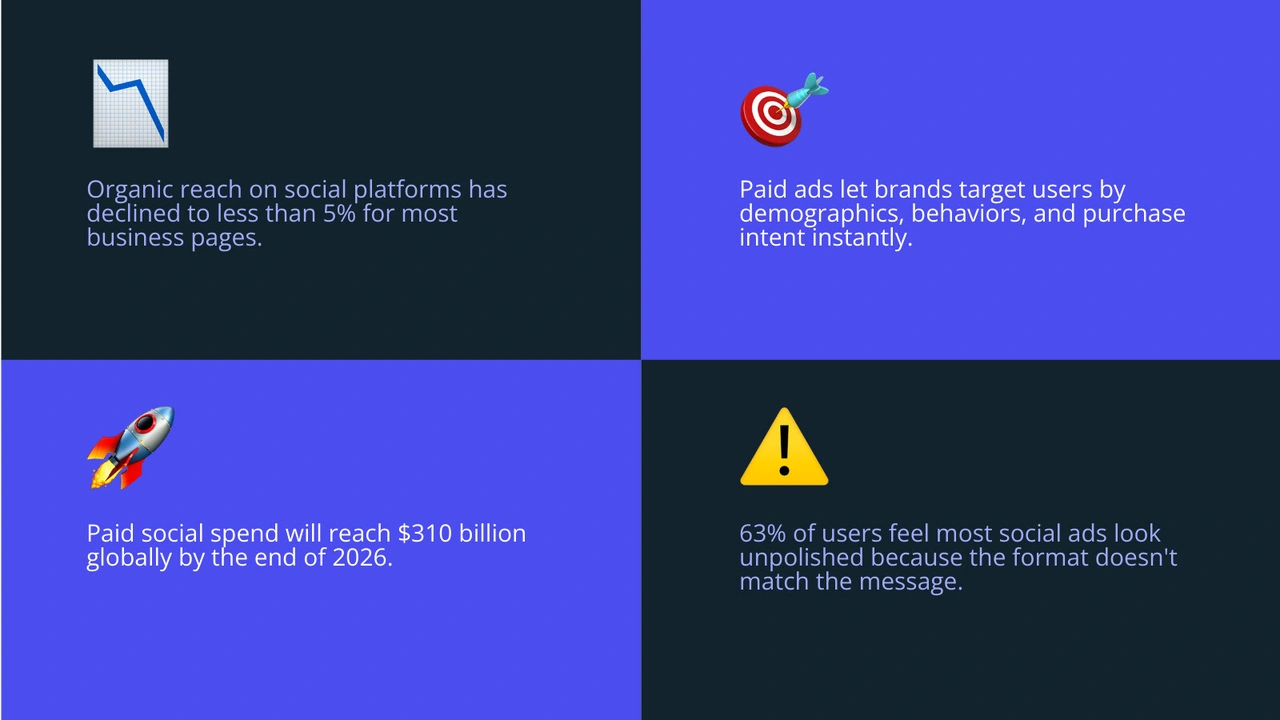
Paid social advertising is no longer optional for most ecommerce brands. Global social media ad spend crossed $280 billion in 2025 and is on track to reach $310 billion by the end of 2026. More businesses competing for the same feed space means higher costs and lower tolerance from audiences for ads that don't immediately earn attention.
The problem most advertisers run into isn't budget — it's format mismatch. Research shows that 63% of users feel most social ads look unpolished, largely because the message doesn't fit the chosen format. Pick the wrong ad type for your objective, and even a well-funded campaign underperforms.
This guide breaks down every major paid social ad format across platforms, explains which formats suit which campaign goals, and shows you how to build a strategy that doesn't burn budget on the wrong placements.
Paid Social vs. Organic Social: The Strategic Shift
Organic social media is built for brand building, community management, and customer service. However, relying solely on organic reach to drive revenue is like hosting a party and forgetting to send the invitations. Because social media algorithms restrict the unpaid reach of business pages to a tiny fraction of their followers, organic growth is a slow, long-term play.
Paid social media advertising acts as a direct shortcut to revenue. Instead of waiting for the algorithm to distribute your content, you pay to place your message directly in front of a targeted audience. This model allows you to target users based on their specific demographics, behaviors, and interests rather than relying on keyword queries.
While organic visitors are often browsing casually, paid traffic can be directed to highly specific landing pages to capture immediate purchase intent. For ecommerce brands, integrating a paid channel is essential to scale customer acquisition. To build a sustainable funnel, businesses must align their unpaid community-building efforts with a dedicated Shopify Paid Social plan.
Using paid campaigns allows you to control exactly who sees your brand, when they see it, and what action they are prompted to take. This control makes paid ads the second largest market in digital advertising, trailing only search engines. Here at First Pier, we know that transitioning from a purely organic approach to a paid framework is a foundational step in a modern Digital Marketing Strategy for Ecommerce Business. To manage these campaigns, advertisers use specialized tools like the Meta Ads Guide to set budgets, build target groups, and monitor real-time performance.
The Core Types of Paid Social Ads by Platform
Every major social platform operates on an ad auction system. When you launch a campaign, you compete against other advertisers for ad space based on your bid, estimated action rates, and ad quality. Because each platform attracts different demographics, choosing where to advertise is just as important as choosing your ad format.

Here at First Pier, we find that to build campaigns that perform, you must understand the unique placement options and specifications of each network. For a detailed breakdown of industry standards, the IAB UK Guide to Paid Social Formats provides an excellent foundation for cross-platform planning.
Meta Formats: Facebook and Instagram Specs
Meta remains the dominant force in social advertising, controlling 23.7% of global digital ad spend. Its ads are managed through a unified platform, allowing you to run campaigns across both Facebook and Instagram simultaneously.
- Image Ads: The most straightforward format. These consist of a single image, a caption, and a call-to-action (CTA) button. They are highly effective for clean, simple promotions but require striking visuals to stop users from scrolling past.
- Video Ads: These allow for deeper storytelling, showing products, and brand building. Because many users watch videos without sound, adding clear captions or text overlays is critical.
- Carousel Ads: This format displays up to 10 images or videos within a single ad card, each with its own unique link. Carousels are perfect for highlighting different product features, showcasing a collection, or telling a step-by-step brand story.
- Collection Ads: A mobile-only format that features a main video or image alongside four smaller product images in a grid layout. When a user taps the ad, it opens a full-screen, fast-loading storefront where they can browse and buy products without leaving the app.
To make sure your creative assets display correctly without awkward cropping, you must adhere to official Facebook Ad Specs and Instagram Ads Specs. Because small design changes can have a massive impact on your conversion rates, running a structured Facebook Ads Creative Testing process is essential to identify your top-performing assets before scaling your budget. For detailed setup instructions, refer to the Meta Ads Guide.
TikTok and YouTube Video Placements
Video-centric platforms require a completely different creative approach than traditional social feeds. On these networks, highly polished, corporate commercials often underperform compared to native-looking, organic-style content.
- TikTok Ads: TikTok relies heavily on full-screen, vertical video. The most successful ads on this platform use user-generated content (UGC) and look like standard TikTok posts. Brands can use standard In-Feed ads, or invest in interactive formats like Branded Hashtag Challenges and Branded Effects to drive viral engagement. For technical requirements and setup steps, consult the TikTok Business Help Center.
- YouTube Ads: YouTube offers a mix of Skippable In-Stream ads (which play before or during videos), Non-Skippable In-Stream ads, and In-Feed video ads that appear in search results. Because YouTube is a search-driven video platform, it is highly effective for capturing users who are actively researching products or looking for tutorials.
Using these platforms is a great way to introduce your brand to new prospects. Running TOF Ad Campaigns (Top-of-Funnel) on video networks helps build a large pool of warm prospects who can later be retargeted on other channels.
LinkedIn and Pinterest Formats
If your business targets professional buyers or visual shoppers, LinkedIn and Pinterest offer highly focused environments with distinct ad formats.
- LinkedIn Ads: Designed specifically for B2B marketing. Beyond standard single-image and video ads, LinkedIn offers Sponsored Messaging and Conversation Ads. These deliver personalized, interactive messages directly to a user's LinkedIn inbox, making them highly effective for lead generation, webinar signups, and high-value professional services. You can review the full range of options in the LinkedIn Ad Formats directory.
- Pinterest Ads: Pinterest operates as a visual search engine. Users browse the platform to find inspiration, plan projects, and make purchase decisions. Standard Pins, Video Pins, and Carousel Pins blend naturally into the user's feed. Because Pinterest users have high purchase intent, visual product ads on this platform often yield excellent long-term conversion rates.
Managing campaigns across these diverse channels requires a unified approach. Professional Digital Ad Management ensures your messaging remains consistent, your tracking is accurate, and your budget is allocated to the platforms driving the highest return.
Campaign Strategy and Creative Execution
A successful paid social campaign relies on performance creative—ad assets designed specifically to drive measurable business actions. In digital advertising, your creative assets do the heavy lifting when it comes to targeting and capturing attention.
One of the biggest obstacles to campaign profitability is ad fatigue. Because users see thousands of ads daily, their click-through rates drop sharply after seeing the same ad creative just four times. To combat this, you must diversify your creative styles. Using a mix of lifestyle images, product-focused shots, customer testimonials, and short videos can increase your campaign efficiency by up to 32%.
Furthermore, mixed-format campaigns that combine static images with video assets outperform static-only campaigns by 82%. To protect your margins, you should also implement a robust retargeting strategy. By using AdRoll Retargeting alongside your social campaigns, you can re-engage warm site visitors who left without purchasing. To build a comprehensive retargeting system, you can follow the steps outlined in our Retargeting Playbook.
Selecting Types of Paid Social Ads for Your Objectives
You should always select your ad format based on your primary campaign objective. Platforms like Meta organize their campaign creation tools around these goals to ensure their algorithms deliver your ads to the users most likely to take your desired action.
[Awareness] ----> Image & Video Ads (Broad Reach) |[Consideration] -> Carousel & Story Ads (Deep Engagement) |[Conversion] ----> Collection & Shopping Ads (Direct Purchase)- Brand Awareness: If your goal is to introduce your brand to a new audience, use single image ads, broad video ads, or YouTube In-Stream placements. These formats are optimized for reach and recall rather than immediate clicks.
- Consideration and Engagement: To get users to interact with your brand, research your products, or sign up for a newsletter, use Carousel ads, Lead Gen ads, or Sponsored Messaging.
- Conversions and Catalog Sales: If you want to drive immediate online purchases, use Collection ads, Shopping ads, or dynamic product ads linked directly to your inventory.
For a deeper look at how platforms handle these goals, review the official Meta Campaign Objectives documentation. Aligning your creative assets with these objectives is a core component of a profitable Ecommerce Ads Strategy.
How to Budget for Different Types of Paid Social Ads
To budget effectively, you must understand how platforms charge for ad delivery. The two primary cost models are:
- Cost-Per-Click (CPC): You only pay when a user clicks on your ad. This model is ideal for driving targeted traffic to a specific landing page or product listing.
- Cost-Per-Thousand-Impressions (CPM): You pay for every 1,000 times your ad is shown, regardless of whether users click it. This model is standard for brand awareness and video view campaigns.
Your actual costs will fluctuate based on your target audience, industry competition, time of year, and ad relevance score. To get the most out of your budget, you must select the right bidding strategy—such as lowest cost, cost cap, or target cost—within your ad manager. For detailed bidding mechanics, consult the Meta Ads Bidding resources.
On average, pay-per-click advertising yields a 200% return on investment (ROI). However, achieving this benchmark requires continuous testing, careful audience segmentation, and regular budget reallocation. Developing a clear Ecommerce PPC Strategy will help you balance your acquisition costs against your customer lifetime value to ensure long-term profitability.
Frequently Asked Questions About Paid Social Ads
What is the most effective type of paid social ad?
The most effective format depends on your campaign goal, but video and carousel ads generally drive the highest engagement and conversion rates across most platforms. Video ads excel at storytelling and building brand awareness, while carousel ads allow ecommerce brands to showcase multiple products or features in a single placement, making them highly effective for direct-response campaigns.
How much do paid social ads cost in 2026?
Costs vary widely by platform and industry, with average CPMs ranging from $2 to $5 on Pinterest up to $25 to $45 on LinkedIn. Factors such as target audience specificity, industry competition, ad relevancy, and the time of year heavily influence your final cost-per-click (CPC) and cost-per-thousand-impressions (CPM).
How do you prevent ad fatigue in paid social campaigns?
You can prevent ad fatigue by regularly refreshing your creative assets, using mixed-format campaigns, and setting frequency caps on your ad sets. Monitoring your frequency metrics closely ensures that users do not see the same ad creative more than four times, keeping your click-through rates high and your acquisition costs stable.
To Sum Up
Choosing the right paid social ad format requires aligning your creative assets with your specific business goals and target audience. By testing different formats across platforms and monitoring performance metrics, you can build a balanced campaign that drives consistent traffic and conversions.
If you need help managing your paid social ads, get in touch.





.png)
.png)

