


Why AI Ads Subscription Churn Is the Retention Challenge You Can't Ignore
Summary
- Machine learning models predict subscriber cancellation risk 30 to 60 days in advance by analyzing behavioral and billing data.
- Sending predicted lifetime value (pLTV) signals directly to ad networks shifts acquisition focus from first-order conversion to long-term retention.
- Automated workflows trigger targeted interventions, such as personalized email flows or billing updates, based on individual risk scores.
- Companies using predictive churn models report a 20% to 35% reduction in voluntary subscriber loss within the first year.
AI ads subscription churn is one of the costliest blind spots in subscription commerce today — and most businesses are still fighting it with the wrong tools.
Here's the short answer for operators who want it fast:
How AI reduces subscription churn — at a glance:
- Predict at-risk subscribers 30 to 60 days before cancellation using machine learning models trained on behavioral and billing data
- Align ad spend with retention by shifting from first-order ROAS to predicted lifetime value (pLTV) signals sent directly to ad platforms
- Trigger personalized interventions automatically — targeted offers, content nudges, or outreach — based on each subscriber's risk score
- Measure true ROI through cohort-level churn rate reduction and customer lifetime value, not just click-through rates
The numbers make the case clearly. The average monthly churn rate runs between 2% and 8% for SaaS businesses, and can exceed 10% for consumer subscriptions. It costs five times more to acquire a new subscriber than to keep an existing one. And companies that deploy AI-driven churn models have reported between 20% and 35% reductions in voluntary churn within the first year.
Yet most subscription brands still focus their ad campaigns on the first order — while subscription economics depend on months four through twelve.
The real problem isn't just that subscribers leave. It's that standard ad attribution never shows you why, or who's about to.
This guide walks through how to deploy predictive AI to identify at-risk subscribers early, connect churn signals to your ad and retention stack, and build a roadmap that protects recurring revenue at every stage of the subscriber lifecycle.
Understanding AI Ads Subscription Churn and Predictive Scoring
To stop subscribers from leaving, you first have to understand why they cancel. Traditional analytics only show you historical data—meaning you find out a customer has churned after they have already clicked "cancel."
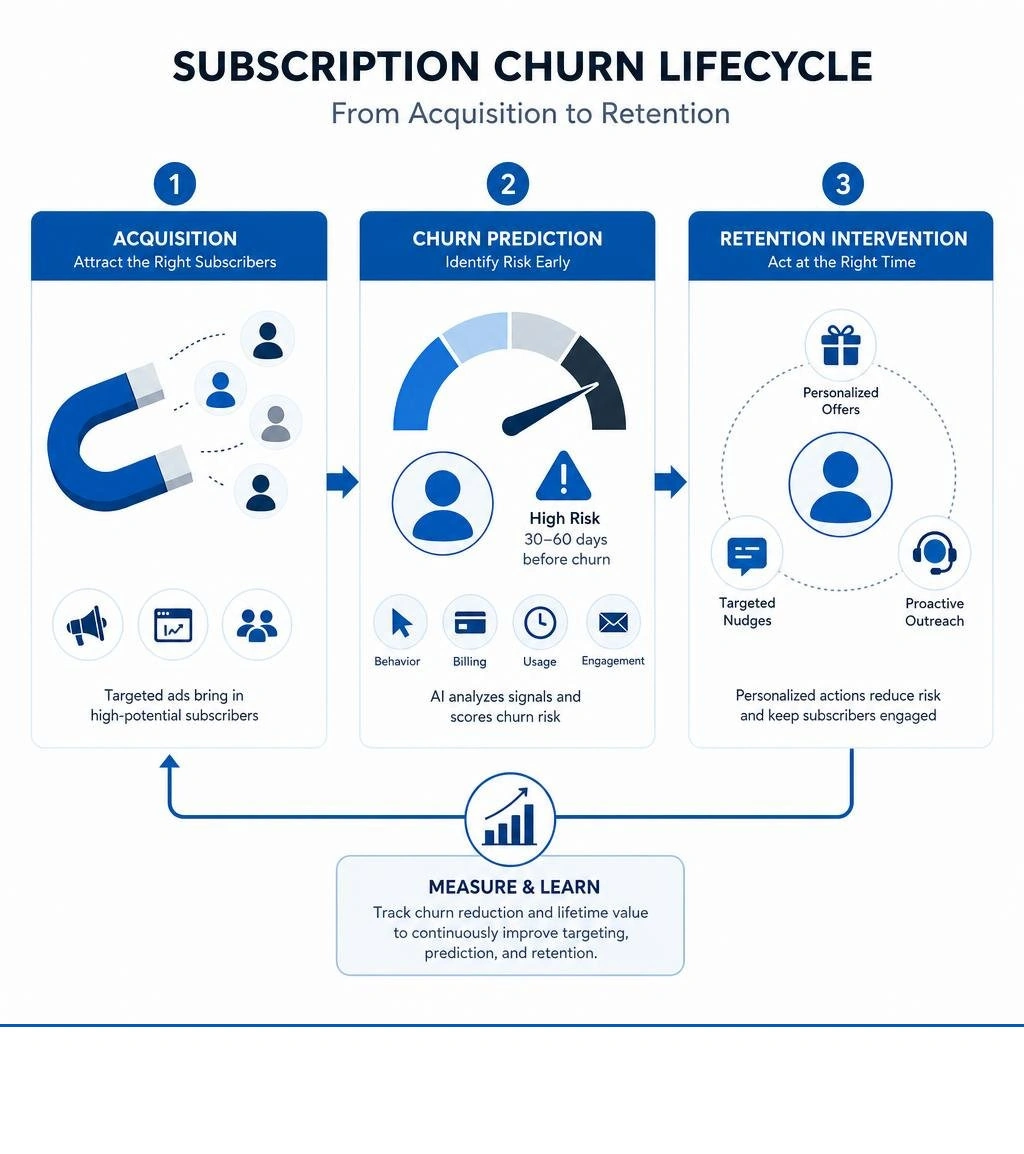
AI-enhanced subscription churn scoring changes this by shifting your strategy from reactive to predictive. By using machine learning, systems can analyze complex patterns across your entire subscriber base to generate a dynamic risk score for every customer.
Predictive modeling works by looking at historical data of past churned subscribers and comparing it to current subscriber behavior. This helps you identify at-risk accounts weeks before they make the final decision to cancel.
When you connect these risk scores back to your advertising channels, you can solve the core problem of ai ads subscription churn. Instead of spending your ad budget to acquire low-quality subscribers who leave after their first order, you can use these predictive signals to find and keep high-value customers.

How Machine Learning Models Predict Churn Risk
Modern predictive retention systems rely on sophisticated machine learning models to calculate subscriber-level attrition risk. These systems use gradient boosting algorithms (like XGBoost) and survival analysis to determine not just if a customer will cancel, but when they are most likely to do so.
Survival analysis is particularly useful for subscription models. It treats the subscriber lifecycle as a timeline, calculating the probability of a customer staying active at each renewal interval. Rather than looking at a static snapshot, the AI monitors how risk changes day by day.
These models typically operate on a 30-to-60-day prediction horizon. This timeline is the sweet spot for marketing and customer success teams. It gives you enough time to run targeted, personalized interventions before the user makes up their mind. According to research on AI in Subscription Businesses in 2026 | Digital Marketing Knight , these predictive models achieve accuracy rates of 82% to 91% when evaluated on this 30-to-60-day window.
Behavioral and Transactional Signals for Churn Prediction
An AI model is only as good as the data you feed it. To predict churn accurately, the machine learning system combines first-party behavioral, transactional, and customer service data.
The most effective signals for predicting churn include:
- Login and Usage Frequency: A sudden drop in how often a customer logs in or uses a service is the strongest indicator of a drop in perceived value.
- Billing Anomalies: Failed credit card payments, expired cards, or multiple payment retries are leading causes of involuntary churn.
- Support Interactions: An increase in support tickets, especially those related to technical issues or pricing questions, signals a high risk of cancellation.
- Engagement Milestones: In media and publishing, engagement is highly predictive. For example, subscribers who read content at least 10 times a month are 50% less likely to churn.
When these signals are ignored, businesses suffer from high Churn Rate averages. While typical SaaS businesses experience a monthly churn rate of 2% to 8%, consumer subscription services can see rates jump past 10%. Tracking these behavioral patterns helps you build a solid foundation for Customer Retention and keep your customer base stable. You can learn more about aligning these metrics by reading our Ecommerce KPIs Complete Guide 2026.
Integrating AI Churn Models with Your Tech Stack
To turn predictions into actual revenue, your AI churn engine cannot live in an isolated silo. It must connect directly with your existing commercial tech stack. This allows your customer success, marketing, and advertising teams to act on risk scores automatically.
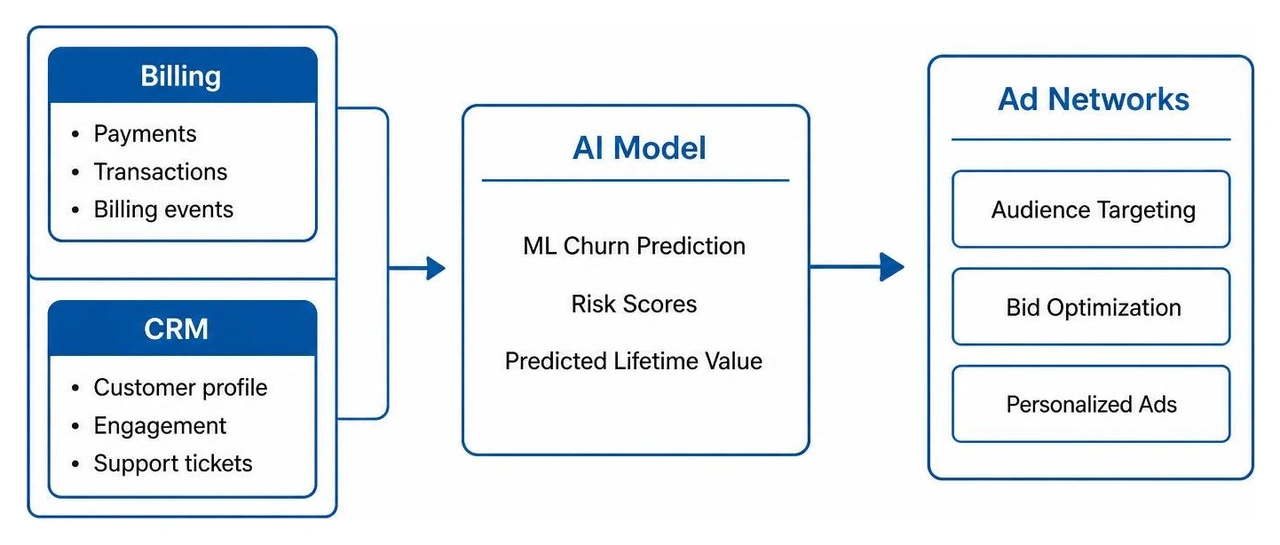
A fully integrated predictive retention system connects four main layers:
- Data Ingestion: Gathering raw behavioral and transactional data from your billing platform, database, and web analytics tools.
- Predictive Engine: Processing the data using machine learning models to output subscriber risk scores and predicted lifetime value.
- Orchestration Layer: Sending those scores to your CRM and marketing automation tools.
- Action Layer: Executing targeted email flows, customer support playbooks, or ad campaigns based on the risk segments.
Connecting Predictive Engines to Shopify and Klaviyo
For ecommerce brands, the most critical integrations are with Shopify and your email marketing platform, such as Klaviyo. When your AI engine identifies a cohort of at-risk subscribers, it can sync these segments to Klaviyo in real time.
Instead of sending generic, sitewide discounts that hurt your profit margins, you can trigger highly targeted automated flows. For example, if a subscriber's risk score spikes because their usage has dropped, Klaviyo can automatically send a personalized usage-activation email. If the risk is tied to a billing issue, you can trigger a soft billing-update reminder.
This integration also helps you run smarter winback campaigns. By syncing your high-risk and recently churned cohorts directly to Google Ads and Meta Ads, you can exclude them from standard acquisition campaigns. At the same time, you can target them with specific, value-focused social ads. To learn how to align these platforms, check out our guide on Digital Marketing for Shopify.
Deploying AI Ads Subscription Churn Solutions via Cloud and BYOL
When implementing an AI churn prediction tool, businesses generally choose between two primary deployment options: fully managed cloud-based software or a Bring Your Own License (BYOL) model deployed on private cloud infrastructure, like AWS EC2.
| Deployment Model | Pros | Cons | Best For |
|---|---|---|---|
| Fully Managed Cloud | Fast setup, no server maintenance, automatic updates | Less control over data storage, higher ongoing platform costs | Small to mid-sized brands wanting speed |
| BYOL (e.g., AWS EC2) | Complete control over data, better security, lower long-term infrastructure costs | Requires internal technical resources to set up and maintain | Enterprise brands with strict data privacy rules |
For brands with strict data privacy and compliance requirements, the BYOL model on private cloud infrastructure is often the preferred path. This setup ensures that sensitive customer billing and behavioral data never leaves your secure cloud environment.
This is particularly important for complying with strict regulations like GDPR. By using techniques like pseudonymization and data minimization, you can train your models on secure, anonymous customer profiles. Platforms like AI Intelligence for Subscription Ecommerce | Cresva show how here at First Pier we see modern brands connect their data sources securely to build unified retention views without sacrificing customer privacy.
B2B vs. B2C Retention Dynamics and Generative AI Workflows
The way you predict and prevent churn depends heavily on whether you sell to businesses (B2B) or directly to consumers (B2C). B2B subscription models are defined by high contract values, multi-user accounts, and active customer success management. B2C subscriptions, on the other hand, feature lower price points, high transaction volumes, and self-service customer journeys.
Because the customer journeys are so different, your AI models must look at different signals for each model:
| Metric / Feature | B2B Churn Models | B2C Churn Models |
|---|---|---|
| Primary Data Sources | CRM notes, seat utilization, support tickets, NPS | Clickstream data, purchase frequency, billing failures |
| Key Risk Signals | Drop in active seat usage, champion departure, unpaid invoices | App uninstalls, lower login frequency, credit card expiration |
| Intervention Channel | Customer success outreach, executive business reviews | Automated email, SMS, push notifications, in-app alerts |
| Data Volume | Low volume, high complexity per account | High volume, lower complexity per account |
Generative AI and LLMs in Modern Churn Analytics
Generative AI and Large Language Models (LLMs) have changed how marketing and customer success teams use churn data. Traditionally, understanding customer health required data science teams to write complex SQL queries. Today, LLMs allow non-technical business users to query their customer data using natural language.
For example, a marketing manager can ask the AI: "Which subscriber cohorts in Portland, Maine show the highest risk of churn due to pricing concerns?" The system can instantly analyze customer support transcripts, email replies, and survey feedback to deliver a clear, summarized report.
Beyond answering questions, generative AI can write and launch automated retention playbooks. When an at-risk subscriber is identified, systems like the Co-Pilot: Predictive AI for Customer Retention can automatically draft a personalized email offer. This offer is tailored specifically to that user's past purchase history and stated cancellation reasons, creating a highly relevant retention message.
Mitigating the AI Ads Subscription Churn Cliff
One of the most dangerous phases in the subscription lifecycle is the "churn cliff." This is the point where retention rates drop sharply, typically occurring between the initial order and the first recurring shipment.
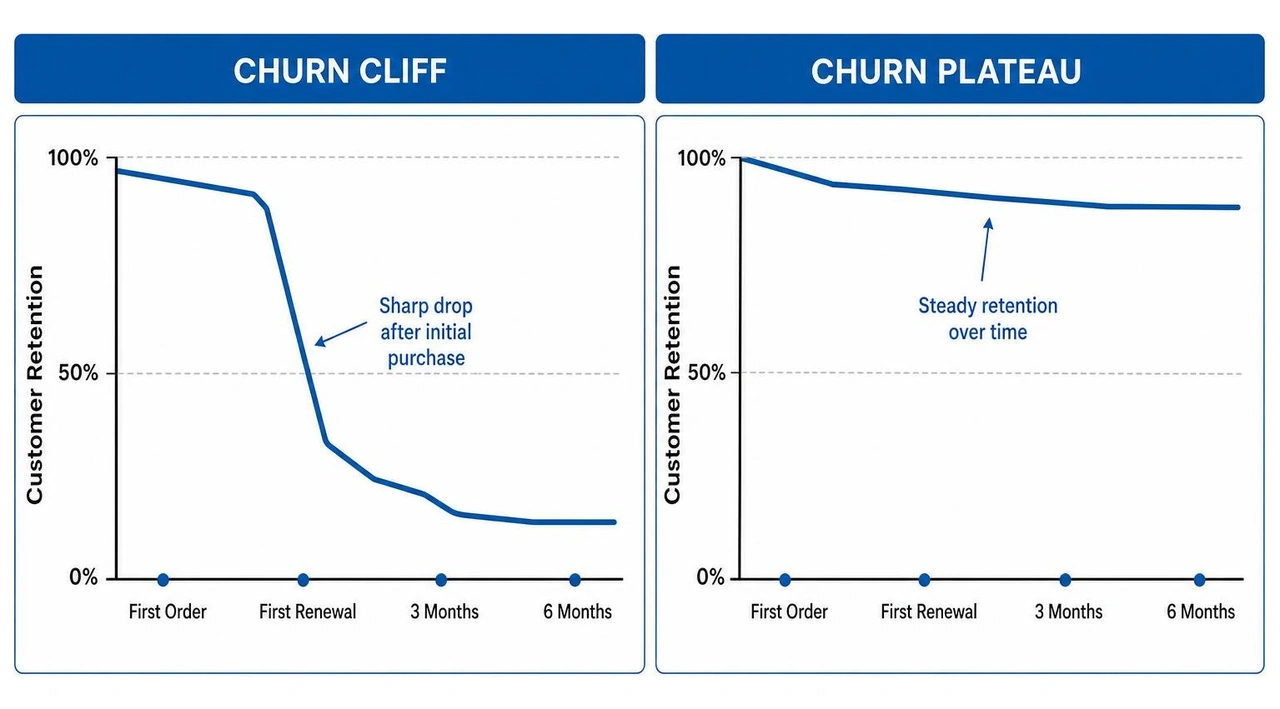
To survive this drop, brands must look past first-order return on ad spend (ROAS). If your ads are bringing in plenty of first-time buyers, but those buyers cancel immediately, your acquisition campaign is actually losing you money.
A recent report highlighted by TechCrunch showed that even popular AI-powered apps struggle with long-term retention. While these apps convert trial users to paid customers 52% better than traditional apps, they also experience annual cancellation rates that are 30% faster at the median. This highlights a clear trend: strong initial sales do not guarantee long-term loyalty.
To combat this, growth teams must use cohort analysis to identify which ad channels, creatives, and offers bring in customers who actually stay past the churn cliff. Shifting your ad bidding from simple conversion volume to predicted lifetime value (pLTV) ensures that your ad budget goes toward channels that drive sustainable growth.
Measuring ROI and Building a Predictive Retention Roadmap
Implementing an AI-driven predictive retention system requires a clear financial business case. To measure the return on investment (ROI) of your retention efforts, you must track how your predictive models directly impact your customer lifetime value (LTV).
A minor improvement in your retention rate can have a massive impact on your bottom line. According to industry benchmarks, a 5% increase in customer retention can grow business profits by 25% to 95%. When you reduce voluntary churn, you directly increase the average lifetime value of your customer cohorts. This gives you more budget to spend on customer acquisition. To find practical ways to scale these metrics, check out our guide on Ways to Increase Customer Lifetime Value.
Improving Model Accuracy and Explainability
One major hurdle to adopting AI in business is the "black box" problem. If a machine learning model flags a high-value customer as a churn risk, but cannot explain why, your team will struggle to take the right action.
To solve this, modern predictive retention platforms use explainable AI frameworks, such as SHAP (SHapley Additive exPlanations) and LIME (Local Interpretable Model-agnostic Explanations). These frameworks break down the specific factors driving each subscriber's risk score.
For example, the AI might show that a customer has an 85% risk score because:
- Their weekly login frequency dropped by 40% (contributing +35% to risk)
- They had a failed payment attempt last week (contributing +30% to risk)
- They submitted a technical support ticket (contributing +20% to risk)
This level of detail helps your customer success team or automated email systems send the exact right message to resolve the issue. Platforms like Churney | AI-Powered Predicted LifetimeValue to Maximize ROAS & Growth use these causal machine learning models to continuously improve prediction accuracy while providing clear, actionable insights for your marketing team.
A Four-Stage Roadmap for Predictive Retention
Building a predictive retention system does not have to be an all-or-nothing project. You can scale your system sustainably by following a structured, four-stage roadmap:
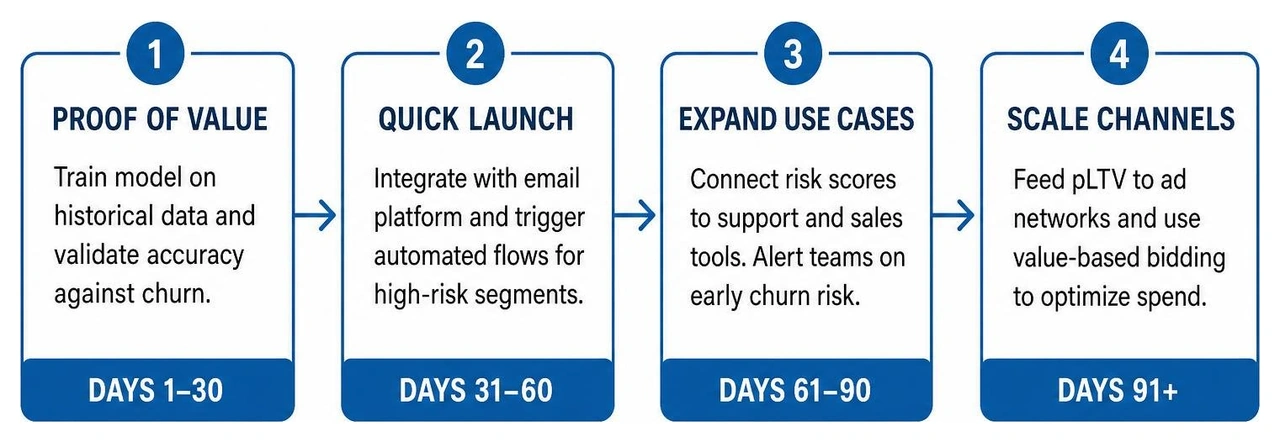
- Proof of Value: Connect your historical subscription and behavioral data to train your first machine learning model. Evaluate the model's accuracy against your historical churn events to prove it can reliably flag at-risk users.
- Quick Launch: Integrate the predictive engine with your email marketing platform (like Klaviyo). Start syncing risk scores and trigger basic automated flows for your highest-risk segments.
- Expand Use Cases: Connect your predictive risk scores to your customer support and sales tools. Set up alerts for your team when high-value accounts show early signs of churn risk.
- Scale Channels: Feed your predicted lifetime value (pLTV) data back to your advertising networks (Google Ads, Meta Ads). Use value-based bidding to focus your ad spend on high-retaining customers.
By breaking down the implementation into clear, manageable steps, you can start seeing real-world retention gains within your first 60 days. For more ideas on how to design these campaigns, explore our resources on Ecommerce Retention Strategies.
Frequently Asked Questions about Subscription Churn
What is AI-driven subscription churn scoring?
AI-driven subscription churn scoring is a method of using machine learning algorithms to calculate the probability of a subscriber canceling their service. By continuously analyzing customer behavior, billing history, and support interactions, the AI assigns a risk score (from 0 to 100%) to every subscriber. This helps businesses identify at-risk customers 30 to 60 days before they cancel, allowing teams to launch targeted retention campaigns.
Why do AI-powered subscription apps struggle with long-term retention?
While AI-powered apps are highly effective at converting trial users to paid subscribers, they often experience faster long-term churn. This is primarily because many users sign up to solve a temporary problem or to try out a new technology, leading to high feature-switching rates. Without ongoing product updates, personalized content recommendations, and clear long-term value, these users quickly cancel their subscriptions once their immediate need is met.
How does predicted lifetime value improve return on ad spend?
Predicted lifetime value (pLTV) improves return on ad spend by shifting your ad bidding from short-term conversions to long-term profitability. By sending pLTV predictions back to ad networks as conversion events, you can use value-based bidding. This trains the ad platform's algorithms to find and target high-value users who are likely to stay subscribed, rather than low-cost users who are highly likely to churn after their first month.
Keeping Your Subscribers for the Long Haul
Solving the problem of ai ads subscription churn requires a major shift in how you think about growth. You cannot scale a subscription business by focusing entirely on customer acquisition while ignoring a leaky retention bucket.
By using predictive AI, you can identify at-risk customers early, understand the exact behavioral and billing issues driving their risk, and launch automated retention campaigns that protect your recurring revenue. More importantly, feeding these lifetime value signals back to your advertising platforms ensures that your marketing budget is spent on acquiring customers who will stick around for months and years to come.
If you would like help setting up or optimizing your subscription retention stack, get in touch with the team at First Pier.





.png)
.png)

