


Understanding the B2C Ecommerce Landscape

Summary
- B2C ecommerce platforms handle direct-to-consumer online sales and data.
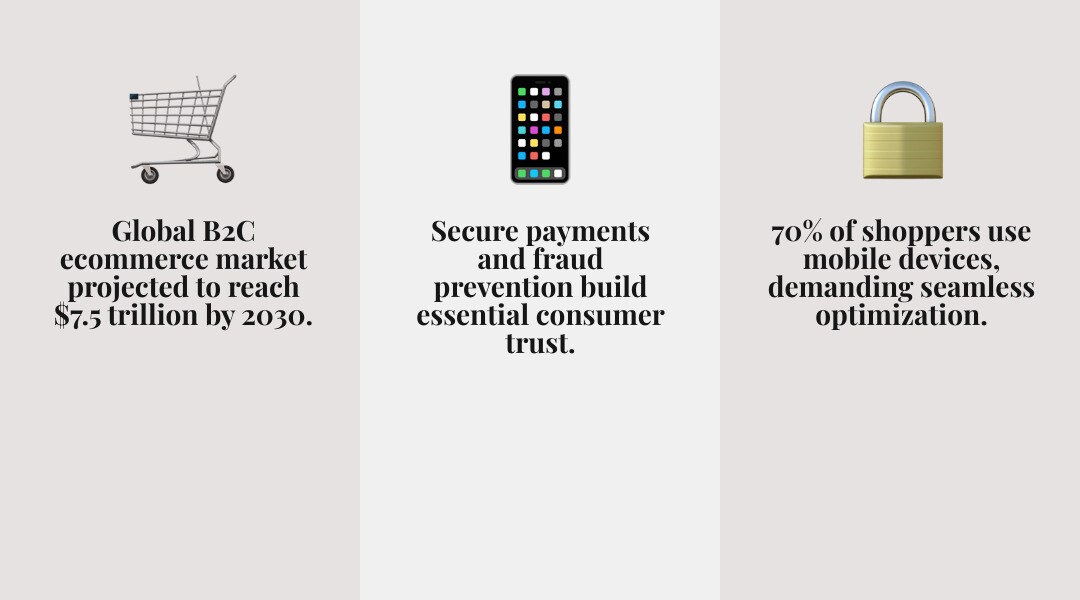
- The global market is estimated to reach $7.5 trillion by 2030.
- Platform models include single-brand, multi-vendor marketplaces, and D2C.
- Technical requirements include mobile optimization, secure payments, and order management.
- Selection depends on scalability, integration capacity, and total cost of ownership.
B2C ecommerce solutions are platforms that connect businesses directly with consumers online. These systems handle product display, payment processing, order fulfillment, and customer data.
The market is growing. Global B2C ecommerce is projected to reach $7.5 trillion by 2030. Buyers shop on mobile devices at all hours and expect a store that works every time they visit.
| Category | What It Includes |
|---|---|
| Platform Types | Single-brand stores, multi-vendor marketplaces, D2C |
| Core Features | Mobile performance, product catalogs, secure checkout |
| Use Cases | Direct selling, subscriptions, dropshipping, digital products |
| Technology | AI personalization, headless/composable architecture, analytics |
| Key Platforms | Shopify, Salesforce B2C Commerce, Adobe Commerce, BigCommerce |
Whether you run a high-volume brand or a niche D2C operation, the platform you build on determines your growth. This guide examines the features, architectures, and decisions that matter most.
I'm Steve Pogson, founder here at First Pier and a certified Shopify specialist with over two decades of experience helping brands build and scale B2C ecommerce solutions. I have worked with brands across retail, food, and outdoor gear to implement systems that perform in practice.
Quick look at b2c ecommerce solutions:
Market Dynamics and Growth
The $7.5 trillion by 2030 projection represents a change in how people shop. Consumers have 24/7 access to global brands, allowing a business in Portland, Maine, to sell to someone in Tokyo as easily as someone down the street.
This global reach increases the customer base but also the competition. To stand out, your site needs to be an efficient experience. I often tell my clients that their website is their most important salesperson. If that salesperson is slow or doesn't work on a phone, you lose revenue. For those bridging the gap between retail and professional services, B2B E-commerce Web Design principles can help build trust through professional layouts.
Core Features of Modern B2C Ecommerce Solutions
When I look at a brand's online store, I look for a few non-negotiables. If these aren't right, nothing else matters.
Mobile Performance
During the first quarter of 2024, 70% of all buyers used mobile devices to browse online shops. If your site isn't built for a thumb-driven experience, you are ignoring the majority of your audience. Mobile performance means fast load times, buttons that are easy to tap, and a checkout process that doesn't require a magnifying glass. Here at First Pier, we prioritize "mobile-first" design because that is where the transactions are happening.
User Experience (UX)
Good UX is invisible. It's the reason a customer finds what they need in two clicks instead of ten. This includes advanced filtering options, high-quality imagery, and intuitive navigation. A well-organized product catalog helps customers pinpoint products quickly, which directly increases conversion rates. If you're building a new site, focusing on B2B E-commerce Web Development principles—like clarity and speed—can actually help your B2C side as well.
Security and Fraud Prevention
Trust is the currency of the internet. If a customer doesn't feel safe, they won't buy. This is a massive issue: payment fraud is expected to reach $343 billion by 2027.
To protect your business and your customers, you need:
- Strong Encryption: SSL certificates are the bare minimum.
- Secure Gateways: Use multiple payment options like PayPal, Apple Pay, and credit card processors with built-in fraud detection.
- Compliance: Following standards like PCI-DSS is mandatory for keeping data safe.
Streamlined Order Processing and Management
Selling the product is only half the battle. You have to get it to the customer. Modern b2c ecommerce solutions should include:
- Inventory Tracking: Real-time updates to avoid selling items that are out of stock.
- Automated Workflows: Sending order confirmations and shipping updates without manual work.
- Shipping Integration: Connecting directly with carriers to print labels and track packages.
- Return Management: Making it straightforward for customers to send things back—because a good return experience builds loyalty.
Types and Use Cases for B2C Platforms
Not every business needs the same setup. I've helped brands launch everything from boutique shops to multi-vendor marketplaces.
| Model | Description | Best For |
|---|---|---|
| Single-Brand (D2C) | You sell your own products directly. | Niche brands, boutiques, manufacturers. |
| Multi-Brand Marketplace | You host multiple sellers (like Amazon). | Large-scale retail projects, niche hubs. |
| Dropshipping | You sell items shipped by a third party. | New businesses, testing new product lines. |
| Subscription | Customers pay a recurring fee for products. | Consumables, beauty, "box of the month." |
Direct Selling (D2C)
Many vendors build an online store to sell directly to consumers. This gives you full control over your brand, pricing, and customer data. You aren't at the mercy of a third-party marketplace's rules or fees.
Dropshipping and Print-on-Demand
For those starting out, dropshipping platforms allow you to sell without holding inventory. When a customer buys, the order goes to the supplier, who handles the rest. This works for items like print on demand airpod cases or custom apparel. It's a low-risk way to test the market before committing to a large inventory purchase.
Subscription Models and Recurring Revenue
Subscription models create predictable income. Whether it’s a monthly coffee delivery or a replenishment service for vitamins, subscriptions foster long-term loyalty. I often recommend using Shopify B2B Strategies to automate recurring orders so customers return without having to re-order manually.
The Role of AI and Data in B2C Ecommerce
We use AI daily to help brands grow. AI-powered personalization can increase revenue by 175% per site visit.
Personalization and Recommendations
AI looks at a customer's past behavior to show them products they are likely to buy. Salesforce B2C Commerce, for example, uses its "Einstein" AI to deliver billions of recommendations during peak times like Cyber Week.
Predictive Analytics
Predictive AI analyzes historical data to help plan inventory so you don't run out of best-sellers. It also helps with dynamic pricing—adjusting prices in real-time based on demand and competitor activity.
Automated Customer Service
AI-driven chatbots (like Shopify Inbox) handle basic questions about shipping or returns, allowing your team to handle more complex issues. This improves the customer experience by providing instant answers. For brands concerned about data handling, we use data compliance resources to ensure adherence to GDPR and CCPA rules.
Architecture: Headless and Composable Commerce
If you want a site that is incredibly fast and flexible, you might look into headless or composable commerce.
In a traditional setup, the "head" (what the customer sees) and the "body" (the back-end systems like inventory and payments) are glued together. In a headless setup, they are decoupled. They talk to each other through APIs.
Why Go Headless?
- Speed: Headless sites can load much faster. Composable storefront customers have seen page loads improve by 40%.
- Flexibility: You can change the look of your site without touching the back-end logic.
- Omnichannel: You can use the same back-end to sell on your website, a mobile app, or even a smart mirror.
Large enterprise brands often use Shopify Plus B2B Features and headless builds to manage complex, global operations while keeping the customer experience unique.
Choosing the Right B2C Ecommerce Solutions for Growth
Choosing a platform is one of the biggest decisions you'll make. It impacts your conversion rates, your staffing needs, and your long-term costs.
Comparing the Big Players
- Shopify: This is my top recommendation for most brands. It powers over 4.8 million stores and is known for its world-class checkout. In fact, Shopify's checkout has shown conversion rates up to 36% higher than competitors like Salesforce. It is straightforward to use but scales to the enterprise level.
- Salesforce B2C Commerce: A leader for large-scale global brands. It offers deep AI integration and is built to handle massive volume—like processing 72,000 orders in 12 minutes.
- Adobe Commerce (Magento): Best for brands that need a "blank canvas" and have a dedicated development team. It’s highly customizable but often comes with a higher total cost of ownership (TCO).
- CS-Cart: A great choice for those looking to build a multi-vendor marketplace. It’s flexible and offers already-configured hosting options to get you up and running quickly.
Factors to Consider
When I sit down with a brand in Portland, ME, we look at:
- Total Cost of Ownership (TCO): Don't just look at the monthly fee. Look at the cost of apps, developers, and transaction fees.
- Scalability: Can the platform handle it if you go from 100 orders a day to 10,000?
- Integration: Does it play nice with your email marketing (like Klaviyo), your ERP, and your shipping software? If you're feeling stuck on an old system, platform migrations are a common way to get onto a more modern stack.
Frequently Asked Questions about B2C Ecommerce
What are the main benefits of B2C ecommerce platforms?
The biggest benefit is the ability to reach customers anywhere, at any time. You lower your overhead because you don't need as many physical storefronts, and you get access to incredible data. This data helps you understand exactly who your customer is and what they want, allowing for much better marketing.
How does AI improve the shopping experience?
AI makes shopping feel personal. It provides smarter search results, so customers find what they want faster. It also helps with "conversational commerce," where AI assistants can help shoppers make decisions in real-time, much like a helpful clerk in a physical store.
What is the difference between single-brand and multi-brand platforms?
A single-brand store (like a boutique's Shopify site) only sells its own goods. It’s about building a specific brand identity. A multi-brand platform (like Amazon or a niche marketplace) hosts many different sellers. The focus there is on variety, price comparison, and convenience.
The Future of B2C Selling
The future is omnichannel. This means your customer might see an ad on Instagram, browse on their phone, and then finish the purchase on their laptop—and they expect that journey to be consistent.
We are also seeing a rise in contextual commerce, where the ability to buy is embedded directly into content—like buying a pair of shoes directly from a video.
At First Pier, we stay focused on the fundamentals: speed, security, and a great customer experience. Whether you are starting with Shopify Foundations or you are an established brand moving to the next level, the right b2c ecommerce solutions drive growth.
If you are a brand in Portland, Maine, or elsewhere looking to build a high-performance online business, I’d love to help you find the right path. The tools are available; you just need to know how to use them.





.png)
.png)

