


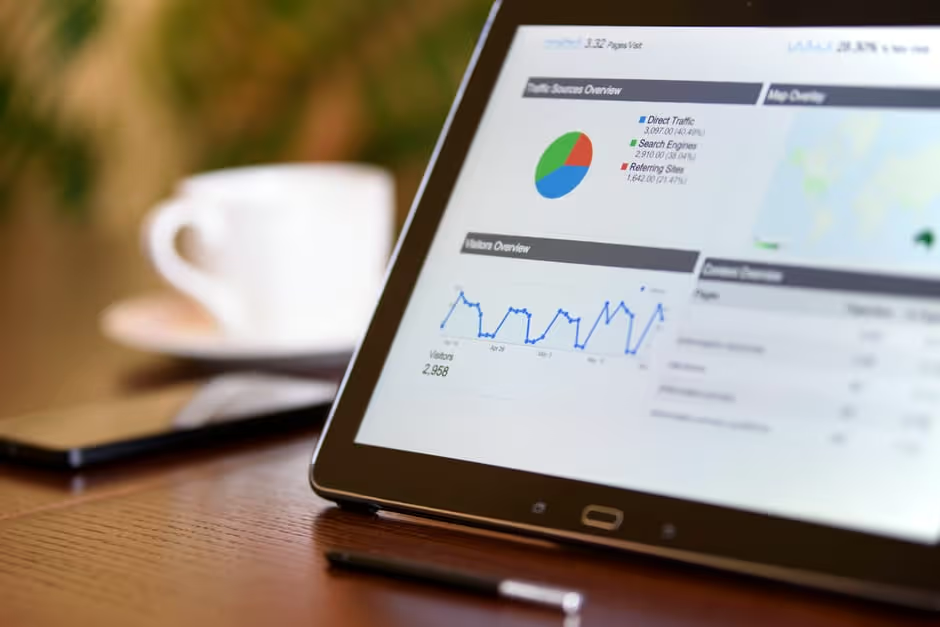

Why Your Ecommerce Conversion Strategy Is Leaking Revenue
Summary
- An ecommerce conversion strategy is a plan to increase the percentage of store visitors who complete a purchase, without necessarily increasing ad spend.
- Average ecommerce conversion rates in 2026 range from 1% to 4%, with top-performing stores reaching 6% or higher.
- The biggest conversion killers are slow page speed, checkout friction, forced account creation, and poor mobile experience.
- Continuous testing, trust-building, and data analysis are required to sustain revenue growth over time.
An ecommerce conversion strategy is the set of decisions you make to turn more of your existing traffic into paying customers. Most stores are already getting enough visitors to grow. The problem is that the majority of those visitors leave without buying anything.
The numbers are stark. The average online store converts somewhere between 1% and 4% of visitors. That means at minimum, 96 out of every 100 people who visit your store leave empty-handed. For a store doing $10 million in revenue, a single percentage point improvement adds $100,000 — without spending another dollar on ads.
Here are the core elements of an effective ecommerce conversion strategy:
- Optimized product pages — high-quality images, benefit-driven copy, and visible reviews
- Friction-free checkout — guest checkout, minimal form fields, and multiple payment options
- Fast, mobile-first design — pages that load in under 2.5 seconds and are easy to use on a phone
- Trust signals — security badges, clear return policies, and real customer reviews
- Continuous testing — A/B tests, heatmaps, and analytics to find and fix drop-off points
- Personalization — product recommendations and content tailored to user behavior
- Cart recovery — abandoned cart emails, exit-intent offers, and retargeting
The biggest leaks tend to happen at checkout. Around 70% of shoppers abandon their carts, and 18% of them do so specifically because the checkout process is too long or complicated. Another 23% to 26% leave when they're forced to create an account before buying.
These are fixable problems. And fixing them is exactly what a structured conversion strategy is designed to do.
I'm Steve Pogson, founder of First Pier and a certified Shopify Expert with over two decades of experience building and refining ecommerce conversion strategies for growing DTC brands. In this guide, I'll walk you through the specific areas where most stores lose revenue, and what to do about each one.
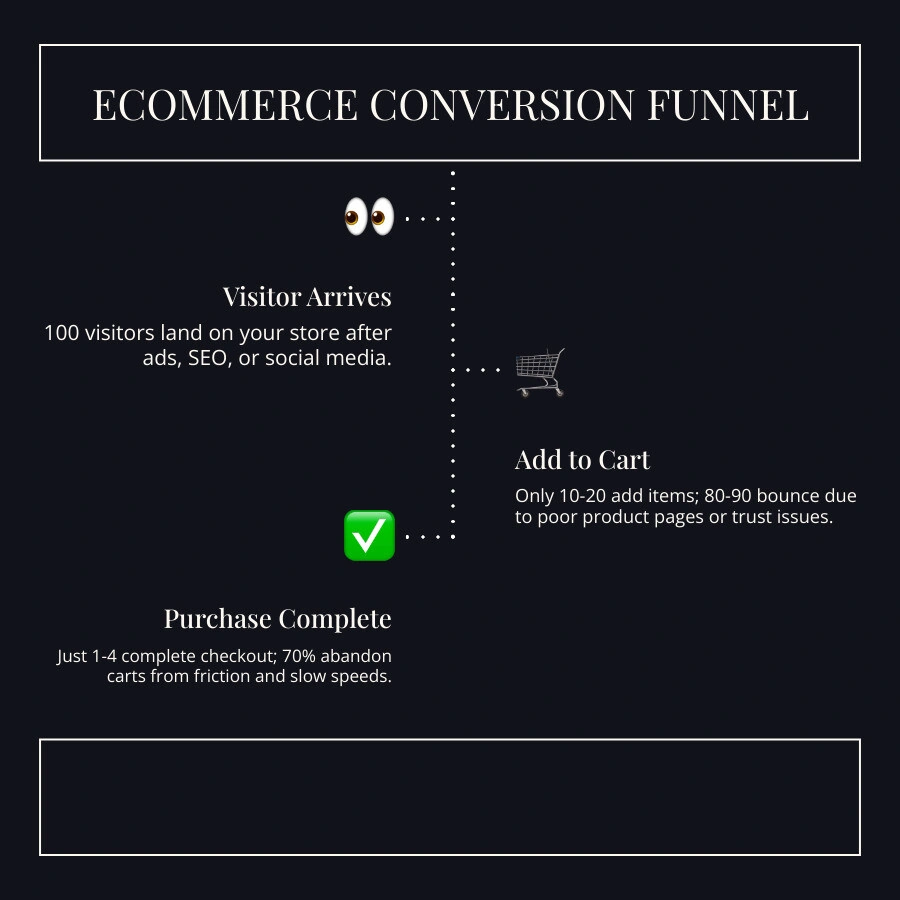
Ecommerce conversion strategy terms simplified:
Understanding Ecommerce Conversion Rate Optimization
Before you can fix your store, you have to know how to measure it. Conversion Rate is a simple formula: take your total number of orders, divide it by the total number of unique visitors, and multiply by 100. If you had 200 orders from 10,000 visitors, your rate is 2%.
In April 2026, the global average for E-Commerce Conversion Rates is roughly 3.3%. However, that number changes drastically depending on what you sell and how long you’ve been in business. New stores usually start between 1% and 2%. Service-based ecommerce sites often see rates closer to 9% because their workflows are simpler.
2026 Benchmarks by Industry
Benchmarks aren't goals; they are a compass to show you which way to go. If you sell luxury watches, a 1% rate might be fantastic. If you sell groceries, 1% is a disaster.
| Industry | Average Conversion Rate |
|---|---|
| Food & Beverage | 4.9% - 6.2% |
| Health & Beauty | 3.2% - 4.9% |
| Home & Garden | 2.7% |
| Fashion & Apparel | 2.5% |
| Electronics | 1.4% - 2.1% |
| Luxury & Jewelry | 0.9% - 1.2% |
I often tell my clients here at First Pier in Portland, ME, that the most important benchmark is your own historical performance. If you were at 1.5% last month and you're at 1.7% this month, your ecommerce conversion strategy is working.
Building a High-Performance Ecommerce Conversion Strategy
A great strategy isn't just a list of "hacks." It’s a systematic way to remove friction and build trust. When a visitor lands on your site, they are silently asking: Is this a real business? Can I trust them with my credit card? Will this product actually solve my problem?
If your site doesn't answer "yes" to all of those within three seconds, they leave. This is why Conversion Rate Optimization starts with trust signals.
Establishing User Trust
Trust is the foundation of any sale. According to research, 19% of shoppers abandon their purchase if they have security concerns. You can fix this by placing trust signals near your "Add to Cart" buttons and on your checkout pages. These include:
- Security badges (SSL certificates, Norton, McAfee)
- Payment processor logos (Visa, Mastercard, PayPal, Shop Pay)
- A clear, easy-to-find return policy
- Real contact information, including a phone number and physical address
Social proof is another heavy hitter. 74% of consumers check at least two review platforms before buying. If you don't have reviews on your product pages, you are practically sending your customers to a competitor's site to find them.

For a deeper dive into the technical side, check out this Ecommerce Conversion Rate Optimization: The Complete Guide for 2026.
Optimizing Product Pages for an Ecommerce Conversion Strategy
Your product page is where the decision happens. Many brands treat it like a digital filing cabinet, but it should be a high-pressure sales tool. To create a High-Converting Shopify Store, you need to focus on visual storytelling.
1. High-Quality Video and Images56% of users immediately look at product images. If your photos are blurry or only show one angle, you're losing sales. Use at least 5-8 images, including lifestyle shots that show the product in use. Adding a 15-second product video can increase conversions by 20% to 30%.
2. Benefit-Driven CopyDon't just list features. Tell the customer how the product makes their life better. Instead of saying "100% cotton," say "Breathable 100% cotton that stays cool on summer nights." This helps Increase Conversion on Shopify Store pages by connecting with the buyer’s emotions.
3. Visible Review RatingsDisplay star ratings directly under the product title. Products with 50 or more reviews convert 4.6 times better than those with none. Don't fear a 4-star review; shoppers actually find a 4.2 to 4.5 rating more authentic than a perfect 5.0.
Refining Checkout in Your Ecommerce Conversion Strategy
The checkout is where the most money is lost. 70% of visitors who make it this far still abandon their carts. My job at First Pier often involves stripping away everything that isn't a "Buy" button from this part of the funnel.
Guest Checkout is Non-Negotiable67% of sites fail to make guest checkout the most prominent option. Forcing a user to create an account is a massive hurdle. 24% of shoppers will leave your site immediately if they are forced to register. Always offer a guest option first.
Simplify Your FormsThe average checkout has 21 form fields. The best-in-class checkouts only have 8 to 12. Every extra field is a reason for someone to quit. Use address auto-complete tools to save them time. 47% of sites lack address validators, which leads to shipping errors and unhappy customers.
Payment Flexibility9% of shoppers abandon because their preferred payment method isn't there. In 2026, you need to offer more than just credit cards. Accelerated options like Shop Pay, Apple Pay, and Google Pay can increase mobile conversions by 20% to 35%. Buy Now, Pay Later (BNPL) services are also a major driver of sales for higher-priced items.
For more Shopify-specific tips, see our Shopify CRO service page or read the glossary entry for Conversion Rate Optimization (CRO).
Technical Performance and Mobile-First Design
You can have the best product in the world, but if your site takes five seconds to load, no one will see it. 53% of mobile users leave a page if it takes longer than three seconds to load.
The Need for Speed
Every one-second delay in page load time reduces conversions by 7%. To keep your ecommerce conversion strategy on track, aim for a load time of under 2.5 seconds. Use WebP formats for images, use lazy loading for off-screen content, and remove any third-party scripts you aren't using.
Mobile-First is the Only Way
63% of web traffic now comes from mobile devices. However, mobile conversion rates (around 1.8%) still lag behind desktop (around 3.9%). This "mobile gap" is usually caused by poor design.
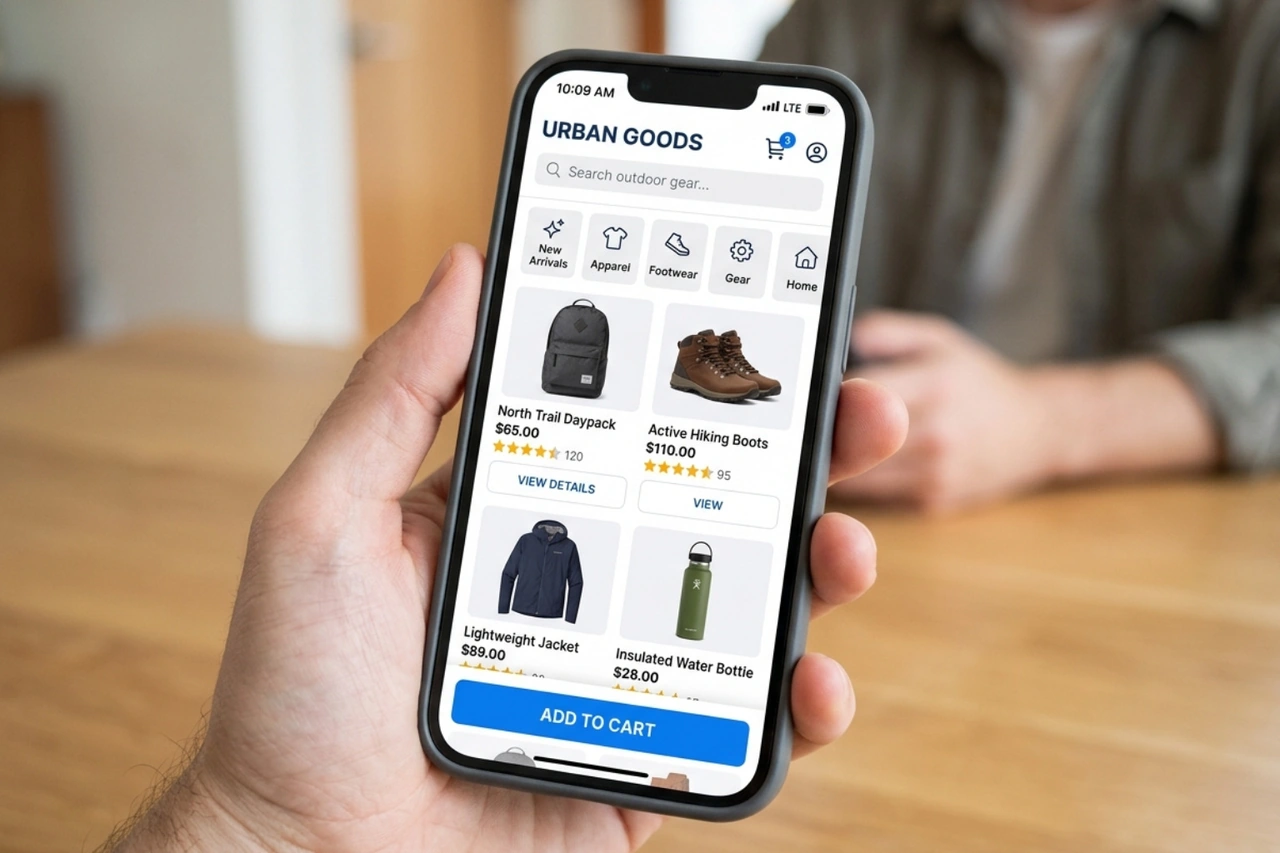
To fix this, use "thumb-friendly" navigation. Buttons should be at least 44x44 pixels so they are easy to tap. Use sticky "Add to Cart" buttons that stay at the bottom of the screen as the user scrolls. If you want to see how we handle this for our clients, look at our Conversion Rate Optimization for Shopify: Complete Guide and our page on Shopify Store Conversion Rate Optimization.
Using Data to Iterate and Test
CRO is not a "one and done" project. It is a cycle. I tell my team that "CRO without testing is just guessing." You need to use real data to decide what to change.
1. A/B TestingThis is where you show two versions of a page to different groups of visitors to see which performs better. Use the ICE framework to prioritize:
- Impact: How much will this change increase revenue?
- Confidence: How sure am I that this will work?
- Ease: How hard is it to build?
2. Heatmaps and Session RecordingsTools like Hotjar or Microsoft Clarity show you exactly where people click and where they get stuck. If you see people clicking on an image that isn't a link, you know you need to make it one.
3. GA4 AnalyticsTrack your Conversion Funnel to see where the biggest leaks are. Is it the homepage to the product page? Or the cart to the checkout? Fix the biggest leaks first.
For professional help with these tools, you can explore our Shopify Store Conversion Rate Optimization Services or read the Conversion Rate Optimization Ecommerce Guide 2026 | Build Grow Scale.
Frequently Asked Questions about Ecommerce Conversions
What is a good conversion rate for an online store?
As I mentioned earlier, the global average is about 3.3% in 2026. However, "good" is relative. If you are a new store, 1% to 2% is a healthy start. If you are an established brand with high-quality traffic from email or organic search, you should aim for 4% to 6%. If you're looking for an expert eye to review your numbers, a Conversion Rate Optimization Agency can help you set realistic goals.
How does site speed affect sales?
Site speed is a direct revenue driver. A 1-second delay can drop your conversions by 7%. Slow sites also have higher bounce rates, meaning people leave before the page even finishes loading. We saw this in our Case Study: Conversion Rate Optimization for Outdoor Gear Brand, where improving load times led to a significant sales jump.
Why do shoppers abandon their carts?
The top reasons are:
- Hidden costs: Shipping, taxes, or fees that only appear at the very end.
- Forced registration: Making someone create an account before they buy.
- Complexity: Too many steps or form fields in the checkout process.
- Lack of payment options: Not offering Apple Pay, PayPal, or BNPL.
Conclusion
Building a better ecommerce conversion strategy isn't about finding a magic button. It’s about doing a dozen small things correctly. It’s about making your site faster, your checkout simpler, and your brand more trustworthy.
Start by auditing your site. Set SMART goals (Specific, Measurable, Achievable, Relevant, Time-bound). Don't try to fix everything at once. Pick your biggest leak — usually the checkout or mobile speed — and start there.
If you’re ready to stop the leaks and start growing, we’re here to help. At First Pier in Portland, Maine, we specialize in turning Shopify stores into high-performance sales engines. More info about our services is just a click away. Let's build something great together.





.png)
.png)

