




What Your Website Traffic Is Really Costing You

Summary
- A conversion rate optimization agency uses data analysis and user research to increase the percentage of website visitors who complete a specific action.
- Professional agencies typically achieve higher test win rates than in-house teams by using specialized tools and cross-industry experience.
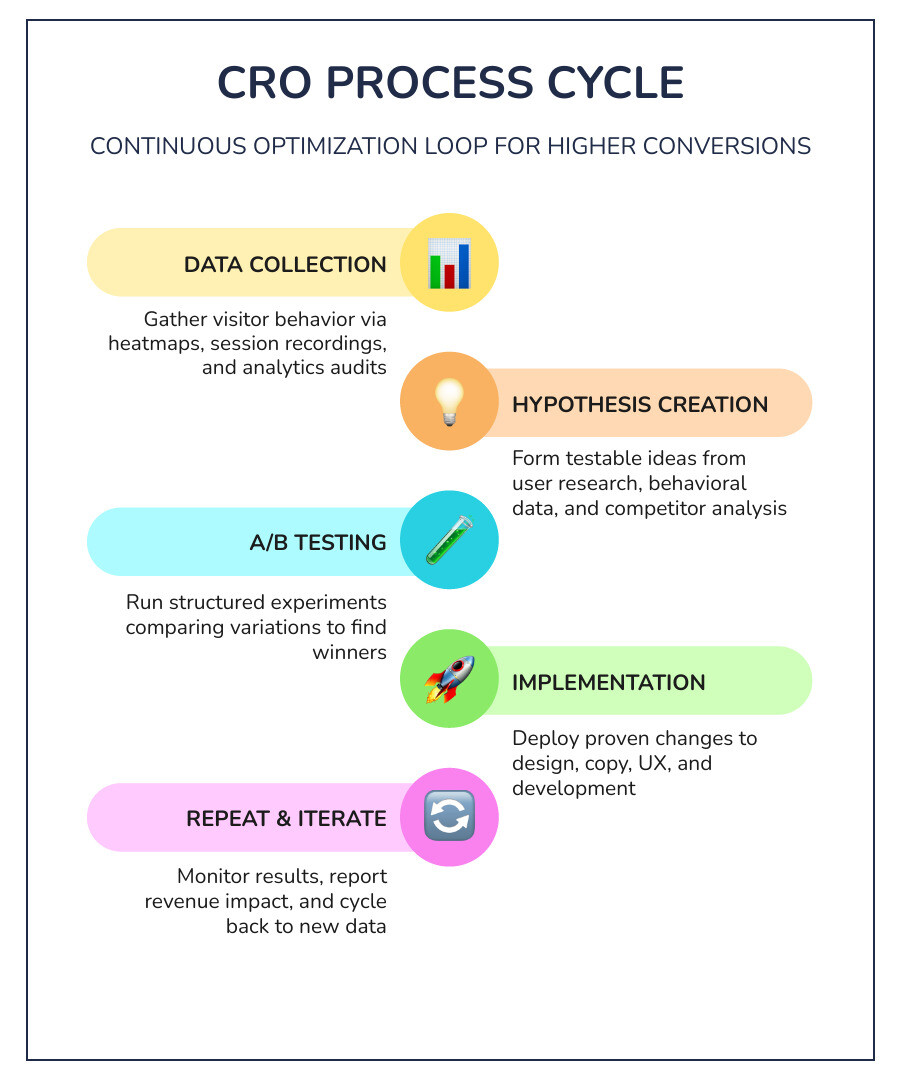
- The optimization process involves a continuous cycle of data collection, hypothesis creation, A/B testing, and implementation.
- Businesses generally need a minimum of 1,000 unique monthly visitors to produce statistically significant results from testing.
A conversion rate optimization agency is a specialized firm that uses data, user research, and structured testing to turn more of your existing website visitors into buyers, leads, or subscribers — without spending more on traffic.
If you're driving solid traffic to your Shopify store but revenue isn't keeping pace, the problem is almost never the traffic itself. It's what happens after visitors land.
Here's a quick breakdown of what a CRO agency actually does:
| What They Do | How They Do It |
|---|---|
| Diagnose conversion problems | Heatmaps, session recordings, analytics audits |
| Form testable hypotheses | User research, behavioral data, competitor analysis |
| Form structured experiments | A/B testing, multivariate testing, personalization |
| Implement winning changes | Design, copy, UX, and development updates |
| Report and iterate | Ongoing reporting tied to revenue metrics |
The difference between a CRO agency and a general digital marketing firm comes down to depth. Most marketing agencies treat conversion as a side task. A dedicated CRO agency treats it as the entire job — backed by statistical rigor and a repeatable process built from hundreds or thousands of real experiments across industries.
Think of it this way: your ad budget buys the visit. A CRO agency makes the visit count.
Working with a conversion rate optimization agency approach is something I've applied directly to leading brands, and the results consistently come down to one thing: treating your website as a living system, not a finished product.
What is a Conversion Rate Optimization Agency?
When I talk to store owners in Portland, Maine, they often think of website updates as a matter of personal taste. "I don't like that blue," or "Let's move this button." A conversion rate optimization agency moves the conversation away from "I think" and toward "The data shows."
Defining the Role of a CRO Partner
Think of a CRO agency as a team of data-driven detectives. They perform what I call a "digital autopsy" on your website to find out exactly where and why your potential customers are dropping off. Instead of guessing, they use e-commerce conversion optimization techniques to look at visitor behavior.
They examine the entire conversion funnel—from the moment someone clicks an ad to the "Thank You" page. By analyzing user intent, they identify the friction points that cause people to leave their carts or abandon a form. Their job is to ensure that every dollar you spend on marketing results in the highest possible return.
Why a Conversion Rate Optimization Agency is Different from General Marketing Firms
A general digital marketing agency is usually focused on the "top of the funnel"—getting people to the site through SEO or PPC. While that’s important, it’s only half the battle.
A conversion rate optimization agency focuses on the "middle and bottom" of the funnel. They bring a level of specialized expertise that most general firms lack. This includes:
- Testing Velocity: They have the infrastructure to run multiple tests simultaneously without breaking your site.
- Statistical Rigor: They don't just look at a small bump in sales; they use math to ensure a "win" isn't just a random fluke.
- Revenue Focus: While an SEO firm might celebrate a boost in rankings, a CRO agency only celebrates when your revenue increases.
The Step-by-Step Process of Professional Optimization
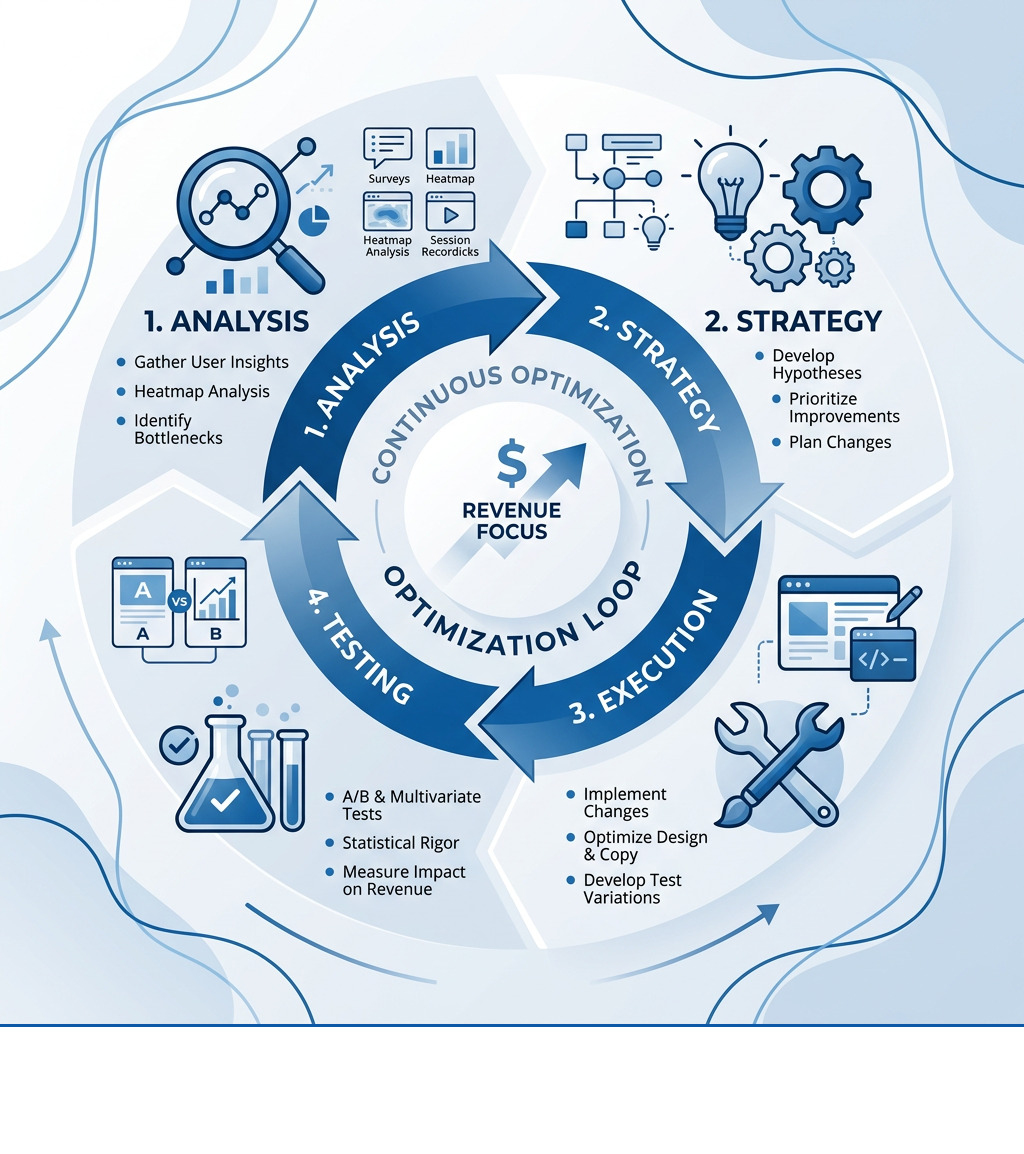
Optimization isn't a one-time project; it’s a continuous loop. Here at First Pier, we see it as a four-stage cycle that never truly ends because there is always room to improve.
Core Services Provided by a Conversion Rate Optimization Agency
The process begins with deep research. You can't fix what you don't understand. Agencies use a variety of tools to gather insights, including Google Analytics for quantitative data, as well as:
- User Research: Surveys, interviews, and persona mapping to understand the "why" behind customer actions.
- Heatmap Analysis: Visualizing where people click, move their mouse, and how far they scroll.
- Session Recordings: Watching anonymous videos of real users navigating your site to find bugs or confusing layouts.
For those on specific platforms, Shopify conversion services often involve looking at checkout flow and app integrations that might be slowing down the user experience.
From Data Analysis to Implementation
Once the data is in, the agency creates a hypothesis. This is an educated bet: "If we change X, then Y will happen because of Z."
Next comes the testing:
- A/B Testing: Comparing two versions of a page (A and B) to see which performs better.
- Multivariate Testing: Testing multiple variables on a single page simultaneously to find the best combination of headlines, images, and buttons.
- Personalization: Showing different content to different users based on their location, device, or past behavior.
After a test reaches statistical significance, the winning variations are implemented permanently. Then, the agency looks for the next bottleneck and starts the cycle over again.
Agency Expertise vs. In-House Teams
Many businesses consider building an in-house CRO team. While it sounds good in theory, the reality is often different.
Avoiding Tunnel Vision
Internal teams often suffer from "tunnel vision." When you look at the same website every day, you become blind to its flaws. An external conversion rate optimization agency provides an objective perspective. They bring cross-industry knowledge—what worked for a SaaS company might be the perfect solution for your boutique e-commerce store.
Furthermore, agencies have access to expensive, high-end tools that may be cost-prohibitive for a single brand to license. If you're looking for a guide to increasing e-commerce conversion rates, you'll find that the most successful brands often rely on outside experts to challenge their internal assumptions.
The Economics of Outsourcing
Building an in-house team is expensive. You need a data analyst, a UX designer, a copywriter, and a developer. By the time you factor in hiring costs, training overhead, and software licenses, the price tag is significant.
An agency offers immediate access to a full ecosystem of specialists for a fraction of the cost of four full-time salaries. This leads to faster testing speed and, ultimately, a more immediate ROI.
| Feature | In-House Team | CRO Agency |
|---|---|---|
| Win Rate | 1 in 8 tests | 1 in 2 tests |
| Setup Time | Months to hire/train | Immediate |
| Perspective | Internal bias | Objective/Cross-industry |
| Tool Access | Limited by budget | Enterprise-grade included |
Costs, Results, and Performance Guarantees
I often get asked what kind of results are realistic. While every site is different, the data from top agencies shows consistent trends.
Understanding Pricing Models
CRO agencies typically work on one of three models:
- Monthly Retainers: A fixed fee for ongoing testing and optimization.
- Project Fees: A one-time cost for a specific audit or landing page redesign.
- Performance-Based Pricing: A model where the agency only gets paid if they deliver a specific lift in conversions.
For Shopify owners, choosing the right Shopify CRO partner often involves finding a model that aligns the agency's incentives with your store's growth.
Realistic Expectations and Guarantees
Some agencies are so confident in their "prediction engines"—databases of thousands of previous tests—that they guarantee results. For example, some firms promise a 38% lift within 90 days or you don't pay.
However, these guarantees always come with "traffic requirements." To get statistically significant results in a 90-day sprint, you generally need a 1,000-visitor-minimum per month. If your traffic is lower, the math simply doesn't work; it takes too long to gather enough data to prove a change actually worked.
How to Choose the Best Partner for Your Store
Choosing a conversion rate optimization agency is a big decision. You are giving them access to your data and your customer experience.
Key Criteria for Selection
- Case Studies: Look for real-world examples in your industry. Don't just look at "percentage lifts"—look for revenue growth.
- Transparency: They should be willing to show you their "homework." How did they reach a conclusion? What data did they use?
- Reporting Frequency: You should receive regular updates that explain not just what was tested, but what was learned. Even a "losing" test provides valuable data about your customers.
Red Flags to Watch For
Be wary of "guaranteed results traps." If an agency promises a 50% increase before they’ve even looked at your Google Analytics, run away. Real CRO is based on data, not magic. Also, watch out for a lack of technical depth. If they can't explain how they handle conversion optimization on Shopify, they might not be the right fit for your tech stack.
Integrating CRO with Your Marketing Channels
CRO doesn't live in a vacuum. It is the "supercharger" for every other marketing activity you do.
How a Conversion Rate Optimization Agency Works with SEO and PPC
If you spend $10,000 a month on Google Ads and your conversion rate is 2%, you’re getting a certain number of sales. If a CRO agency helps you bump that to 3%, your ad spend suddenly becomes much more efficient. You’re getting 50% more sales for the exact same ad spend.
This alignment between traffic quality and landing page experience is vital. A good CRO for Shopify strategy ensures that the promise made in an ad is fulfilled the moment the user lands on the site.
Long-Term Strategy and Maintenance
The digital world moves fast. Customer behavior changes, new devices come out, and your competitors will eventually copy your best ideas. This is why we recommend quarterly reviews and iterative testing. Optimization isn't about finding one "silver bullet"; it's about making hundreds of small, data-backed improvements that compound over time to increase customer retention and lifetime value.
Frequently Asked Questions about CRO Agencies
Do I need a minimum amount of traffic to start?
Yes. Most agencies recommend at least 1,000 unique visitors per month. Without this, A/B tests can take months to reach a "statistically significant" conclusion, which slows down your progress and delays your ROI.
How long does it take to see results?
While simple "low-hanging fruit" changes (like fixing a broken button or clarifying a headline) can show immediate impact, a comprehensive program usually takes about 12 weeks to produce its first round of validated, high-impact data.
Can an agency guarantee a specific conversion lift?
Some do, but be careful. A guarantee is usually a marketing tool. The best agencies focus on the integrity of the process. If the process is sound and the data is used correctly, the lift will follow naturally.
To Sum Up
Stop letting your hard-earned traffic go to waste. Every visitor who leaves your site without buying is a missed opportunity and, essentially, cash leaking out of your business.
Whether you are looking for e-commerce UX design or a full-scale testing program, the goal is the same: make your website work harder for you. Here at First Pier, we believe that the best way to grow is to stop guessing and start testing.




.png)
.png)

