



Why Ecommerce Operations & Shipping Determines Whether Your Store Grows or Stalls
Summary
- Ecommerce Operations & Shipping covers every process that moves an order from purchase to delivery, including fulfillment, carrier selection, packaging, tracking, and returns.
- Last-mile delivery accounts for more than 40% of total supply chain costs, making shipping one of the biggest cost drivers in ecommerce.
- 85% of consumers will not reorder from a retailer after a poor delivery experience.
- 62% of shoppers expect free delivery in under 3 business days.
- Businesses can improve shipping performance through automation, multi-carrier strategies, inventory distribution, and clear tracking communication.
Ecommerce Operations & Shipping is the backbone of every online store — and for most growing brands, it's where the gap between a good customer experience and a lost customer is decided.
Here's a quick look at what this topic covers:
| Area | What it includes |
|---|---|
| Order fulfillment | Receiving, picking, packing, labeling |
| Shipping strategy | Carrier selection, rates, zones, methods |
| Cost management | DIM weight, packaging, free shipping thresholds |
| Customer experience | Tracking, notifications, returns |
| Scaling | Automation, 3PLs, inventory distribution |
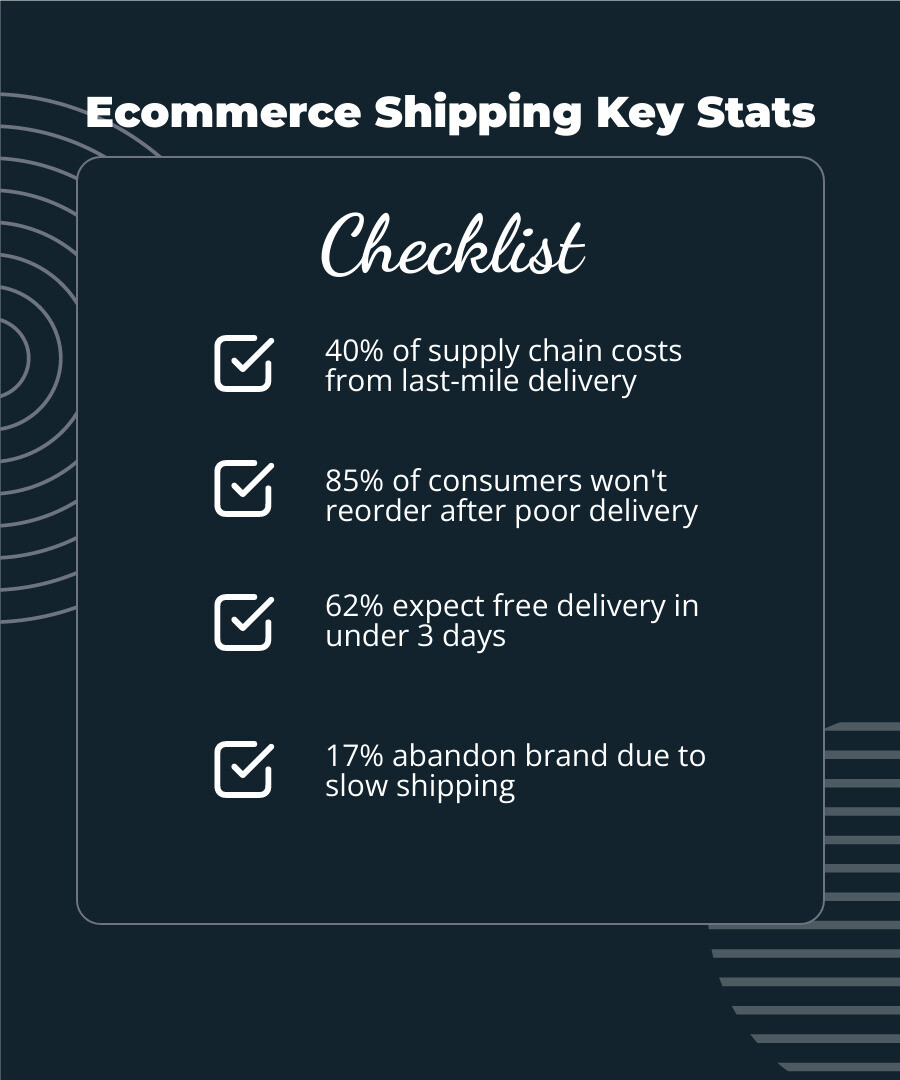
The numbers are hard to ignore. More than 40% of total supply chain costs come from last-mile delivery alone. And 85% of consumers say they won't reorder from a retailer after a poor delivery experience. One bad shipment can erase months of marketing effort.
At the same time, 62% of shoppers expect free delivery in under 3 business days. That's a real operational pressure — not just a preference.
For Shopify brands that are already generating consistent revenue, shipping isn't a back-office detail. It's a direct input to your margin, your repeat purchase rate, and your brand reputation. Getting it right means building systems, not just picking a carrier.
This guide walks through the full picture — from the core stages of the shipping process to cost strategies, resilient delivery operations, and the tools that tie it all together.
I'm Steve Pogson, founder of First Pier and a Shopify Expert with over two decades of experience helping growing brands build high-performance ecommerce operations. I've worked hands-on with Ecommerce Operations & Shipping challenges across many Shopify stores, and this guide reflects what actually works in practice. Let's get into it.
Defining Ecommerce Operations & Shipping
When I talk to brand owners about Ecommerce Shipping Operations, they often think solely about the brown box leaving the building. In reality, Ecommerce Operations & Shipping starts the moment a customer clicks "buy" and doesn't end until the product is in their hands—and sometimes not until a return is processed.
It is a complex choreography of shipping operations that includes order receiving, processing, picking, packing, and the final handoff to a carrier for last-mile delivery. This entire lifecycle is what determines your efficiency and, ultimately, your customer retention.
The Impact of Delivery on Brand Loyalty
The stakes for your delivery experience are incredibly high in April 2026. Research shows that 17% of consumers will stop buying from a brand they love after just one bad delivery experience. Even more concerning, 85% of online shoppers hesitate to reorder after a poor delivery.
Shipping isn't just a cost center; it's a marketing tool. When you get Shopify and shipping right, you turn a logistical necessity into a competitive advantage. If a customer receives their order faster than expected and in perfect condition, they are far more likely to become a repeat buyer. If the package arrives late, damaged, or with no tracking updates, you’ve likely lost that customer for good.
Shipping vs. Fulfillment
It's helpful to distinguish between these two terms, as they are often used interchangeably but mean different things in a professional ecommerce shipping guide.
- Fulfillment is the "inside the four walls" work. it involves receiving inventory, storing it, picking items from shelves, and packing them into boxes.
- Shipping is the "outside the walls" work. It focuses on the carrier transit, choosing the right service level (Ground vs. Air), and the actual movement of the parcel to the customer's doorstep.
Understanding this difference helps you identify where your bottlenecks are. Are you slow at getting boxes out the door (fulfillment), or are your carriers taking too long to deliver them (shipping)?
The Core Stages of the Shipping Process
To run a tight ship, you need to view your workflow as a series of repeatable steps. Every friction point in these stages adds cost and time.
- Order Receiving: The order flows from Shopify into your fulfillment system.
- Picking: A team member (or robot) finds the items in the warehouse.
- Packing: Items are placed in the right-sized packaging with necessary dunnage.
- Labeling: The shipping label is generated and applied.
Mastering how to fulfill orders on Shopify requires a solid grasp of inventory management. If your digital inventory doesn't match your physical shelves, you'll end up with "out of stock" emails that kill customer trust.

Automating Ecommerce Operations & Shipping Workflows
Manual data entry is the enemy of growth. If you are still copy-pasting addresses or manually choosing carriers for every package, you are inviting human error. Here at First Pier, I always recommend that brands learn how to automate order fulfillment on Shopify.
Automation can handle:
- Rate Shopping: Automatically choosing the cheapest carrier that meets your delivery promise.
- Label Printing: Batch printing hundreds of labels in seconds.
- Order Routing: Sending the order to the warehouse closest to the customer.
Automation acts as an insurance policy against downtime and helps you handle seasonal surges without needing to 10x your staff.
Inventory and Warehouse Management
Efficiency in shipping starts with how you organize your space. Warehouse slotting—placing high-velocity SKUs closer to packing stations—can reduce picking time by up to 40%.
You also need visibility across all your sales channels. Whether you are selling on your site or need to sync Shopify and Etsy inventory, having a Shopify multi-channel inventory setup ensures you never oversell. Maintaining safety stock—extra inventory for emergencies—is critical to avoid stockouts during peak periods.
Strategies for Managing Ecommerce Operations & Shipping Costs
Shipping costs can eat your margins alive if you don't have a strategy. You have to balance what the customer wants (fast and free) with what your business can afford.
Choosing Your Pricing Model
| Strategy | Pros | Cons |
|---|---|---|
| Free Shipping | Highest conversion; 79% of shoppers prefer it. | Absorbs all costs; can hurt margins. |
| Flat-Rate | Predictable for customers; easy to set up. | May overcharge for small items or undercharge for heavy ones. |
| Real-Time Rates | Business never loses money on the label. | High shipping costs at checkout cause cart abandonment. |
Many successful brands use a hybrid approach, such as setting up free shipping on Shopify for orders over a specific dollar amount. This helps increase your Average Order Value (AOV) while covering the Shopify shipping costs.
Keep an eye on DIM weight (Dimensional Weight). Carriers charge based on the size of the box, not just the weight. If you ship a small item in a large box, you are paying for air. Right-sizing your packaging is one of the fastest ways to cut costs.
International Shipping and Customs Compliance
Selling globally is a huge growth opportunity, but it adds layers of complexity. You need to understand how to set up international shipping on Shopify, including handling duties, taxes, and HS codes (Harmonized System codes).
If you use Google Merchant Center shipping settings correctly, you can show international customers the total landed cost—including duties—so they aren't surprised by a bill upon delivery. This transparency is key to reducing refused packages at customs.
Packaging and Insurance Strategies
Your packaging is the only physical touchpoint you have with your customer. While branded boxes look great, they can be expensive. Many brands now use eco-friendly materials like compostable poly mailers to meet consumer demand for sustainability.
I also recommend looking into Shopify advanced shipping rules to manage when and how you offer insurance. For high-value items, insurance is a must. Most carriers only cover up to $100 by default. Third-party insurance is often cheaper and offers faster claim reimbursements if a package goes missing.
Best Practices for Resilient Delivery Operations
A resilient operation is one that doesn't break when a carrier has a strike, a storm hits the coast, or your volume triples overnight.
Multi-Carrier Diversification
Relying on a single carrier is a recipe for trouble. If that carrier has a delay, your entire business stops. By using a multi-carrier strategy, you can switch between USPS, UPS, and FedEx based on performance and price. Some brands have seen a 20% jump in conversion just by adding more pickup and drop-off options at checkout.
3PL Partnerships and Inventory Distribution
As you grow, you might outgrow your own basement or small warehouse. This is where a Shopify 3PL (Third-Party Logistics) partner comes in. They handle the storage and shipping for you, often at lower rates because they aggregate volume from many clients.
Strategic ecommerce supply chain management often involves distributing inventory across multiple warehouses. If you store product in both Maine and California, you can reach the entire US in 2 days via ground shipping, which is much cheaper than air.
Measuring Ecommerce Operations & Shipping Performance
You can't improve what you don't measure. Use a shipping guide framework to track these Key Performance Indicators (KPIs):
- On-time delivery rate: Are carriers meeting their promises?
- Shipping cost per order: Is this increasing or decreasing over time?
- Damage/Loss rate: Is your packaging protecting the product?
- Return rate: Are people returning items because they arrived too late?
Communicating Shipment Status
The period between the "Order Confirmed" and "Delivered" emails is a high-anxiety time for customers. Proactive Shopify shipping notifications can reduce "Where Is My Order" (WISMO) calls by up to 50%.
Send a Shopify out for delivery notification so the customer knows to look for their package. This transparency builds trust and saves your customer service team hours of manual work.
Frequently Asked Questions
Should I use in-house shipping or a 3PL?
This depends on your volume and your need for control.
- In-house: Best for brands that have highly custom packaging requirements or very low volume. It gives you total control but is hard to scale and requires managing labor.
- 3PL: Best for brands doing more than 100-200 orders a month. It allows you to focus on marketing while experts handle the boxes. You can use the Shopify Fulfillment Network to get started, but be sure to review Shopify Fulfillment Network pricing to ensure it fits your margins.
What are common shipping mistakes to avoid?
One of the biggest mistakes is poor inventory visibility. I've seen this in a case study for a sporting goods retailer, where a lack of integration led to overselling and frustrated customers. Other common errors include mislabeling packages and relying on a single carrier without a backup plan.
How are emerging technologies changing shipping?
We are seeing a massive shift toward data-driven logistics.
- Predictive Analytics: AI can now forecast demand to tell you exactly how much stock to send to which warehouse before the orders even come in.
- Smart Packaging: IoT sensors can monitor the temperature and humidity of sensitive goods in real-time.
- Autonomous Delivery: While still in early stages in some areas, drone and robot delivery are becoming more common for short-distance "last-mile" trips in urban centers.
To Sum Up
Ecommerce Operations & Shipping is far more than a "back-office" task. It is a core pillar of your brand's growth and profitability. From the way you organize your warehouse to the automated notifications you send your customers, every detail matters.
Here at First Pier, based in Portland, Maine, we specialize in helping Shopify brands navigate these complexities. Whether you need help with custom Shopify development or want to find more info about integration operations, we are here to help you build a resilient, scalable business. Shipping doesn't have to be a headache—with the right systems, it can be your biggest advantage.





.png)
.png)

