




Why Blended Metrics Fail in Measuring True ROAS Ecommerce
Summary
- Platform-reported ROAS often overstates performance due to attribution overlap and view-through conversions.
- True ROAS isolates new customer acquisition cost from returning customer revenue to show actual marketing efficiency.
- Accurate measurement requires centralizing first-party data, accounting for gross margins, and running holdout tests.
- Transitioning to a profit-first tracking model prevents overspending on unprofitable ad campaigns.
Measuring true ROAS in ecommerce is one of the most important — and most misunderstood — disciplines in paid media management. If you've ever looked at a 4x ROAS in Meta Ads Manager and then opened your Shopify dashboard to find the numbers simply don't add up, you're not alone. That gap isn't a glitch. It's a fundamental flaw in how platforms report performance.
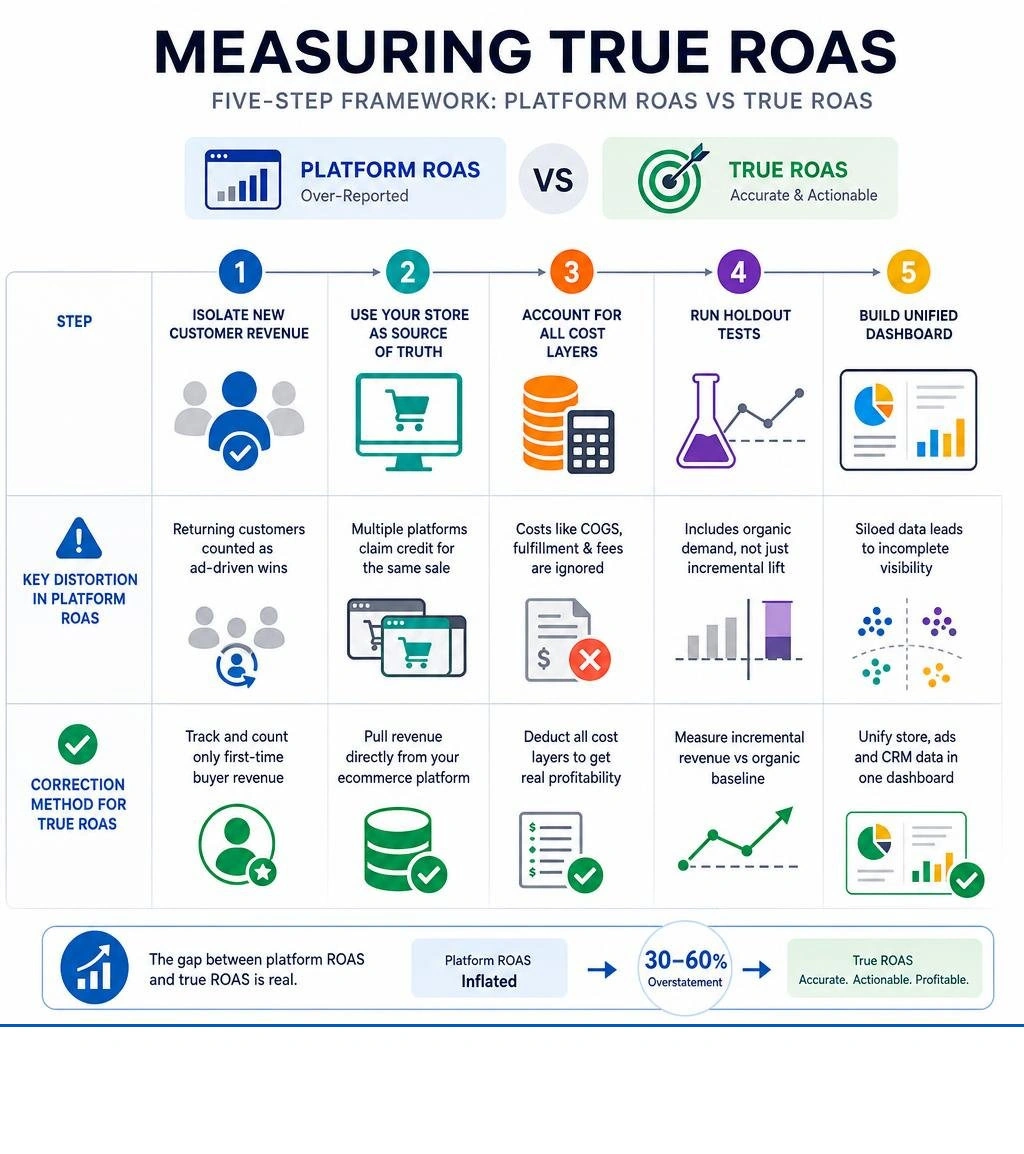
Here's what true ROAS measurement involves, at a glance:
- Isolate new customer revenue - separate first-time buyer revenue from returning customer revenue before dividing by ad spend
- Use your ecommerce platform as the revenue source of truth - not ad platform dashboards
- Account for all cost layers - including COGS, fulfillment, and transaction fees
- Run holdout tests - to measure incremental revenue lift versus organic baseline demand
- Build a unified dashboard - that pulls from your store, ad platforms, and CRM into one view
Platform-reported ROAS inflates performance in several ways: multiple platforms claim credit for the same sale, returning customers get counted as ad-driven wins, and post-iOS 14.5, Meta now statistically models roughly 70% of conversions rather than directly measuring them. The result is that the sum of what your ad platforms report typically exceeds actual store revenue by 30–60%.
Here at First Pier, we see this gap constantly. A brand spending $50,000 per month with a reported 4x blended ROAS might assume it's generating $200,000 in ad-driven revenue. But once you strip out returning customers and account for attribution overlap, the real new customer ROAS can be closer to 1.6x to 2.4x — a number that changes every budget decision on the table.
This guide walks through the exact five steps to calculate and track true ROAS, with real formulas, channel benchmarks, and the data architecture you need to make it operational.
Measuring true roas ecommerce word roundup:
To understand why traditional reporting fails, you must distinguish between blended ROAS and true ROAS. Blended ROAS (often referred to as the Marketing Efficiency Ratio, or MER) divides your total store revenue by your total ad spend. While blended ROAS is a useful metric for high-level health checks, relying on it to make tactical scaling decisions is dangerous.
Blended metrics treat every dollar of revenue as equal. In reality, a significant portion of your sales comes from baseline demand—customers who would have bought from your store anyway through organic search, direct traffic, or word-of-mouth. When you scale ad spend based on blended metrics, you risk overfunding campaigns that are simply intercepting existing demand rather than creating new customers. This distinction is vital for tracking your core Ecommerce KPIs and making accurate budget decisions.
Why Platform Attribution Fails at Measuring True ROAS Ecommerce
Ad platforms operate as self-attributing networks. This means Meta, Google, and TikTok each grade their own homework. If a user clicks a Google Shopping ad, browses your store, leaves, and then purchases after seeing a Meta retargeting ad later that evening, both platforms will claim 100% credit for that sale.
This credit duplication is rampant. Across multi-platform campaigns, attribution overlap can cause platform-reported revenue to exceed actual store revenue by 30% to 60%. Furthermore, platforms heavily rely on view-through conversions—crediting a sale to an ad that was merely loaded on a screen, even if the user never clicked or noticed it.
These challenges are compounded by structural tracking limitations. Following the privacy updates of iOS 14.5 and Apple's App Tracking Transparency framework, Meta lost roughly 30% to 40% of its direct tracking capability. To compensate, ad platforms rely on statistical modeling to infer conversions. This means up to 70% of your reported Meta conversions in June 2026 are modeled mathematically rather than tracked directly, leading to performance overstatements of 20% to 40%. Understanding how these platforms distribute credit is covered in depth in our guide to Ecommerce Attribution Models Explained.
The Financial Gap Between Blended and New Customer Metrics
The performance gap between blended ROAS and new customer ROAS is typically 40% to 60%. For example, a store with a healthy 4x blended ROAS is often operating at a 1.6x to 2.4x new customer ROAS.
If you do not separate these metrics, returning customers will inflate your reporting. Returning customers have a much higher conversion rate and average order value, but they require significantly less ad spend to convert. When ad platforms target your past purchasers with retargeting ads, they show stellar ROAS figures. However, they are often cannibalizing organic repeat purchases and masking unprofitable prospecting campaigns.
To protect your margins, you must track your Top Ten Shopify KPIs by separating acquisition marketing from retention marketing.
The 5-Step Framework to Calculate and Track True ROAS
Transitioning away from platform-reported vanity metrics requires a structured measurement framework. Here at First Pier, we use this five-step framework to establish an accurate, profit-focused workflow for our clients.
Step 1: Isolate New Customer Revenue from Returning Customer Revenue
The first step in calculating true ROAS is to segment your sales data by customer history. You cannot rely on ad platforms to perform this segmentation; you must pull this data directly from your ecommerce platform.
To calculate your New Customer ROAS (NC-ROAS), apply this formula:
$$\text{NC-ROAS} = \frac{\text{New Customer Revenue}}{\text{Total Ad Spend}}$$
For example, if your store generated $150,000 in total revenue last month, with $90,000 coming from first-time buyers and $60,000 from returning customers, and your total ad spend across all channels was $50,000:
$$\text{NC-ROAS} = \frac{\$90,000}{\$50,000} = 1.8\text{x}$$
While your blended ROAS appears to be 3.0x ($150,000 / $50,000), your true acquisition efficiency is 1.8x. To implement this split, tag your orders at the database level as "New" or "Returning" using your customer CRM history, and pass this data into your reporting tools. Using First Party Data Shopify integrations ensures you are working with clean, un-duplicated customer records.
Step 2: Centralize First-Party Data and Server-Side Tracking
Browser-based cookies are no longer sufficient for tracking complex customer journeys. Privacy extensions, ad blockers, and mobile operating system restrictions routinely block client-side pixels. To capture accurate conversion data, you must implement server-side tracking.
By setting up server-to-server connections, such as Meta’s Conversions API (CAPI) and Google’s Enhanced Conversions, your ecommerce platform sends transaction data directly to the ad networks from your server. This bypasses browser blocks and ensures every transaction is recorded with a unique Event ID, allowing the ad platforms to deduplicate client-side and server-side events accurately.
Once your server-side tracking is active, compile your raw transaction data into a centralized location rather than checking individual channel dashboards. You can learn more about configuring these pipelines in our breakdown of Shopify Analytics Reports.
Step 3: Account for Hidden Cost Layers and Gross Margin
Standard ROAS calculations only look at revenue, ignoring the costs required to produce and deliver your products. To measure true profitability, you must calculate your Contribution Margin 3 (GM3 or CM3). This metric subtracts all variable costs from your revenue to show what your ads actually earned.
Your cost calculation should include:
- Cost of Goods Sold (COGS): The raw manufacturing cost of the products sold.
- Fulfillment Costs: Shipping fees, packaging materials, and warehouse labor (typically ranging from $8 to $18 per order).
- Transaction Fees: Payment gateway fees (averaging 2.9% + $0.30 per transaction).
- Returns and Refunds: Deducting returned items (especially critical for apparel brands, which experience 20% to 35% return rates).
To calculate your True Profit-Adjusted ROAS, apply the following framework:
$$\text{True Profit ROAS} = \frac{(\text{Attributed Revenue} - \text{Returns}) \times \text{Gross Margin \%}}{\text{Total Ad Spend} + \text{Variable Fees}}$$
By factoring in these hidden layers, you prevent the common error of scaling a campaign that shows a positive platform ROAS but actually loses money on every order. For more details on budgeting for these underlying expenses, refer to our guide on Marketing Campaign Cost.
Step 4: Run Holdout Tests to Measure Incremental ROAS
How do you know if an ad actually caused a sale, or if the customer would have purchased anyway? The only way to answer this is through incrementality testing.

A holdout test works by splitting your target audience into two groups:
- Treatment Group (80–90%): Exposed to your active advertising campaigns.
- Control Group (10–20%): Withheld from seeing your ads entirely.
By comparing the conversion rate of the treatment group against the control group over a 4-week period, you can isolate your Incremental ROAS (iROAS):
$$\text{iROAS} = \frac{\text{Revenue from Treatment Group} - \text{Revenue from Control Group}}{\text{Ad Spend}}$$
For example, if your treatment group generates $100,000 in revenue with $30,000 in ad spend, and your control group (who saw no ads) still generates $40,000 in baseline organic sales, your incremental revenue is $60,000. Your true incremental ROAS is 2.0x ($60,000 / $30,000), even though your platform dashboard might claim a 3.3x ROAS ($100,000 / $30,000).
For channels where user-level holdouts are restricted by privacy settings, use geo-based experiments. This involves turning off ads in specific, statistically similar geographic regions (like specific states or metro areas) and comparing the sales trend against active regions. Integrating these tests with Media Mix Modeling (MMM) provides a clear view of your overall marketing impact.
Step 5: Build a Unified True ROAS Dashboard
With your data segmented, tracked via server, adjusted for costs, and calibrated for incrementality, you must assemble these metrics into a single operating dashboard.
Your dashboard should pull daily data from three core sources:
- Your Ecommerce Platform (e.g., Shopify): The source of truth for actual net revenue, new vs. returning customer tags, and returns.
- Your Ad Platforms (Meta, Google, TikTok): The source of truth for daily ad spend.
- Your ERP or Accounting System: The source of truth for updated COGS and shipping costs.
Avoid relying on any single ad platform's tracking dashboard. Instead, review your centralized dashboard on a weekly cadence to make budget reallocation decisions, comparing your platform-reported metrics against your true, cost-adjusted figures.
Channel Benchmarks and Break-Even Calculations
To manage your ad spend effectively, you must understand your break-even true ROAS. This is the absolute floor required for a campaign to remain profitable. Your break-even point is dictated entirely by your gross margins.
Calculate your Break-Even ROAS with this formula:
$$\text{Break-Even ROAS} = \frac{1}{\text{Gross Margin \%}}$$
- If your Gross Margin is 40%, your Break-Even ROAS is 2.5x ($1 / 0.40$).
- If your Gross Margin is 50%, your Break-Even ROAS is 2.0x ($1 / 0.50$).
- If your Gross Margin is 60%, your Break-Even ROAS is 1.67x ($1 / 0.60$).
If your campaigns fall below this floor, you are losing money on every initial transaction.
Here at First Pier, we use these benchmarks to evaluate campaign health. The table below outlines realistic, industry-standard benchmarks for true ROAS across major channels in June 2026, compared against typical platform-reported figures:
| Acquisition Channel | Typical Platform-Reported ROAS | Realistic True ROAS Benchmark | Average Incrementality Factor |
|---|---|---|---|
| Meta Prospecting | 2.5x – 4.5x | 1.5x – 2.8x | 50% – 70% |
| Google Shopping / PMax | 3.5x – 6.0x | 2.0x – 4.0x | 60% – 80% |
| TikTok Ads | 1.8x – 3.2x | 1.1x – 2.0x | 40% – 60% |
| Google Branded Search | 10.0x – 25.0x | 1.1x – 1.5x | 5% – 20% |
The Role of First-Party Data in Measuring True ROAS Ecommerce
As the table shows, Google Branded Search often boasts an incredibly high platform-reported ROAS. However, incrementality testing reveals that up to 95% of those users would have clicked your organic listing and purchased anyway. This means branded keywords often consume 10% to 15% of your search budget while delivering near-zero incremental return.
By contrast, top-of-funnel Meta prospecting campaigns and Google Shopping Ads have lower reported numbers but much higher incrementality factors, meaning they are driving true, net-new customer acquisition. Using first-party data allows you to identify these distinctions and direct your budget where it causes actual business growth.
Frequently Asked Questions
What is the difference between blended ROAS and true ROAS?
Blended ROAS divides total store revenue by total ad spend, while true ROAS isolates net-new customer revenue and subtracts cost of goods sold to measure actual marketing profitability. Blended metrics can easily hide unprofitable acquisition campaigns by mixing in high-margin repeat purchases from returning customers who would have bought organically.
Why do ad platforms overstate ROAS performance?
Ad platforms overstate performance because they rely on self-attributing networks that claim credit for the same conversion, count view-through actions, and cannot easily track cross-device user journeys. Additionally, following privacy updates like iOS 14.5, platforms use statistical modeling to estimate up to 70% of conversions, which frequently inflates reported results by 30% to 60%.
How do you calculate incremental ROAS?
Incremental ROAS is calculated by running holdout tests where a specific geographic region or audience segment is excluded from advertising, allowing you to compare the revenue lift against baseline organic sales. The formula is the difference in revenue between your advertised (treatment) group and your unadvertised (control) group, divided by the ad spend allocated to the test.
Bottom Line

Using platform-reported ROAS to scale your ecommerce business is a recipe for shrinking margins. By implementing a systematic, five-step framework—isolating new customer revenue, centralizing first-party data, accounting for variable costs, running regular holdout tests, and monitoring a unified dashboard—you shift from chasing vanity metrics to building a highly profitable, sustainable acquisition engine.
If you need help setting up accurate tracking and measuring your true ROAS, get in touch with our team here at First Pier.





.png)
.png)

