




Why B2B Ecommerce Strategy & Solutions Determine Who Wins Online
Summary
- B2B ecommerce strategy & solutions involve the platforms and integrations businesses use to sell to other businesses online.
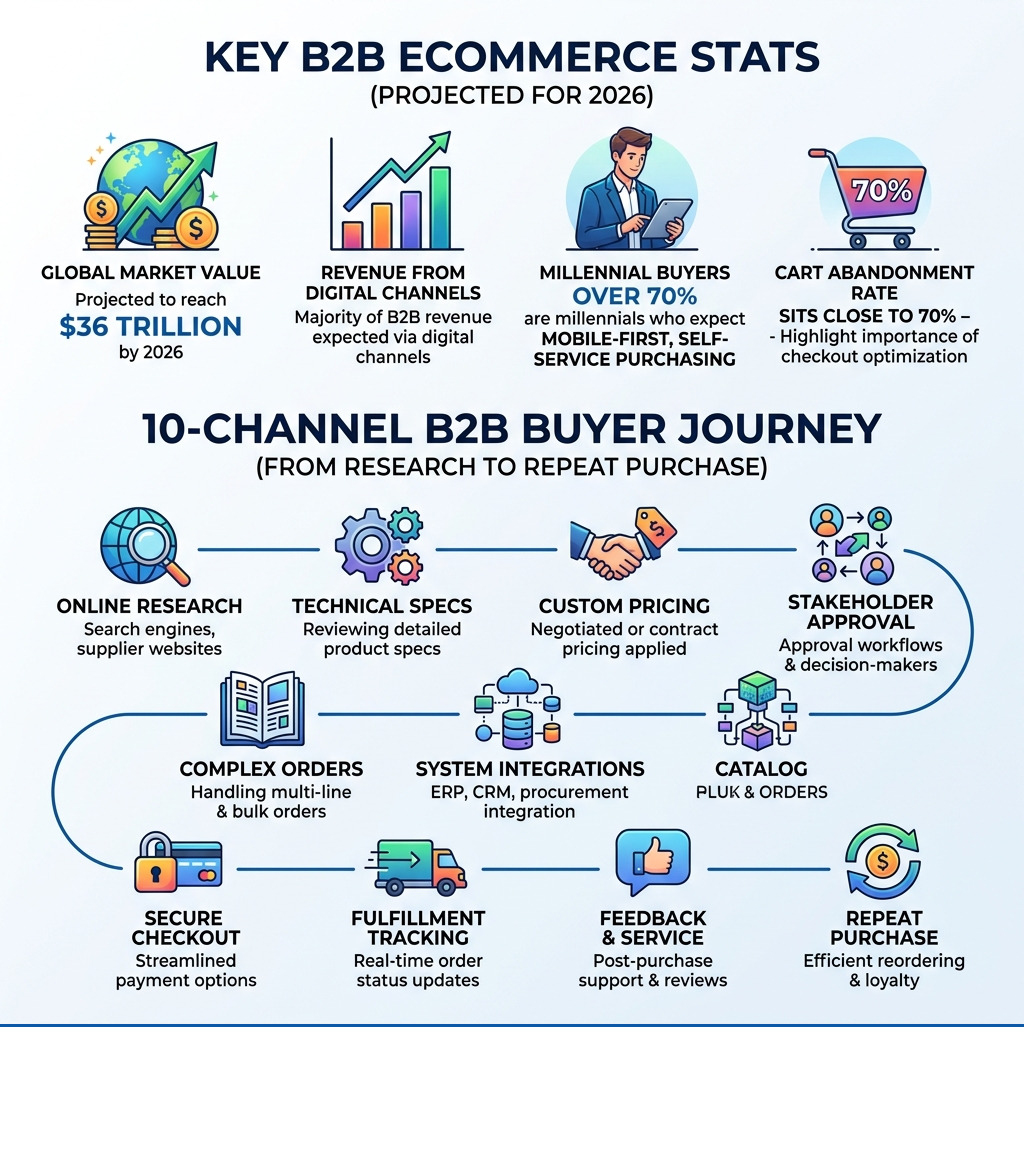
- The global B2B ecommerce market is expected to reach $36 trillion by 2026.
- Over 70% of B2B buyers are millennials who prefer mobile-first, self-service purchasing.
- Key strategies include ERP integration, custom pricing, and account-based personalization.
- High cart abandonment rates make checkout improvement and approval workflows a priority.
B2B ecommerce strategy & solutions are how modern businesses sell to other businesses online. The market is growing. B2B ecommerce is projected to hit $36 trillion in global value by 2026, and 83% of B2B buyers already prefer to order through digital channels.
But here's the problem: 65% of B2B decision-makers say ecommerce is broken in their organizations. The tools exist. The buyer demand is there. The gap is strategy and execution.
B2B buying is not like B2C. A single purchase can involve:
- Multiple decision-makers and approval layers
- Custom pricing tied to contracts or volume
- Complex products with technical specifications
- Integration with procurement systems like SAP Ariba or internal ERPs
And yet buyers — most of whom are now millennials — expect the same speed and convenience they get from consumer platforms. 39% of B2B buyers are willing to spend over $500,000 on a single online transaction without ever speaking to a sales rep. That is a significant change in how business gets done.
The old playbook — a product catalog, a sales rep, and a phone call — simply does not hold up anymore.
Here at First Pier, we help businesses build and grow high-performance ecommerce operations. This includes complex B2B ecommerce strategy & solutions for manufacturers, wholesalers, and distributors. This guide covers how to build and run a B2B ecommerce operation that works.
Understanding the B2B Ecommerce Market in 2026
The market value of B2B ecommerce is exploding, but the real story is about who is doing the buying. Over 70% of B2B buyers are now millennials. These professionals grew up with Amazon and DoorDash; they have zero patience for faxing order forms or waiting 48 hours for a sales rep to call them back with a price.
In my work here at First Pier, I see this shift every day. Buyers want to research, compare, and pull the trigger on their own time. This is why mobile-first design is no longer a "nice to have." About 70% of online sales are now generated via mobile devices. If a procurement manager is walking through a warehouse in Portland, ME, and needs to restock a part, they should be able to scan a barcode and hit "reorder" on their phone in seconds.

While many businesses look at B2C Ecommerce Solutions for inspiration, B2B requires a much more robust backbone to handle the weight of professional transactions.
How B2B Differs from B2C Models
The biggest mistake I see is treating B2B like B2C with a "wholesale" tag slapped on it. The intent and complexity are worlds apart.
- Buyer Rationale: B2C is often emotional or impulsive. B2B is logical and driven by ROI. A buyer isn't just "shopping"; they are fulfilling a business requirement.
- Decision-Making Groups: In B2C, one person decides. In B2B, a single purchase often involves 6 to 10 decision-makers. Your website needs to provide the data, CAD files, and ROI proof each of those stakeholders needs.
- Pricing Complexity: B2C has one price for everyone. B2B features negotiated contract pricing, tiered discounts for volume, and regional price lists.
- Transaction Size: While B2C orders are small, B2B involves massive bulk orders. 39% of buyers are now comfortable spending half a million dollars in a single digital session.
Key Business Types: Manufacturers and Wholesalers
Different business models require different B2B ecommerce strategy & solutions.
- Manufacturers: Often move from traditional rep-assisted sales to direct-to-business models. They need systems that handle complex configurations and technical specs.
- Wholesalers and Distributors: These businesses focus on high-volume turnover. Their priority is speed—quick order forms, real-time inventory visibility, and efficient Shopify Wholesale portals.
- SaaS and Service Providers: They rely on subscription models and usage-based billing, requiring deep integration between the storefront and the service delivery platform.
Core B2B Ecommerce Strategy & Solutions for Growth
To grow in 2026, you have to move past "digitizing your catalog" and start "automating your operations." The goal isn't just more revenue; it's efficiency. I've seen businesses save 20 minutes of manual labor per order just by moving to a self-service model.
Self-service portals allow customers to manage their own accounts, track shipments, and view their specific Shopify B2B Strategies. When a customer can find their own invoice at 10 PM on a Sunday, your customer service team wins back hours of time on Monday morning.
Building a Mobile-First Buying Experience
Millennial buyers are frequently on the move. Whether they are on a job site or commuting, they use an average of 10 different channels during their buying journey. A responsive B2B Ecommerce Web Design is the foundation, but 2026 demands more.
We are seeing a rise in Progressive Web Apps (PWAs) because they offer an app-like experience without the friction of a download. Features like barcode scanning via the phone's camera allow warehouse staff to reorder supplies instantly, bridging the gap between the physical and digital world.
Personalization and AI in B2B Ecommerce Strategy & Solutions
Personalization in B2B isn't about saying "John" in an email. It’s about showing John the specific products his company is contracted to buy, at the prices they negotiated, with the inventory levels available in their nearest region.
AI is now the engine behind this. About 84% of retailers are already using or considering AI to help with:
- Smart Search: Helping buyers find specific part numbers or attributes instantly.
- Predictive Reordering: Using machine learning to remind a customer to restock before they run out.
- Dynamic Pricing: Adjusting quotes based on real-time market data or customer loyalty.
By using these Shopify B2B Features, you make the buying process so easy that customers wouldn't dream of switching to a competitor.
Technical Implementation and System Integration
If your ecommerce site doesn't talk to your back-office, you don't have a strategy—you have a data entry problem. The "broken" feeling many B2B leaders report often stems from disconnected systems.
A successful B2B ecommerce strategy & solutions plan must include a bidirectional sync between your storefront and your ERP (Enterprise Resource Planning) or CRM (Customer Relationship Management). When a price changes in your ERP, it should update on the site instantly. When an order is placed online, it should flow directly into your fulfillment system without a human touching a keyboard.
For most businesses, this involves B2B API Integration. Here at First Pier, we specialize in Shopify ERP Services to ensure that your inventory, pricing, and customer data remain a single source of truth across the entire organization.
Improving the B2B Ecommerce Strategy & Solutions Checkout Process
The checkout is where most B2B sales die. With cart abandonment rates hitting 70%, your B2B Checkout Process needs to be frictionless.
Unlike B2C, where a credit card is standard, B2B buyers need:
- Net Terms: Offering Net 30, 60, or 90 days for established accounts.
- Purchase Orders (PO): Allowing buyers to upload or enter a PO number to match their internal accounting.
- Credit Limits: Automatically checking if a customer has remaining credit before allowing a "pay on account" transaction.
Inventory Management and Repeat Ordering
In B2B, "out of stock" doesn't just mean a lost sale; it can mean a halted production line for your customer. Providing real-time inventory visibility builds trust.
To speed up the process, use a Shopify Wholesale Portal Guide approach to implement:
- Quick Order Lists: A simple grid where buyers can enter SKUs and quantities.
- Requisition Templates: Saved lists of frequently purchased items for different job sites or departments.
- One-Click Reordering: Letting customers duplicate a past order in seconds.
Marketing and Sales Improvement Tactics
You can build the best portal in the world, but if your customers don't use it, your ROI will suffer. B2B marketing is about building long-term partnerships, often through Account-Based Marketing (ABM). At least 60% of B2B marketers use ABM to target specific high-value accounts with tailored content.
SEO is equally critical. Over one-third of B2B leads come from search. If you aren't showing up when a procurement officer searches for a specific industrial component, you're invisible. Our Shopify SEO Services focus on the technical and intent-based keywords that B2B buyers actually use.
Content Marketing for Technical Buyers
Technical buyers are skeptical. They don't want marketing fluff; they want data. Your site should serve as a resource library.
- CAD Models and STEP Files: Essential for engineers to "fit" your product into their designs.
- ROI Calculators: Helping procurement managers justify the purchase to their CFO.
- Case Studies: Showing real-world proof of your solution in action.
Providing these assets through professional Collateral Design Services makes your business the easy choice for busy professionals.
Using Data Analytics to Improve ROI
You can't manage what you don't measure. Companies using real-time analytics report a 29% improvement in decision speed. We recommend focusing on these KPIs:
- Conversion Rate: Are visitors actually buying, or just browsing?
- Average Order Value (AOV): Are your upsell and cross-sell strategies working?
- Customer Lifetime Value (CLV): This is the gold standard for B2B success.
- Digital Adoption Rate: What percentage of your total orders are coming through the portal versus phone/email?
Regularly reviewing Ecommerce Data Analytics allows you to spot friction points—like a specific step in the checkout that causes drop-offs—and fix them before they cost you a major account.
Emerging Trends Shaping the Future of B2B
As we look toward 2026, several trends are moving from "experimental" to "essential." Generative AI is helping businesses create thousands of unique product descriptions and personalized email campaigns in minutes. Sustainability is also becoming a deal-breaker; many enterprise companies now require their suppliers to provide data on their carbon footprint or ethical sourcing.
One of the most significant technical shifts is the comparison between PWAs and traditional apps:
| Feature | Progressive Web App (PWA) | Native Mobile App |
|---|---|---|
| Installation | Instant (Add to home screen) | App Store download required |
| Maintenance | Single codebase for all devices | Separate iOS and Android builds |
| Offline Access | Limited | Robust |
| Push Notifications | Yes | Yes |
| Development Cost | Lower | Higher |
Omnichannel Experiences and Conversational AI
B2B success depends on being wherever the customer is. This is "unified commerce." Whether a buyer starts a search on LinkedIn, asks a question via a chatbot, and then completes the purchase on their desktop, the experience should be consistent.
Conversational AI—more than just basic chatbots—can now handle complex queries, qualify leads, and even help with "quote-to-order" workflows. Using Shopify Automation allows you to scale your sales efforts without adding more headcount.
Flexible Payments and Financial Solutions
The way businesses pay is changing. While Net terms are classic, "Buy Now Pay Later" (BNPL) for business is gaining traction, especially for smaller companies that need to manage cash flow.
Offering a variety of Shopify Plus B2B Features like digital wallets (Apple Pay, Google Pay) and integrated credit management makes you the most convenient vendor to work with.
Frequently Asked Questions about B2B Ecommerce
How long does it take to implement a B2B ecommerce strategy?
Implementation typically takes three to twelve months. We suggest a phased approach. Start with a "Minimum Viable Product" (MVP) that includes your core catalog and customer-specific pricing. Once that is stable and your customers are using it, you can begin the more complex work of deep ERP integrations and AI-driven personalization.
What are the main barriers to B2B ecommerce growth?
The biggest hurdle isn't usually the technology—it's the data and the culture. Many businesses have "dirty" data—product information scattered across spreadsheets and legacy systems. There is also often resistance from traditional sales teams who fear that a website will replace them. In reality, a good portal frees sales reps from order-taking so they can focus on high-value consulting.
How can businesses reduce B2B cart abandonment?
B2B abandonment often happens because the buyer needs to get internal approval. You can reduce this by:
- Offering a "Save for Later" or "Download Quote" feature.
- Sending automated reminders when a cart has been sitting for 24 hours.
- Streamlining the approval workflow so a manager can log in and approve a subordinate's cart with one click.
To Sum Up
Building a scalable B2B ecommerce strategy & solutions plan is a marathon, not a sprint. It requires a clear understanding of your buyers, a commitment to clean data, and a platform that can grow with you.
The businesses that win in 2026 will be the ones that treat ecommerce as a core operational infrastructure rather than just a marketing project. They will be the ones that save their customers time, provide total transparency, and make the complex process of business purchasing feel as simple as buying a pair of shoes.
If you are ready to move away from "broken" systems and build a high-performance wholesale operation, we are here to help. From initial planning to deep technical integrations, we can help you navigate the transition. For a deeper dive into the technical side, check out our B2B Ecommerce Web Development Complete Guide.





.png)
.png)

