




Summary
- Paid social planning is the process of structuring, budgeting, and managing paid social media advertising campaigns.
- Effective campaign architecture separates cold prospecting, warm retargeting, and customer retention into isolated campaigns.
- Creative testing requires a systematic protocol to rotate ads every two to three weeks and prevent performance decline.
- Modern audience targeting relies on first-party data, engagement seeds, and broad targeting rather than manual interest groups.
- Budgets should be increased in small increments of 20% to 30% to avoid disrupting platform delivery algorithms.
Why Paid Social Planning Determines Whether Your Ad Budget Grows or Burns
Paid social planning is the process of structuring, budgeting, and managing paid advertising campaigns across social media platforms to hit specific business outcomes at a predictable cost.
Here is what effective paid social planning covers:
- Define goals and KPIs - Set cost-per-acquisition targets and revenue goals before spending a dollar.
- Separate campaigns by funnel stage - Cold prospecting, warm retargeting, and retention campaigns must stay isolated to prevent audience dilution.
- Build an audience strategy - Use first-party data, lookalikes, and custom audiences to control who sees each ad.
- Plan creative testing - Run 3-15 ad variants depending on spend level, with clear rules for promoting winners and pausing losers.
- Set a refresh cadence - Rotate creative every 2-3 weeks to prevent fatigue and protect cost-per-outcome efficiency.
- Choose platforms by audience - Meta first for most brands, then TikTok, LinkedIn, or Pinterest based on audience demographics and objectives.
- Grow systematically - Increase budgets in 20-30% increments with 48-72 hours between steps to avoid disrupting the algorithm's learning phase.
Organic reach on social media has been declining for years. Most brand posts now reach only a small fraction of followers without paid promotion. At the same time, 62% of the global population uses social media, and 87% of buyers say social media influences their purchasing decisions. The audience is there. The organic window to reach them for free is largely closed.
That gap is where paid social planning comes in - and where most brands either build a real growth engine or waste budget on campaigns that never find their footing.
The difference between brands that expand paid social campaigns efficiently and those that don't usually isn't budget size. It's structure. Research shows that the top quartile of paid social advertisers spend 35% less per conversion than the median, driven by stricter campaign architecture rather than higher spend. Brands running systematic creative refresh cycles show 22% better cost-per-outcome efficiency over six months compared to those that don't.
This guide covers the full planning process: funnel architecture, audience targeting, creative testing, platform selection, budget management, and performance analysis.
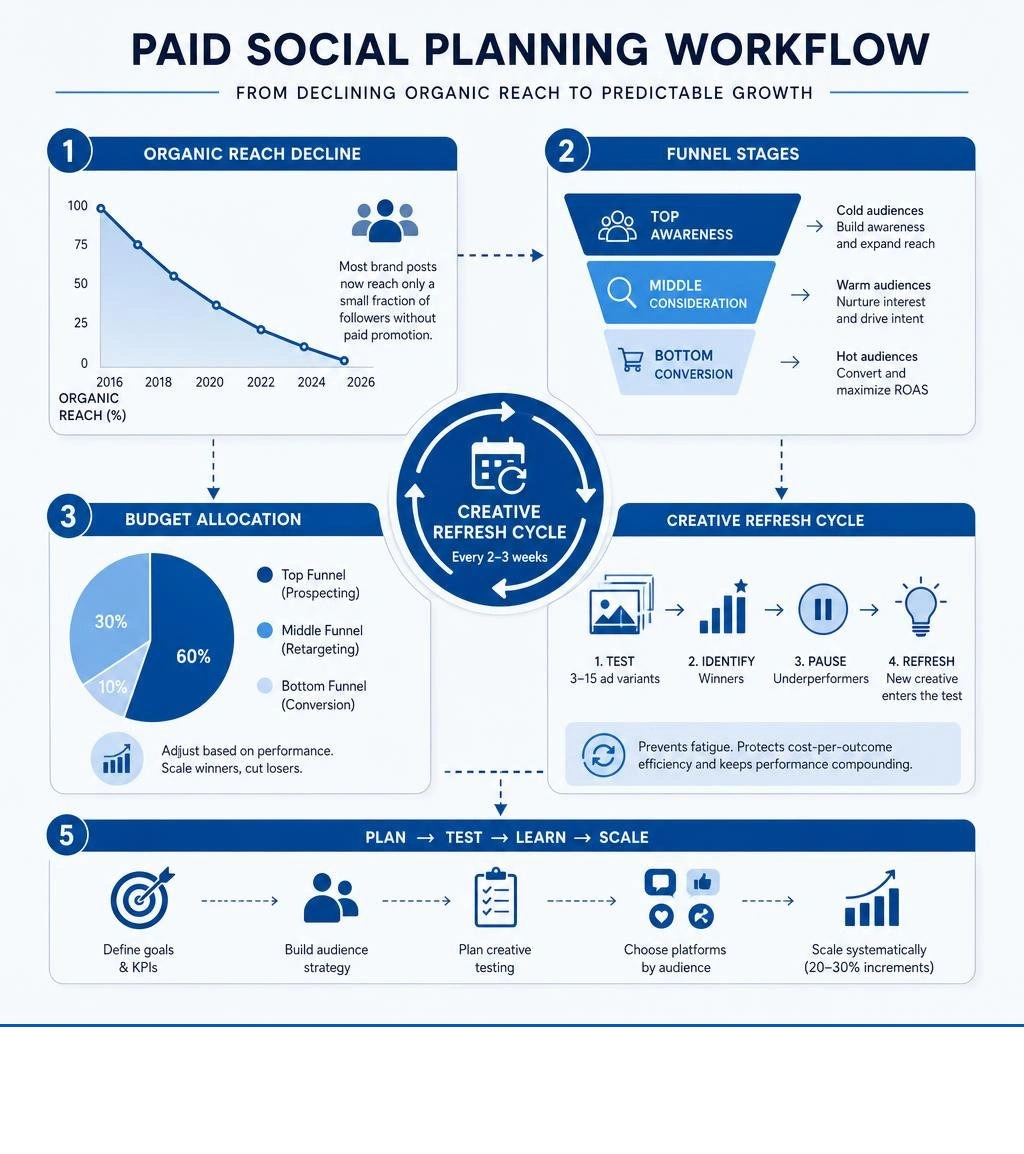
Paid social planning word guide:
Organic vs. Paid Social: Defining the Modern Mix
Organic social media relies on free tools provided by each platform to build a community, share updates, and respond to comments. It is a valuable tool for listening to customers and managing customer support. However, relying on organic social as a primary driver for customer acquisition is no longer practical. Algorithmic changes have cut organic reach down to single-digit percentages for most business pages.
Paid social, by contrast, involves paying platforms to distribute content to specific audiences outside of an existing follower base. This approach guarantees visibility. While organic social nurtures existing relationships, paid social focuses on acquisition and conversion.
Here at First Pier, we design modern marketing strategies that use organic social to establish brand legitimacy and manage customer relationships, while using Paid Social Media Advertising to drive predictable traffic and sales. Planning tools like the Planoly Social Media Planner & Scheduling Tool help maintain a consistent organic posting schedule, ensuring that when paid traffic visits a brand's profile, they find an active, trustworthy community.
Funnel Architecture and Campaign Structure
To build a reliable acquisition system, campaigns must be structured by funnel stage. Here at First Pier, we have found that mixing cold prospects with warm retargeting audiences confuses the platform's delivery algorithm and leads to inefficient budget distribution.
A standard paid social campaign structure includes three core layers:
- Cold Prospecting (TOFU): Targeting users who have had no prior contact with the brand. The objective is to introduce the product and build initial interest.
- Warm Retargeting (MOFU): Targeting users who have engaged with social content or visited the website but did not buy.
- Retention and Upsell (BOFU): Targeting existing customers to drive repeat purchases or increase lifetime value.
Using different Types of Paid Social Ads across these stages ensures the messaging matches the user's intent. For a deeper look at managing these structures, refer to the Paid Social Media Strategy: Practitioner's Guide to Building and Scaling.
Funnel-Stage Campaign Separation in Paid Social Planning
Separating campaigns by funnel stage prevents audience dilution. When cold and warm audiences are grouped into a single campaign, the delivery algorithm naturally favors the warm audience because they are more likely to convert quickly. This makes campaign performance look strong in the short term, but it starves the prospecting layer of budget, stopping the flow of new customers.
Maintaining clean separation allows for precise budget control and clearer algorithm signals. Each ad set needs roughly 50 conversion events per week to exit the learning phase. Isolating your prospecting campaigns ensures that budget is dedicated to finding new buyers, while separate retargeting campaigns handle mid-funnel nurturing. This structure is a fundamental part of modern Digital Ad Management.
Audience Targeting and Signal Management
Audience targeting has changed with recent platform updates. Detailed manual interest targeting is less effective than it used to be, as modern algorithms often expand targeting parameters automatically.
Instead of building narrow interest groups, our planning here at First Pier relies on first-party data and high-quality audience "seeds."
- First-Party Data: Customer list uploads (such as past buyers) provide the strongest signal. Uploaded lists should contain at least 500 high-value customers to build reliable lookalike audiences.
- Engagement Seeds: Website visitors, cart abandoners, and social page engagers serve as excellent seeds for automated targeting systems.
- Broad Targeting: Using broad targeting with age, gender, and location constraints, then letting the creative asset itself do the targeting work by speaking directly to the ideal buyer.
When preparing campaigns, especially Facebook Ads for Shopify, ensuring clean pixel data and API signals is critical. For a step-by-step approach to managing these configurations, the Intelligent Meta Campaign Planning: The 2026 Framework details how to structure audience inputs to work alongside automated delivery systems.
Creative Testing and Optimization Cadence
Because modern social ad algorithms use creative assets to find the right audience, creative testing is the most important performance lever available.

Paid social planning must include a systematic testing framework to combat creative fatigue. When the same ad is shown to an audience too many times, the click-through rate drops, and the cost per acquisition rises.
To prevent this, our team here at First Pier tracks five atomic metrics to diagnose account health:
- Spend: The actual budget used.
- CPM (Cost Per Thousand Impressions): Indicates audience competitiveness and creative quality.
- CTR (Click-Through Rate): Shows how engaging the creative is to the audience.
- CVR (Conversion Rate): Measures landing page performance and purchase intent.
- AOV (Average Order Value): Determines the revenue value of each conversion.
Understanding how these metrics interact helps identify exactly where a campaign is failing. For example, a high CTR paired with a low CVR points to a landing page issue, not an ad issue. Reviewing How to Optimize Digital Marketing Campaigns offers a structured approach to solving these performance bottlenecks, while the Campaign optimization: the 2026 paid social guide provides an operational roadmap for cross-channel testing.
Creative Testing Protocols for Paid Social Planning
An effective testing protocol separates the testing environment from the growth environment. This is typically done by running two types of campaigns:
- Testing Campaigns (using Ad Set Budget Optimization - ABO): Used to test new creative concepts. Each concept gets a dedicated ad set with a fixed budget to ensure a clean read.
- Scaling Campaigns (using Campaign Budget Optimization - CBO): Used to run proven, winning creative assets with larger budgets.
When a creative variant outperforms the benchmark in the testing campaign, it is promoted to the scaling campaign. Underperforming ads are paused immediately. To keep this system running smoothly, brands must maintain a consistent production schedule. Testing 3 to 5 new concepts per week is standard for moderate budgets, while larger accounts may test 10 or more. This structured approach to creative analysis is a core part of Digital Marketing Analytics.
Frequently Asked Questions about Paid Social Planning
How much budget is required to start paid social planning?
Here at First Pier, we find that a practical starting budget is $500 to $1,000 per month. This amount provides enough daily spend to gather conversion data and test initial creative concepts. During the testing phase, the focus is on finding winning creatives rather than immediate profitability. Once winning assets are identified, the budget can be increased systematically. To understand how to structure these initial investments, review the guide on Marketing Campaign Cost.
How often should ad creatives be refreshed to prevent fatigue?
For moderate budgets, ad creative should be refreshed every 2 to 3 weeks. For larger budgets (over $100,000 per month), creative fatigue can hit within 7 to 10 days, requiring weekly refreshes. Tracking CTR decay and frequency metrics helps determine the exact refresh cycle. When updating visual assets, keeping within the Instagram Ad Safe Zones ensures key text and visual elements are not cut off by platform interfaces.
What is the difference between CBO and ABO in campaign setup?
Campaign Budget Optimization (CBO) distributes the campaign budget automatically across all ad sets, giving more budget to the ad sets it predicts will perform best. Ad Set Budget Optimization (ABO) allows the media buyer to set specific budgets manually at the ad set level. ABO is best for creative testing to ensure every ad set gets equal spend, while CBO is best for scaling proven winners. For more details on budget structures, see Campaign Management in Digital Marketing.
To Sum Up
Paid social planning is not about guessing which interests to target or hoping a single ad goes viral. It is a systematic process of separating campaigns by funnel stage, feeding clean data signals to the delivery algorithms, and running a consistent creative testing engine. By establishing clear testing protocols, monitoring the five atomic metrics, and increasing budgets gradually, brands can build a predictable, revenue-generating acquisition channel.
If you want to build a structured acquisition engine for your ecommerce store, explore Shopify Paid Social Advertising Services to see how to align your ad spend with real business outcomes.





.png)
.png)

